
PUBLISHER: Mordor Intelligence | PRODUCT CODE: 1939017

PUBLISHER: Mordor Intelligence | PRODUCT CODE: 1939017
Detergents - Market Share Analysis, Industry Trends & Statistics, Growth Forecasts (2026 - 2031)
The Detergents Market was valued at USD 140.12 billion in 2025 and estimated to grow from USD 145.82 billion in 2026 to reach USD 178.06 billion by 2031, at a CAGR of 4.07% during the forecast period (2026-2031).
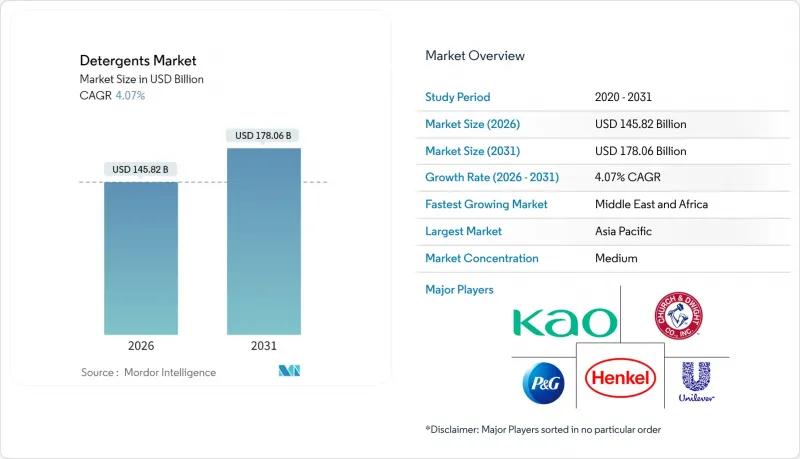
Structural shifts stem from cold-water enzymes that reduce household energy use, carbon-pricing policies favoring ultra-concentrated formats, and regulatory mandates that accelerate the adoption of biodegradable surfactants. The Asia-Pacific region continues to drive demand, largely due to the rapid adoption of washing machines, while direct-to-consumer (D2C) subscription services are redefining last-mile economics in North America and China. Competitive intensity remains high: Procter & Gamble, Unilever, and Henkel leverage enzyme technology and concentrated pods to command premium pricing, whereas regional specialists gain share with sachet distribution that meets tight household budgets. Input-cost volatility in palm-kernel oil and enzymes compresses margins for mid-tier brands yet hastens investment in algae-derived and fermentation-based surfactants that bypass constrained supply chains.
Global Detergents Market Trends and Insights
Rising Washing-Machine Penetration in Emerging Economies
Automatic washer ownership in India increased from 14% in 2020 to 28% in 2024, resulting in a rise in per-capita detergent usage, as drum cycles require 30%-40% more product than hand-washing. Smaller 250ml liquid packs and 10-wash sachets help keep entry prices low while sustaining margins above 40%. Similar adoption curves in Indonesia and Vietnam benefit from appliance subsidies and installment-payment schemes. Formulators now specify enzymes optimized for 30-minute, 20°C cycles, with BASF's Lavergy protease delivering equivalent stain removal at 35% lower energy consumption.
Boom in E-Commerce and D2C Channels for Detergents
Direct-to-consumer subscriptions generated USD 4.2 billion in 2024, representing a 38% year-over-year growth as brands bypass retailers' 25%-35% markup. Lower acquisition costs (USD 18 per subscriber) and churn below 15% after the third delivery underpin profitability. Online sales reached 32% in North America and 41% in China, driven by same-day logistics and influencer marketing that emphasize ingredient transparency. Concentrated pods and strips, 70% lighter than equivalent liquids, shave USD 0.12 from last-mile freight while reducing packaging waste by 60%.
Stringent Global and Regional Chemical Regulations
In October 2023, the European Chemicals Agency, under REACH Annex XVII, restricted microplastics, banning their intentional use in rinse-off detergents with transition periods of 4 to 12 years. In April 2024, the US Environmental Protection Agency expanded PFAS restrictions, requiring manufacturers to certify that surfactants and processing aids contain no per- and polyfluoroalkyl substances above 1 part per billion, effectively banning legacy fluorosurfactants in industrial and institutional cleaning products. These regulations disproportionately affect smaller regional brands, which lack the R&D budgets for rapid reformulation, while multinationals spread compliance costs over global volumes exceeding 500,000 metric tons annually.
Other drivers and restraints analyzed in the detailed report include:
- Consumer Shift to Eco-Friendly and Biodegradable Formulations
- Cold-Water Enzyme Breakthroughs Cut Energy Use
- Raw-Material Price Volatility (Surfactants, Enzymes)
For complete list of drivers and restraints, kindly check the Table Of Contents.
Segment Analysis
Anionic surfactants held 45.84% of the Detergents market share in 2025, supported by low-cost linear alkylbenzene sulfonates that anchor powder and liquid staples in South Asia and Africa. Non-ionic alcohol ethoxylates and alkyl polyglucosides, prized for rapid ultimate biodegradation, are forecast to grow at a 4.95% CAGR, lifted by EU rules requiring aerobic breakdown within 28 days. Henkel reformulated Persil Sensitive in 2024 by substituting 40% of LAS with corn-starch-derived alkyl polyglucosides, thereby lowering aquatic toxicity by 35% while retaining the product's performance.
Cationic quaternary ammonium surfactants remain niche outside fabric softeners because their positive charge limits co-formulation with anionics. EPA scrutiny of quats is prompting pilots of faster-biodegrading ester-quat alternatives. Zwitterionic cocamidopropyl betaine, 6% of 2024 volume, stabilizes foam in hard-water markets across the Middle East and North Africa, and its broad pH stability suits cold-water pods that avoid mineral chelators.
The Detergents Market Report is Segmented by Type (Anionic, Cationic, Non-Ionic, and Zwitterionic), Application (Laundry, Household Cleaning, Dishwashing, Fuel Additives, Biological Reagents, and Other Applications), and Geography (Asia-Pacific, North America, Europe, South America, and Middle East and Africa). Market Forecasts are Provided in Terms of Value (USD).
Geography Analysis
The Asia-Pacific region accounted for 44.10% of the global 2025 volume, driven by a doubling of washing-machine ownership in India and Indonesia, robust e-commerce in China, and a shift toward premiumization of enzyme-rich liquids. Local champions such as Blue Moon and Liby hold a 38% share of China's liquid category through direct online engagement and tailored fragrances. India's market expanded by 7.2% in 2024, driven by affordable 250 ml packs targeting first-time machine users. Mature Japan and South Korea focus on bio-based isethionate surfactants that accelerate soil release by 30%.
The Middle East & Africa are forecast to deliver the fastest growth, with a 4.78% CAGR, as urbanization lifts per-capita consumption above 3 kg. Saudi Arabia's Vision 2030 infrastructure push raises washer penetration toward 65%, spurring demand for hard-water-tolerant pods. South Africa's market increased by 5.8% in volume in 2024, driven by enzyme-fortified powders that perform well in cold cycles, a necessity amid intermittent electricity supply. Sachet-priced powders dominate rural Sub-Saharan Africa, but liquid formats are gaining traction in Lagos and Nairobi as front-load adoption increases.
Europe and North America register slower growth but lead sustainability innovation. Germany's eco-labeled segment reached 42% of 2024 detergent sales. US pods and strips command 32% of laundry volume, and refill stations in Canadian and UK grocers reduce packaging by 40%. South America grew by 4.2% in 2024; powders still hold a 68% share, but liquids are rising in urban Brazil and Argentina, alongside washer ownership above 55%.
- Blue Moon Group
- Church & Dwight Co., Inc.
- Guangzhou Liby Group Co. Ltd
- Henkel AG & Co. KGaA
- Johnson & Johnson Private Limited
- Kao Corporation
- Lion Corporation
- Nice Group
- Procter & Gamble
- Reckitt Benckiser Group plc
- RSPL Group
- SC Johnson
- Seventh Generation Inc.
- Unilever
Additional Benefits:
- The market estimate (ME) sheet in Excel format
- 3 months of analyst support
TABLE OF CONTENTS
1 Introduction
- 1.1 Study Assumptions & Market Definition
- 1.2 Scope of the Study
2 Research Methodology
3 Executive Summary
4 Market Landscape
- 4.1 Market Overview
- 4.2 Market Drivers
- 4.2.1 Rising washing-machine penetration in emerging economies
- 4.2.2 Boom in e-commerce and D2C channels for detergents
- 4.2.3 Consumer shift to eco-friendly/biodegradable formulations
- 4.2.4 Cold-water enzyme breakthroughs cut energy use
- 4.2.5 Carbon-tax driven demand for ultra-concentrates
- 4.3 Market Restraints
- 4.3.1 Stringent global and regional chemical regulations
- 4.3.2 Raw-material price volatility (surfactants, enzymes)
- 4.3.3 Micro-plastic filtration mandates raise reformulation costs
- 4.4 Value Chain Analysis
- 4.5 Porter's Five Forces
- 4.5.1 Bargaining Power of Suppliers
- 4.5.2 Bargaining Power of Buyers
- 4.5.3 Threat of New Entrants
- 4.5.4 Threat of Substitutes
- 4.5.5 Degree of Competition
5 Market Size & Growth Forecasts (Volume)
- 5.1 By Type
- 5.1.1 Anionic Detergents
- 5.1.2 Cationic Detergents
- 5.1.3 Non-ionic Detergents
- 5.1.4 Zwitterionic (Amphoteric) Detergents
- 5.2 By Application
- 5.2.1 Laundry Cleaning Products
- 5.2.2 Household Cleaning Products
- 5.2.3 Dishwashing Products
- 5.2.4 Fuel Additives
- 5.2.5 Biological Reagents
- 5.2.6 Other Applications
- 5.3 By Geography
- 5.3.1 Asia-Pacific
- 5.3.1.1 China
- 5.3.1.2 India
- 5.3.1.3 Japan
- 5.3.1.4 South Korea
- 5.3.1.5 ASEAN Countries
- 5.3.1.6 Rest of Asia-Pacific
- 5.3.2 North America
- 5.3.2.1 United States
- 5.3.2.2 Canada
- 5.3.2.3 Mexico
- 5.3.3 Europe
- 5.3.3.1 Germany
- 5.3.3.2 United Kingdom
- 5.3.3.3 Italy
- 5.3.3.4 France
- 5.3.3.5 Russia
- 5.3.3.6 Spain
- 5.3.3.7 NORDIC Countries
- 5.3.3.8 Rest of Europe
- 5.3.4 South America
- 5.3.4.1 Brazil
- 5.3.4.2 Argentina
- 5.3.4.3 Rest of South America
- 5.3.5 Middle-East and Africa
- 5.3.5.1 Saudi Arabia
- 5.3.5.2 South Africa
- 5.3.5.3 Rest of Middle East and Africa
- 5.3.1 Asia-Pacific
6 Competitive Landscape
- 6.1 Market Concentration
- 6.2 Strategic Moves
- 6.3 Market Share(%)/Ranking Analysis
- 6.4 Company Profiles (includes Global level Overview, Market level overview, Core Segments, Financials as available, Strategic Information, Market Rank/Share for key companies, Products & Services, and Recent Developments)
- 6.4.1 Blue Moon Group
- 6.4.2 Church & Dwight Co., Inc.
- 6.4.3 Guangzhou Liby Group Co. Ltd
- 6.4.4 Henkel AG & Co. KGaA
- 6.4.5 Johnson & Johnson Private Limited
- 6.4.6 Kao Corporation
- 6.4.7 Lion Corporation
- 6.4.8 Nice Group
- 6.4.9 Procter & Gamble
- 6.4.10 Reckitt Benckiser Group plc
- 6.4.11 RSPL Group
- 6.4.12 SC Johnson
- 6.4.13 Seventh Generation Inc.
- 6.4.14 Unilever
7 Market Opportunities and Future Outlook
- 7.1 White-space and Unmet-Need Assessment

