PUBLISHER: Mordor Intelligence | PRODUCT CODE: 1939033

PUBLISHER: Mordor Intelligence | PRODUCT CODE: 1939033
Canned Food - Market Share Analysis, Industry Trends & Statistics, Growth Forecasts (2026 - 2031)
Canned food market size in 2026 is estimated at USD 143.96 billion, growing from 2025 value of USD 137.97 billion with 2031 projections showing USD 177.98 billion, growing at 4.34% CAGR over 2026-2031.
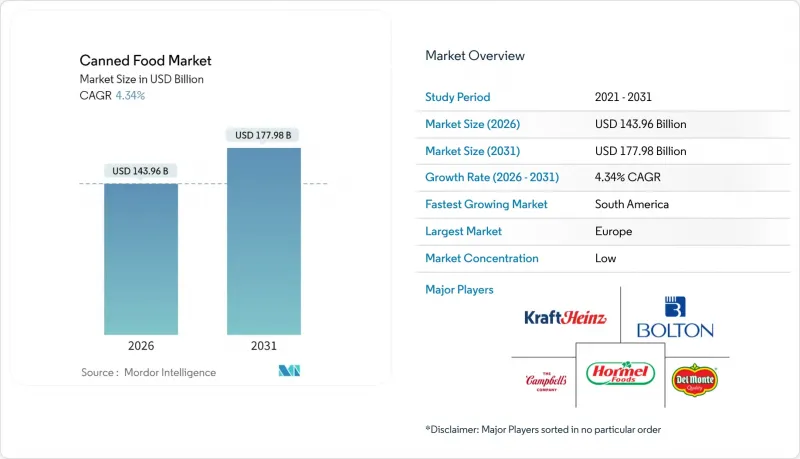
Urbanization is fueling the demand for convenient meal options, especially among working professionals and students. Government mandates on emergency preparedness are bolstering the stockpiling of canned foods. Meanwhile, manufacturers are innovating, enhancing flavors, nutritional content, and embracing sustainable packaging. Regulatory shifts, like China's stringent clean-label mandates and Europe's push for sustainability, are nudging manufacturers towards natural ingredients, reduced artificial preservatives, and eco-friendly packaging. The market's fragmented landscape is a boon for regional players and niche producers, allowing them to carve out a niche with unique products, ethnic flavors, and locally-sourced ingredients. With economic recovery in South America boosting consumer spending, retail growth in emerging Asia-Pacific markets, and a rising appetite for premium, organic, and gourmet canned products in North America and Europe, the market is poised for robust growth.
Global Canned Food Market Trends and Insights
Convenience and health drive surge in canned food
As urban living spaces shrink, the demand for convenience and health has propelled a notable rise in canned food consumption. Statistics Korea highlights a rise in South Korea's one-person households, increasing from 7.5 million in 2022 to 7.83 million in 2023. This trend has intensified the appetite for compact, portion-controlled canned meals, perfectly suited for today's time-constrained lifestyles. Premium brands, such as Fishwife, are not just selling canned food; they're curating an aspirational lifestyle, especially resonating with millennials and Gen Z through vibrant online communities. Social media has become a pivotal platform, with consumers actively discovering and promoting new canned offerings, amplifying their market presence. Moreover, single-serve packaging not only aligns with health and convenience trends but also mitigates concerns about food waste and budget constraints, making canned foods a go-to for urban shoppers prioritizing both affordability and sustainability.
Extended shelf life and storage capabilities aligned with modern consumer requirements
During times of supply chain disruptions and high inflation, households increasingly rely on canned foods, thanks to their extended shelf life. Metal cans can preserve food quality and nutritional value for 2-5 years without refrigeration. This not only cuts down on food waste but also results in carbon dioxide savings, akin to taking millions of vehicles off the road. Such preservation is especially advantageous for consumers who buy in bulk, helping them counter rising food prices and secure their household's food supply. Beyond homes, institutional buyers and foodservice operators leverage canned products to manage inventory costs, ensure a steady supply, and reduce food spoilage. This shift has led to a surge in demand for shelf-stable foods, which promise long-term food security without the need for specialized storage or constant power. Canned foods, with their minimal storage requirements, play a pivotal role in sustainable food distribution, cutting down energy consumption while ensuring product quality. Moreover, the sturdy design of metal cans shields contents from external threats, guaranteeing safety and quality, whether in tough storage conditions or during lengthy transport.
Consumer purchasing behavior influenced by sodium content and preservative levels in products
As health consciousness rises, consumers are scrutinizing sodium and preservative levels in their food choices, driving growth in the canned food market. Alarmingly, Americans consume too much sodium, largely from processed foods, including canned goods. This trend has sparked concerns from health organizations and regulatory bodies alike. Responding to these concerns, the FDA has rolled out comprehensive sodium reduction guidelines, exerting significant pressure on the canned food industry to reformulate its products. Simultaneously, there's a growing consumer demand for preservative-free options. In China, the National Health Commission (NHC) and the State Administration for Market Regulation (SAMR) have introduced the National Food Safety Standard for Canned Foods (GB 7098-2025). This rigorous standard governs all canned products in China, detailing requirements for ingredients, physical and chemical indicators, contaminants, and microbial limits.
Other drivers and restraints analyzed in the detailed report include:
- Canned seafood consumption increased by protein diversification
- Strategic government stockpiling for military and emergency response
- Environmental Impact of Metal Can Disposal Raises Sustainability Concerns
For complete list of drivers and restraints, kindly check the Table Of Contents.
Segment Analysis
In 2025, canned fish and seafood command a 33.10% market share, buoyed by a surge in consumer preference for nutrient-rich, high-protein foods. This segment's expansion is bolstered by its widespread availability, extended shelf life, and a strong sustainability image, especially for products like tuna, salmon, and sardines. In developed markets, brands are capitalizing on premium positioning, rolling out offerings like wild-caught, traceable, and low-sodium seafood to cater to health-savvy consumers. Additionally, the growing focus on transparency in sourcing and labeling has further strengthened consumer trust in these products. Moreover, the adaptability of seafood in diverse cuisines has cemented its popularity among retail shoppers and foodservice providers alike, solidifying its top market status.
With a projected CAGR of 5.50% through 2031, this segment stands out as the fastest-growing in the canned food realm. The uptick in demand is fueled by rising seafood consumption in emerging markets, fresh innovations in packaging and flavors, and a heightened consumer awareness of the benefits of omega-3s and proteins. Companies are also tapping into sustainability certifications and ethical sourcing narratives to draw in new clientele. Furthermore, advancements in packaging technology, such as easy-open cans and recyclable materials, are enhancing convenience and aligning with eco-conscious consumer preferences. The growth of online platforms and convenience stores as sales channels further broadens market access, driving consistent expansion in both mass-market and premium segments.
The Canned Food Market Report is Segmented by Product Type (Canned Meat and Poultry, Canned Fish and Seafood, Canned Fruits, Canned Vegetables, and Other Types), Form (Whole, Chunks/Pieces and Others), Distribution Channel (Off-Trade, and On-Trade), and Geography (North America, Europe, Asia-Pacific, South America, and Middle East and Africa). The Market Forecasts are Provided in Terms of Value (USD).
Geography Analysis
Europe contributed 38.70% of 2025 revenue, maintaining its position as the largest regional market. This dominance stems from established consumption patterns, robust supply chains, and strict sustainability regulations. The region's emphasis on Marine Stewardship Council certification and high-recycled-content metal cans generates additional value that supports environmental innovations. Germany, France, the United Kingdom, the Netherlands, Belgium, and Spain represent the primary importing and consuming markets of canned food.
Germany, as Europe's largest food market, presents significant export opportunities, particularly in the organic segment. While the UK and France show strong demand due to lower domestic production compared to Spain and Italy, the Netherlands serves as both a major consumer and re-export hub. South America demonstrates the highest growth trajectory with a 7.12% CAGR. Economic recovery in Argentina and Colombia improves consumer purchasing power, while government initiatives support domestic seafood processing to enhance export value.
In Asia-Pacific, market conditions vary by country. Indian consumers increase spending on essential items, with canned legumes and fruits gaining popularity during monsoon-related supply disruptions. China's implementation of the National Food Safety Standard (GB 7098-2025) introduces tighter controls on contaminants and microbiological parameters, potentially increasing operational costs while improving consumer confidence. Chinese manufacturers are adapting to Beijing's February 2025 preservative restrictions by implementing enhanced thermal processing technology to maintain product quality. North America sustains market volume through product innovation, established brand preferences, and new fish-canning facilities in Oregon and Massachusetts, reducing import dependence.
List of Companies Covered in this Report:
- The Kraft Heinz Company
- Conagra Brands Inc.
- Thai Union Group PCL
- Bolton Group
- FCF Co., Ltd
- The Campbell's Company
- JBS S.A.
- Bonduelle SA
- Tyson Foods, Inc.
- Century Pacific Food Inc.
- Del Monte Pacific Ltd.
- The Dongwon Group
- Hormel Foods Corp.
- Robert Damkjaer A/S
- Goya Foods, Inc.
- Maison Denis S.A.
- Keystone Meat Company
- Zwanenberg Food Group
- Bush Brothers & Company
- Amy's Kitchen, Inc.
Additional Benefits:
- The market estimate (ME) sheet in Excel format
- 3 months of analyst support
TABLE OF CONTENTS
1 INTRODUCTION
- 1.1 Study Assumptions and Market Definition
- 1.2 Scope of the Study
2 RESEARCH METHODOLOGY
3 EXECUTIVE SUMMARY
4 MARKET LANDSCAPE
- 4.1 Market Overview
- 4.2 Market Drivers
- 4.2.1 Convenience and health drive surge in canned food
- 4.2.2 Extended shelf life and storage capabilities aligned with modern consumer requirements
- 4.2.3 Canned seafood consumption increased by protein diversification
- 4.2.4 Consumer purchase decisions influenced by sustainability certifications and product traceability
- 4.2.5 Technological advancements in packaging materials
- 4.2.6 Expansion of canned food offerings in the foodservice sectors
- 4.3 Market Restraints
- 4.3.1 Consumer purchasing behavior influenced by sodium content and preservative levels in products
- 4.3.2 Environmental impact of metal can disposal raises sustainability concerns
- 4.3.3 Quality issues and product recalls raising trust issues
- 4.3.4 Growing consumer preference for fresh and unprocessed food products
- 4.4 Value Chain Analysis
- 4.5 Regulatory and Technological Outlook
- 4.6 Porter's Five Forces Analysis
- 4.6.1 Threat of New Entrants
- 4.6.2 Bargaining Power of Buyers/Consumers
- 4.6.3 Bargaining Power of Suppliers
- 4.6.4 Threat of Substitute Products
- 4.6.5 Intensity of Competitive Rivalry
5 MARKET SIZE AND GROWTH FORECASTS (VALUE)
- 5.1 By Product Type
- 5.1.1 Canned Meat and Poultry
- 5.1.2 Canned Fish and Seafood
- 5.1.3 Canned Fruits
- 5.1.4 Canned Vegetables
- 5.1.5 Other Types
- 5.2 By Form
- 5.2.1 Whole
- 5.2.2 Chunks/Pieces
- 5.2.3 Others
- 5.3 By Distribution Channel
- 5.3.1 Off-Trade
- 5.3.1.1 Supermarkets and Hypermarkets
- 5.3.1.2 Convenience/Grocery Stores
- 5.3.1.3 Online Retailers
- 5.3.1.4 Other Distribution Channels
- 5.3.2 On-Trade (Food-Service/Catering)
- 5.3.1 Off-Trade
- 5.4 By Geography
- 5.4.1 North America
- 5.4.1.1 United States
- 5.4.1.2 Canada
- 5.4.1.3 Mexico
- 5.4.1.4 Rest of North America
- 5.4.2 Europe
- 5.4.2.1 Germany
- 5.4.2.2 United Kingdom
- 5.4.2.3 France
- 5.4.2.4 Italy
- 5.4.2.5 Spain
- 5.4.2.6 Netherlands
- 5.4.2.7 Russia
- 5.4.2.8 Norway
- 5.4.2.9 Sweden
- 5.4.2.10 Denmark
- 5.4.2.11 Rest of Europe
- 5.4.3 Asia-Pacific
- 5.4.3.1 China
- 5.4.3.2 Japan
- 5.4.3.3 India
- 5.4.3.4 South Korea
- 5.4.3.5 Australia
- 5.4.3.6 Indonesia
- 5.4.3.7 Thailand
- 5.4.3.8 Vietnam
- 5.4.3.9 Malaysia
- 5.4.3.10 Rest of Asia-Pacific
- 5.4.4 South America
- 5.4.4.1 Brazil
- 5.4.4.2 Argentina
- 5.4.4.3 Chile
- 5.4.4.4 Peru
- 5.4.4.5 Rest of South America
- 5.4.5 Middle East and Africa
- 5.4.5.1 Saudi Arabia
- 5.4.5.2 United Arab Emirates
- 5.4.5.3 South Africa
- 5.4.5.4 Rest of Middle East and Africa
- 5.4.1 North America
6 COMPETITIVE LANDSCAPE
- 6.1 Market Concentration
- 6.2 Strategic Moves
- 6.3 Market Share Analysis
- 6.4 Company Profiles (includes Global Level Overview, Market Level Overview, Core Segments, Financials as available, Strategic Information, Market Rank/Share, Products and Services, Recent Developments)
- 6.4.1 The Kraft Heinz Company
- 6.4.2 Conagra Brands Inc.
- 6.4.3 Thai Union Group PCL
- 6.4.4 Bolton Group
- 6.4.5 FCF Co., Ltd
- 6.4.6 The Campbell's Company
- 6.4.7 JBS S.A.
- 6.4.8 Bonduelle SA
- 6.4.9 Tyson Foods, Inc.
- 6.4.10 Century Pacific Food Inc.
- 6.4.11 Del Monte Pacific Ltd.
- 6.4.12 The Dongwon Group
- 6.4.13 Hormel Foods Corp.
- 6.4.14 Robert Damkjaer A/S
- 6.4.15 Goya Foods, Inc.
- 6.4.16 Maison Denis S.A.
- 6.4.17 Keystone Meat Company
- 6.4.18 Zwanenberg Food Group
- 6.4.19 Bush Brothers & Company
- 6.4.20 Amy's Kitchen, Inc.
7 MARKET OPPORTUNITIES AND FUTURE OUTLOOK

