PUBLISHER: Mordor Intelligence | PRODUCT CODE: 1939088

PUBLISHER: Mordor Intelligence | PRODUCT CODE: 1939088
Xanthan Gum - Market Share Analysis, Industry Trends & Statistics, Growth Forecasts (2026 - 2031)
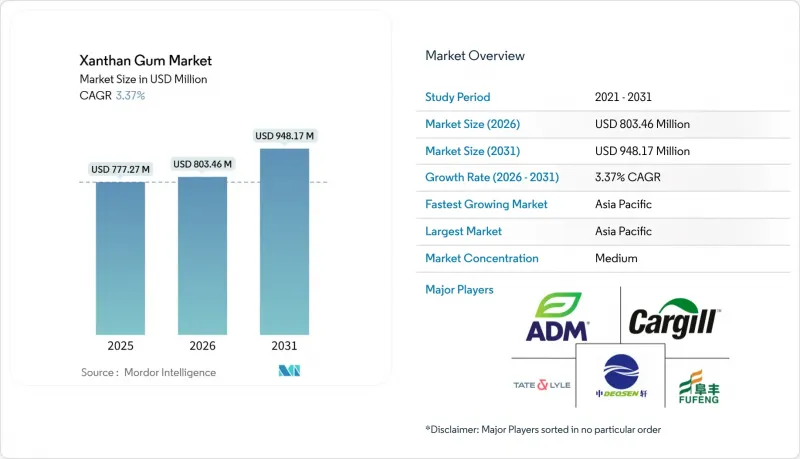
The xanthan gum market is expected to grow from USD 777.27 million in 2025 to USD 803.46 million in 2026 and is forecast to reach USD 948.17 million by 2031 at 3.37% CAGR over 2026-2031.
This growth is driven by the widespread use of xanthan gum as a cost-effective viscosity modifier across various industries. In the food industry, it is widely used in formulations, while specialty drilling fluid companies utilize its performance characteristics. Additionally, the personal care and pharmaceutical industries leverage its properties for product development. Xanthan gum's pseudoplastic behavior and stability across different pH levels ensure consistent performance under challenging conditions, including temperature changes, mechanical stress, and ionic interactions. The market is further supported by increasing consumer demand for gluten-free bakery products, plant-based dairy alternatives, and clean-label condiments. In the oil and gas industry, xanthan gum's salt tolerance enhances reservoir integrity in high-salinity drilling environments. Industry players are addressing market needs through strategic investments, with North American companies expanding production capacity and Asia-Pacific manufacturers focusing on operational optimization to improve regional supply security and manufacturing efficiency.
Global Xanthan Gum Market Trends and Insights
Rising Use in Food and Beverage Industry as Thickener and Stabilizer
Food manufacturers have recognized the significant advantages of xanthan gum's pseudoplastic properties in their formulations. By incorporating this versatile ingredient, manufacturers effectively maintain product consistency while addressing the growing consumer demand for clean-label products with fewer ingredients. The biopolymer demonstrates remarkable efficiency by creating stable emulsions at minimal concentrations of 0.05%, making it a cost-effective solution for texture modification across dairy products, baked goods, and beverages . In the rapidly expanding plant-based milk alternatives market, manufacturers utilize xanthan gum to successfully replicate the smooth, creamy mouthfeel of traditional dairy products, delivering comparable viscosity profiles that meet consumer expectations. The FDA's continued approval without quantity limitations has strengthened industry confidence, encouraging manufacturers to explore new applications. This market driver particularly enhances the growth of dry xanthan gum segments, where the product's inherent shelf stability and ability to enable precise dosing align perfectly with the requirements of large-scale food processing operations.
Growing Adoption in Personal Care and Cosmetics for Emulsifying Properties
Xanthan gum's film-forming properties enable cosmetic formulators to enhance product texture while aligning with the growing consumer demand for natural ingredients in their personal care products. Research indicates that varying xanthan gum concentrations influence the characteristics of cosmetic film surfaces, allowing manufacturers to precisely control product texture and application properties. The ingredient demonstrates excellent compatibility with other natural gums, which helps reduce dependence on synthetic emulsifiers in surfactant-free formulations. This transition is particularly evident in European and North American markets, where regulatory frameworks increasingly favor naturally-derived ingredients over synthetic alternatives. The personal care industry's preference for liquid xanthan gum formulations continues to drive substantial growth in this product category, reflecting broader market trends toward natural solutions.
Potential Allergic Reactions in Sensitive Individuals
While xanthan gum consistently demonstrates robust safety profiles through extensive clinical studies, the emergence of isolated allergic reaction cases has prompted increased regulatory scrutiny and heightened consumer awareness, particularly in sensitive applications. The European Food Safety Authority's (EFSA) comprehensive re-evaluation has reinforced xanthan gum's safety status for the general population, including infants above 12 weeks of age . However, the authority has implemented additional safeguards by recommending enhanced monitoring protocols for toxic elements in commercial products. In response to these developments, manufacturers now face more stringent documentation requirements to demonstrate comprehensive product purity and establish clear traceability pathways, especially in pharmaceutical and infant food applications. The European Union's implementation of a notification system specifically targeting non-compliant xanthan gum imports from China underscores the fundamental importance of maintaining rigorous quality control standards to ensure continued market access. These evolving regulatory considerations predominantly impact premium applications where adherence to stringent safety standards remains paramount for market success.
Other drivers and restraints analyzed in the detailed report include:
- Increasing Demand for Clean-Label, Natural Ingredients
- Expanding Use in Oil and Gas Industry for Drilling Fluids and Enhanced Oil Recovery
- Availability of Substitute Products
For complete list of drivers and restraints, kindly check the Table Of Contents.
Segment Analysis
Dry xanthan gum maintains a substantial 85.76% market share in 2025, demonstrating its strong position in the food manufacturing industry. Food manufacturers consistently choose dry xanthan gum due to its shelf-stable properties and seamless integration with existing powder handling systems. The segment's market leadership is built on its reliable storage characteristics and ability to provide precise dosing capabilities, which are fundamental requirements for food producers managing large-scale operations where product consistency and operational cost control are primary concerns.
In contrast, liquid xanthan gum occupies a smaller portion of the market but exhibits more robust growth potential, with a projected CAGR of 5.30% through 2031. This growth trajectory is primarily driven by specific industrial applications where immediate dissolution and enhanced mixing efficiency are critical operational requirements. The liquid format's performance characteristics make it particularly valuable in manufacturing processes that demand rapid incorporation and uniform distribution of the ingredient.
The Xanthan Gum Market Report is Segmented by Form (Liquid, and Dry), Application (Food and Beverages, Pharmaceuticals, Personal Care and Cosmetics and More), and Geography (North America, Europe, Asia-Pacific, South America, and Middle East and Africa). The Market Forecasts are Provided in Terms of Value (USD).
Geography Analysis
Asia-Pacific is set to dominate the xanthan gum market with a 35.22% share in 2025, driven by its cost-effective manufacturing and robust fermentation infrastructure. China plays a central role, leveraging its production capacity to cater to both domestic needs and global exports. The region is expected to grow at a compound annual growth rate (CAGR) of 4.58% through 2031, supported by innovations aimed at reducing manufacturing costs through alternative substrates and process optimization. Additionally, evolving regulatory frameworks are enhancing quality control standards to meet international export requirements and address compliance challenges that have previously impacted market access.
North America is expected to witness stable demand growth, fueled by clean-label trends and expanding industrial applications. The region benefits from strong regulatory frameworks that enable premium pricing for high-quality products. A significant development is Jungbunzlauer's USD 200 million facility in Canada, which expands regional production capacity and reduces reliance on imports. Furthermore, oil and gas applications, particularly in unconventional drilling, are driving demand due to xanthan gum's thermal stability and environmental benefits. The mature food processing industry and established regulatory pathways for pharmaceutical applications further reinforce the region's growth potential.Europe maintains a strong presence in premium applications, supported by stringent quality requirements and a focus on sustainability. The European Food Safety Authority's (EFSA) safety evaluations provide regulatory certainty, though enhanced monitoring for toxic elements adds compliance costs. Meanwhile, South America, the Middle East, and Africa present emerging opportunities as food processing industries grow and awareness of xanthan gum's benefits increases. However, limited technical expertise and higher costs compared to traditional alternatives pose challenges to adoption in these regions.
- Tate & Lyle PLC
- Fufeng Group
- Deosen Biochemical Ltd.
- Cargill, Incorporated
- Archer Daniels Midland
- Ingredion Incorporated
- Solvay S.A.
- Jungbunzlauer Suisse AG
- Shandong Unionchem Co., Ltd.
- Hebei Xinhe Biochemical Co., Ltd.
- Foodchem International Corp.
- Meihua Holdings Group Co., Ltd.
- Qingdao BZ Oligo Biotech Co., Ltd.
- Ceamsa
- Seawin Biotech Group
- Mitsubishi Corporation
- International Flavors & Fragrances Inc.
- C.E. Roeper GmbH
- Kerry Group plc
- CP Kelco
Additional Benefits:
- The market estimate (ME) sheet in Excel format
- 3 months of analyst support
TABLE OF CONTENTS
1 INTRODUCTION
- 1.1 Study Assumptions and Market Definition
- 1.2 Scope of the Study
2 RESEARCH METHODOLOGY
3 EXECUTIVE SUMMARY
4 MARKET LANDSCAPE
- 4.1 Market Overview
- 4.2 Market Drivers
- 4.2.1 Rising use in the food and beverage industry as a thickener and stabilizer
- 4.2.2 Growing adoption in personal care and cosmetics for its emulsifying properties
- 4.2.3 Increasing demand for clean-label, natural ingredients
- 4.2.4 Rising demand for gluten-free and vegan products
- 4.2.5 Growing popularity of low-fat and reduced-calorie food products
- 4.2.6 Expanding use in oil and gas industry for drilling fluids and enhanced oil recovery
- 4.3 Market Restraints
- 4.3.1 Potential allergic reactions in sensitive individuals
- 4.3.2 Stringent food safety and quality standards
- 4.3.3 Availability of substitute products
- 4.3.4 Limited awareness in developing regions
- 4.4 Supply Chain Analysis
- 4.5 Regulatory Outlook
- 4.6 Porter's Five Forces
- 4.6.1 Threat of New Entrants
- 4.6.2 Bargaining Power of Buyers/Consumers
- 4.6.3 Bargaining Power of Suppliers
- 4.6.4 Threat of Substitute Products
- 4.6.5 Intensity of Competitive Rivalry
5 MARKET SIZE AND GROWTH FORECASTS (VALUE AND VOLUME)
- 5.1 By Form
- 5.1.1 Liquid
- 5.1.2 Dry
- 5.2 By Application
- 5.2.1 Food and Beverages
- 5.2.1.1 Bakery Products
- 5.2.1.2 Confectionery
- 5.2.1.3 Meat Products
- 5.2.1.4 Frozen Food
- 5.2.1.5 Dairy Products
- 5.2.1.6 Beverages
- 5.2.1.7 Others
- 5.2.2 Pharmaceuticals
- 5.2.3 Personal Care and Cosmetics
- 5.2.4 Oil Refinery
- 5.2.5 Other Applications
- 5.2.1 Food and Beverages
- 5.3 By Geography
- 5.3.1 North America
- 5.3.1.1 United States
- 5.3.1.2 Canada
- 5.3.1.3 Mexico
- 5.3.1.4 Rest of North America
- 5.3.2 Europe
- 5.3.2.1 Germany
- 5.3.2.2 United Kingdom
- 5.3.2.3 Italy
- 5.3.2.4 France
- 5.3.2.5 Spain
- 5.3.2.6 Netherlands
- 5.3.2.7 Poland
- 5.3.2.8 Rest of Europe
- 5.3.3 Asia-Pacific
- 5.3.3.1 China
- 5.3.3.2 India
- 5.3.3.3 Japan
- 5.3.3.4 Australia
- 5.3.3.5 Rest of Asia-Pacific
- 5.3.4 South America
- 5.3.4.1 Brazil
- 5.3.4.2 Argentina
- 5.3.4.3 Colombia
- 5.3.4.4 Rest of South America
- 5.3.5 Middle East and Africa
- 5.3.5.1 South Africa
- 5.3.5.2 Saudi Arabia
- 5.3.5.3 United Arab Emirates
- 5.3.5.4 Rest of Middle East and Africa
- 5.3.1 North America
6 COMPETITIVE LANDSCAPE
- 6.1 Market Concentration
- 6.2 Strategic Moves
- 6.3 Market Ranking Analysis
- 6.4 Company Profiles (includes Global-level Overview, Market-level Overview, Core Segments, Financials (if available), Strategic Information, Market Rank/Share, Products and Services, Recent Developments)
- 6.4.1 Tate & Lyle PLC
- 6.4.2 Fufeng Group
- 6.4.3 Deosen Biochemical Ltd.
- 6.4.4 Cargill, Incorporated
- 6.4.5 Archer Daniels Midland
- 6.4.6 Ingredion Incorporated
- 6.4.7 Solvay S.A.
- 6.4.8 Jungbunzlauer Suisse AG
- 6.4.9 Shandong Unionchem Co., Ltd.
- 6.4.10 Hebei Xinhe Biochemical Co., Ltd.
- 6.4.11 Foodchem International Corp.
- 6.4.12 Meihua Holdings Group Co., Ltd.
- 6.4.13 Qingdao BZ Oligo Biotech Co., Ltd.
- 6.4.14 Ceamsa
- 6.4.15 Seawin Biotech Group
- 6.4.16 Mitsubishi Corporation
- 6.4.17 International Flavors & Fragrances Inc.
- 6.4.18 C.E. Roeper GmbH
- 6.4.19 Kerry Group plc
- 6.4.20 CP Kelco
7 MARKET OPPORTUNITIES AND FUTURE OUTLOOK

