PUBLISHER: Mordor Intelligence | PRODUCT CODE: 1939098

PUBLISHER: Mordor Intelligence | PRODUCT CODE: 1939098
Bluetooth Speaker - Market Share Analysis, Industry Trends & Statistics, Growth Forecasts (2026 - 2031)
The Bluetooth Speaker Market was valued at USD 18.32 billion in 2025 and estimated to grow from USD 21.93 billion in 2026 to reach USD 53.79 billion by 2031, at a CAGR of 19.65% during the forecast period (2026-2031).
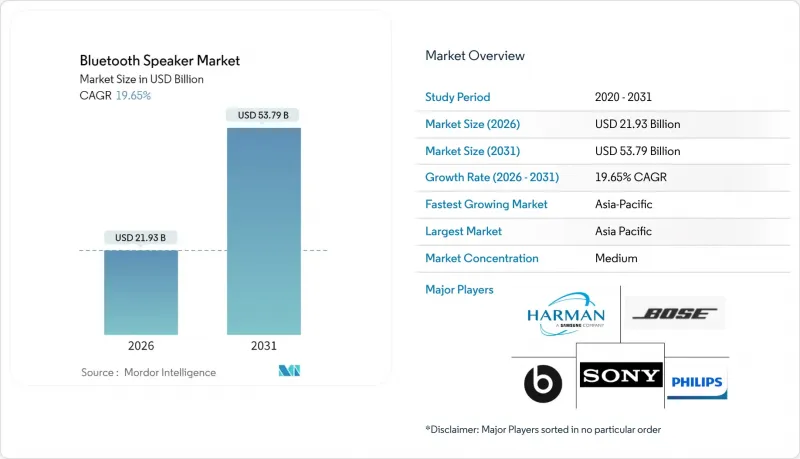
Robust demand stems from smart-home adoption, mass music-streaming uptake, battery cost declines, and the commercialization of Bluetooth LE Audio, each widening the addressable user base while shortening replacement cycles. Asia-Pacific leads current unit volumes thanks to competitive manufacturing clusters and a rapidly expanding middle class, while North America and Europe deliver premium average selling prices (ASPs) on the back of early smart-home penetration. Voice-assistant-enabled models are the fastest-growing category, yet Bluetooth-only speakers still represent the largest sub-segment because they deliver a simple, low-latency experience that does not rely on Wi-Fi. Competitive dynamics are shifting toward consolidation as established brands purchase luxury audio houses to secure patented technologies and brand cachet, thereby raising entry barriers for commodity players.
Global Bluetooth Speaker Market Trends and Insights
Rapid Adoption of Smart-Home Ecosystems
Seamless interoperability delivered by the Matter standard elevates Bluetooth speakers from stand-alone entertainment devices to multifunction smart-home hubs. Amazon's 2025 Echo Show range illustrates the shift by embedding Fire TV services, auto-framing video communications, and full Matter, Zigbee, and Thread support in a single unit. Inter-brand compatibility lowers switching costs and drives premium replacement demand as households unify lighting, HVAC, and security control via voice-enabled speakers. Chinese ODM platforms such as LegatoXP shorten product development cycles, letting second-tier brands enter the smart-home space with smaller engineering budgets. Collectively, these forces accelerate household penetration, intensify brand competition, and enlarge the total volume opportunity for the Bluetooth speaker market.
Expansion of Music-Streaming Subscriptions
Music-streaming services surpassed 750 million paid subscribers in 2024, boosting demand for hardware capable of high-resolution and spatial-audio playback. As codecs such as LC3, LDAC, and aptX Lossless mature, users recognize audible quality deltas between legacy devices and next-generation speakers, prompting replacement purchases. Subscription platforms also encourage multi-device plans that natively support group listening, thereby favoring multi-room speakers over single-speaker setups. Streaming's recurring revenue model fosters promotional bundling, where discounted speakers act as customer-acquisition vehicles, further stimulating hardware volumes throughout the forecast window.
Rampant Counterfeiting and Piracy
Unauthorized factories replicate popular designs, flooding e-commerce channels with low-quality imitations that undercut legitimate brands on price and erode consumer trust. Counterfeits often omit essential safety circuits, raising the risk of battery fires and accelerating brand-protection expenditures for authentication technologies, blockchain labeling, and legal enforcement. While premium players deploy security holograms and supply-chain tracing, smaller vendors lack capital for large-scale monitoring, exposing them to revenue leaks and reputational damage.
Other drivers and restraints analyzed in the detailed report include:
- Bluetooth LE Audio and Auracast Roll-out
- Outdoor Recreation and Van-Life Boom
- Safety Recalls Tied to Battery Fires
For complete list of drivers and restraints, kindly check the Table Of Contents.
Segment Analysis
Fixed and wall-mounted units accounted for 68.75% of the Bluetooth speaker market share in 2025, illustrating consumers' preference for power-fed systems that integrate seamlessly with televisions and multi-room platforms. This segment's steady revenue base gives manufacturers predictable upgrade cycles tied to smart-home renovation projects. Portable speakers, however, post a 21.95% CAGR, gaining from urban outdoor activities and remote-work mobility.
Fixed solutions emphasize audio fidelity, bass response, and voice-assistant control, traits that favor higher ASPs and bundling with streaming services. Portable designs optimize for rugged builds, lighter weight, and prolonged battery life, attracting first-time buyers in emerging markets. The two sub-segments, therefore, expand in parallel rather than cannibalize, yielding a diversified revenue structure for the overall Bluetooth speaker market.
Residential settings delivered 60.55% of the Bluetooth speaker market size in 2025 and also hold the fastest 21.85% CAGR, underscoring the permanence of home-centric entertainment habits formed during pandemic lockdowns. Continuous smart-home upgrades keep the replacement cycle under four years, far shorter than the historical averages for legacy hi-fi components.
Commercial demand, restaurants, hotels, and small offices, remains important for premium installed systems but faces elongated procurement processes and tighter capital budgets. As voice assistants mature, residential speakers increasingly serve as hubs for lighting and HVAC control, blending functional utility with leisure use and cementing their primacy in long-term demand projections for the Bluetooth speaker market.
The Global Bluetooth Speaker Market Report is Segmented by Portability (Portable, Fixed/Wall-Mounted), Application (Residential, Commercial), Connectivity Technology (Bluetooth-Only, and More), Distribution Channel (Online-Only Retailers, and More), Price Range (Economy Less Than USD 50, and More), and Geography (North America, South America, Europe, and More). The Market Forecasts are Provided in Terms of Value (USD).
Geography Analysis
Asia-Pacific commanded 31.45% of the Bluetooth speaker market share in 2025, generating a 21.15% CAGR to 2031 on the back of manufacturing scale, youth-oriented consumption, and rapid smartphone proliferation. Chinese OEMs leverage proximity to printed-circuit and battery supply chains to compress lead times and capitalize on domestic demand, which is forecast to surpass CNY 5.8 trillion for professional AV equipment by 2030. Government incentives for IoT ecosystems further accelerate the adoption of smart speakers, solidifying regional leadership in both volume and innovation.
North America trails in unit volumes yet achieves the highest ASPs. Early smart-home adoption and consumer willingness to pay for voice-assistant integration keep the region's gross margins above global averages. Outdoor recreation trends-from national park camping to city rooftop gatherings- stimulate demand for ruggedized models with multi-device pairing. Brand loyalty is strong, allowing category leaders such as Sonos to maintain premium shelf space even amid price-based competition.
Europe posts steady mid-teen growth, backed by stringent quality and cybersecurity standards that favor established brands. The updated Radio Equipment Directive effective August 2024 mandates secure boot and network safeguards, effectively filtering out low-end imports lacking compliance budgets. Consumers reward compliance with premium pricing, prompting local and international manufacturers to certify early and use CE markings as marketing differentiators, sustaining a value-heavy contribution to global Bluetooth speaker market revenues.
- Sony Group Corporation
- Samsung Electronics Co., Ltd. (Harman International Industries, Inc.)
- Panasonic Holdings Corporation
- Bose Corporation
- Beats Electronics LLC (Apple Inc.)
- Koninklijke Philips N.V.
- LG Electronics Inc.
- Logitech International S.A.
- Sonos, Inc.
- Bang & Olufsen A/S
- Yamaha Corporation
- Altec Lansing LLC
- JVCKENWOOD Corporation
- Anker Innovations Technology Co., Ltd.
- Ultimate Ears (Logitech)
- Tribit Audio (Thesy Technology Co., Ltd.)
- Onkyo Home Entertainment Corporation
- Zebronics India Pvt. Ltd.
- AOMAIS Audio (Shenzhen Jin Wen Hua)
- SoundBot Inc.
Additional Benefits:
- The market estimate (ME) sheet in Excel format
- 3 months of analyst support
TABLE OF CONTENTS
1 INTRODUCTION
- 1.1 Study Assumptions and Market Definition
- 1.2 Scope of the Study
2 RESEARCH METHODOLOGY
3 EXECUTIVE SUMMARY
4 MARKET LANDSCAPE
- 4.1 Market Overview
- 4.2 Market Drivers
- 4.2.1 Rapid adoption of smart-home ecosystems
- 4.2.2 Expansion of music-streaming subscriptions
- 4.2.3 Falling ASPs of lithium-ion batteries
- 4.2.4 Outdoor recreation and van-life boom
- 4.2.5 Bluetooth LE Audio and Auracast roll-out
- 4.2.6 Growing demand for immersive classroom audio
- 4.3 Market Restraints
- 4.3.1 Rampant counterfeiting and piracy
- 4.3.2 Margin erosion from price wars
- 4.3.3 Safety recalls tied to battery fires
- 4.3.4 Stricter EU EMI limits for more than 30 W speakers
- 4.4 Value Chain Analysis
- 4.5 Regulatory Landscape
- 4.6 Technological Outlook
- 4.7 Porter's Five Forces Analysis
- 4.7.1 Bargaining Power of Suppliers
- 4.7.2 Bargaining Power of Buyers
- 4.7.3 Threat of New Entrants
- 4.7.4 Threat of Substitutes
- 4.7.5 Degree of Competition
5 MARKET SIZE AND GROWTH FORECASTS (VALUE)
- 5.1 By Portability
- 5.1.1 Portable
- 5.1.2 Fixed / Wall-Mounted
- 5.2 By Application
- 5.2.1 Residential
- 5.2.2 Commercial
- 5.3 By Connectivity Technology
- 5.3.1 Bluetooth-only
- 5.3.2 Bluetooth + Wi-Fi (Multi-room)
- 5.3.3 Smart Speakers w/ Voice Assistant
- 5.4 By Distribution Channel
- 5.4.1 Online-Only Retailers
- 5.4.2 Omnichannel Consumer-Electronics Stores
- 5.5 By Price Range
- 5.5.1 Economy (Less than USD 50)
- 5.5.2 Mid-range (USD 50-199)
- 5.5.3 Premium (More than USD 200)
- 5.6 By Geography
- 5.6.1 North America
- 5.6.1.1 United States
- 5.6.1.2 Canada
- 5.6.1.3 Mexico
- 5.6.2 South America
- 5.6.2.1 Brazil
- 5.6.2.2 Argentina
- 5.6.2.3 Rest of South America
- 5.6.3 Europe
- 5.6.3.1 Germany
- 5.6.3.2 United Kingdom
- 5.6.3.3 France
- 5.6.3.4 Italy
- 5.6.3.5 Rest of Europe
- 5.6.4 Asia-Pacific
- 5.6.4.1 China
- 5.6.4.2 Japan
- 5.6.4.3 South Korea
- 5.6.4.4 India
- 5.6.4.5 Rest of Asia-Pacific
- 5.6.5 Middle East
- 5.6.5.1 Saudi Arabia
- 5.6.5.2 United Arab Emirates
- 5.6.5.3 Rest of Middle East
- 5.6.6 Africa
- 5.6.6.1 South Africa
- 5.6.6.2 Rest of Africa
- 5.6.1 North America
6 COMPETITIVE LANDSCAPE
- 6.1 Market Concentration
- 6.2 Strategic Moves
- 6.3 Market Share Analysis
- 6.4 Company Profiles (includes Global level Overview, Market level overview, Core Segments, Financials as available, Strategic Information, Market Rank/Share for key companies, Products and Services, and Recent Developments)
- 6.4.1 Sony Group Corporation
- 6.4.2 Samsung Electronics Co., Ltd. (Harman International Industries, Inc.)
- 6.4.3 Panasonic Holdings Corporation
- 6.4.4 Bose Corporation
- 6.4.5 Beats Electronics LLC (Apple Inc.)
- 6.4.6 Koninklijke Philips N.V.
- 6.4.7 LG Electronics Inc.
- 6.4.8 Logitech International S.A.
- 6.4.9 Sonos, Inc.
- 6.4.10 Bang & Olufsen A/S
- 6.4.11 Yamaha Corporation
- 6.4.12 Altec Lansing LLC
- 6.4.13 JVCKENWOOD Corporation
- 6.4.14 Anker Innovations Technology Co., Ltd.
- 6.4.15 Ultimate Ears (Logitech)
- 6.4.16 Tribit Audio (Thesy Technology Co., Ltd.)
- 6.4.17 Onkyo Home Entertainment Corporation
- 6.4.18 Zebronics India Pvt. Ltd.
- 6.4.19 AOMAIS Audio (Shenzhen Jin Wen Hua)
- 6.4.20 SoundBot Inc.
7 MARKET OPPORTUNITIES AND FUTURE OUTLOOK
- 7.1 White-space and Unmet-need Assessment

