PUBLISHER: Mordor Intelligence | PRODUCT CODE: 1939141

PUBLISHER: Mordor Intelligence | PRODUCT CODE: 1939141
Business Process Management - Market Share Analysis, Industry Trends & Statistics, Growth Forecasts (2026 - 2031)
The business process management market was valued at USD 16.73 billion in 2025 and estimated to grow from USD 18.67 billion in 2026 to reach USD 32.34 billion by 2031, at a CAGR of 11.62% during the forecast period (2026-2031).
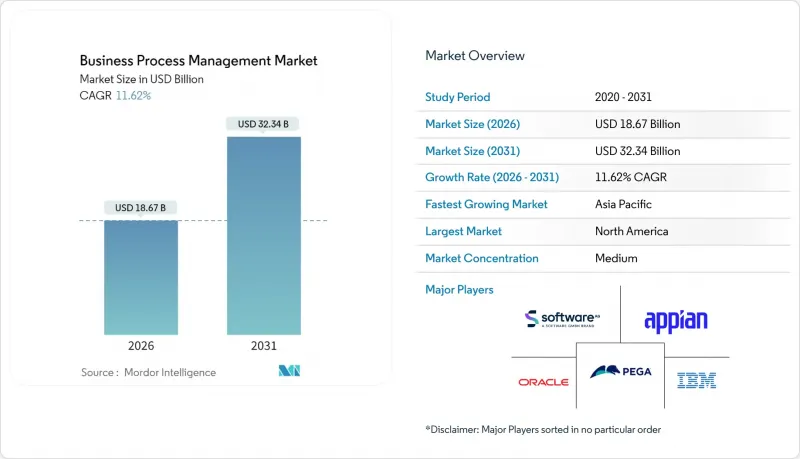
Expanding digital-first operating models, the integration of AI engines into workflow suites, and heightened regulatory oversight are reinforcing steady demand for end-to-end process orchestration platforms. Cloud-native delivery, low-code development, and process-mining-enabled digital twins are converging to reduce time-to-value for both enterprise and mid-market adopters. Asia-Pacific's aggressive automation agenda, combined with the widening scope of compliance programs across BFSI and healthcare, further amplifies growth potential. Market leaders are therefore accelerating ecosystem plays that blend analytics, rules engines, and robotic assistants into unified hyper-automation stacks.
Global Business Process Management Market Trends and Insights
Accelerated adoption of low-code / no-code BPM suites democratizes process automation
Three out of four BPM platforms embed low-code tooling in 2025, allowing business teams to configure workflows without deep coding knowledge, which trims project delivery cycles from months to weeks and lifts process efficiency by 30% in early programs .Citizen-developer rollouts help SMEs bypass scarce IT resources while preserving governance through templates and visual version control . Vendors such as Bizagi extend AI agents that auto-generate models from natural-language prompts, broadening access without jeopardizing compliance.
Cloud-native process automation platforms enable elastic scalability
Horizontal scale-out engines like Camunda Zeebe maintain linear throughput growth as cluster nodes are added, which delivers 65% gains in automation coverage for early adopters in public-sector claims processing. Cloud delivery mitigates capex and ensures fault tolerance across hybrid footprints, an attribute underscored by USD 6.2 billion in Oracle's latest quarterly cloud revenue . Rapid connector libraries accelerate integration, aligning with the 27% YoY surge in cloud BPM services consumption.
Rising integration complexity in heterogeneous IT landscapes
Multi-layered ecosystems blending legacy ERPs, cloud SaaS, and niche line-of-business apps inflate BPM integration scopes and can double original budget estimates, as documented in longitudinal ERP studies. The BPM Institute warns that overlooking API depth, event streams, and data-mapping demands elevates project-failure odds and total cost of ownership.
Other drivers and restraints analyzed in the detailed report include:
- Hyper-automation initiatives integrate RPA and AI for end-to-end process intelligence
- Compliance-driven digital transformation accelerates across BFSI and healthcare
- High upfront costs and uncertain ROI for enterprise-wide roll-outs
For complete list of drivers and restraints, kindly check the Table Of Contents.
Segment Analysis
Hybrid deployment accounted for 17.80% of the business process management market size and is forecast to post the fastest CAGR through 2031, whereas cloud retained 61.35% share in 2025. Financial regulators' location-based data rules make hybrid the preferred pathway for workloads requiring on-premise audit trails yet benefiting from elastic analytics sandboxes.
Organizations cite hybrid's risk-balanced profile as critical to sustain modernization while avoiding expensive wholesale migration of high-volume transactional cores. Europe's GDPR mandates, for instance, push government agencies to retain personal data in local servers while tapping cloud AI engines for document classification, exemplified by the U.S. Veterans Affairs' 65% automation rate leap using Camunda's flexible partitioning. As integration fabrics mature, hybrid footprints are expected to capture a larger slice of the business process management market by 2031 without displacing pure public-cloud exemplars in greenfield contexts.
Process automation dominated revenue with 39.20% share, yet process mining and analytics is set to expand at 22.10% CAGR, making it the most dynamic segment within the business process management market. Early adopters pivot toward proactive anomaly detection and predictive workflow tuning, capabilities that conventional task automation lacks.
Platform roadmaps now bundle mining modules with real-time recommendations, thereby raising switching costs and shrinking time to savings. Celonis' ranking in the 2024 Forbes Cloud 100 underlines market appetite for process intelligence, while acquisitions such as Symbio extend reach into design governance and continuous improvement. Content management, case management, and rule engines retain specialist relevance but cede headline growth to analytics-centric orchestration suites.
The Business Process Management Market Report Segments the Industry Into by Deployment (Cloud, On-Premise), by Solution (Process Improvement, Process Automation, Content and Document Management, and More), by End-User Industry (Banking, Financial Services, and Insurance (BFSI), Government and Defense, Healthcare, and More), and by Geography. The Market Forecasts are Provided in Terms of Value (USD).
Geography Analysis
North America accounted for 41.10% of the business process management market size in 2025 thanks to mature cloud adoption, deep integration skill sets, and a dense ecosystem of AI-enabled service providers. Financial services, public sector, and technology verticals represent the bulk of regional demand, with hyper-automation pilots shifting steadily into scaled programs. Vendor competition is pronounced, spurring continuous feature refresh and driving subscription-pricing innovations.
Asia-Pacific is on track for a 14.20% CAGR to 2031, reflecting government-backed digital-transformation mandates across India, Indonesia, and Vietnam that funnel automation budgets into BPM platforms. IBM's survey shows 71% of Asia-Pacific enterprises struggle to unlock full digital investment returns, positioning BPM as the structural framework for end-to-end optimization. Telecommunications, e-commerce, and public-sector digital-identity schemes are early adoption hotspots; low-code access further de-risks adoption for burgeoning SMEs.
Europe maintains steady growth buoyed by GDPR, ESG reporting, and emerging AI-act requirements that force enterprises to codify data lineage and consent management into orchestrated processes. Latin America's fintech surge, exemplified by Brazil's PIX real-time payment rails serving 130 million users, creates a demand cascade for back-office orchestration and risk analysis modules. Middle East and Africa see selective acceleration where national digital-government charters bankroll workflow modernization for tax, customs, and citizen-service functions.
- IBM Corporation
- OpenText Corporation
- Oracle Corporation
- Software AG
- TIBCO Software Inc.
- Fujitsu Limited
- Ultimus Inc.
- BP Logix Inc.
- Pegasystems Inc.
- Appian Corporation
- SAP Signavio (SAP SE)
- ASG Technologies Group, LLC
- Kissflow Inc.
- Nintex Global Ltd
- Comindware (CMW Lab)
- Microsoft Corporation
- Celonis SE
- UiPath Inc.
- Camunda Services GmbH
- Bizagi Group Ltd
Additional Benefits:
- The market estimate (ME) sheet in Excel format
- 3 months of analyst support
TABLE OF CONTENTS
1 INTRODUCTION
- 1.1 Study Assumptions and Market Definition
- 1.2 Scope of the Study
2 RESEARCH METHODOLOGY
3 EXECUTIVE SUMMARY
4 MARKET LANDSCAPE
- 4.1 Market Overview
- 4.2 Market Drivers
- 4.2.1 Accelerated adoption of low-code / no-code BPM suites
- 4.2.2 Growing demand for cloud-native process automation platforms
- 4.2.3 Expansion of hyper-automation initiatives integrating RPA and AI
- 4.2.4 Compliance-driven digital transformation across BFSI and healthcare
- 4.2.5 Emergence of process-mining-driven digital twins for optimisation
- 4.2.6 Embedded ESG reporting workflows within BPM solutions
- 4.3 Market Restraints
- 4.3.1 Rising integration complexity in heterogeneous IT landscapes
- 4.3.2 High upfront costs and uncertain ROI for enterprise-wide roll-outs
- 4.3.3 Skills shortage to govern citizen-developer BPM initiatives
- 4.3.4 Vendor lock-in risks from proprietary process-model standards
- 4.4 Value Chain Analysis
- 4.5 Regulatory Landscape
- 4.6 Technological Outlook
- 4.7 Porter's Five Forces Analysis
- 4.7.1 Bargaining Power of Buyers
- 4.7.2 Bargaining Power of Suppliers
- 4.7.3 Threat of New Entrants
- 4.7.4 Threat of Substitutes
- 4.7.5 Intensity of Competitive Rivalry
- 4.8 Impact of Macroeconomic Factors
5 MARKET SIZE AND GROWTH FORECASTS (VALUE)
- 5.1 By Deployment
- 5.1.1 Cloud
- 5.1.2 On-Premise
- 5.1.3 Hybrid
- 5.2 By Solution
- 5.2.1 Process Improvement
- 5.2.2 Process Automation
- 5.2.3 Content and Document Management
- 5.2.4 Case Management
- 5.2.5 Business Rules Management
- 5.2.6 Integration and Optimisation
- 5.2.7 Process Mining and Analytics
- 5.3 By Organization Size
- 5.3.1 Large Enterprises
- 5.3.2 Small and Medium Enterprises
- 5.4 By End-User Industry
- 5.4.1 Banking, Financial Services and Insurance (BFSI)
- 5.4.2 Government and Public Sector
- 5.4.3 Healthcare and Life Sciences
- 5.4.4 IT and Telecommunication
- 5.4.5 Retail and Consumer Goods
- 5.4.6 Manufacturing and Industrial
- 5.4.7 Other Industries (Energy, Education, etc.)
- 5.5 By Geography
- 5.5.1 North America
- 5.5.1.1 United States
- 5.5.1.2 Canada
- 5.5.1.3 Mexico
- 5.5.2 South America
- 5.5.2.1 Brazil
- 5.5.2.2 Argentina
- 5.5.2.3 Rest of South America
- 5.5.3 Europe
- 5.5.3.1 United Kingdom
- 5.5.3.2 Germany
- 5.5.3.3 France
- 5.5.3.4 Italy
- 5.5.3.5 Rest of Europe
- 5.5.4 Asia-Pacific
- 5.5.4.1 China
- 5.5.4.2 Japan
- 5.5.4.3 India
- 5.5.4.4 South Korea
- 5.5.4.5 Rest of Asia-Pacific
- 5.5.5 Middle East and Africa
- 5.5.5.1 Middle East
- 5.5.5.1.1 Israel
- 5.5.5.1.2 Saudi Arabia
- 5.5.5.1.3 United Arab Emirates
- 5.5.5.1.4 Turkey
- 5.5.5.1.5 Rest of Middle East
- 5.5.5.2 Africa
- 5.5.5.2.1 South Africa
- 5.5.5.2.2 Egypt
- 5.5.5.2.3 Rest of Africa
- 5.5.5.1 Middle East
- 5.5.1 North America
6 COMPETITIVE LANDSCAPE
- 6.1 Market Concentration
- 6.2 Strategic Moves
- 6.3 Market Share Analysis
- 6.4 Company Profiles {(includes Global level Overview, Market level overview, Core Segments, Financials as available, Strategic Information, Market Rank/Share for key companies, Products and Services, and Recent Developments)}
- 6.4.1 IBM Corporation
- 6.4.2 OpenText Corporation
- 6.4.3 Oracle Corporation
- 6.4.4 Software AG
- 6.4.5 TIBCO Software Inc.
- 6.4.6 Fujitsu Limited
- 6.4.7 Ultimus Inc.
- 6.4.8 BP Logix Inc.
- 6.4.9 Pegasystems Inc.
- 6.4.10 Appian Corporation
- 6.4.11 SAP Signavio (SAP SE)
- 6.4.12 ASG Technologies Group, LLC
- 6.4.13 Kissflow Inc.
- 6.4.14 Nintex Global Ltd
- 6.4.15 Comindware (CMW Lab)
- 6.4.16 Microsoft Corporation
- 6.4.17 Celonis SE
- 6.4.18 UiPath Inc.
- 6.4.19 Camunda Services GmbH
- 6.4.20 Bizagi Group Ltd
7 MARKET OPPORTUNITIES AND FUTURE OUTLOOK
- 7.1 White-space and Unmet-Need Assessment

