
PUBLISHER: Mordor Intelligence | PRODUCT CODE: 1939637

PUBLISHER: Mordor Intelligence | PRODUCT CODE: 1939637
Slimming Aids - Market Share Analysis, Industry Trends & Statistics, Growth Forecasts (2026 - 2031)
The Slimming aids market was valued at USD 23.49 billion in 2025 and estimated to grow from USD 27.03 billion in 2026 to reach USD 54.59 billion by 2031, at a CAGR of 15.09% during the forecast period (2026-2031).
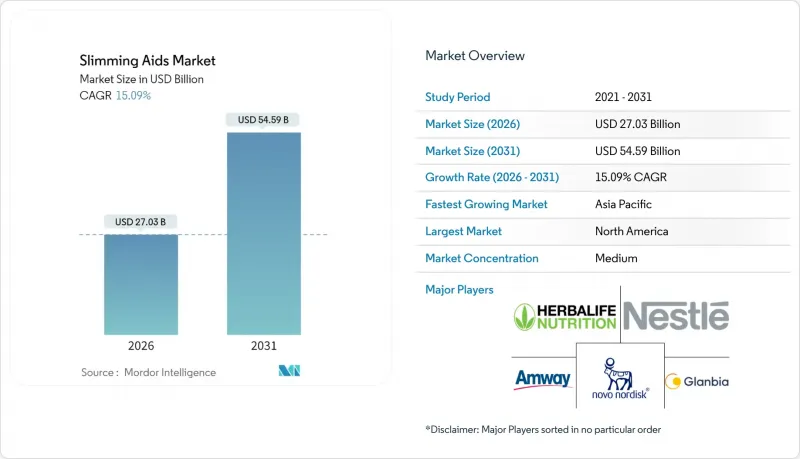
Consistent double-digit growth reflects the repositioning of obesity from a cosmetic issue to a chronic disease, the rapid approval cycle for next-generation GLP-1 drugs, and rising disposable incomes in emerging economies. Strong cardiovascular outcome data for semaglutide and tirzepatide is broadening payer coverage, while telehealth platforms shorten the prescription pathway and lift adherence rates. At the same time, the fitness ecosystem is integrating wearables and connected equipment that complement pharmacotherapy rather than compete with it. Competitive pressure is intense as incumbents in meal plans and supplements overhaul their portfolios to counter the clinical efficacy of injectable therapies.
Global Slimming Aids Market Trends and Insights
Rising Global Obesity Prevalence
Adult obesity - 1 in 8 people lived with obesity in 2022. Forecasts indicate 3.80 billion adults could be overweight or obese by 2050, underscoring a structural demand driver that persists regardless of economic cycles. Healthcare systems now frame obesity as a chronic disease requiring long-term pharmacotherapy, which secures reimbursement pathways and expands the Slimming aids market beyond cosmetic users. The estimated USD 3 trillion annual cost burden projected for 2030 places political urgency on early-stage intervention, further institutionalizing anti-obesity therapeutics. This epidemiological backdrop cements multiyear visibility for innovators and retailers positioned across the continuum of care.
Growing Disposable Incomes in Emerging Markets
Rising purchasing power in Asia-Pacific translates into new demand for premium slimming solutions. India's domestic weight-management sector was INR 172,000 crore (USD 20.6 billion) in 2022 and is tracking toward INR 315,000 crore (USD 37.8 billion) by 2028. Chinese manufacturers are scaling GLP-1 biosimilars that promise affordability as well as efficacy, a move that will likely compress prices in export markets once regulatory clearances are secured. Urbanization and sedentary lifestyles raise obesity incidence, while government incentives such as India's Production Linked Incentive scheme lower local production costs and improve supply security. These combined factors unlock a sizable middle-class consumer base that previously relied on lower-efficacy herbal remedies, accelerating formal sector penetration.
Safety Concerns & Side-Effects of Weight-Loss Drugs
Warnings about counterfeit semaglutide in three continents underscore the parallel-trade risk for high-value injectables. Black-box cautions for pancreatitis, thyroid tumors and severe hypoglycemia remain prominent on prescribing information. Studies show up to 30% of initial lean-mass loss is muscle, prompting clinicians to recommend resistance training and protein supplementation for long-term maintenance. Gen Z skepticism is notable: 57.5% prefer lifestyle modification over medication, a sentiment amplified by viral social-media anecdotes. These perceptions may delay uptake or increase discontinuation rates, trimming near-term volume growth.
Other drivers and restraints analyzed in the detailed report include:
- Launch of Next-Gen GLP-1 Drugs
- Telehealth-Centred Prescription Models
- High Therapy Cost
For complete list of drivers and restraints, kindly check the Table Of Contents.
Segment Analysis
Dietary supplements captured 36.74% of the Slimming aids market share in 2025, underscoring the category's entrenched retail penetration and low regulatory hurdles. However, the segment's CAGR trails the equipment boom as consumers pivot toward holistic regimens that pair GLP-1 therapy with exercise. Connected treadmills and cycles posted 42% year-over-year revenue growth at Peloton, illustrating appetite for premium hardware that supports weight-loss accountability. The Slimming aids market size for fitness equipment is forecast to expand at 15.48% CAGR to 2031, suggesting incremental revenue pools even as the broader wearables category saturates.
Supplement brands respond with clinically-validated actives such as inulin and berberine, aiming to align efficacy narratives with pharmaceutical standards. Cross-promotion with smart scales and calorie-tracking apps furnishes consumer data that informs personalized dosages, enhancing perceived value. Meanwhile, meal replacements defend share via portion-controlled convenience but face cannibalization as GLP-1 users experience appetite suppression. Manufacturers differentiate through protein-dense formulations to offset lean-mass losses, a strategic pivot that tempers volume erosion.
The natural and semi-synthetic segments complement the slimming aids market with their unique value propositions. The natural segment, comprising herbal extracts, plant-based ingredients, and organic compounds, appeals to consumers seeking holistic weight management solutions with minimal side effects. Products in this category often include ingredients like green tea extracts, garcinia cambogia, and various botanical extracts. The semi-synthetic segment bridges the gap between natural and synthetic products, offering a balanced approach by combining natural ingredients with synthetic compounds to enhance efficacy while maintaining a relatively favorable safety profile. This segment particularly appeals to consumers who seek the benefits of both natural and synthetic ingredients in their weight management journey.
Global Slimming Aids Market is Segmented by Product Type (Natural, Synthetic, Semi-Synthetic), Mode of Consumption (Tablets, Capsules, Powder, Syrups, and Others), and Geography (North America, Europe, Asia-Pacific, Middle East, and Africa, and South America). The Report Offers the Value (in USD Million) for the Above Segments.
Geography Analysis
North America generated 41.87% of Slimming aids market revenue in 2025 on the back of high obesity prevalence and early GLP-1 adoption. U.S. payers increasingly reimburse anti-obesity drugs following strong cardiovascular data, while Canadian single-payer systems integrate GLP-1s into chronic-disease pathways. Direct-to-consumer models, such as LillyDirect, streamline distribution and bolster adherence through two-day delivery.
Asia-Pacific is the fastest-growing region at 16.63% CAGR, propelled by expanding middle-class populations and proactive government policies. India exemplifies the convergence of rising income and high unmet medical need, with the Slimming aids market size projected to more than double by 2028. Chinese biosimilar entrants will likely compress prices and catalyze volume expansion.
Europe maintains a premium positioning with rigorous EMA oversight that validates therapeutic safety. German sickness funds pilot outcome-based reimbursements, while the U.K. navigates post-Brexit supply logistics. South America and the Middle East & Africa contribute smaller shares but hold long-run optionality as healthcare access improves and pricing pressure eases.
- Herbalife Ltd.
- WW International Inc.
- Novo Nordisk
- Eli Lilly and Company
- Simply Good Foods Co.
- GlaxoSmithKline
- Roche
- Amway Corp.
- Nestle S.A.
- Unilever PLC
- Peloton Interactive Inc.
- Johnson Health Tech Co. Ltd.
- Slimming World Group Ltd.
- GNC Holdings LLC
- FANCL Corp.
- Abbott Laboratories
- Bayer
- Nestle Health Science S.A.
- Abbott Nutrition Manufacturing Inc.
- Aurobindo Pharma Ltd.
Additional Benefits:
- The market estimate (ME) sheet in Excel format
- 3 months of analyst support
TABLE OF CONTENTS
1 Introduction
- 1.1 Study Assumptions & Market Definition
- 1.2 Scope of the Study
2 Research Methodology
3 Executive Summary
4 Market Landscape
- 4.1 Market Overview
- 4.2 Market Drivers
- 4.2.1 Rising global obesity prevalence
- 4.2.2 Growing disposable incomes in emerging markets
- 4.2.3 Launch of next-gen GLP-1 drugs
- 4.2.4 Telehealth-centred prescription models
- 4.2.5 Corporate weight-management benefit schemes
- 4.2.6 Microbiome-targeted slimming products
- 4.3 Market Restraints
- 4.3.1 Safety concerns & side-effects of weight-loss drugs
- 4.3.2 High therapy cost
- 4.3.3 Social-media-driven fad-diet backlash
- 4.3.4 API supply bottlenecks for semaglutide family
- 4.4 Value / Supply-Chain Analysis
- 4.5 Regulatory Landscape
- 4.6 Technological Outlook
- 4.7 Porter's Five Forces Analysis
- 4.7.1 Threat of New Entrants
- 4.7.2 Bargaining Power of Suppliers
- 4.7.3 Bargaining Power of Buyers
- 4.7.4 Threat of Substitutes
- 4.7.5 Competitive Rivalry
5 Market Size & Growth Forecasts (Value, USD Bn)
- 5.1 By Product Type
- 5.1.1 Dietary Supplements
- 5.1.2 Meal Replacements
- 5.1.3 Pharmeuticals (RX and OTC)
- 5.1.4 Fitness Equipment
- 5.2 By End User
- 5.2.1 Women
- 5.2.2 Men
- 5.2.3 Children & Adolescents
- 5.3 By source
- 5.3.1 Natural
- 5.3.2 synthetic
- 5.3.3 Semi-synthetic
- 5.4 By Distribution Channel
- 5.4.1 Online Retail
- 5.4.2 Pharmacies & Drug Stores
- 5.4.3 Hypermarkets / Supermarkets
- 5.4.4 Weight-Management Clinics
- 5.5 By Geography
- 5.5.1 North America
- 5.5.1.1 United States
- 5.5.1.2 Canada
- 5.5.2 Europe
- 5.5.2.1 Germany
- 5.5.2.2 United Kingdom
- 5.5.2.3 France
- 5.5.2.4 Italy
- 5.5.2.5 Spain
- 5.5.2.6 Rest of Europe
- 5.5.3 Asia-Pacific
- 5.5.3.1 China
- 5.5.3.2 India
- 5.5.3.3 Japan
- 5.5.3.4 South Korea
- 5.5.3.5 Australia
- 5.5.3.6 Rest of Asia-Pacific
- 5.5.4 South America
- 5.5.4.1 Brazil
- 5.5.4.2 Argentina
- 5.5.4.3 Rest of South America
- 5.5.5 Middle East and Africa
- 5.5.5.1 GCC
- 5.5.5.2 South Africa
- 5.5.5.3 Rest of Middle East and Africa
- 5.5.1 North America
6 Competitive Landscape
- 6.1 Market Concentration
- 6.2 Market Share Analysis
- 6.3 Company Profiles {(includes Global level Overview, Market level overview, Core Segments, Financials as available, Strategic Information, Market Rank/Share, Products & Services, Recent Developments)}
- 6.3.1 Herbalife Ltd.
- 6.3.2 WW International Inc.
- 6.3.3 Novo Nordisk A/S
- 6.3.4 Eli Lilly and Company
- 6.3.5 Simply Good Foods Co.
- 6.3.6 GlaxoSmithKline plc
- 6.3.7 Hoffmann-La Roche AG
- 6.3.8 Amway Corp.
- 6.3.9 Nestle S.A.
- 6.3.10 Unilever PLC
- 6.3.11 Peloton Interactive Inc.
- 6.3.12 Johnson Health Tech Co. Ltd.
- 6.3.13 Slimming World Group Ltd.
- 6.3.14 GNC Holdings LLC
- 6.3.15 FANCL Corp.
- 6.3.16 Abbott Laboratories
- 6.3.17 Bayer AG
- 6.3.18 Nestle Health Science S.A.
- 6.3.19 Abbott Nutrition Manufacturing Inc.
- 6.3.20 Aurobindo Pharma Ltd.
7 Market Opportunities & Future Outlook
- 7.1 White-space & Unmet-Need Assessment

