
PUBLISHER: Mordor Intelligence | PRODUCT CODE: 1939639

PUBLISHER: Mordor Intelligence | PRODUCT CODE: 1939639
Submarine Optical Fiber Cable - Market Share Analysis, Industry Trends & Statistics, Growth Forecasts (2026 - 2031)
The submarine optical fiber cable market size in 2026 is estimated at USD 5.89 billion, growing from 2025 value of USD 5.31 billion with 2031 projections showing USD 9.86 billion, growing at 10.87% CAGR over 2026-2031.
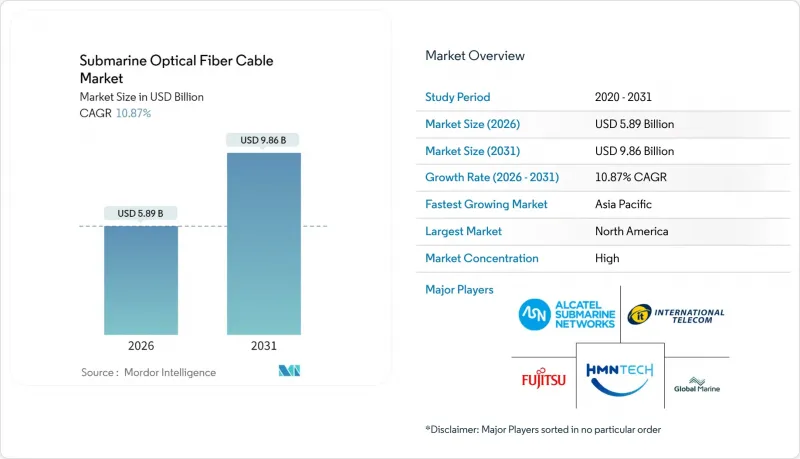
Heightened investment by hyperscale cloud providers, accelerating 400 GbE/800 GbE upgrade cycles, and the commercial roll-out of Space Division Multiplexing (SDM) systems are reshaping the competitive landscape and economics of intercontinental connectivity. Systems designed for 60 + Tbps are now routine, lowering unit bandwidth costs and enabling AI-intensive data flows. Capacity expansion strategies increasingly intersect with national-security rule-making, exemplified by the FCC's 2024-2025 overhaul of cable-licensing procedures, which is steering route selection and vendor qualification. At the same time, repair-ship bottlenecks and repeated Baltic-Sea disruptions reveal a growing exposure to geopolitical risks that elevate operating expenditure and insurance premiums.
Global Submarine Optical Fiber Cable Market Trends and Insights
Growing Smartphone Penetration and Rising Internet Bandwidth Demand
Intercontinental traffic is projected to climb 39% annually through 2029 as 5G and emerging AI workloads multiply bandwidth requirements. Submarine links sustain 1-5 millisecond latency, an order of magnitude lower than satellite constellations, preserving competitiveness for high-frequency trading and industrial IoT use cases. Forthcoming 6G specifications targeting 1 Tbps peak rates intensify the call for repeaters able to handle 800 GbE wavelengths. Unresolved route-approval delays in the South China Sea restrict new capacity, creating price premiums for Southeast-Asian traffic.
Hyperscale Cloud and OTT Investment in Private Cables
Private ownership by Meta, Google, Amazon, and Microsoft now eclipses traditional consortium funding and exceeds USD 20 billion in aggregate commitments. Direct termination inside hyperscaler data centers eliminates terrestrial backhaul, trimming latency and OPEX while tightening data-sovereignty control. Google's 250 Tbps Dunant and Meta's 50,000 km Project Waterworth exemplify the new vertical-integration model.
High Maintenance and Repair-Ship Costs
Just 60 specialized vessels support more than 600 active systems, extending restoration timelines when multiple outages occur. Arctic and trans-Pacific repairs exceed USD 1 million per incident and face seasonal weather windows, elevating insurance premiums by 15-20% annually in high-risk zones.
Other drivers and restraints analyzed in the detailed report include:
- Rapid 400 GbE/800 GbE Upgrade Cycle Among Carriers
- Push Toward Low-Latency Trans-Polar Routes
- Growing Investment in LEO Satellite Constellations
For complete list of drivers and restraints, kindly check the Table Of Contents.
Segment Analysis
Wet-plant equipment contributed 52.74% of the submarine optical fiber cable market size in 2025 and benefits from 20 + fiber-pair designs that intensify repeater demand. SubCom's expansion of marine fulfillment capabilities is aligned with this demand surge. Auxiliary and marine services are scaling at a 11.86% CAGR as complex geopolitical disruptions lengthen repair cycles and raise the value of specialized intervention vessels.
Continued maintenance revenue over a 25-year operational life adds predictable cash flows for service providers. Dry-plant equipment enjoys steady replacement demand as landing-station power and monitoring systems age, though it remains a smaller contributor to the submarine optical fiber cable market.
Single-mode fiber represented 67.02% of 2025 revenue; however, SDM multi-core fiber is forecast to grow at an annual rate of 13.62% to 2031. SDM units such as OFS's TeraWave SCUBA 4X deliver fourfold capacity improvements, mitigating the looming Shannon-limit crunch. Sumitomo Electric's coupled multi-core fiber achieves 0.158 dB/km attenuation, validating SDM performance over trans-oceanic spans.
Google's deployment of 12 fiber-pair SDM architecture on Dunant proves commercial viability and accelerates broader adoption. Multimode fiber remains limited to intra-station applications.
The Submarine Optical Fiber Cable Market Report is Segmented by Component (Wet-Plant Equipment, Dry-Plant Equipment, and More), Cable Type (Single-Mode Fiber, Multimode Fiber, and More), Client Type (Telecom Operators, Content and Hyperscale Cloud Providers, and More), Capacity Design (less Than or Equal To 16 Tbps Systems, 16-60 Tbps Systems, and More), and Geography. The Market Forecasts are Provided in Terms of Value (USD).
Geography Analysis
North America's 36.25% share of the submarine optical fiber cable market in 2025 is driven by a hyperscale cluster and strong regulatory frameworks. Google's USD 1 billion US-Japan cable commitment reinforces Pacific capacity while LS Cable's USD 681 million Virginia plant secures domestic supply resilience.
The Asia Pacific is projected to expand at a 11.40% CAGR, driven by digital economy programs and alternative routes that circumvent geopolitical flashpoints. India's Blue Origin landing and SoftBank's new trans-Pacific build typify this activity. Chinese vendors HMN Technologies and ZTT scale up production, although U.S. sanctions prompt them to shift toward Belt-and-Road markets.
Europe leverages mature trans-Atlantic corridors while championing the Far North Fiber project for Asia latency advantages. EU-wide cable-security action plans and the French State's acquisition of Alcatel Submarine Networks highlight sovereign-infrastructure priorities. The European Union's Action Plan on Cable Security establishes robust measures for preventing, detecting, and responding to threats against submarine cables, underscoring the EU's commitment to safeguarding its critical infrastructure. In a move highlighting the strategic importance of submarine cable technology, Nokia finalized the sale of Alcatel Submarine Networks to the French State, signaling European governments' view of this technology as a vital national asset warranting sovereign oversight.
- Alcatel Submarine Networks Ltd.
- HMN Technologies Co., Ltd.
- Nexans S.A.
- Fujitsu Ltd.
- Global Marine Group Ltd.
- Orange Marine SAS
- Sumitomo Electric Industries Ltd.
- LS Cable and System Ltd.
- Jiangsu Hengtong Marine Cable Systems Co., Ltd.
- S.B. Submarine Systems Co., Ltd.
- IT International Telecom Inc.
- PT Communication Cable Systems Indonesia Tbk
- NTT Communications Corporation
- Verizon Communications Inc.
- Telstra Group Limited
- China Unicom Global Limited
- Telekom Malaysia Berhad
- Oman Telecommunications Company S.A.O.G. (Omantel)
- Meta Platforms, Inc.
- Amazon.com, Inc.
- Google LLC
Additional Benefits:
- The market estimate (ME) sheet in Excel format
- 3 months of analyst support
TABLE OF CONTENTS
1 INTRODUCTION
- 1.1 Study Assumptions and Market Definition
- 1.2 Scope of the Study
2 RESEARCH METHODOLOGY
3 EXECUTIVE SUMMARY
4 MARKET LANDSCAPE
- 4.1 Market Overview
- 4.2 Market Drivers
- 4.2.1 Growing smartphone penetration and rising internet bandwidth demand
- 4.2.2 Increasing fiber connectivity in emerging regions
- 4.2.3 Hyperscale cloud and OTT investment in private cables
- 4.2.4 Rapid 400 GbE/800 GbE upgrade cycle among carriers
- 4.2.5 Push toward Low-Latency trans-polar routes
- 4.2.6 Offshore wind farms adopting hybrid power-data cables
- 4.3 Market Restraints
- 4.3.1 High maintenance and repair-ship costs
- 4.3.2 Growing investment in LEO satellite constellations
- 4.3.3 Geopolitical cable-landing permit delays
- 4.3.4 Fiber-optic theft/vandalism in shallow waters
- 4.4 Regulatory Landscape
- 4.5 Technological Outlook
- 4.6 Porter's Five Forces
- 4.6.1 Bargaining Power of Suppliers
- 4.6.2 Bargaining Power of Buyers
- 4.6.3 Threat of New Entrants
- 4.6.4 Threat of Substitute Products
- 4.6.5 Degree of Competition
- 4.7 Impact of Macro Trends (incl. COVID-19)
- 4.8 Investment Analysis
- 4.9 Submarine Cable Projects Database
5 MARKET SIZE AND GROWTH FORECASTS (VALUE)
- 5.1 By Component
- 5.1.1 Wet-Plant Equipment
- 5.1.2 Dry-Plant Equipment
- 5.1.3 Auxiliary and Marine Services
- 5.1.4 Other Components
- 5.2 By Cable Type
- 5.2.1 Single-mode Fiber
- 5.2.2 Multimode Fiber
- 5.2.3 SDM / Multi-core Fiber
- 5.3 By Client Type
- 5.3.1 Telecom Operators
- 5.3.2 Content and Hyperscale Cloud Providers
- 5.3.3 Government and Research Networks
- 5.3.4 Offshore Energy Operators
- 5.3.5 Other Clinet Types
- 5.4 By Capacity Design
- 5.4.1 less than or equal to 16 Tbps Systems
- 5.4.2 16 - 60 Tbps Systems
- 5.4.3 above 60 Tbps Systems
- 5.5 By Geography
- 5.5.1 North America
- 5.5.1.1 United States
- 5.5.1.2 Canada
- 5.5.2 South America
- 5.5.2.1 Brazil
- 5.5.2.2 Argentina
- 5.5.2.3 Rest of South America
- 5.5.3 Europe
- 5.5.3.1 Germany
- 5.5.3.2 France
- 5.5.3.3 United Kingdom
- 5.5.3.4 Rest of Europe
- 5.5.4 Asia Pacific
- 5.5.4.1 China
- 5.5.4.2 India
- 5.5.4.3 Japan
- 5.5.4.4 Australia
- 5.5.4.5 Rest of Asia Pacific
- 5.5.5 Middle East and Africa
- 5.5.5.1 Middle East
- 5.5.5.1.1 Saudi Arabia
- 5.5.5.1.2 United Arab Emirates
- 5.5.5.1.3 Turkey
- 5.5.5.1.4 Rest of Middle East
- 5.5.5.2 Africa
- 5.5.5.2.1 South Africa
- 5.5.5.2.2 Egypt
- 5.5.5.2.3 Nigeria
- 5.5.5.2.4 Rest of Africa
- 5.5.5.1 Middle East
- 5.5.1 North America
6 COMPETITIVE LANDSCAPE
- 6.1 Market Concentration
- 6.2 Strategic Moves
- 6.3 Market Share Analysis
- 6.4 Company Profiles (includes Global level Overview, Market level overview, Core Segments, Financials as available, Strategic Information, Market Rank/Share for key companies, Products and Services, and Recent Developments)
- 6.4.1 Alcatel Submarine Networks Ltd.
- 6.4.2 HMN Technologies Co., Ltd.
- 6.4.3 Nexans S.A.
- 6.4.4 Fujitsu Ltd.
- 6.4.5 Global Marine Group Ltd.
- 6.4.6 Orange Marine SAS
- 6.4.7 Sumitomo Electric Industries Ltd.
- 6.4.8 LS Cable and System Ltd.
- 6.4.9 Jiangsu Hengtong Marine Cable Systems Co., Ltd.
- 6.4.10 S.B. Submarine Systems Co., Ltd.
- 6.4.11 IT International Telecom Inc.
- 6.4.12 PT Communication Cable Systems Indonesia Tbk
- 6.4.13 NTT Communications Corporation
- 6.4.14 Verizon Communications Inc.
- 6.4.15 Telstra Group Limited
- 6.4.16 China Unicom Global Limited
- 6.4.17 Telekom Malaysia Berhad
- 6.4.18 Oman Telecommunications Company S.A.O.G. (Omantel)
- 6.4.19 Meta Platforms, Inc.
- 6.4.20 Amazon.com, Inc.
- 6.4.21 Google LLC
7 MARKET OPPORTUNITIES AND FUTURE OUTLOOK
- 7.1 White-space and Unmet-Need Assessment

