
PUBLISHER: Mordor Intelligence | PRODUCT CODE: 1939647

PUBLISHER: Mordor Intelligence | PRODUCT CODE: 1939647
Aerosol - Market Share Analysis, Industry Trends & Statistics, Growth Forecasts (2026 - 2031)
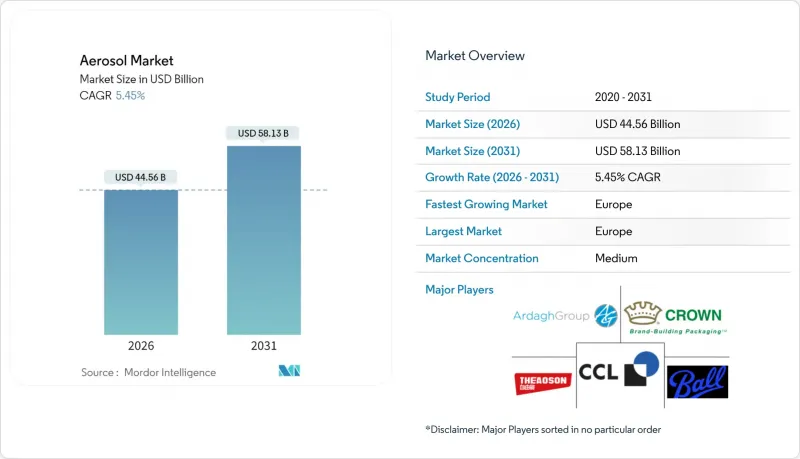
The Aerosol Market was valued at USD 42.26 billion in 2025 and estimated to grow from USD 44.56 billion in 2026 to reach USD 58.13 billion by 2031, at a CAGR of 5.45% during the forecast period (2026-2031).
Steady gains stem from consumer preference for convenient, pressurized dispensing across personal care, medical, and industrial uses. Early compliance with evolving F-gas regulations, particularly in Europe, is accelerating the transition from hydrofluorocarbons (HFCs) to hydrofluoroolefins (HFOs). Europe's regulatory leadership is shaping global formulations, while e-commerce and direct-to-consumer channels are extending product reach and reinforcing demand for lightweight, recyclable cans. Ongoing aluminum price fluctuations and the pursuit of lower-carbon packaging intensify competition among material suppliers, yet they also create opportunities for product differentiation through recycled content and universal waste program coverage.
Global Aerosol Market Trends and Insights
Rising Demand for Personal-Care and Hygiene Aerosols
Premiumization in beauty and grooming drives the wider use of pressurized formats, which offer precise dosing, hygienic delivery, and longer product shelf life. India's skincare segment is experiencing growth, driven by the popularity of SPF-infused sprays and hybrid moisturizers. Global brand owners are bolstering innovation pipelines around refillable metal cans and airless systems to address VOC caps while retaining convenience credentials. Patent filings for low-VOC dry shampoo underscore how leading firms prioritize both emissions compliance and scalp-friendly formulations. European makers strengthen brand equity by spotlighting aerosols' ability to shield contents from oxidation and contamination. Collective effect: premium price elasticity offsets propellant reformulation costs and sustains aerosol market growth.
Expansion of Paints-and-Coatings Spray Applications
Industrial users adopt electrostatic spray technology to curb overspray by up to 30%, enhancing material efficiency in large-area coatings. Southeast Asian infrastructure booms-Indonesia's paint demand topped 1 million tons in 2024-support higher volumes for protective aerosols used on steel, concrete, and composite surfaces. Auto refinish segments favor touch-up aerosols for color-matching versatility. Water-based formulas compliant with stricter VOC ceilings still require propellants that maintain atomization, thereby driving the uptake of dimethyl ether and other alternatives. Agricultural drones now rely on aerosol-compatible formulations to spread pesticides evenly across narrow rows, opening new revenue streams for propellant suppliers. Compliance with ISO 14001 standards guides the procurement of eco-optimized solvents and additives.
Stringent VOC/F-gas Regulations
Divergent limits on volatile organic compounds oblige region-specific formulations and double certification costs. Consumer deodorants tested in Korea emitted 13.89 ppm of total VOC at a 1-meter distance, with certain benzene levels exceeding proposed ACGIH limits, indicating compliance hurdles for fragrance-heavy aerosols. The European Union's F-gas quota auction elevates the price of high-GWP blends, compelling even small brands to adopt cleaner chemistries. Air Label Score criteria force proof of low indoor emissions, extending time-to-market for new SKUs. Inventory tied to legacy propellants risks write-downs if phaseout dates accelerate. Global distributors must navigate a patchwork of rules, which raises logistics overhead for multi-country rollouts.
Other drivers and restraints analyzed in the detailed report include:
- Convenience-Driven Portable Packaging Across Sectors
- Regulatory Shift to Low-GWP Propellants Spurring Re-tooling
- Energy-Intensive Aluminum Supply Tightening Can Margins
For complete list of drivers and restraints, kindly check the Table Of Contents.
Segment Analysis
Hydrofluorocarbons held a 40.62% market share in the aerosol sector in 2025, underpinned by well-established supply chains and broad formulation compatibility. Yet tightening phase-down quotas are steering customers toward hydrofluoro-olefins, which are projected to post a 6.58% CAGR through 2031. Dimethyl ether, produced from bio-methanol, is drawing attention for its negative carbon intensity profile and WHO endorsement for medical uses. Nitrous oxide and carbon dioxide still dominate edible and technical segments where non-flammability is mandatory. Early movers completing medical device validations with HFO propellants enjoy premium pricing and longer contract tenures.
Adoption rates vary by region, with Europe leading due to earlier F-gas restrictions, while North America accelerates the transition through state-level mandates. In the Asia-Pacific region, larger multinational personal care players follow global formulation standards, whereas local brands gradually phase in alternatives. Suppliers capable of offering bundled propellant plus sustainability certification packages capture loyal demand. Investments in HFO capacity mitigate long-term supply risk and stabilize cost structures for downstream fillers.
The Aerosol Market Report is Segmented by Propellant Type (Dimethyl Ether, Hydrofluorocarbons, Hydrofluoro Olefins, and Other Types), Can Type (Steel, Aluminum, Plastic, and Other Can Types), Application (Automotive, Personal Care, Food Products, Agriculture, and More), and Geography (Asia-Pacific, North America, Europe, South America, and Middle-East and Africa). The Market Forecasts are Provided in Terms of Value (USD).
Geography Analysis
Europe accounted for 32.12% of the global aerosol market in 2025 and is forecast to grow at a 6.41% CAGR through 2031. Stringent F-gas legislation and robust recycling infrastructure are spurring the rapid uptake of HFO propellants and low-carbon metal cans. Germany, France, and the United Kingdom lead research and development investments focused on premium personal-care and industrial formulations. Retailers promote products bearing eco-labels that highlight the aerosols' benefits of contamination-free delivery. Earlier compliance timetables enable European fillers to license technology abroad and capture a share in emerging markets.
Asia-Pacific shows the fastest incremental volume gains, driven by infrastructure growth and rising discretionary spending. China's aluminum dominance secures supply-chain cost advantages, although coal-intensive smelting raises concerns about its carbon footprint, which stimulates demand for recycled aluminum. India's expanding skincare market stimulates local filling capacity, while Indonesia's one-million-ton paint sector buoys industrial sprays. Japan and South Korea emphasize precision valves and safety certifications, exporting high-performance components across the region.
North America remains a mature but sizable contributor, buoyed by almost 4 billion aerosol cans sold annually. Universal waste rules adopted by 36 states lower disposal barriers and promote curbside collection schemes. E-commerce accelerates adoption of portable food and cleaning aerosols that bypass cold chains. Mexico emerges as a strategic export platform after Beiersdorf's EUR 350 million Silao expansion, feeding regional personal-care demand. Canada's focus on low-VOC standards parallels U.S. regulations, streamlining multi-country product launches.
- ACT Aerosol Chemie Technik GmbH
- Ardagh Group S.A,
- Ball Corporation
- Beiersdorf AG
- CCL Container
- Coster Tecnologie Speciali S.p.A.
- Crown
- Guangdong Theaoson Technology Co. Ltd.
- Henkel AG & Co. KGaA
- Honeywell International Inc.
- Hydrokem Aerosols Limited
- Reckitt Benckiser Group PLC
- S.C. Johnson & Son Inc.
- Shenzhen Sunrise New Energy Co. Ltd.
- Suhan Aerosol
- Toyo Seikan Group Holdings Ltd.
Additional Benefits:
- The market estimate (ME) sheet in Excel format
- 3 months of analyst support
TABLE OF CONTENTS
1 Introduction
- 1.1 Study Assumptions and Market Definition
- 1.2 Scope of the Study
2 Research Methodology
3 Executive Summary
4 Market Landscape
- 4.1 Market Overview
- 4.2 Market Drivers
- 4.2.1 Rising demand for personal-care and hygiene aerosols
- 4.2.2 Expansion of paints-and-coatings spray applications
- 4.2.3 Convenience-driven portable packaging across sectors
- 4.2.4 Regulatory shift to low-GWP propellants spurring re-tooling
- 4.2.5 E-commerce growth of food/dairy dispensing aerosols
- 4.3 Market Restraints
- 4.3.1 Stringent VOC/F-gas regulations
- 4.3.2 Flammability and safety liabilities
- 4.3.3 Energy-intensive aluminium supply tightening can margins
- 4.4 Value Chain Analysis
- 4.5 Porter's Five Forces
- 4.5.1 Bargaining Power of Suppliers
- 4.5.2 Bargaining Power of Buyers
- 4.5.3 Threat of New Entrants
- 4.5.4 Threat of Substitutes
- 4.5.5 Competitive Rivalry
5 Market Size and Growth Forecasts (Value)
- 5.1 By Propellant Type
- 5.1.1 Dimethyl Ether (DME)
- 5.1.2 Hydrofluorocarbons (HFC)
- 5.1.3 Hydrofluoro Olefins (HFO)
- 5.1.4 Other Types (Nitrous Oxide, Carbon Dioxide, etc.)
- 5.2 By Can Type
- 5.2.1 Steel
- 5.2.2 Aluminum
- 5.2.3 Plastic
- 5.2.4 Other Can Types (Glass and Tin)
- 5.3 By Application
- 5.3.1 Automotive
- 5.3.2 Personal Care
- 5.3.3 Food Products
- 5.3.4 Agriculture
- 5.3.5 Household Products
- 5.3.6 Industrial and Technical
- 5.3.7 Medical
- 5.3.8 Paints and Coatings
- 5.3.9 Other Applications (Cleaning Products, Sprays, etc.)
- 5.4 By Geography
- 5.4.1 Asia-Pacific
- 5.4.1.1 China
- 5.4.1.2 India
- 5.4.1.3 Japan
- 5.4.1.4 South Korea
- 5.4.1.5 ASEAN Countries
- 5.4.1.6 Rest of Asia-Pacific
- 5.4.2 North America
- 5.4.2.1 United States
- 5.4.2.2 Canada
- 5.4.2.3 Mexico
- 5.4.3 Europe
- 5.4.3.1 Germany
- 5.4.3.2 United Kingdom
- 5.4.3.3 France
- 5.4.3.4 Italy
- 5.4.3.5 Spain
- 5.4.3.6 Russia
- 5.4.3.7 Rest of Europe
- 5.4.4 South America
- 5.4.4.1 Brazil
- 5.4.4.2 Argentina
- 5.4.4.3 Rest of South America
- 5.4.5 Middle-East and Africa
- 5.4.5.1 Saudi Arabia
- 5.4.5.2 United Arab Emirates
- 5.4.5.3 South Africa
- 5.4.5.4 Rest of Middle-East and Africa
- 5.4.1 Asia-Pacific
6 Competitive Landscape
- 6.1 Market Concentration
- 6.2 Strategic Moves
- 6.3 Market Share(%)/Ranking Analysis
- 6.4 Company Profiles (includes Global level Overview, Market level overview, Core Segments, Financials as available, Strategic Information, Market Rank/Share, Products and Services, Recent Developments)
- 6.4.1 ACT Aerosol Chemie Technik GmbH
- 6.4.2 Ardagh Group S.A,
- 6.4.3 Ball Corporation
- 6.4.4 Beiersdorf AG
- 6.4.5 CCL Container
- 6.4.6 Coster Tecnologie Speciali S.p.A.
- 6.4.7 Crown
- 6.4.8 Guangdong Theaoson Technology Co. Ltd.
- 6.4.9 Henkel AG & Co. KGaA
- 6.4.10 Honeywell International Inc.
- 6.4.11 Hydrokem Aerosols Limited
- 6.4.12 Reckitt Benckiser Group PLC
- 6.4.13 S.C. Johnson & Son Inc.
- 6.4.14 Shenzhen Sunrise New Energy Co. Ltd.
- 6.4.15 Suhan Aerosol
- 6.4.16 Toyo Seikan Group Holdings Ltd.
7 Market Opportunities and Future Outlook
- 7.1 White-space and Unmet-need Assessment

