PUBLISHER: Mordor Intelligence | PRODUCT CODE: 1939663

PUBLISHER: Mordor Intelligence | PRODUCT CODE: 1939663
Banana - Market Share Analysis, Industry Trends & Statistics, Growth Forecasts (2026 - 2031)
The banana market is expected to grow from USD 139.51 billion in 2025 to USD 145.97 billion in 2026 and is forecast to reach USD 183.43 billion by 2031 at 4.63% CAGR over 2026-2031.
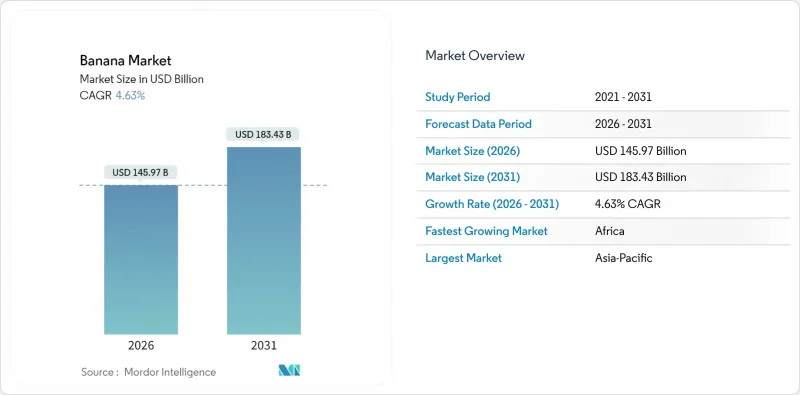
Robust demand in health-focused consumer segments, steady growth in functional snack formats, and widening cold-chain coverage underpin this expansion, giving the banana market resilience against regional income swings. Asia-Pacific remains the largest regional contributor due to strong production bases and rising intra-regional trade, while Africa posts the fastest growth as urban buyers shift toward convenient fresh produce. Large multinationals continue to drive innovation in sustainability and logistics efficiency, and supermarket private-label programs tighten requirements for verifiable social and environmental standards. Disease management costs, volatile freight rates, and stricter pesticide regulations temper growth but do not overturn the long-term bullish outlook for the banana market as a staple food and premium snack item.
Global Banana Market Trends and Insights
Escalating Demand from Health-Conscious Consumers
Premium banana consumption accelerates as fitness-oriented buyers focus on the fruit's potassium, fiber, and natural-sugar attributes. Organic and fair-trade labels command 20-30% price premiums in North America and Europe, enabling growers to recover higher farming costs while funding soil-health projects. Brand collaborations such as Givaudan and Dole's upcycled green banana powder showcase a circular-economy approach that turns culls into ingredients for bakery and beverage lines. Retail data indicate a 15-20% uptick in purchases when bananas appear in wellness merchandising sets alongside sports drinks and protein bars. Higher margins gained from health positioning encourage exporters to upgrade quality protocols, which in turn deepen supplier-retailer partnerships in premium supermarket channels.
Trade Liberalization in Key Importing Nations
Lower tariffs and streamlined customs rules expand market access for emerging exporters. Agreements such as the Economic Partnership pacts between the European Union and Caribbean producers remove most quota barriers, giving small islands wider access to large retail chains. Parallel reforms in selected Asia-Pacific economies open high-value niches for varietals that were previously unviable due to duties. Exporters that couple duty-free access with modern ripening facilities capture early-mover advantages, yet stringent phytosanitary standards still filter out growers who lack compliance certification. Over the long term, smoother trade channels reduce landed costs, stimulate origin diversification, and reinforce the banana market as one of the most globally traded produce segments.
Incidence of Panama Disease TR4
Tropical Race 4 poses an existential biological threat to Cavendish plantations across Asia, Australia, and, more recently, parts of North America. The pathogen remains latent in soil for decades, forcing farms to adopt quarantine trenches, disinfectant footbaths, and crop-rotation schemes. These biosecurity layers elevate unit costs and discourage greenfield expansion in high-risk zones. Breeders are trialing resistant cultivars, yet commercial roll-out remains years away, thereby holding back plantation investment and tempering growth in the banana market.
Other drivers and restraints analyzed in the detailed report include:
- Rapid Expansion of Supermarket Private Labels
- Emerging Cold-Chain Hubs
- Volatile Freight Rates and Container Shortages
For complete list of drivers and restraints, kindly check the Table Of Contents.
Geography Analysis
Asia-Pacific led with 48.20% of the banana market share in 2025, while Africa is forecast to record a 5.63% CAGR through 2031. Asia-Pacific retains primacy in both cultivation scale and local demand, delivering nearly half of global trade crates. While China scaled back imports, urban Indian households lifted fresh-fruit spend, and Indonesian supermarkets expanded controlled-temperature displays, muting the overall regional drag. India's exporter INI Farms signed a direct farm-to-retail deal with LuLu Group to stock outlets across the Gulf, proving that outbound flows can coexist with robust domestic pull. Continuous growth in Vietnam's shipments also reflects the low-land freight and tariff headroom available to regional producers, reinforcing the banana market's strategic shift toward regional sourcing.
Africa's growth narrative centers on untapped consumption and supply potential. Kenyan consumer-oriented food imports topped, underlining the appetite for ready-to-eat fruit. Tanzania plans to more than double horticulture output, backed by road and cold-store projects open to blended finance. Multinational retailers scout sourcing nodes in Uganda and Rwanda, encouraged by new packhouses and wider airline cargo links. These initiatives collectively sharpen Africa's role from subsistence producer to competitive export origin, providing new depth to the banana market.
Europe and North America illustrate maturity and premiumization. Growth relies on higher-value organic, fair-trade, and functional spin-offs, not sheer volume. European Union policy updates on pesticides drive continuous agronomic innovation among South American exporters, who respond with integrated pest management and digital traceability. North American chains pilot carbon-footprint labels, giving suppliers with renewable energy credentials a clear advantage. The Middle East, led by the United Arab Emirates in banana imports, acts as a redistribution hub for North African and Gulf states. South America, despite disease and labor headwinds, leverages cost-efficient land, favorable weather, and established logistics to remain a crucial pillar of the banana market.
- Market Overview
- Market Drivers
- Market Restraints
- Regulatory Landscape
- Technological Outlook
- Value/Supply-Chain Analysis
- PESTEL Analysis
- List of Stakeholders
Additional Benefits:
- The market estimate (ME) sheet in Excel format
- 3 months of analyst support
TABLE OF CONTENTS
1 Introduction
- 1.1 Study Assumptions and Market Definition
- 1.2 Scope of the Study
2 Research Methodology
3 Executive Summary
4 Market Landscape
- 4.1 Market Overview
- 4.2 Market Drivers
- 4.2.1 Escalating demand from health-conscious consumers
- 4.2.2 Trade liberalization in key importing nations
- 4.2.3 Rapid expansion of supermarket private labels
- 4.2.4 Emerging cold-chain hubs
- 4.2.5 Carbon-neutral banana initiatives by multinationals
- 4.2.6 Rise of functional banana-based snacks
- 4.3 Market Restraints
- 4.3.1 Incidence of Panama Disease TR4
- 4.3.2 Volatile freight rates and container shortages
- 4.3.3 Stricter pesticide residue regulations in the Europe
- 4.3.4 Rising labor activism in South American plantations
- 4.4 Regulatory Landscape
- 4.5 Technological Outlook
- 4.6 Value/Supply-Chain Analysis
- 4.7 PESTEL Analysis
5 Market Size and Growth Forecasts (Production Analysis (Volume), Consumption Analysis (Volume and Value), Import Analysis (Volume and Value), Export Analysis (Volume and Value), and Price Trend Analysis)
- 5.1 By Geography
- 5.1.1 North America
- 5.1.1.1 United States
- 5.1.1.2 Canada
- 5.1.2 South America
- 5.1.2.1 Ecuador
- 5.1.2.2 Colombia
- 5.1.2.3 Brazil
- 5.1.3 Europe
- 5.1.3.1 Germany
- 5.1.3.2 Netherlands
- 5.1.3.3 Russia
- 5.1.4 Asia-Pacific
- 5.1.4.1 India
- 5.1.4.2 China
- 5.1.4.3 Indonesia
- 5.1.4.4 Philippines
- 5.1.5 Middle East
- 5.1.5.1 Saudi Arabia
- 5.1.5.2 United Arab Emirates
- 5.1.6 Africa
- 5.1.6.1 Egypt
- 5.1.6.2 Kenya
- 5.1.1 North America
6 Competitive Landscape
- 6.1 List of Stakeholders
- 6.1.1 Dole plc
- 6.1.2 Chiquita Brands International Sarl
- 6.1.3 Fresh Del Monte Produce Inc.
- 6.1.4 Fyffes Ltd. (Sumitomo Corporation)
- 6.1.5 Grupo Noboa S.A.
- 6.1.6 Reybanpac Holding
- 6.1.7 Westfalia Fruit International (HMH Group)
- 6.1.8 Sumifru Philippines Corp. (Sumitomo Fruit Co.)
- 6.1.9 Uniban S.A.
- 6.1.10 Pacific Fruit Company
- 6.1.11 Banacol Group
7 Market Opportunities and Future Outlook

