
PUBLISHER: Mordor Intelligence | PRODUCT CODE: 1939684

PUBLISHER: Mordor Intelligence | PRODUCT CODE: 1939684
Analog Integrated Circuit (IC) - Market Share Analysis, Industry Trends & Statistics, Growth Forecasts (2026 - 2031)
The analog IC market was valued at USD 83.82 billion in 2025 and estimated to grow from USD 86.13 billion in 2026 to reach USD 98.61 billion by 2031, at a CAGR of 2.76% during the forecast period (2026-2031).
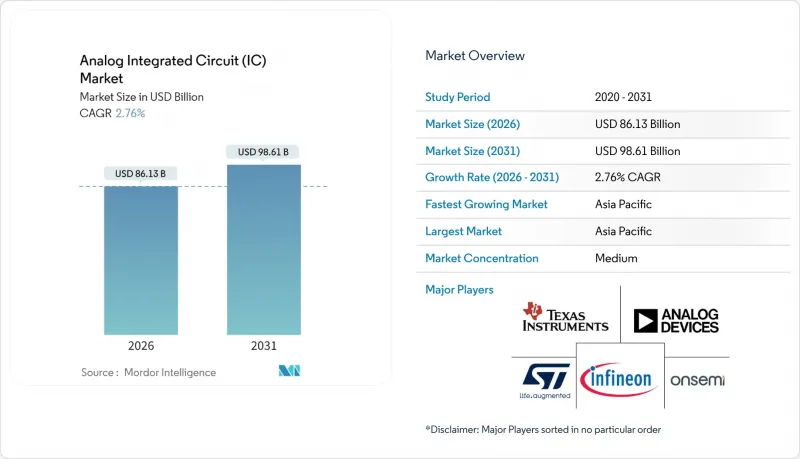
Market growth reflects steady demand for power-efficient signal conditioning, battery management, and RF front-end solutions across automotive electrification, 5G/6G roll-outs, and industrial automation initiatives. Intensifying edge-AI inference pushes premium pricing for high-accuracy power-management and interface devices, while mature technology nodes remain profitable owing to lower design risk and strong yields. Capacity shifts toward 300 mm fabs improve cost structure and enable tighter analog-digital integration, yet skilled mixed-signal talent shortages and cyclical consumer demand continue to temper output expansion. Nevertheless, the analog IC market demonstrates resilience because its precision functions cannot be fully commoditized or digitized.
Global Analog Integrated Circuit (IC) Market Trends and Insights
Accelerating 5G/6G RF Front-End Content Per Handset
Analog content per premium smartphone climbed from USD 18 in 4G devices to USD 25 in 5G models as Doherty GaAs amplifiers now deliver 31 dBm linear power with 34% efficiency, while 40 nm CMOS receivers achieve 39 dB gain at 60 GHz. FinFET-based RF circuits support millimeter-wave beamforming, increasing demand for precision phase-shifter and low-noise amplifier ICs. Massive-MIMO base-station roll-outs require envelope-tracking drivers and high-linearity mixers that remain firmly analog. Component complexity justifies premium average selling prices, sustaining the analog IC market despite handset unit volatility. Supply-chain localization initiatives in Asia-Pacific accelerate regional analog capacity additions.
Rapid EV Power-Train Electrification Boosting High-Voltage Analog Demand
High-voltage battery-management ICs now monitor 14-cell stacks with 16-bit accuracy and daisy-chain up to 31 devices, ensuring functional safety in 800 V packs. Infineon's 1200 V SiC MOSFETs with top-side cooling lower thermal resistance, enabling compact 11 kW onboard chargers that reach 95% efficiency. Transition from 400 V to 800 V architectures drives gate-driver IC innovation and precision current sensing. Auto OEM qualification cycles lock-in multiyear analog content, anchoring long-term revenue streams for suppliers and reinforcing analog IC market stability. Government incentives for zero-emission vehicles in China, Europe, and the United States further magnify demand.
Rising Design Complexity and Verification Cost for Sub-28 nm Analog
FinFET and gate-all-around structures introduce variability that invalidates classical analog layout heuristics; verification cycles now span 36 months and mask sets exceed USD 5 million, limiting entry for small firms. Analog IP migration across nodes demands extensive silicon characterization, raising non-recurring engineering costs. Only high-volume platforms justify such investment, concentrating market power among cash-rich players. EDA limitations delay time-to-market, suppressing analog IC market velocity in advanced nodes.
Other drivers and restraints analyzed in the detailed report include:
- Industrial Automation Ramp-Up (Industry 4.0, IIoT)
- Edge-AI Inference Requiring Precision Power-Management
- Chronic Analog Talent Shortage in Mixed-Signal Layout and Test Engineering
For complete list of drivers and restraints, kindly check the Table Of Contents.
Segment Analysis
Power-management products account for 30.65 of % analog IC market share in 2025 and will grow at a 3.98% CAGR through 2031, propelled by AI data-center vertical-power delivery and 800 V EV drivetrains. Interface ICs remain second in revenue thanks to proliferating connectivity standards. Programmable PMICs with ISO 26262 compliance now embed diagnostic ADCs, watchdog timers, and CAN/LIN transceivers, enabling single-chip power and communication modules. Machine-learning-enabled PMICs optimize energy dynamically, illustrating the convergence of analog control loops with embedded intelligence.
Signal-conversion components, including ADCs and DACs, benefit from ubiquitous sensing in industrial and consumer devices, but unit ASPs face competitive pressure from high-volume microcontroller vendors bundling converter IP. Amplifiers and comparators retain relevance in instrumentation and RF chains where noise, bandwidth, and offset parameters drive design-in decisions. Collectively, diversified applications insulate the analog IC market from segment-specific downturns.
The Analog Integrated Circuits (IC) Market Report is Segmented by Type (General-Purpose IC Including Interface, Power Management, Signal Conversion, Amplifiers/Comparators; Application-Specific IC Including Consumer, Automotive, and More), Technology Node (>65 Nm, and More), Wafer Size (150 Mm, 200 Mm, 300 Mm), and Geography (North America, South America, Europe, and More). The Market Forecasts are Provided in Terms of Value (USD).
Geography Analysis
Asia-Pacific captured 49.88% of the analog IC market share in 2025 and is forecast to expand at a 4.37% CAGR. China's domestic sales rose from USD 500 million in 2016 to USD 1.732 billion in 2023, mirroring state-backed self-sufficiency goals. India's 222 million-unit smart-meter program secures sizable analog content pipelines, while Japan revives analog IC capacity via public-private partnerships. Regional fabs capitalize on subsidies to localize supply chains, enhancing lead-time agility and lowering logistics risks for global OEMs.
North America leverages CHIPS-Act incentives to triple fab capacity by 2032; analog IC producers target defense and automotive customers seeking geographically diversified sources. Europe's regulatory acumen in functional safety and environmental compliance sustains high-value niches, buttressed by the European Chips Act's ambition for a 20% global output share. Emerging markets in Latin America and Africa adopt cost-optimized analog solutions for grid modernization and connectivity upgrades, albeit from a smaller base.
- Texas Instruments Incorporated
- Analog Devices Inc.
- Infineon Technologies AG
- STMicroelectronics N.V.
- ON Semiconductor Corporation
- NXP Semiconductors N.V.
- Renesas Electronics Corporation
- Skyworks Solutions Inc.
- Qorvo Inc.
- Microchip Technology Inc.
- ROHM Co. Ltd.
- Monolithic Power Systems Inc.
- Diodes Incorporated
- Cirrus Logic Inc.
- Allegro MicroSystems Inc.
- Semtech Corporation
- Silicon Laboratories Inc.
- Melexis N.V.
- Richtek Technology Corporation
- Asahi Kasei Microdevices Corporation
- Vicor Corporation
- Power Integrations Inc.
- MaxLinear Inc.
- Nordic Semiconductor ASA
- Dialog Semiconductor (GmbH)
Additional Benefits:
- The market estimate (ME) sheet in Excel format
- 3 months of analyst support
TABLE OF CONTENTS
1 INTRODUCTION
- 1.1 Study Assumptions and Market Definition
- 1.2 Scope of the Study
2 RESEARCH METHODOLOGY
3 EXECUTIVE SUMMARY
4 MARKET LANDSCAPE
- 4.1 Market Overview
- 4.2 Market Drivers
- 4.2.1 Accelerating 5G/6G RF front-end content per handset
- 4.2.2 Rapid EV power-train electrification boosting high-voltage analog demand
- 4.2.3 Industrial automation ramp-up (Industry 4.0, IIoT)
- 4.2.4 Edge-AI inference requiring precision power-management
- 4.2.5 Next-gen satellite constellations requiring radiation-hardened analog
- 4.2.6 Growth of smart-meter retrofit programs in emerging economies
- 4.3 Market Restraints
- 4.3.1 Rising design complexity and verification cost for sub-28 nm analog
- 4.3.2 Cyclical consumer-electronics demand volatility
- 4.3.3 Chronic analog talent shortage in mixed-signal layout and test engineering
- 4.3.4 GaN/SiC module integration displacing discrete analog BOM value
- 4.4 Industry Value Chain Analysis
- 4.5 Regulatory Landscape
- 4.6 Technological Outlook
- 4.7 Porter's Five Forces Analysis
- 4.7.1 Threat of New Entrants
- 4.7.2 Bargaining Power of Consumers
- 4.7.3 Bargaining Power of Suppliers
- 4.7.4 Threat of Substitutes
- 4.7.5 Intensity of Competitive Rivalry
- 4.8 Impact of Macroeconomic Factors on the Market
5 MARKET SIZE AND GROWTH FORECASTS (VALUE)
- 5.1 By Type
- 5.1.1 General-Purpose IC
- 5.1.1.1 Interface
- 5.1.1.2 Power Management
- 5.1.1.3 Signal Conversion
- 5.1.1.4 Amplifiers / Comparators
- 5.1.2 Application-Specific IC
- 5.1.2.1 Consumer
- 5.1.2.1.1 Audio / Video
- 5.1.2.1.2 Digital Cameras and Camcorders
- 5.1.2.1.3 Other Consumer Devices
- 5.1.2.2 Automotive
- 5.1.2.2.1 Infotainment
- 5.1.2.2.2 Advanced Driver-Assistance Systems (ADAS)
- 5.1.2.3 Communication
- 5.1.2.3.1 Cell Phone
- 5.1.2.3.2 Infrastructure
- 5.1.2.3.3 Wired Communication
- 5.1.2.3.4 Short-Range Wireless
- 5.1.2.4 Computer
- 5.1.2.4.1 System and Display
- 5.1.2.4.2 Peripherals
- 5.1.2.4.3 Storage
- 5.1.2.5 Industrial and Others
- 5.1.2.1 Consumer
- 5.1.1 General-Purpose IC
- 5.2 By Technology Node
- 5.2.1 >65 nm
- 5.2.2 40-65 nm
- 5.2.3 28-40 nm
- 5.2.4 <=28 nm
- 5.3 By Wafer Size
- 5.3.1 150 mm
- 5.3.2 200 mm
- 5.3.3 300 mm
- 5.4 By Geography
- 5.4.1 North America
- 5.4.1.1 United States
- 5.4.1.2 Canada
- 5.4.1.3 Mexico
- 5.4.2 South America
- 5.4.2.1 Brazil
- 5.4.2.2 Argentina
- 5.4.2.3 Rest of South America
- 5.4.3 Europe
- 5.4.3.1 Germany
- 5.4.3.2 United Kingdom
- 5.4.3.3 France
- 5.4.3.4 Russia
- 5.4.3.5 Rest of Europe
- 5.4.4 Asia-Pacific
- 5.4.4.1 China
- 5.4.4.2 Japan
- 5.4.4.3 India
- 5.4.4.4 South Korea
- 5.4.4.5 South-East Asia
- 5.4.4.6 Rest of Asia-Pacific
- 5.4.5 Middle East and Africa
- 5.4.5.1 Middle East
- 5.4.5.1.1 Saudi Arabia
- 5.4.5.1.2 United Arab Emirates
- 5.4.5.1.3 Rest of Middle East
- 5.4.5.2 Africa
- 5.4.5.2.1 South Africa
- 5.4.5.2.2 Egypt
- 5.4.5.2.3 Rest of Africa
- 5.4.5.1 Middle East
- 5.4.1 North America
6 COMPETITIVE LANDSCAPE
- 6.1 Market Concentration
- 6.2 Strategic Moves
- 6.3 Market Share Analysis
- 6.4 Company Profiles (includes Global level Overview, Market level Overview, Core Segments, Financials as available, Strategic Information, Market Rank/Share, Products and Services, Recent Developments)
- 6.4.1 Texas Instruments Incorporated
- 6.4.2 Analog Devices Inc.
- 6.4.3 Infineon Technologies AG
- 6.4.4 STMicroelectronics N.V.
- 6.4.5 ON Semiconductor Corporation
- 6.4.6 NXP Semiconductors N.V.
- 6.4.7 Renesas Electronics Corporation
- 6.4.8 Skyworks Solutions Inc.
- 6.4.9 Qorvo Inc.
- 6.4.10 Microchip Technology Inc.
- 6.4.11 ROHM Co. Ltd.
- 6.4.12 Monolithic Power Systems Inc.
- 6.4.13 Diodes Incorporated
- 6.4.14 Cirrus Logic Inc.
- 6.4.15 Allegro MicroSystems Inc.
- 6.4.16 Semtech Corporation
- 6.4.17 Silicon Laboratories Inc.
- 6.4.18 Melexis N.V.
- 6.4.19 Richtek Technology Corporation
- 6.4.20 Asahi Kasei Microdevices Corporation
- 6.4.21 Vicor Corporation
- 6.4.22 Power Integrations Inc.
- 6.4.23 MaxLinear Inc.
- 6.4.24 Nordic Semiconductor ASA
- 6.4.25 Dialog Semiconductor (GmbH)
7 MARKET OPPORTUNITIES AND FUTURE OUTLOOK
- 7.1 White-space and Unmet-Need Assessment

