PUBLISHER: Mordor Intelligence | PRODUCT CODE: 1939739

PUBLISHER: Mordor Intelligence | PRODUCT CODE: 1939739
Set-Top Box - Market Share Analysis, Industry Trends & Statistics, Growth Forecasts (2026 - 2031)
The set-top box market size in 2026 is estimated at USD 202.27 billion, growing from 2025 value of USD 204.72 billion with 2031 projections showing USD 190.44 billion, growing at -1.20% CAGR over 2026-2031.
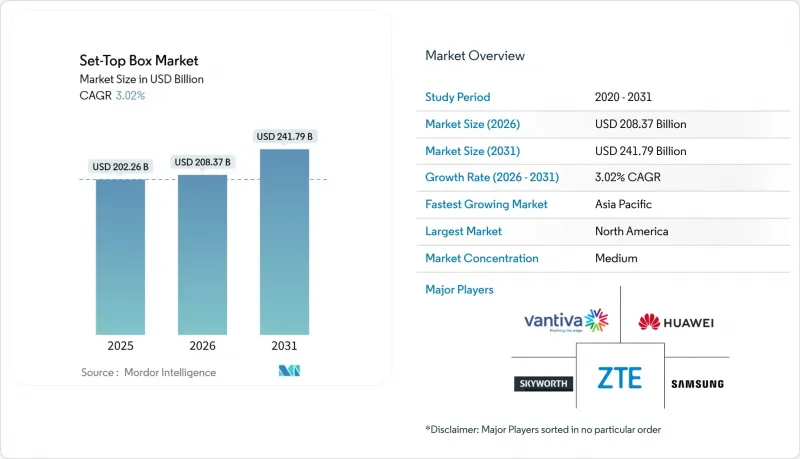
Even with negative growth, operators are transforming traditional reception devices into IP-enabled hubs that unify broadcast and streaming services, cut software licensing fees, and lower energy use. Fiber network rollouts, open-source platforms such as RDK and Android TV, and hybrid IP gateways continue to stimulate replacement demand. UHD sports channels ahead of global tournaments, bundled OTT aggregation in emerging-market DTH, and ESG-driven refresh cycles sustain hardware innovation. Competitive intensity is rising as technology giants bypass operator distribution with direct-to-consumer devices that blend entertainment, smart-home, e-commerce, and advertising functions.
Global Set-Top Box Market Trends and Insights
Fiber-backed migration to IP/hybrid STBs
European cable groups shifting to fibre while retaining HFC for the medium-term need boxes that handle both DOCSIS and full-IP delivery. CommScope's DOCSIS 4.0 trials show unified chipsets that exploit higher upstream bandwidth, spurring operator purchase of hybrid hardware. Sweden's BoxerTV exit from terrestrial broadcast underscores a broader move toward streaming-only distribution that accelerates replacement demand.
Open-source RDK and Android-TV lowering opex
Vantiva has shipped more than 125 million RDK units and 22 million Android TV units, proving that standardized stacks trim licensing costs and simplify certification. Indonesia's Telkomsel deployed 2 million Android TV units, highlighting open-source momentum in price-sensitive markets. Operators now merge RDK security with Android's app catalogue inside hybrid boxes, accelerating time-to-market while keeping UI control.
Cord-cutting in North America and Western Europe
DISH and Sling lost 253,000 pay-TV subscribers in Q4 2024 alone, eroding demand for operator-supplied boxes. The BBC plans an internet-only switchover in the 2030s, signalling that even public broadcasters see a limited future for legacy distribution.
Other drivers and restraints analyzed in the detailed report include:
- 4K/HDR sports channels before mega-events
- Digitisation stimulus in Africa and SE-Asia
- Grey-market IPTV piracy devices
For complete list of drivers and restraints, kindly check the Table Of Contents.
Segment Analysis
Satellite held a 37.42% share in 2025, anchoring the set-top box market despite cord-cutting. IPTV, supported by fiber rollouts, will grow at a 0.83% CAGR as operators bundle broadband, voice, and video. Cable's move to all-IP QAM replacement is underway, while hybrid DTT-OTT models such as Brazil's TV 3.0 combine broadcast reach with interactive streaming. The set-top box market size for satellite remains large, yet the long-term trajectory tilts toward IP gateways.
Operators want boxes that decode DVB-S2 today and HLS or DASH tomorrow, pressuring vendors to add multi-protocol chipsets. Astound's conversion from QAM to IPTV in the United States shows how legacy cable infrastructure is being repurposed for managed IP. Free-to-air satellite households in Brazil are projected to reach 9 million by 2025, underscoring dual demand for both pay and free platforms.
HD represents half of 2025 shipments due to mature production chains and lower bandwidth needs. UHD/4K will lead growth at 1.03% CAGR as AI-assisted upscaling enables operators to market premium experiences without full native content libraries. ZTE's 4K AI-SR box lowers power use by 50% and boosts speed by 29%, proving efficiency gains alongside resolution upgrades. The set-top box market share for UHD remains modest today but rises steadily as sports rights holders mandate 4K distribution.
AI super-resolution devices from SEI Robotics bridge the gap between scarce native 4K feeds and consumer appetite for sharper imagery, reducing operator bandwidth while sustaining quality. Native 4K live sports streaming is still limited by production costs, but hybrid upscaling solutions keep momentum intact.
The Set-Top Box Market Report is Segmented by Technology (Satellite/DTH, Cable, IPTV, DTT/Hybrid), Resolution (SD, HD, UHD/4K and Higher), End-User (Residential, Commercial/Hospitality, Government and Education, Transportation), Operating System (Android-TV, RDK, Proprietary Linux, Other Open-Source), and Geography. The Market Forecasts are Provided in Terms of Value (USD).
Geography Analysis
North America contributed 29.65% revenue in 2025, anchored by high ARPU and widespread broadband. Energy-efficiency rules have cut average box power by 68% since 2012, prompting vendors to adopt advanced silicon nodes. Continuous cord-cutting forces operators to shift toward IP-only gateways paired with Wi-Fi mesh for whole-home coverage.
Asia-Pacific is the fastest-growing region at 0.58% CAGR, propelled by fiber buildouts in India, China, and Indonesia. ZTE and Telkomsel's 2 million-unit Android TV deployment showcases how telcos bundle broadband with OTT aggregators in price-sensitive markets. Japan and South Korea champion 4K/HDR, creating premium niches for high-spec boxes.
Europe shows a bifurcated trend: Western markets decline with streaming adoption, while Eastern markets still digitize terrestrial and cable networks. EU e-waste directives raise recycling costs yet also open demand for modular, repairable hardware. The Middle East invests in UHD satellite platforms linked to national Vision programs. Africa expects 12 million additional pay-TV homes by 2029, often financed through state vouchers that include low-cost DVB-T2 or satellite kits. South America's focus on Brazil's TV 3.0 keeps hybrid boxes on vendor roadmaps as ATSC 3.0 launches.
- Vantiva SA
- Samsung Electronics Co., Ltd.
- Huawei Technologies Co., Ltd.
- Skyworth Digital Technology Co., Ltd.
- Humax Holdings Co., Ltd.
- ZTE Corporation
- Sagemcom SAS
- Kaonmedia Co., Ltd.
- CommScope Holding Company, Inc.
- Shenzhen SDMC Technology Co., Ltd.
- Shenzhen Coship Electronics Co., Ltd.
- Evolution Digital LLC
- Technicolor Connected Home USA LLC
- Dish TV India Ltd.
- Tata Play Ltd.
- ARRIS International plc (re-branded)
- Apple Inc. (Apple TV 4K)
- Roku Inc.
- Amazon .com, Inc. (Fire TV Cube)
- DISH Network L.L.C. (Hopper)
Additional Benefits:
- The market estimate (ME) sheet in Excel format
- 3 months of analyst support
TABLE OF CONTENTS
1 INTRODUCTION
- 1.1 Study Assumptions and Market Definition
- 1.2 Scope of the Study
2 RESEARCH METHODOLOGY
3 EXECUTIVE SUMMARY
4 MARKET LANDSCAPE
- 4.1 Market Overview
- 4.2 Market Drivers
- 4.2.1 Fibre-backed migration to IP/hybrid STBs
- 4.2.2 Open-source RDK and Android-TV lowering opex
- 4.2.3 4K / HDR sports channels before mega-events
- 4.2.4 Bundled OTT aggregation in emerging-market DTH
- 4.2.5 Digitisation stimulus in Africa and SE-Asia
- 4.2.6 ESG-driven low-power CPE refresh cycles
- 4.3 Market Restraints
- 4.3.1 Cord-cutting in N. America and W. Europe
- 4.3.2 Grey-market IPTV piracy devices
- 4.3.3 Semiconductor cost inflation
- 4.3.4 Strict e-waste take-back mandates
- 4.4 Industry Value-Chain Analysis
- 4.5 Regulatory Landscape
- 4.6 Technological Outlook
- 4.7 Porter's Five Forces Analysis
- 4.7.1 Bargaining Power of Suppliers
- 4.7.2 Bargaining Power of Buyers
- 4.7.3 Threat of New Entrants
- 4.7.4 Threat of Substitutes
- 4.7.5 Intensity of Competitive Rivalry
- 4.8 Industry Stakeholder Analysis
- 4.9 Assessment of Macroeconomic Trends
- 4.10 Investment and Funding Landscape
5 MARKET SIZE AND GROWTH FORECASTS (VALUE)
- 5.1 By Technology
- 5.1.1 Satellite / DTH
- 5.1.2 Cable
- 5.1.3 IPTV
- 5.1.4 DTT / Hybrid
- 5.2 By Resolution
- 5.2.1 SD
- 5.2.2 HD
- 5.2.3 UHD / 4K and Higher
- 5.3 By End-User
- 5.3.1 Residential
- 5.3.2 Commercial / Hospitality
- 5.3.3 Government and Education
- 5.3.4 Transportation (Airline, Maritime)
- 5.4 By Operating System
- 5.4.1 Android-TV
- 5.4.2 RDK
- 5.4.3 Proprietary Linux
- 5.4.4 Other Open-Source
- 5.5 By Geography
- 5.5.1 North America
- 5.5.1.1 United States
- 5.5.1.2 Canada
- 5.5.1.3 Mexico
- 5.5.2 Europe
- 5.5.2.1 United Kingdom
- 5.5.2.2 Germany
- 5.5.2.3 France
- 5.5.2.4 Italy
- 5.5.2.5 Rest of Europe
- 5.5.3 Asia-Pacific
- 5.5.3.1 China
- 5.5.3.2 Japan
- 5.5.3.3 India
- 5.5.3.4 South Korea
- 5.5.3.5 Rest of Asia
- 5.5.4 Middle East
- 5.5.4.1 Israel
- 5.5.4.2 Saudi Arabia
- 5.5.4.3 United Arab Emirates
- 5.5.4.4 Turkey
- 5.5.4.5 Rest of Middle East
- 5.5.5 Africa
- 5.5.5.1 South Africa
- 5.5.5.2 Egypt
- 5.5.5.3 Rest of Africa
- 5.5.6 South America
- 5.5.6.1 Brazil
- 5.5.6.2 Argentina
- 5.5.6.3 Rest of South America
- 5.5.1 North America
6 COMPETITIVE LANDSCAPE
- 6.1 Market Concentration
- 6.2 Strategic Moves
- 6.3 Market Share Analysis
- 6.4 Company Profiles {(includes Global level Overview, Market level overview, Core Segments, Financials as available, Strategic Information, Market Rank/Share for key companies, Products and Services, and Recent Developments)}
- 6.4.1 Vantiva SA
- 6.4.2 Samsung Electronics Co., Ltd.
- 6.4.3 Huawei Technologies Co., Ltd.
- 6.4.4 Skyworth Digital Technology Co., Ltd.
- 6.4.5 Humax Holdings Co., Ltd.
- 6.4.6 ZTE Corporation
- 6.4.7 Sagemcom SAS
- 6.4.8 Kaonmedia Co., Ltd.
- 6.4.9 CommScope Holding Company, Inc.
- 6.4.10 Shenzhen SDMC Technology Co., Ltd.
- 6.4.11 Shenzhen Coship Electronics Co., Ltd.
- 6.4.12 Evolution Digital LLC
- 6.4.13 Technicolor Connected Home USA LLC
- 6.4.14 Dish TV India Ltd.
- 6.4.15 Tata Play Ltd.
- 6.4.16 ARRIS International plc (re-branded)
- 6.4.17 Apple Inc. (Apple TV 4K)
- 6.4.18 Roku Inc.
- 6.4.19 Amazon .com, Inc. (Fire TV Cube)
- 6.4.20 DISH Network L.L.C. (Hopper)
7 MARKET OPPORTUNITIES AND FUTURE OUTLOOK
- 7.1 White-space and Unmet-need Assessment

