PUBLISHER: Mordor Intelligence | PRODUCT CODE: 1940552

PUBLISHER: Mordor Intelligence | PRODUCT CODE: 1940552
Sterilization Services - Market Share Analysis, Industry Trends & Statistics, Growth Forecasts (2026 - 2031)
The sterilization services market is expected to grow from USD 5.45 billion in 2025 to USD 5.74 billion in 2026 and is forecast to reach USD 7.42 billion by 2031 at 5.29% CAGR over 2026-2031.
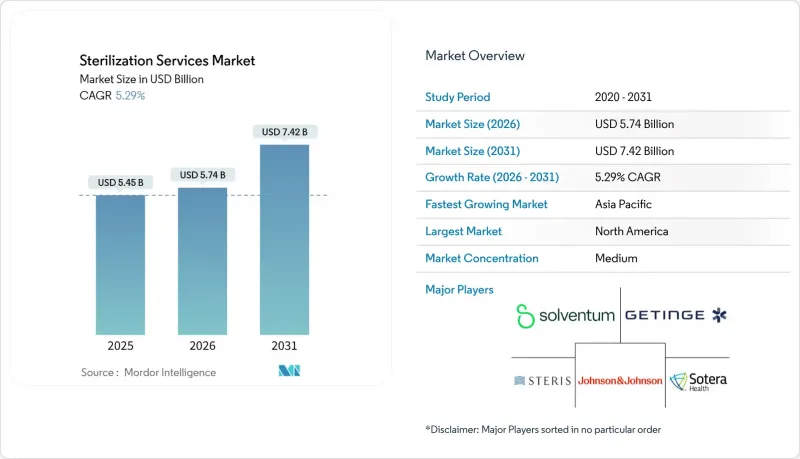
Consistent adoption of stringent infection-control protocols, regulatory convergence toward ISO 13485, and rapid uptake of outsourced processing underpin steady expansion. Accelerating transition away from high-emission ethylene oxide (EtO) toward X-ray, electron-beam, and hydrogen-peroxide technologies adds both capital pressure and innovation headroom. Demand also rises as single-use bioprocess components and minimally invasive devices flood global supply chains. Market leaders leverage acquisitions to broaden geographic reach and validation expertise, while emerging specialists focus on niche materials and digitalized monitoring. Collectively, these forces sustain pricing power even as competitive intensity grows.
Global Sterilization Services Market Trends and Insights
Escalating Global Incidence of Hospital-Acquired Infections Driving Sterilization Demand
Healthcare facilities worldwide are intensifying decontamination protocols to curb infections that prolong hospital stays and inflate costs. Guidance from the Centers for Disease Control and Prevention positions thorough environmental cleaning as a frontline defense, pushing providers to adopt validated, high-capacity sterilization services. Low-resource regions, which report infection rates several times higher than advanced economies, increasingly outsource processing to achieve reliable sterility assurance without heavy capital spending. Insurance payers reinforce the shift by linking reimbursement to infection metrics. Contract processors benefit as device manufacturers bundle sterile packaging with production runs to streamline regulatory submissions. Collectively, these behaviors lift annual procedure volumes flowing into the sterilization services market.
Expansion of Medical Device & Pharmaceutical Manufacturing Footprint Worldwide
Relocation of device assembly lines and biologics fill-finish plants toward Asia-Pacific fuels regional demand for validated sterilization capacity. Global suppliers establish multi-modal hubs so that supply chains stay resilient amid logistics disruption. Injectable biologics, which require the highest sterility assurance level, now represent a growing slice of outsourced cycles. Specialized processors with class-leading dose mapping and microbial challenge expertise capture premium pricing. Governments courting foreign investment offer incentives for greenfield irradiation facilities, accelerating local availability and reinforcing compliance with ISO 11137.
High Capital & Operating Costs of Establishing Compliant Sterilization Facilities
Irradiators, vacuum-draw EtO chambers, and vaporized hydrogen-peroxide isolators each demand multimillion-dollar outlays, specialized ventilation, and redundant monitoring. Annual upkeep includes biological indicators, filter validation, and regulatory audits. Smaller regional hospitals defer investment and instead pursue multiyear outsourcing contracts. Financial barriers also restrict new competitors, leading to industry consolidation that can strain capacity in underserved territories.
Other drivers and restraints analyzed in the detailed report include:
- Tightening & Harmonization of International Sterilization Standards (ISO, FDA, EMA)
- Growing Preference for Outsourced Sterilization to Manage Compliance & Cost Pressures
- Stringent Environmental & Occupational Regulations on EtO and Radio-isotope Use
For complete list of drivers and restraints, kindly check the Table Of Contents.
Segment Analysis
Ethylene oxide retained a dominant 49.30% slice of the sterilization services market size in 2025, reflecting unmatched compatibility with heat-sensitive, lumen-rich devices. Yet, cumulative regulatory pressure and public health concerns accelerate diversification. X-ray cycles, already validated for a widening catalog, are forecast to record a 12.15% CAGR through 2031, the fastest within the segment. Dose-uniformity studies show its efficacy equals gamma irradiation while avoiding cobalt-60 logistics. Gamma retains entrenched infrastructure and reliable deep-penetration performance, although isotope supply constraints spur contingency planning. Electron-beam offers rapid throughput but faces limitations with dense pallets. Hydrogen-peroxide plasma and vapor-phase systems capture temperature-sensitive items like electronic endoscopes, building a loyal customer base in high-value surgical kits. As material science evolves, method selection increasingly hinges on polymer behavior under oxidative stress, pushing processors to offer multi-modal capabilities.
The sterilization services market continues reallocating capex toward radiation vaults equipped for dual-energy switching, enabling seamless migration from isotope to machine sources. Providers collaborate with device engineers to embed dose mapping at the design stage, reducing post-production inconsistencies. Regulatory acceptance of vaporized hydrogen-peroxide as an Established Category A method simplifies 510(k) submissions, further fragmenting modal shares. Consequently, method diversification reshapes revenue streams and safeguards supply continuity.
Off-site service centers captured 67.05% of the sterilization services market in 2025, leveraging scale to amortize capital outlays and environmental controls. Centralized hubs process mixed loads 24/7, offering validated truck routes and digital chain-of-custody reporting. Hospitals pressured by staffing shortages and surgical-instrument backlogs increasingly divert trays to regional off-site re-processing centers, citing improved compliance and predictable turnaround. Conversely, on-site service models, projected to advance at an 10.98% CAGR, appeal to high-volume pharma campuses where real-time release trims inventory days. Hybrid models emerge, blending mobile EtO pods for overflow with routine off-site irradiation, permitting clients to fine-tune cost versus cycle time.
Evolving geopolitical risks underscore redundancy. Multinational manufacturers allocate dual validation across geographically separated providers to ensure pandemic or natural-disaster resilience. In response, contract processors develop mirrored digital documentation systems, enabling instant transfer of cycle data between facilities and clients' quality portals.
The Sterilization Services Market Report is Segmented by Method (Ethylene Oxide (ETO) Sterilization, Gamma Irradiation, and More), Mode of Delivery (Off-Site Sterilization, and More), Service Type (Contract Sterilization Services, and More), End User (Medical Device Manufacturers, Hospitals and Clinics, and More), and Geography (North America, Europe, and More). The Market Forecasts are Provided in Terms of Value (USD).
Geography Analysis
North America led the sterilization services market with a 39.10% share in 2025, underpinned by robust reimbursement models, dense medical-device clusters, and proactive environmental oversight. The Environmental Protection Agency's 2025 final rule demanding 99.99% EtO capture forces providers to retrofit abatement technology and accelerates migration toward machine-source radiation. Investment in alternative modalities safeguards supply continuity and sustains regional leadership despite higher compliance costs.
Asia-Pacific represents the fastest-growing arena at an 10.82% CAGR through 2031. Expanding device contract-manufacturing organizations in China, India, and Malaysia require proximity sterilization capacity that satisfies U.S. and EU audits. STERIS's 2025 commissioning of an X-ray facility in Suzhou exemplifies market-entry strategies oriented toward multi-energy resilience. Governments encourage domestic irradiation to minimize export bottlenecks, and local regulators are aligning with ISO 11137 and ISO 13408, streamlining cross-border trade.
Europe maintains roughly 30.20% share in 2025, characterized by the Medical Device Regulation's stringent device and packaging validation clauses. Providers diversify into super-critical carbon-dioxide and vaporized hydrogen-peroxide cycles to meet sustainability objectives. SGS's expanded MDR sterilization certification scope highlights competitive advantage through process breadth. Sustainability metrics embedded in corporate tenders now influence vendor selection, prompting investment in energy-efficient accelerators and heat-recovery ventilation.
- STERIS
- Sotera Health (Sterigenics, Nordion, Nelson Labs)
- Getinge
- Solventum Corporation
- Johnson & Johnson
- BGS Beta-Gamma-Service GmbH
- E-BEAM Services Inc.
- Medistri
- Noxilizer Inc.
- Stryker
- Prince Sterilization Services LLC
- Advanced Sterilization Products (ASP)
- GERMITECH Srl
- Cosmed Group
- MMM Group
- Belimed
Additional Benefits:
- The market estimate (ME) sheet in Excel format
- 3 months of analyst support
TABLE OF CONTENTS
1 Introduction
- 1.1 Study Assumptions & Market Definition
- 1.2 Scope of the Study
2 Research Methodology
3 Executive Summary
4 Market Landscape
- 4.1 Market Overview
- 4.2 Market Drivers
- 4.2.1 Escalating Global Incidence of Hospital-Acquired Infections Driving Sterilization Demand
- 4.2.2 Expansion of Medical Device & Pharmaceutical Manufacturing Footprint Worldwide
- 4.2.3 Tightening & Harmonization of International Sterilization Standards (ISO, FDA, EMA)
- 4.2.4 Growing Preference for Outsourced Sterilization to Manage Compliance & Cost Pressures
- 4.2.5 Rising Adoption of Single-Use & Minimally Invasive Devices Increasing Sterilization Volumes
- 4.3 Market Restraints
- 4.3.1 High Capital & Operating Costs of Establishing Compliant Sterilization Facilities
- 4.3.2 Stringent Environmental & Occupational Regulations on EtO and Radio-isotope Use
- 4.3.3 Global Shortage of Certified Sterility Assurance & Validation Professionals
- 4.4 Technological Outlook
- 4.5 Porter's Five Forces
- 4.5.1 Threat of New Entrants
- 4.5.2 Bargaining Power of Buyers
- 4.5.3 Bargaining Power of Suppliers
- 4.5.4 Threat of Substitutes
- 4.5.5 Intensity of Competitive Rivalry
5 Market Size & Growth Forecasts (Value, USD)
- 5.1 By Method
- 5.1.1 Ethylene Oxide (EtO) Sterilization
- 5.1.2 Gamma Irradiation
- 5.1.3 Electron-Beam (E-beam) Radiation
- 5.1.4 X-ray Radiation
- 5.1.5 Steam (Moist-Heat) Sterilization
- 5.1.6 Dry-Heat Sterilization
- 5.1.7 Hydrogen Peroxide & Plasma Sterilization
- 5.2 By Mode of Delivery
- 5.2.1 Off-site (Service-Center) Sterilization
- 5.2.2 On-site (In-house as a Service) Sterilization
- 5.3 By Service Type
- 5.3.1 Contract Sterilization Services
- 5.3.2 Sterilization Validation & Testing Services
- 5.3.3 Process Advisory & Optimization Services
- 5.4 By End-user
- 5.4.1 Medical Device Manufacturers
- 5.4.2 Pharmaceutical & Biotech Manufacturers
- 5.4.3 Hospitals & Clinics
- 5.4.4 Food & Beverage Industry
- 5.4.5 Laboratory & Research Organizations
- 5.4.6 Other Industrial Users
- 5.5 Geography
- 5.5.1 North America
- 5.5.1.1 United States
- 5.5.1.2 Canada
- 5.5.1.3 Mexico
- 5.5.2 Europe
- 5.5.2.1 Germany
- 5.5.2.2 United Kingdom
- 5.5.2.3 France
- 5.5.2.4 Italy
- 5.5.2.5 Spain
- 5.5.2.6 Rest of Europe
- 5.5.3 Asia-Pacific
- 5.5.3.1 China
- 5.5.3.2 Japan
- 5.5.3.3 India
- 5.5.3.4 South Korea
- 5.5.3.5 Australia
- 5.5.3.6 Rest of Asia-Pacific
- 5.5.4 Middle East and Africa
- 5.5.4.1 GCC
- 5.5.4.2 South Africa
- 5.5.4.3 Rest of Middle East and Africa
- 5.5.5 South America
- 5.5.5.1 Brazil
- 5.5.5.2 Argentina
- 5.5.5.3 Rest of South America
- 5.5.1 North America
6 Competitive Landscape
- 6.1 Market Concentration
- 6.2 Market Share Analysis
- 6.3 Company Profiles (includes Global level Overview, Market level overview, Core Business Segments, Financials, Headcount, Key Information, Market Rank, Market Share, Products and Services, and analysis of Recent Developments)
- 6.3.1 STERIS PLC
- 6.3.2 Sotera Health (Sterigenics, Nordion, Nelson Labs)
- 6.3.3 Getinge AB
- 6.3.4 Solventum Corporation
- 6.3.5 Johnson & Johnson (Ethicon)
- 6.3.6 BGS Beta-Gamma-Service GmbH
- 6.3.7 E-BEAM Services Inc.
- 6.3.8 Medistri SA
- 6.3.9 Noxilizer Inc.
- 6.3.10 Stryker Corporation
- 6.3.11 Prince Sterilization Services LLC
- 6.3.12 Advanced Sterilization Products (ASP)
- 6.3.13 GERMITECH Srl
- 6.3.14 Cosmed Group
- 6.3.15 MMM Group
- 6.3.16 Belimed AG
7 Market Opportunities & Future Outlook
- 7.1 White-space & Unmet-need Assessment

