
PUBLISHER: Mordor Intelligence | PRODUCT CODE: 1940554

PUBLISHER: Mordor Intelligence | PRODUCT CODE: 1940554
Application Container - Market Share Analysis, Industry Trends & Statistics, Growth Forecasts (2026 - 2031)
The application container market is expected to grow from USD 10.27 billion in 2025 to USD 12.64 billion in 2026 and is forecast to reach USD 35.62 billion by 2031 at 23.05% CAGR over 2026-2031.
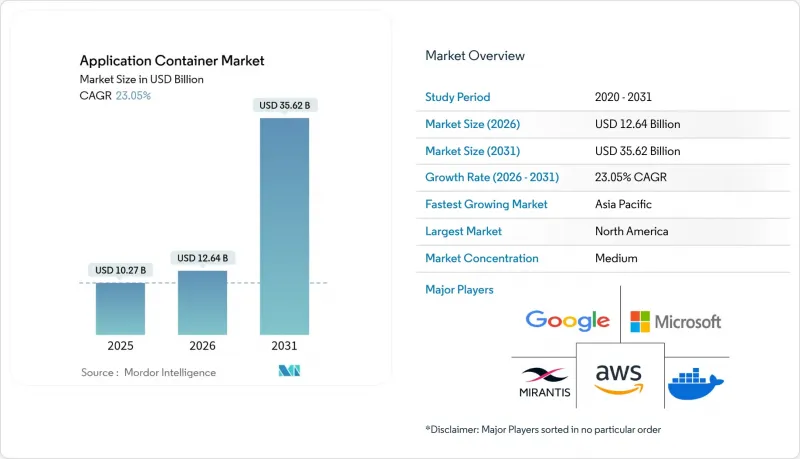
Strong enterprise migration toward micro-services, the proliferation of DevOps pipelines and the growing preference for hybrid, multi-cloud architectures are sustaining this momentum. Platform solutions accounted for 57.1% revenue in 2024, reflecting the central role of Kubernetes-based orchestration, yet services are expanding faster at an 18.20% CAGR as organizations seek implementation, migration, and managed expertise . Public-cloud deployments led with 64.3% share, but hybrid and multi-cloud setups are the fastest risers at 24.50% CAGR, driven by workload portability and compliance demands. Large enterprises retained a 68.2% share, although small and medium enterprises are scaling adoption at a 21.30% CAGR as managed container offerings lower entry barriers. Industry uptake remains highest in IT and telecom (35.8% share), while healthcare shows the strongest vertical upside at 19.70% CAGR, propelled by digital health mandates and stringent data-privacy regulations.
Global Application Container Market Trends and Insights
Accelerating Adoption of Micro-services Architecture
Container penetration reached 88% among surveyed technology leaders in 2025, with micro-services framed as the principal catalyst . Deutsche Bank's centralized platform runs more than 3,100 active projects and cut release cycles from six months to three weeks once workloads were containerized. Decoupling monoliths into independently deployable services enables elastic scaling and streamlined incident isolation, illustrated by financial institutions such as Bank Mandiri, whose digital banking backbone now processes 12,000 requests per second while sustaining 99.95% uptime. The architectural shift has also unlocked continuous delivery patterns that align development sprints with business imperatives. As a result, enterprises view micro-services not merely as a development paradigm but as a strategic lever for time-to-market acceleration.
Demand for Hybrid and Multi-Cloud Agility
Seventy-six percent of organizations operated two or more public clouds in 2024, citing vendor lock-in avoidance and regulatory flexibility as top rationales. Banco Galicia consolidated disparate workloads across on-premises and multiple public clouds, realizing a 40% downtime reduction after adopting a unified Kubernetes control plane. Service-mesh overlays now route east-west traffic securely among clusters residing in different regions, providing uniform policy enforcement regardless of underlying provider. Infrastructure-as-Code practices further standardize provisioning, allowing enterprises to shift workloads in response to price, latency or governance triggers without refactoring code. The resulting operational agility propels the application container market as organizations future-proof application estates against evolving compliance and performance constraints.
Container Security Vulnerabilities and Misconfigurations
Containers harbor more than 600 disclosed vulnerabilities on average, and 97% of surveyed teams voice concerns about Kubernetes security posture. Misconfigurations top the risk list, prompting Gartner to forecast that 99% of cloud breaches will stem from customer error rather than provider flaws by 2026. A recent NVIDIA Container Toolkit flaw (CVE-2024-0132, CVSS 9.0) illustrated potential host-escape vectors that threaten multi-tenant clusters. Enterprises respond by integrating image scanning, runtime monitoring, and zero-trust network policies, yet skills gaps and tool sprawl complicate remediation. Until organizations harden pipelines end-to-end, security fears will temper the CAGR of the application container market.
Other drivers and restraints analyzed in the detailed report include:
- Surge in DevOps and CI/CD Pipelines
- Need for Resource Optimization and Cost Efficiency
- Complexity of Large-Scale Orchestration
For complete list of drivers and restraints, kindly check the Table Of Contents.
Segment Analysis
Platform software constituted 56.45% of 2025 revenue as enterprises standardized on Kubernetes distributions such as OpenShift and Tanzu, yet services exhibited an 17.55% CAGR that outpaced every other component. The application container market size for services is projected to swell as firms confront skills shortages and regulatory audits. Consulting and managed engagements accelerate greenfield rollouts while de-risking migrations of legacy workloads into micro-services. The rising complexity of multi-cloud estates further cements long-term demand for integration partners and 24x7 support desks.
Vendor roadmaps now bundle training and FinOps guidance alongside pure technology deliverables. Deutsche Bank's partnership with Red Hat exemplifies the model: the bank leaned on vendor architects to cut release cycles by two-thirds, proving that knowledge transfer can be as valuable as software licenses. The virtuous loop of tooling plus expertise positions services as the most vibrant profit pool within the application container market over the forecast horizon.
Public cloud captured 63.55% of revenue in 2025, a figure buoyed by the maturity of managed Kubernetes offerings like Amazon EKS, Google GKE, and Azure AKS. However, hybrid and multi-cloud footprints are scaling at a 24.05% CAGR-double the broader application container market-because companies now distribute workloads to optimize latency, sovereignty, and uptime. The application container market share for public cloud may narrow modestly as regulated industries shift critical databases to private regions while keeping stateless micro-services at hyperscale.
Edge gateways, 5G core functions, and AI inference clusters intensify the need for uniform governance spanning bare metal, virtualized stacks, and public IaaS. Banco Galicia's 40% downtime reduction after adopting a multi-cloud mesh demonstrates the operational upside of unified policy engines. Over the next five years, workload placement decisions will hinge less on raw compute pricing and more on data jurisdiction and sustainability constraints, reinforcing hybrid design patterns across the application container market.
Application Container Market Report is Segmented by Component (Platform and Services), Deployment Model (Public Cloud, Private Cloud and Hybrid and Multi-Cloud), Organization Size (Large Enterprises, and SMEs), Industry Vertical (IT and Telecom, BFSI, and More), Container Use-Case Area (Management and Orchestration, Monitoring, Devops Tool-Chain, and More), and Geography. The Market Forecasts are Provided in Terms of Value (USD).
Geography Analysis
North America produced 43.65% of 2025 revenue, a testament to entrenched DevOps cultures, abundant venture capital and the dominance of U.S. hyperscalers. Docker's recent USD 40 million Series C, steered by Sequoia Capital, typifies continued investor confidence. Federal modernization programs and fintech deregulation further spur adoption. Canada's healthcare digitization push and Mexico's e-commerce boom extend North America's container footprint beyond its largest economy.
Asia-Pacific records the steepest growth profile at 22.35% CAGR. Government smart-city grants, surging mobile-commerce volumes, and 5G rollouts stimulate containerized edge infrastructure in China, India, Japan, and South Korea. Singapore's Infocomm Media Development Authority allocates cloud credits that lower onboarding costs for start-ups, while Australian state agencies pilot Kubernetes-based digital-identity platforms. Collectively these efforts grow the application container market size across APAC faster than any other region.
Europe maintains steady progress underpinned by GDPR, which turns data sovereignty from an obstacle to an enabler for hybrid adoption. Germany's Industrie 4.0 factories, France's public-cloud sovereignty initiative, and the United Kingdom's open-banking benchmarks reinforce demand for policy-aware container stacks. Multi-vendor alliances in Spain and the Netherlands show how mid-tier economies can leapfrog legacy infrastructure by standardizing on cloud-native blueprints. The Middle East and Africa trail but accelerate as energy conglomerates in Saudi Arabia deploy containers for predictive maintenance and South African banks digitize retail channels.
- Red Hat, Inc.
- Mirantis, Inc.
- VMware, Inc.
- SUSE SE
- Canonical Ltd.
- Docker, Inc.
- Amazon Web Services, Inc.
- Google LLC
- Microsoft Corporation
- Oracle Corporation
- IBM Corporation
- Rancher Labs, Inc.
- Alibaba Cloud Computing Co., Ltd.
- Hewlett Packard Enterprise Company
- Cisco Systems, Inc.
- Palo Alto Networks, Inc.
- Portainer Ltd.
- Heroku LLC (Salesforce, Inc.)
- NetApp, Inc.
- HashiCorp, Inc.
Additional Benefits:
- The market estimate (ME) sheet in Excel format
- 3 months of analyst support
TABLE OF CONTENTS
1 INTRODUCTION
- 1.1 Study Assumptions and Market Definition
- 1.2 Scope of the Study
2 RESEARCH METHODOLOGY
3 EXECUTIVE SUMMARY
4 MARKET INSIGHTS
- 4.1 Market Overview
- 4.2 Market Drivers
- 4.2.1 Accelerating adoption of micro-services architecture
- 4.2.2 Demand for hybrid and multi-cloud agility
- 4.2.3 Surge in DevOps and CI/CD pipelines
- 4.2.4 Need for resource optimisation and cost efficiency
- 4.2.5 Edge-native AI workloads needing lightweight runtimes
- 4.2.6 Arm-based servers boosting container performance
- 4.3 Market Restraints
- 4.3.1 Container security vulnerabilities and misconfigurations
- 4.3.2 Complexity of large-scale orchestration
- 4.3.3 Open-source licence-compliance uncertainty
- 4.3.4 Data-sovereignty limits on multi-region deployment
- 4.4 Value Chain Analysis
- 4.5 Regulatory Landscape
- 4.6 Technological Outlook
- 4.7 Porter's Five Forces Analysis
- 4.7.1 Bargaining Power of Suppliers
- 4.7.2 Bargaining Power of Buyers
- 4.7.3 Threat of New Entrants
- 4.7.4 Threat of Substitutes
- 4.7.5 Competitive Rivalry
- 4.8 Industry Ecosystem Analysis
- 4.9 Key Use Cases and Case Studies
- 4.10 Assessment of Macroeconomic Trends
- 4.11 Investment Analysis
5 MARKET SIZE AND GROWTH FORECASTS (VALUE)
- 5.1 By Component
- 5.1.1 Platform
- 5.1.2 Services
- 5.2 By Deployment Model
- 5.2.1 Public Cloud
- 5.2.2 Private Cloud
- 5.2.3 Hybrid and Multi-Cloud
- 5.3 By Organization Size
- 5.3.1 Large Enterprises
- 5.3.2 Small and Medium Enterprises (SMEs)
- 5.4 By Industry Vertical
- 5.4.1 IT and Telecom
- 5.4.2 BFSI
- 5.4.3 Healthcare
- 5.4.4 Retail and e-Commerce
- 5.4.5 Manufacturing
- 5.4.6 Government and Public Sector
- 5.5 By Container Use-Case Area
- 5.5.1 Management and Orchestration
- 5.5.2 Monitoring
- 5.5.3 DevOps Tool-chain
- 5.5.4 Security
- 5.5.5 Networking
- 5.5.6 Storage
- 5.6 By Geography
- 5.6.1 North America
- 5.6.1.1 United States
- 5.6.1.2 Canada
- 5.6.1.3 Mexico
- 5.6.2 South America
- 5.6.2.1 Brazil
- 5.6.2.2 Argentina
- 5.6.2.3 Colombia
- 5.6.2.4 Rest of South America
- 5.6.3 Europe
- 5.6.3.1 Germany
- 5.6.3.2 United Kingdom
- 5.6.3.3 France
- 5.6.3.4 Italy
- 5.6.3.5 Spain
- 5.6.3.6 Russia
- 5.6.3.7 Netherlands
- 5.6.3.8 Rest of Europe
- 5.6.4 Asia-Pacific
- 5.6.4.1 China
- 5.6.4.2 Japan
- 5.6.4.3 South Korea
- 5.6.4.4 India
- 5.6.4.5 Australia
- 5.6.4.6 Singapore
- 5.6.4.7 Rest of Asia-Pacific
- 5.6.5 Middle East and Africa
- 5.6.5.1 Middle East
- 5.6.5.1.1 Saudi Arabia
- 5.6.5.1.2 United Arab Emirates
- 5.6.5.1.3 Rest of Middle East
- 5.6.5.2 Africa
- 5.6.5.2.1 South Africa
- 5.6.5.2.2 Egypt
- 5.6.5.2.3 Rest of Africa
- 5.6.5.1 Middle East
- 5.6.1 North America
6 COMPETITIVE LANDSCAPE
- 6.1 Market Concentration
- 6.2 Strategic Moves
- 6.3 Market Share Analysis
- 6.4 Company Profiles (includes Global level Overview, Market level overview, Core Segments, Financials as available, Strategic Information, Market Rank/Share for key companies, Products and Services, and Recent Developments)
- 6.4.1 Red Hat, Inc.
- 6.4.2 Mirantis, Inc.
- 6.4.3 VMware, Inc.
- 6.4.4 SUSE SE
- 6.4.5 Canonical Ltd.
- 6.4.6 Docker, Inc.
- 6.4.7 Amazon Web Services, Inc.
- 6.4.8 Google LLC
- 6.4.9 Microsoft Corporation
- 6.4.10 Oracle Corporation
- 6.4.11 IBM Corporation
- 6.4.12 Rancher Labs, Inc.
- 6.4.13 Alibaba Cloud Computing Co., Ltd.
- 6.4.14 Hewlett Packard Enterprise Company
- 6.4.15 Cisco Systems, Inc.
- 6.4.16 Palo Alto Networks, Inc.
- 6.4.17 Portainer Ltd.
- 6.4.18 Heroku LLC (Salesforce, Inc.)
- 6.4.19 NetApp, Inc.
- 6.4.20 HashiCorp, Inc.
7 MARKET OPPORTUNITIES AND FUTURE OUTLOOK
- 7.1 White-space and Unmet-Need Assessment

