PUBLISHER: Mordor Intelligence | PRODUCT CODE: 1940555

PUBLISHER: Mordor Intelligence | PRODUCT CODE: 1940555
Sports Management Software - Market Share Analysis, Industry Trends & Statistics, Growth Forecasts (2026 - 2031)
Sports management software market size in 2026 is estimated at USD 11.33 billion, growing from 2025 value of USD 10.2 billion with 2031 projections showing USD 19.16 billion, growing at 11.08% CAGR over 2026-2031.
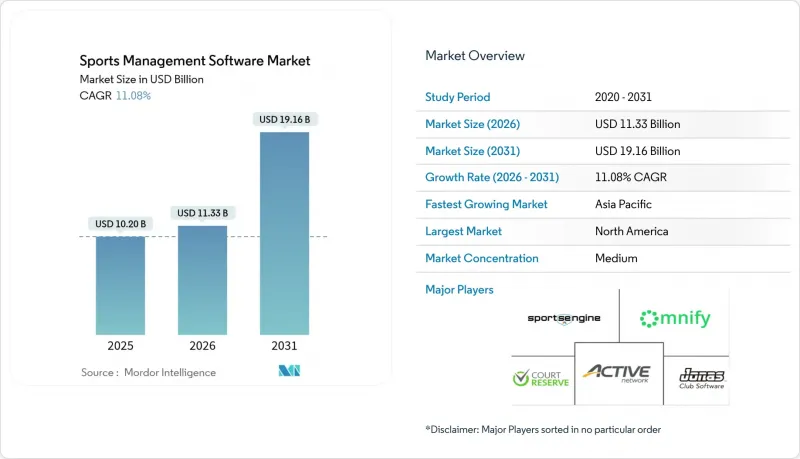
This expansion follows rapid digitization across professional and grassroots organizations, fueled by cloud-first subscription platforms, AI-driven automation, and rising demand for integrated payment and communication tools. Cloud deployment holds clear dominance, event scheduling remains the largest application, and professional franchises still command the greatest spending power. Yet the fastest gains stem from AI-enabled scheduling, embedded finance, and school-based adoption, signaling broadening penetration beyond elite clubs. Intensifying vendor consolidation and government digitization grants further widen the addressable base while simultaneously elevating competition and pricing pressure for feature-rich offerings. The sports management software market now sits at the nexus of technology, fan engagement, and operational efficiency, enabling scalable solutions from youth leagues to global franchises.
Global Sports Management Software Market Trends and Insights
Growing Investment in Professional and Grassroots Sports Facilities
Government and private-sector capital continues to modernize stadiums, community arenas, and school fields, embedding technology requirements within construction grants. A Chinese infrastructure program worth USD 450 million obligated venues to integrate digital management systems. In the United Kingdom, the GBP 100 million (USD 130 million) Multi-Sport Grassroots Facilities Programme links funding to digital readiness, steering clubs toward subscription platforms that track usage and performance data. Parallel moves by North American franchises underscore the top-down influence of professional spend on community adoption. Vendors respond with tiered pricing that scales features without large capital outlays, broadening access while keeping enterprise clients on premium tiers. As a result, the sports management software market records stable demand from elite teams and expanding uptake from grassroots beneficiaries of facility grants.
Rapid Shift Toward Cloud-First SaaS Subscription Models
Subscription pricing removes hefty license fees, making professional-grade software viable for youth leagues with modest budgets. TeamSnap's cloud architecture supports 19,000 organizations and delivers 98% customer satisfaction through constant feature releases. The SaaS model aligns costs with participant growth, offers elastic capacity for seasonal spikes, and simplifies security updates that satisfy evolving privacy rules. Larger franchises gain real-time data sharing across venues, while small clubs avoid hardware expenditure entirely. Because cloud APIs integrate payments, analytics, and digital ticketing, adoption accelerates among organizations previously hampered by fragmented legacy systems. Consequently, cloud subscriptions underpin the 12.02% CAGR that keeps the sports management software market ahead of on-premise alternatives
Escalating Data-Security and Privacy Compliance Costs
Rules such as GDPR and CCPA impose encryption standards, access audits, and breach-response protocols that stretch club resources. European clubs risk fines up to EUR 300,000 (USD 339,000) for mishandling personal data. Vendors must certify compliance, invest in penetration testing, and offer user-friendly consent dashboards that increase development overhead. Smaller organizations struggle to hire dedicated IT staff, delaying adoption despite clear operational benefits. While privacy features elevate platform trust, they also raise subscription prices, tempering near-term growth in regions subject to the strictest legislation.
Other drivers and restraints analyzed in the detailed report include:
- Integration of Mobile Payments and Embedded Finance Modules
- AI-Driven Automated Scheduling and Communications
- Budget Constraints at Amateur and Community Clubs
For complete list of drivers and restraints, kindly check the Table Of Contents.
Segment Analysis
Cloud platforms generated 62.25% of sports management software market revenue in 2025 and are forecast to expand at a 11.83% CAGR through 2031. That momentum stems from elastic capacity, device-agnostic access, and lower upfront investment compared with on-premise set-ups. Professional franchises appreciate the ability to link ticketing, concessions, and fan engagement analytics in real time, as evidenced by an MLB club's stadium partnership with Global Payments.
On-premise installations persist among organizations with sunk hardware costs or regulated data-sovereignty mandates. Yet even these holdouts adopt hybrid models that retain sensitive data onsite while shifting communication modules or AI analytics to the cloud. This transition opens incremental opportunities for vendors via modular migration paths that keep customers within the same ecosystem. Consequently, the sports management software market size attributable to cloud continues to outpace overall growth as hybrid converts eventually shift fully online.
The Sports Management Software Market Report is Segmented by Deployment (On-Premise, and Cloud), Application (Event Management and Scheduling, Marketing Management, Client Management, League and Competition Management, and More), End-User (Professional Sports Clubs and Franchises, Schools and Academies, Community Recreation Organizations, and More), and Geography. The Market Forecasts are Provided in Terms of Value (USD).
Geography Analysis
North America captured 40.68% of revenue in 2025 owing to mature professional leagues, high disposable income for youth programs, and an established ecosystem of SaaS providers. Clubs readily integrate cloud analytics for player tracking and fan personalization, sustaining premium pricing. Canada's broad community-sports participation also feeds a large installed base of tier-two and tier-three organizations that upgrade steadily.
Asia Pacific posts the highest 12.04% CAGR through 2031. Chinese public-sports investments require digital performance and safety tracking, lifting demand among municipal facilities. Japan's focus on venue modernization before international tournaments accelerates rollouts of multilingual ticketing and crowd-flow software. India's sports-technology value is forecast to jump from INR 26,700 crore in FY2024 to INR 49,500 crore (USD 5.96 billion) by FY2029, highlighting scalable growth in large-population markets.
Europe advances at a steady pace, anchored by regulatory pressures such as GDPR that force clubs to upgrade to compliant platforms. The continent's grassroots grants, including the GBP 100 million (USD 130 million) U.K. program, underpin demand among community facilities. Meanwhile, South America and the Middle East and Africa remain nascent but high-potential regions, where improving broadband and upcoming international events present long-run opportunities for the sports management software market.
- Active Network LLC
- SportsEngine Inc.
- Jonas Club Software (Jonas Computing UK Ltd)
- Omnify Inc.
- Stack Sports Holdings Inc.
- SAP SE
- CourtReserve.com LLC
- LeagueApps Inc.
- TeamSideline.com Inc.
- SquadFusion Inc.
- Jersey Watch LLC
- TeamSnap Inc.
- PerfectMind Inc.
- MINDBODY Inc.
- Glofox (ABC Fitness Solutions LLC)
- EZFacility Inc.
- Gladstone MRM Ltd
- Xplor Technologies Ltd
- Virtuagym B.V.
- First Sports International Ltd
Additional Benefits:
- The market estimate (ME) sheet in Excel format
- 3 months of analyst support
TABLE OF CONTENTS
1 INTRODUCTION
- 1.1 Study Assumptions and Market Definition
- 1.2 Scope of the Study
2 RESEARCH METHODOLOGY
3 EXECUTIVE SUMMARY
4 MARKET LANDSCAPE
- 4.1 Market Overview
- 4.2 Market Drivers
- 4.2.1 Growing investment in professional and grassroots sports facilities
- 4.2.2 Rapid shift toward cloud-first SaaS subscription models
- 4.2.3 Integration of mobile payments and embedded finance modules
- 4.2.4 AI-driven automated scheduling and communications
- 4.2.5 Government-backed digital transformation grants for community clubs
- 4.2.6 Growth of women's leagues demanding dedicated management platforms
- 4.3 Market Restraints
- 4.3.1 Escalating data-security and privacy compliance costs
- 4.3.2 Budget constraints at amateur and community clubs
- 4.3.3 Vendor lock-in fears limiting long-term contracts
- 4.3.4 Fragmented legacy systems hampering interoperability
- 4.4 Industry Value Chain Analysis
- 4.5 Regulatory Landscape
- 4.6 Technological Outlook
- 4.7 Impact of Macroeconomic Factors
- 4.8 Porter's Five Forces Analysis
- 4.8.1 Bargaining Power of Suppliers
- 4.8.2 Bargaining Power of Buyers and Consumers
- 4.8.3 Threat of New Entrants
- 4.8.4 Threat of Substitute Products
- 4.8.5 Intensity of Competitive Rivalry
- 4.9 Significant Market Trends
- 4.10 Investment Analysis
5 MARKET SIZE AND GROWTH FORECASTS (VALUE)
- 5.1 By Deployment
- 5.1.1 On-Premise
- 5.1.2 Cloud
- 5.2 By Application
- 5.2.1 Event Management and Scheduling
- 5.2.2 Marketing Management
- 5.2.3 Client Management
- 5.2.4 League and Competition Management
- 5.2.5 Membership and Payment Processing
- 5.3 By End-user
- 5.3.1 Professional Sports Clubs and Franchises
- 5.3.2 Colleges and Universities
- 5.3.3 Schools and Academies
- 5.3.4 Community Recreation Organizations
- 5.3.5 Gyms and Fitness Centers
- 5.4 By Geography
- 5.4.1 North America
- 5.4.1.1 United States
- 5.4.1.2 Canada
- 5.4.1.3 Mexico
- 5.4.2 South America
- 5.4.2.1 Brazil
- 5.4.2.2 Argentina
- 5.4.2.3 Rest of South America
- 5.4.3 Europe
- 5.4.3.1 Germany
- 5.4.3.2 United Kingdom
- 5.4.3.3 France
- 5.4.3.4 Italy
- 5.4.3.5 Spain
- 5.4.3.6 Russia
- 5.4.3.7 Rest of Europe
- 5.4.4 Asia Pacific
- 5.4.4.1 China
- 5.4.4.2 Japan
- 5.4.4.3 India
- 5.4.4.4 South Korea
- 5.4.4.5 Australia and New Zealand
- 5.4.4.6 Rest of Asia Pacific
- 5.4.5 Middle East
- 5.4.5.1 Saudi Arabia
- 5.4.5.2 United Arab Emirates
- 5.4.5.3 Turkey
- 5.4.5.4 Rest of Middle East
- 5.4.6 Africa
- 5.4.6.1 South Africa
- 5.4.6.2 Nigeria
- 5.4.6.3 Kenya
- 5.4.6.4 Rest of Africa
- 5.4.1 North America
6 COMPETITIVE LANDSCAPE
- 6.1 Market Concentration
- 6.2 Strategic Moves
- 6.3 Market Share Analysis
- 6.4 Company Profiles (includes Global level Overview, Market level overview, Core Segments, Financials as available, Strategic Information, Market Rank/Share for key companies, Products and Services, and Recent Developments)
- 6.4.1 Active Network LLC
- 6.4.2 SportsEngine Inc.
- 6.4.3 Jonas Club Software (Jonas Computing UK Ltd)
- 6.4.4 Omnify Inc.
- 6.4.5 Stack Sports Holdings Inc.
- 6.4.6 SAP SE
- 6.4.7 CourtReserve.com LLC
- 6.4.8 LeagueApps Inc.
- 6.4.9 TeamSideline.com Inc.
- 6.4.10 SquadFusion Inc.
- 6.4.11 Jersey Watch LLC
- 6.4.12 TeamSnap Inc.
- 6.4.13 PerfectMind Inc.
- 6.4.14 MINDBODY Inc.
- 6.4.15 Glofox (ABC Fitness Solutions LLC)
- 6.4.16 EZFacility Inc.
- 6.4.17 Gladstone MRM Ltd
- 6.4.18 Xplor Technologies Ltd
- 6.4.19 Virtuagym B.V.
- 6.4.20 First Sports International Ltd
7 MARKET OPPORTUNITIES AND FUTURE OUTLOOK
- 7.1 White-space and unmet-need assessment

