PUBLISHER: Mordor Intelligence | PRODUCT CODE: 1940632

PUBLISHER: Mordor Intelligence | PRODUCT CODE: 1940632
Chlor-alkali - Market Share Analysis, Industry Trends & Statistics, Growth Forecasts (2026 - 2031)
Chlor-alkali market size in 2026 is estimated at 286.25 Million tons, growing from 2025 value of 277.94 Million tons with 2031 projections showing 331.68 Million tons, growing at 2.99% CAGR over 2026-2031.
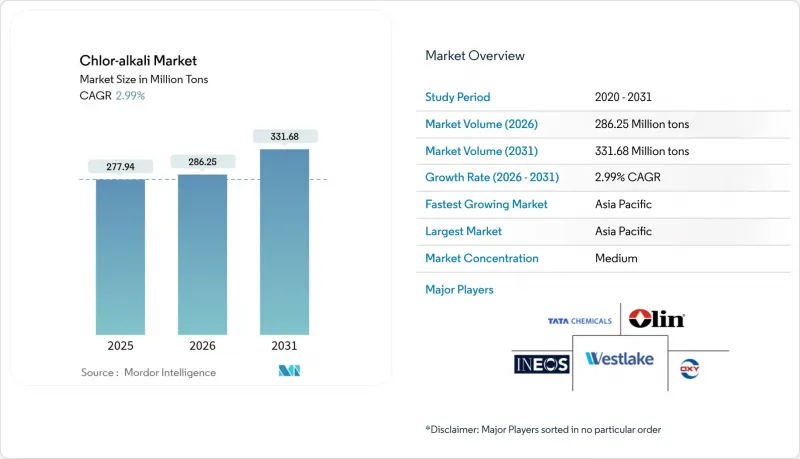
Momentum stems from persistent PVC build-outs, widening water-treatment coverage, and escalating alumina demand for electric-vehicle battery materials. Unique co-product balances between chlorine, caustic soda, and soda ash tighten supply-demand linkages, prompting producers to align operating rates with downstream pull signals. Renewed investment in membrane electrolysis is lowering unit power consumption, while renewable-electricity contracts cushion electricity cost volatility. At the same time, regulatory scrutiny over mercury cell retirements and carbon emissions compels sustained capital deployment into cleaner technology platforms.
Global Chlor-alkali Market Trends and Insights
Surging PVC Capacity Additions in Asia
PVC additions across China, India, and Southeast Asia underpin forward chlorine offtake, even as real-estate softness tempers near-term volumes. PCC Group is investing USD 340 million in a chlor-alkali complex inside Chemours' Mississippi site that will supply 340,000 tons of annual capacity by 2028. India's antidumping duties on imported PVC stimulate domestic builds that translate directly into incremental chlorine pull, while ASEAN producers gain from supply-chain diversification. Each new PVC line obliges fixed electrochemical chlorine-to-PVC ratios, so merchant chlorine availability outside the chain tightens, reinforcing regional price premiums. Localized oversupply pockets have therefore triggered logistics shifts toward export pipelines from coastal Chinese hubs into the wider Asia-Pacific chlor-alkali market.
Rising Alumina Output for EV-Grade Aluminium
Battery-grade aluminum calls for ultra-low impurity alumina, which in turn demands high-specification caustic soda. Indonesian alumina ventures are scrambling for secured caustic supply, underscoring the strategic need for integrated chlor-alkali-alumina corridors. Regional mismatch between bauxite deposits, refining basins, and co-located electrolysis capacity inflates freight outlays, incentivizing on-site chlor-alkali plant tie-ups. Producers serving this differentiated caustic pool earn premium margins because purity specs exceed commodity thresholds. Long-haul shipments of concentrated caustic soda face handling constraints, so nearby membrane assets secure an embedded cost edge.
High Power Tariffs and Grid Volatility
Electricity price spikes tied to natural-gas benchmarks have eroded European chlor-alkali margins, spurring partial shutdowns and capacity relocations. Emerging-market grids add operational complexity as voltage dips mandate expensive uninterruptible power systems. Producers able to curtail load during peak tariffs and ramp during off-peak renewables gain a crucial cost hedge. Thailand's gas depletion exemplifies how upstream constraints cascade into power scarcity, amplifying working-capital swings for chlor-alkali operators.
Other drivers and restraints analyzed in the detailed report include:
- Booming Water and Wastewater Treatment Projects
- Capacity-Linked Renewable-Energy Incentives
- Stringent Carbon-Footprint Regulations
For complete list of drivers and restraints, kindly check the Table Of Contents.
Segment Analysis
Chlorine held a 40.85% share of the chlor-alkali market in 2025 and will outpace co-products at a 3.35% CAGR to 2031. Accelerated PVC polymerization capacity in Asia and the Middle East locks in a dependable offtake corridor for every incremental ton of chlorine produced. Water-treatment upgrades across municipal grids layer on additional chlorine derivative demand, assuring more stable run-rates for integrated producers.
Caustic soda, while trailing chlorine in share, secures steady lift from alumina refiners and pulp processors that often engage in multi-year offtake contracts to hedge price risk. Meanwhile, green hydrogen valorization strategies turn the once-vented hydrogen co-product into a revenue contributor, especially where policy support exists. Collectively, diversified end-uses stabilize returns and moderate earnings cyclicality across the chlor-alkali market.
The Chlor-Alkali Report is Segmented by Product (Caustic Soda, Chlorine, and Soda Ash), Production Process (Membrane Cell, Diaphragm Cell, and Other Processes), Application (Pulp and Paper, Organic Chemicals, Inorganic Chemicals, Soaps and Detergents, and More), and Geography (Asia-Pacific, North America, Europe, South America, and Middle-East and Africa). The Market Forecasts are Provided in Terms of Volume (Units).
Geography Analysis
Asia-Pacific retained 62.15% of the chlor-alkali market size in 2025 and is projected to compound at a 3.12% CAGR through 2031. China's manufacturing backbone, from PVC to electronics, embeds robust chlorine and caustic soda pull, even as regional real-estate cooling tempers immediate PVC resin consumption. India's infrastructure binge, spanning rail, metro, and sanitation, stimulates both vinyl pipe uptake and municipal water treatment, locking in multiyear demand visibility.
North America holds a stable share, benefiting from shale-derived ethylene cost advantages that safeguard PVC competitiveness. Municipal water utilities continue renewing decades-old treatment plants, lifting chlorine derivative throughput. Long-term renewable PPAs in Texas and Alberta enable lower emissions footprints for membrane retrofits, enhancing regional operator resilience.
Europe grapples with elevated power tariffs and stringent carbon regimes that have pressured several older diaphragm units into mothballing. Yet specialty chemical niches, stringent potable-water standards, and high-margin pharmaceutical precursors sustain a baseline of local demand, ensuring Europe remains a sizable import destination.
South America's growth rests on Brazilian pulp expansion and mining chemicals in Chile and Peru, while Middle-East and Africa witness selective megaprojects such as Befar Group's USD 500 million Egyptian complex targeting both domestic uses and African export lanes.
- ANWIL SA
- BorsodChem (Wanhua)
- Ciner Group
- Covestro AG
- Dow
- Ercros SA
- Formosa Plastics Corporation
- Genesis Energy, L.P.
- Hanwha Group
- INEOS
- Kemira
- MicroBio
- Nirma
- Nobian (Reyez)
- Occidental Petroleum Corporation
- Olin Corporation
- PCC SE
- Shin-Etsu Chemical Co., Ltd
- Sisecam
- Solvay
- Spolchemie
- Tata Chemicals Ltd
- Tosoh Corporation
- Vynova Group
- Westlake Corporation
Additional Benefits:
- The market estimate (ME) sheet in Excel format
- 3 months of analyst support
TABLE OF CONTENTS
1 Introduction
- 1.1 Study Assumptions and Market Definition
- 1.2 Scope of the Study
2 Research Methodology
3 Executive Summary
4 Market Landscape
- 4.1 Market Overview
- 4.2 Market Drivers
- 4.2.1 Surging PVC Capacity Additions in Asia
- 4.2.2 Rising Alumina Output for EV-Grade Aluminium
- 4.2.3 Booming Water and Wastewater Treatment Projects
- 4.2.4 Capacity-Linked Renewable-Energy Incentives
- 4.2.5 Surging Demand in Chemical Manufacturing
- 4.3 Market Restraints
- 4.3.1 High Power Tariffs and Grid Volatility
- 4.3.2 Stringent Carbon-Footprint Regulations
- 4.3.3 Brine-Disposal Compliance Costs
- 4.4 Value Chain Analysis
- 4.5 Porter's Five Forces
- 4.5.1 Bargaining Power of Suppliers
- 4.5.2 Bargaining Power of Buyers
- 4.5.3 Threat of New Entrants
- 4.5.4 Threat of Substitutes
- 4.5.5 Degree of Competition
- 4.6 Import and Export Trends
5 Market Size and Growth Forecasts (Volume)
- 5.1 By Product
- 5.1.1 Caustic Soda
- 5.1.2 Chlorine
- 5.1.3 Soda Ash
- 5.2 By Production Process
- 5.2.1 Membrane Cell
- 5.2.2 Diaphragm Cell
- 5.2.3 Other Processes
- 5.3 By Application
- 5.3.1 Pulp and Paper
- 5.3.2 Organic Chemicals
- 5.3.3 Inorganic Chemicals
- 5.3.4 Soaps and Detergents
- 5.3.5 Alumina
- 5.3.6 Textiles
- 5.3.7 Other Applications
- 5.4 By Geography
- 5.4.1 Asia-Pacific
- 5.4.1.1 China
- 5.4.1.2 India
- 5.4.1.3 Japan
- 5.4.1.4 South Korea
- 5.4.1.5 Indonesia
- 5.4.1.6 Thailand
- 5.4.1.7 Malaysia
- 5.4.1.8 Vietnam
- 5.4.1.9 Rest of Asia-Pacific
- 5.4.2 North America
- 5.4.2.1 United States
- 5.4.2.2 Canada
- 5.4.2.3 Mexico
- 5.4.3 Europe
- 5.4.3.1 Germany
- 5.4.3.2 United Kingdom
- 5.4.3.3 France
- 5.4.3.4 Italy
- 5.4.3.5 Spain
- 5.4.3.6 Turkey
- 5.4.3.7 Russia
- 5.4.3.8 Nordic Countries
- 5.4.3.9 Rest of Europe
- 5.4.4 South America
- 5.4.4.1 Brazil
- 5.4.4.2 Argentina
- 5.4.4.3 Colombia
- 5.4.4.4 Rest of South America
- 5.4.5 Middle-East and Africa
- 5.4.5.1 Saudi Arabia
- 5.4.5.2 United Arab Emirates
- 5.4.5.3 Qatar
- 5.4.5.4 Egypt
- 5.4.5.5 South Africa
- 5.4.5.6 Nigeria
- 5.4.5.7 Rest of Middle-East and Africa
- 5.4.1 Asia-Pacific
6 Competitive Landscape
- 6.1 Market Concentration
- 6.2 Strategic Moves
- 6.3 Market Share (%)/Ranking Analysis
- 6.4 Company Profiles (includes Global level Overview, Market level overview, Core Segments, Financials as available, Strategic Information, Market Rank/Share, Products and Services, Recent Developments)
- 6.4.1 ANWIL SA
- 6.4.2 BorsodChem (Wanhua)
- 6.4.3 Ciner Group
- 6.4.4 Covestro AG
- 6.4.5 Dow
- 6.4.6 Ercros SA
- 6.4.7 Formosa Plastics Corporation
- 6.4.8 Genesis Energy, L.P.
- 6.4.9 Hanwha Group
- 6.4.10 INEOS
- 6.4.11 Kemira
- 6.4.12 MicroBio
- 6.4.13 Nirma
- 6.4.14 Nobian (Reyez)
- 6.4.15 Occidental Petroleum Corporation
- 6.4.16 Olin Corporation
- 6.4.17 PCC SE
- 6.4.18 Shin-Etsu Chemical Co., Ltd
- 6.4.19 Sisecam
- 6.4.20 Solvay
- 6.4.21 Spolchemie
- 6.4.22 Tata Chemicals Ltd
- 6.4.23 Tosoh Corporation
- 6.4.24 Vynova Group
- 6.4.25 Westlake Corporation
7 Market Opportunities and Future Outlook
- 7.1 White-space and Unmet-need Assessment

