
PUBLISHER: Mordor Intelligence | PRODUCT CODE: 1940633

PUBLISHER: Mordor Intelligence | PRODUCT CODE: 1940633
Electronic Article Surveillance (EAS) - Market Share Analysis, Industry Trends & Statistics, Growth Forecasts (2026 - 2031)
The Electronic Article Surveillance market is expected to grow from USD 1.21 billion in 2025 to USD 1.25 billion in 2026 and is forecast to reach USD 1.44 billion by 2031 at 2.99% CAGR over 2026-2031.
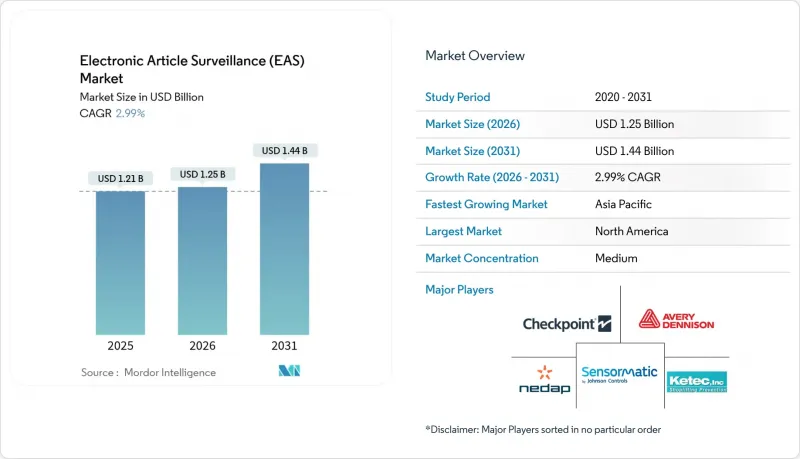
The measured expansion reflects the shift from traditional pedestals and tags to convergent, data-centric security ecosystems. Retailers are confronting USD 112.1 billion in global shrink losses reported for 2022, prompting sustained capital allocation toward loss-prevention technologies that fuse acousto-magnetic, radio-frequency and RFID capabilities. Mandatory source-tagging programs at consumer-goods plants, the roll-out of self-checkout lanes and the phasing-out of electromagnetic formats in favor of RF/RFID hybrids collectively underpin demand. At the same time, a duopoly structure-two players process about 6 billion tags each year-keeps pricing for disposable tags near USD 0.05 while erecting technical and distribution barriers for new entrants. Regulatory pushes for recyclable packaging and carbon-reduction targets further steer investment toward battery-free printable labels embedded at the point of manufacture.
Global Electronic Article Surveillance (EAS) Market Trends and Insights
Continued Shrink-Control Focus Among Tier-1 Retailers
Shrink now averages 1.6% of sales for many large chains, forcing executives to devote more than 50% of prevention budgets to technology that feeds data into enterprise analytics platforms. Item-level RFID-EAS tags convert gates into data collectors that flag repeat offenders and generate predictive insights. Walmart added AI-enabled "missed-scan" detection at self-checkout bays, demonstrating how the Electronic Article Surveillance market is morphing from a simple alarm system into a multi-sensor intelligence layer that closes loss gaps while improving inventory accuracy.
Mandates for Source-Tagging by Consumer-Goods Brands
Global FMCG suppliers embed tags directly on the factory line, driving volume efficiencies and consistent placement that minimizes false alarms. Sensormatic Solutions expanded its RFID service bureau in Matamoros, Mexico, giving North American brands on-shore capacity for encoded tag production. Retailers benefit through labor-savings at the store and improved detection rates, whereas converters leverage recyclable substrates that comply with circular-packaging commitments.
High CAPEX for True Item-Level RFID-EAS Convergence
Complete convergence demands dense reader grids, enterprise software and staff re-training that can exceed USD 500,000 for mid-sized chains. Retailers must often run RF gates in parallel with legacy EM equipment during phased roll-outs, effectively doubling operating costs. Integration timelines stretch 18-24 months and require GS1 data-model alignment. Budget constraints delay upgrades across emerging economies, tempering the Electronic Article Surveillance market growth outlook even as technology costs gradually decline.
Other drivers and restraints analyzed in the detailed report include:
- Migration from EM to RF/RFID Hybrid Systems
- Post-Pandemic Surge in Self-Checkout Lanes
- Declining Mall Traffic in Western Markets
For complete list of drivers and restraints, kindly check the Table Of Contents.
Segment Analysis
Tags retained 53.92% share in 2025, underlining their role as the fundamental detection element across all formats. Source-tagging now covers more than 80% of volume, embedding hard tags or inlays during production and lifting throughput at receiving docks. Labels and Safers, though smaller, are on track for a 4.52% CAGR as printable RFID-EAS inlays marry sustainability and security; 70-90% lower CO2 output compared with etched-aluminium circuits places them at the center of retailer carbon pledges. The Electronic Article Surveillance market size for Labels is therefore projected to widen most rapidly within the component mix. Antenna upgrades follow store refurbishments and hybrid conversions, while automated detachers and deactivators tied to self-checkout kiosks lift ancillary demand.
Second-generation detachers now accommodate dual-technology tags, enabling frictionless returns processing and omnichannel order pick-ups. Integrators routinely bundle antennas with data-analytics dashboards that visualise alarm events alongside traffic counters, elevating the offer from hardware to software-as-a-service. These value-add layers, together with factory-embedded inlays, reinforce the duopolistic tag supply chain yet keep total cost of ownership predictable for retailers.
Electronic Article Surveillance Market Report is Segmented by Component (Tags, Antennas, Deactivators/Detachers, and More), Technology (Acousto-Magnetic AM, Electromagnetic EM, and More), End-User (Apparel and Fashion Accessories, Cosmetics and Pharmacies, Supermarkets/Hypermarkets/Mass-Merchandisers, and More), and Geography. The Market Forecasts are Provided in Terms of Value (USD).
Geography Analysis
North America led with 33.72% of 2025 revenue, propelled by chains that pioneered EAS adoption and by federal guidelines requiring item-level track-and-trace for pharmaceuticals. Gate upgrades integrate video analytics and traffic counters that feed enterprise dashboards, extending EAS usefulness beyond alarm generation. Mexico's emergence as a tag conversion hub underlines regional integration as Sensormatic's Matamoros bureau supplies encoded RFID inlays to United States garment lines. Canada's grocery sector, meanwhile, scales hybrid RFID roll-outs to curb shrink tied to self-checkout adoption.
Asia-Pacific is the fastest-growing territory at 3.84% CAGR. China anchors regional volume with domestic antenna and tag plants that export to ASEAN retailers. Japan and South Korea, early RFID adopters, deploy cloud-native analytics that tie EAS events to merchandising insights, accelerating software revenue streams linked to hardware installations. India's organised retail expansion, including apparel franchises and large-format grocery, adds greenfield opportunities that lift the Electronic Article Surveillance market size across the region.
Europe steadies growth through sustainability regulations that reward recyclable inlay formats. Retailers adopt labels fabricated from paper-based antennas to comply with the EU's circular-economy directives. Germany and France pursue national action plans against organised retail crime, spurring investments in AI-ready pedestal replacements. The Netherlands, Belgium and France host a 740-store RFID roll-out at HEMA, illustrating continental scale and the pivot from stand-alone gates to integrated inventory visibility. Southern Europe catches up through fashion chains that align EAS upgrades with omnichannel fulfilment strategies.
- Sensormatic Solutions (Johnson Controls)
- Checkpoint Systems (CCL Industries)
- Nedap N.V.
- Avery Dennison Corp.
- Gunnebo Gateway AB
- Ketec Inc.
- Agon Systems
- All-Tag Corporation
- Invengo Information Technology
- STid Security
- Labelux (LAB ID)
- Sentry Custom Security
- Cross Point B.V.
- Century Co., Ltd.
- Universal Surveillance Systems (USS)
- SecuSystem Ltd.
- Dexilon Automation
- Tag Company (UK) Ltd.
- Hangzhou Century Co., Ltd.
- Shenzhen Emeno Technology
- MTC EAS
- Shanghai RL Electronics
- InVue Security Products
Additional Benefits:
- The market estimate (ME) sheet in Excel format
- 3 months of analyst support
TABLE OF CONTENTS
1 INTRODUCTION
- 1.1 Study Assumptions and Market Definition
- 1.2 Scope of the Study
2 RESEARCH METHODOLOGY
3 EXECUTIVE SUMMARY
4 MARKET LANDSCAPE
- 4.1 Market Overview
- 4.2 Market Drivers
- 4.2.1 Continued shrink-control focus among Tier-1 retailers
- 4.2.2 Mandates for source-tagging by consumer-goods brands
- 4.2.3 Migration from EM to RF/RFID hybrid systems
- 4.2.4 Post-pandemic surge in self-checkout lanes
- 4.2.5 AI-assisted "smart antenna" deployment in micro-format stores
- 4.2.6 Battery-free printable RFID-EAS labels enabling circular packaging
- 4.3 Market Restraints
- 4.3.1 High CAPEX for true item-level RFID-EAS convergence
- 4.3.2 Declining mall traffic in Western markets
- 4.3.3 Limited read-range reliability around metals and liquids
- 4.3.4 Growing pushback on data-privacy in computer-vision backed EAS
- 4.4 Supply-Chain Analysis
- 4.5 Regulatory Landscape
- 4.6 Technological Outlook
- 4.7 Porter's Five Forces
- 4.7.1 Threat of New Entrants
- 4.7.2 Bargaining Power of Suppliers
- 4.7.3 Bargaining Power of Buyers
- 4.7.4 Threat of Substitutes
- 4.7.5 Intensity of Competitive Rivalry
- 4.8 Assesment of macroeconomic Factors on the Market
5 MARKET SIZE AND GROWTH FORECASTS
- 5.1 By Component
- 5.1.1 Tags
- 5.1.2 Antennas
- 5.1.3 Deactivators / Detachers
- 5.1.4 Labels and Safers
- 5.2 By Technology
- 5.2.1 Acousto-Magnetic (AM)
- 5.2.2 Electromagnetic (EM)
- 5.2.3 Radio-Frequency (RF)
- 5.2.4 RFID-EAS Hybrids
- 5.2.5 Microwave and Other Niches
- 5.3 By End-User
- 5.3.1 Apparel and Fashion Accessories
- 5.3.2 Cosmetics and Pharmacies
- 5.3.3 Supermarkets, Hypermarkets and Mass-Merchandisers
- 5.3.4 Others
- 5.3.4.1 Consumer Electronics and DIY Stores
- 5.3.4.2 Liquor and Specialty Retail
- 5.4 By Geography
- 5.4.1 North America
- 5.4.1.1 United States
- 5.4.1.2 Canada
- 5.4.1.3 Mexico
- 5.4.2 South America
- 5.4.2.1 Brazil
- 5.4.2.2 Argentina
- 5.4.2.3 Rest of South America
- 5.4.3 Europe
- 5.4.3.1 Germany
- 5.4.3.2 United Kingdom
- 5.4.3.3 France
- 5.4.3.4 Italy
- 5.4.3.5 Spain
- 5.4.3.6 Rest of Europe
- 5.4.4 Asia-Pacific
- 5.4.4.1 China
- 5.4.4.2 Japan
- 5.4.4.3 India
- 5.4.4.4 South Korea
- 5.4.4.5 Southeast Asia
- 5.4.4.6 Rest of Asia-Pacific
- 5.4.5 Middle East and Africa
- 5.4.5.1 Middle East
- 5.4.5.1.1 Saudi Arabia
- 5.4.5.1.2 United Arab Emirates
- 5.4.5.1.3 Turkey
- 5.4.5.1.4 Rest of Middle East
- 5.4.5.2 Africa
- 5.4.5.2.1 South Africa
- 5.4.5.2.2 Nigeria
- 5.4.5.2.3 Egypt
- 5.4.5.2.4 Rest of Africa
- 5.4.5.1 Middle East
- 5.4.1 North America
6 COMPETITIVE LANDSCAPE
- 6.1 Market Concentration
- 6.2 Strategic Moves
- 6.3 Market Share Analysis
- 6.4 Company Profiles (includes Global level Overview, Market level overview, Core Segments, Financials as available, Strategic Information, Market Rank/Share, Products and Services, Recent Developments)
- 6.4.1 Sensormatic Solutions (Johnson Controls)
- 6.4.2 Checkpoint Systems (CCL Industries)
- 6.4.3 Nedap N.V.
- 6.4.4 Avery Dennison Corp.
- 6.4.5 Gunnebo Gateway AB
- 6.4.6 Ketec Inc.
- 6.4.7 Agon Systems
- 6.4.8 All-Tag Corporation
- 6.4.9 Invengo Information Technology
- 6.4.10 STid Security
- 6.4.11 Labelux (LAB ID)
- 6.4.12 Sentry Custom Security
- 6.4.13 Cross Point B.V.
- 6.4.14 Century Co., Ltd.
- 6.4.15 Universal Surveillance Systems (USS)
- 6.4.16 SecuSystem Ltd.
- 6.4.17 Dexilon Automation
- 6.4.18 Tag Company (UK) Ltd.
- 6.4.19 Hangzhou Century Co., Ltd.
- 6.4.20 Shenzhen Emeno Technology
- 6.4.21 MTC EAS
- 6.4.22 Shanghai RL Electronics
- 6.4.23 InVue Security Products
7 MARKET OPPORTUNITIES AND FUTURE OUTLOOK

