PUBLISHER: Mordor Intelligence | PRODUCT CODE: 2124406

PUBLISHER: Mordor Intelligence | PRODUCT CODE: 2124406
Digital Lending - Market Share Analysis, Industry Trends & Statistics, Growth Forecasts (2026 - 2031)
According to Mordor Intelligence, the digital lending market size was valued at USD 507.27 billion in 2025 and estimated to grow from USD 566.52 billion in 2026 to reach USD 985.03 billion by 2031, at a CAGR of 11.68% during the forecast period (2026-2031).
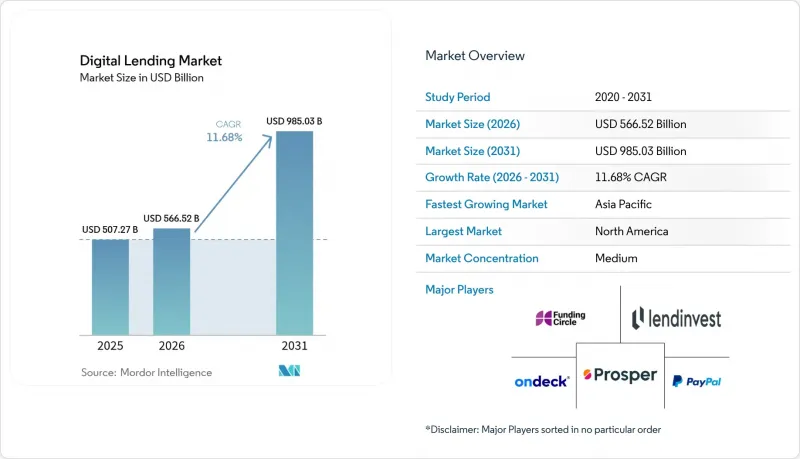
This report is Segmented by Type (Consumer, Enterprise/SME), Loan Type (Personal Loans, Auto Loans, and More), Deployment Mode (Cloud-Based, Hybrid and More), Business Model (Peer-To-Peer Marketplace Lending, Balance-Sheet Direct Lending, and More), Technology (AI/ML-driven Underwriting, API and Open-Banking Platforms, and More), and Geography. The Market Forecasts are Provided in Terms of Value (USD).
Global Digital Lending Market Trends and Insights
Surge in smartphone and internet penetration accelerates mobile-first lending
Global smartphone users totaled 6.8 billion in 2024, giving lenders a direct path to borrowers through mobile apps. In Asia-Pacific alone, digital-wallet payments hit USD 9.8 trillion, reinforcing customer readiness for in-app credit offers. Lenders now harness geolocation, device metadata, and behavioural signals to evaluate risk in seconds, opening credit lines to millions of first-time borrowers. Regulators such as India's Data Protection Board and the EU's AI Act are standardizing data use, which helps lenders scale compliant mobile-first models.
Proliferation of fintech instant-approval platforms transforms borrower expectations
More than 90% of digital loan applications are now routed through automated underwriting engines, and Upstart reports 80% instant approvals without document uploads. Machine-learning models digest hundreds of borrower attributes in real time, cutting origination costs and elevating customer satisfaction. Banks unable to match sub-five-minute approval windows increasingly choose white-label partnerships with fintech vendors to preserve market share.
Cyber-security and data-privacy risks challenge platform scalability
Financial institutions allocate just 13% of IT budgets to security even as API footprints widen. In 2024, 62% of surveyed lenders registered rising fraud incidents, and regulators now demand zero-trust architectures under GDPR and CCPA regimes. Higher cyber-insurance premiums and mandatory breach notifications inflate compliance costs, particularly for cross-border platforms.
Other drivers and restraints analyzed in the detailed report include:
- Favorable open-banking and e-KYC regulations enable data-driven underwriting
- MSME demand for rapid working-capital loans drives B2B adoption
- Investor fatigue in peer-to-peer markets curbs capital supply
For complete list of drivers and restraints, kindly check the Table Of Contents.
Segment Analysis
Consumer loans retained 60.78% of the digital lending market in 2025, propelled by personal finance and BNPL demand. At the same time, SME facilities are forecast to grow at a 16.08% CAGR to 2031, reflecting working-capital shortages and adoption of alternative-data models that reward real-time cash-flow visibility. The digital lending market size for SME products is projected to reach USD 246.09 billion by 2031. Lenders integrate APIs with accounting software to harvest invoices, payroll, and tax data, reducing underwriting cycles from weeks to 48 hours. As localized platforms achieve credit-loss rates on par with consumer portfolios, global banks are entering revenue-sharing partnerships to secure distribution.
In the consumer arena, embedded credit offers inside e-commerce checkouts continue to extend reach into lower-income cohorts. A growing share of salaried millennials now use pay-period data to unlock salary-advance options. Advanced explainable-AI models mitigate bias, pointing to downward pressure on charge-offs across large peer cohorts. Together, these forces preserve a solid base for consumer-loan volumes while opening an even faster-growing SME lane.
Personal loans represented 35.44% of the digital lending market size in 2025, fueled by instant-decision models and low acquisition costs. Auto loans follow, leveraging point-of-sale integrations that cut dealership desk time to under 60 seconds [UPSTART.COM]. Mortgage, home-equity, and student-loan categories are undergoing slower digital migration due to complex collateral checks and subsidy rules.
Working-capital loans to small businesses are projected to register a 10.52% CAGR. Revenue-based financing aligns repayments with daily card receipts, offering merchants flexibility during demand fluctuations. Invoice-factoring platforms that anchor inside enterprise-resource-planning dashboards unlock liquidity within 24 hours of invoice issuance. This embedded-finance route attracts global logistics, agriculture, and freelancer ecosystems that historically lacked collateral for traditional lines of credit.
Complete Report Scope:
- By Type
- Consumer
- Enterprise / SME
- By Loan Type
- Personal Loans
- Auto Loans
- Student Loans
- Mortgage / Home Equity
- Small Business Working-Capital Loans
- By Deployment Mode
- Cloud-based Platforms
- On-premise Solutions
- Hybrid
- By Business Model
- Peer-to-Peer (Marketplace) Lending
- Balance-Sheet (Direct) Lending
- Embedded-Finance / BNPL Lending
- Crowdfunding and Revenue-Based Financing
- By Technology
- AI / Machine-Learning-driven Underwriting
- API and Open-Banking Platforms
- Blockchain-based Lending
- Big-Data Analytics
- By Geography
- North America
- United States
- Canada
- Mexico
- Europe
- Germany
- United Kingdom
- France
- Russia
- Rest of Europe
- Asia-Pacific
- China
- Japan
- India
- South Korea
- Australia
- Rest of Asia-Pacific
- Middle East and Africa
- Middle East
- Saudi Arabia
- United Arab Emirates
- Rest of Middle East
- Africa
- South Africa
- Egypt
- Rest of Africa
- Middle East
- South America
- Brazil
- Argentina
- Rest of South America
- North America
Geography Analysis
Asia-Pacific accounted for 39.35% of the digital lending market in 2025, supported by more than 235 licensed digital banks and government-backed payment infrastructures such as India's UPI, which averaged 12 billion monthly transactions in 2025. China's super-apps layer credit on top of wallets, ride-hailing, and food-delivery services, creating powerful data loops. Governments in Singapore and Australia operate regulatory sandboxes that shorten product-testing cycles to six months, accelerating market entry for challenger lenders.
Africa recorded the fastest 21.85% CAGR and is forecast to reach USD 47 billion in revenues by 2028. Mobile-money rails pioneered in Kenya and Ghana form the backbone of microlending engines that evaluate airtime purchases and peer-to-peer transfers to score risk. Start-ups in Nigeria and Egypt attract international venture funds and develop cross-border payroll-advance solutions for the African diaspora.
North America and Europe exhibit high penetration but slower headline growth. U.S. BNPL legislation remains fluid, yet PayPal surpassed USD 30 billion in cumulative originations, demonstrating scale for mature players. In Europe, PSD3 upgrades and the EU AI Act provide unified rules that enhance cross-border passporting, though interest-rate caps in several consumer-credit directives restrain high-yield segments. Latin America sees growing embedded-finance deals anchored on real-time payments such as Brazil's PIX, creating a runway for double-digit lending growth despite macro volatility.
- Ant Group Co., Ltd.
- WeBank Co., Ltd.
- PayPal Holdings, Inc.
- Klarna Bank AB (publ)
- LendingClub Corporation
- Upstart Holdings, Inc.
- Funding Circle Holdings plc
- On Deck Capital, Inc.
- Prosper Marketplace, Inc.
- SoFi Technologies, Inc.
- Kabbage, Inc. (American Express Co.)
- LendInvest plc
- Zopa Bank Ltd.
- Kaspi.kz JSC
- Ferratum Oyj
- CAN Capital, Inc.
- International Personal Finance plc
- Faircent Tech Pvt. Ltd.
- LenDenClub Techserve Pvt. Ltd.
- CapFloat Financial Services Pvt. Ltd.
- Oriente Group Limited
- Mercado Libre, Inc.
- Square Loans (Block, Inc.)
- PayU Finance India Pvt. Ltd.
- PagSeguro Digital Ltd.
Additional Benefits:
- The market estimate (ME) sheet in Excel format
- 3 months of analyst support
TABLE OF CONTENTS
1 INTRODUCTION
- 1.1 Study Assumptions and Market Definition
- 1.2 Scope of the Study
2 RESEARCH METHODOLOGY
3 EXECUTIVE SUMMARY
4 MARKET LANDSCAPE
- 4.1 Market Overview
- 4.2 Market Drivers
- 4.2.1 Surge in smartphone and internet penetration
- 4.2.2 Proliferation of fintech instant-approval platforms
- 4.2.3 Favorable open-banking and e-KYC regulations
- 4.2.4 MSME demand for rapid working-capital loans
- 4.2.5 Alternative-data credit scoring for thin-file borrowers
- 4.2.6 Rise of embedded-finance lending inside non-bank apps
- 4.3 Market Restraints
- 4.3.1 Cyber-security and data-privacy risks
- 4.3.2 Regulatory interest-rate caps and platform re-classification
- 4.3.3 Investor fatigue in P2P markets after default spikes
- 4.3.4 Concentration risk on third-party cloud infrastructure
- 4.4 Value / Supply-Chain Analysis
- 4.5 Regulatory Landscape
- 4.6 Technological Outlook
- 4.7 Porter's Five Forces Analysis
- 4.7.1 Threat of New Entrants
- 4.7.2 Bargaining Power of Buyers
- 4.7.3 Bargaining Power of Suppliers
- 4.7.4 Threat of Substitutes
- 4.7.5 Intensity of Competitive Rivalry
5 MARKET SIZE AND GROWTH FORECASTS (VALUE)
- 5.1 By Type
- 5.1.1 Consumer
- 5.1.2 Enterprise / SME
- 5.2 By Loan Type
- 5.2.1 Personal Loans
- 5.2.2 Auto Loans
- 5.2.3 Student Loans
- 5.2.4 Mortgage / Home Equity
- 5.2.5 Small Business Working-Capital Loans
- 5.3 By Deployment Mode
- 5.3.1 Cloud-based Platforms
- 5.3.2 On-premise Solutions
- 5.3.3 Hybrid
- 5.4 By Business Model
- 5.4.1 Peer-to-Peer (Marketplace) Lending
- 5.4.2 Balance-Sheet (Direct) Lending
- 5.4.3 Embedded-Finance / BNPL Lending
- 5.4.4 Crowdfunding and Revenue-Based Financing
- 5.5 By Technology
- 5.5.1 AI / Machine-Learning-driven Underwriting
- 5.5.2 API and Open-Banking Platforms
- 5.5.3 Blockchain-based Lending
- 5.5.4 Big-Data Analytics
- 5.6 By Geography
- 5.6.1 North America
- 5.6.1.1 United States
- 5.6.1.2 Canada
- 5.6.1.3 Mexico
- 5.6.2 Europe
- 5.6.2.1 Germany
- 5.6.2.2 United Kingdom
- 5.6.2.3 France
- 5.6.2.4 Russia
- 5.6.2.5 Rest of Europe
- 5.6.3 Asia-Pacific
- 5.6.3.1 China
- 5.6.3.2 Japan
- 5.6.3.3 India
- 5.6.3.4 South Korea
- 5.6.3.5 Australia
- 5.6.3.6 Rest of Asia-Pacific
- 5.6.4 Middle East and Africa
- 5.6.4.1 Middle East
- 5.6.4.1.1 Saudi Arabia
- 5.6.4.1.2 United Arab Emirates
- 5.6.4.1.3 Rest of Middle East
- 5.6.4.2 Africa
- 5.6.4.2.1 South Africa
- 5.6.4.2.2 Egypt
- 5.6.4.2.3 Rest of Africa
- 5.6.4.1 Middle East
- 5.6.5 South America
- 5.6.5.1 Brazil
- 5.6.5.2 Argentina
- 5.6.5.3 Rest of South America
- 5.6.1 North America
6 COMPETITIVE LANDSCAPE
- 6.1 Market Concentration Analysis
- 6.2 Strategic Moves (M&A, Partnerships, Launches)
- 6.3 Market Share Analysis (Top-15, 2024)
- 6.4 Company Profiles (includes Global Level Overview, Market Level Overview, Core Segments, Financials as available, Strategic Information, Market Rank/Share, Products and Services, Recent Developments)
- 6.4.1 Ant Group Co., Ltd.
- 6.4.2 WeBank Co., Ltd.
- 6.4.3 PayPal Holdings, Inc.
- 6.4.4 Klarna Bank AB (publ)
- 6.4.5 LendingClub Corporation
- 6.4.6 Upstart Holdings, Inc.
- 6.4.7 Funding Circle Holdings plc
- 6.4.8 On Deck Capital, Inc.
- 6.4.9 Prosper Marketplace, Inc.
- 6.4.10 SoFi Technologies, Inc.
- 6.4.11 Kabbage, Inc. (American Express Co.)
- 6.4.12 LendInvest plc
- 6.4.13 Zopa Bank Ltd.
- 6.4.14 Kaspi.kz JSC
- 6.4.15 Ferratum Oyj
- 6.4.16 CAN Capital, Inc.
- 6.4.17 International Personal Finance plc
- 6.4.18 Faircent Tech Pvt. Ltd.
- 6.4.19 LenDenClub Techserve Pvt. Ltd.
- 6.4.20 CapFloat Financial Services Pvt. Ltd.
- 6.4.21 Oriente Group Limited
- 6.4.22 Mercado Libre, Inc.
- 6.4.23 Square Loans (Block, Inc.)
- 6.4.24 PayU Finance India Pvt. Ltd.
- 6.4.25 PagSeguro Digital Ltd.
7 MARKET OPPORTUNITIES AND FUTURE TRENDS
- 7.1 White-space and Unmet-Need Assessment

