
PUBLISHER: Mordor Intelligence | PRODUCT CODE: 1940707

PUBLISHER: Mordor Intelligence | PRODUCT CODE: 1940707
Surface Mount Technology - Market Share Analysis, Industry Trends & Statistics, Growth Forecasts (2026 - 2031)
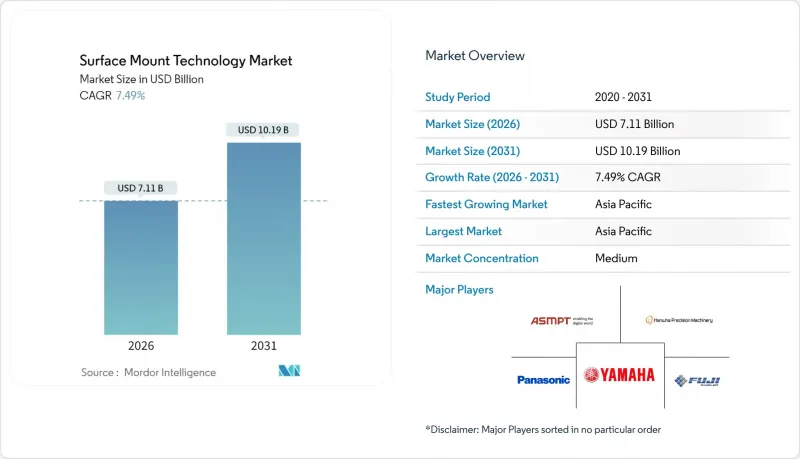
The Surface Mount Technology market was valued at USD 6.61 billion in 2025 and estimated to grow from USD 7.11 billion in 2026 to reach USD 10.19 billion by 2031, at a CAGR of 7.49% during the forecast period (2026-2031).
Demand for miniaturized, high-density electronics in consumer devices, electric vehicles, and industrial automation is underpinning this trajectory. Accelerated deployment of 5 G infrastructure, growth in artificial-intelligence servers, and the spread of edge and IoT products are keeping production lines close to full capacity across Asia, North America, and Europe. Automotive original-equipment manufacturers now specify automotive-grade SMT solutions able to tolerate -40 °C to 150 °C thermal swings, further tightening equipment requirements. Meanwhile, micro-LED and System-in-Package (SiP) innovations are shifting placement accuracy expectations from +-25 µm toward the sub-10 µm realm. Supply-chain volatility, especially for semiconductors and high-precision ceramics, remains the primary brake on near-term throughput despite healthy end-market fundamentals.
Global Surface Mount Technology Market Trends and Insights
IoT and Wearables Fuel Ultra-Dense PCB Adoption
Device makers now pack more than 10,000 multilayer ceramic capacitors into a single smartwatch, tripling the count seen five years ago. To print conductive traces below 50 µm and microvias under 75 µm, assemblies rely on placement tools that consistently handle 01005 packages at +-25 µm accuracy. Compliance with FCC emissions limits and IEC safety requirements is pushing additional electromagnetic-interference shielding steps, elevating demand for precision solder-paste inspection and automated optical inspection systems.
Automotive ADAS Electronics Adoption Reshapes Reliability Needs
Electric-vehicle reference designs use upward of 10,000 MLCCs and more than 200 electronic control units each, lifting SMT volumes even as lifecycle qualification stretches beyond three years. ISO 26262 functional-safety mandates and -40 °C to 150 °C operating windows compel suppliers to certify processes under automotive PPAP and AEC-Q200 stress tests. Equipment makers that can validate long-term solder-joint reliability are winning multiyear supply agreements across Europe and Japan.
High Upfront Capex Constrains Smaller Firms
Next-generation placement platforms cost upward of USD 3 million per line when bundled with in-line SPI, AOI, and x-ray testers. Although predictive-maintenance analytics lower total cost of ownership, many small and medium EMS providers struggle to justify payback within three years. Equipment rental and outcome-based service contracts are emerging but remain uncommon outside Tier-1 OEMs.
Other drivers and restraints analyzed in the detailed report include:
- 5G Infrastructure and High-Frequency Boards
- System-in-Package Integration in Smartphones
- Lead-Free Solder Thermal Constraints Lower Yield
For complete list of drivers and restraints, kindly check the Table Of Contents.
Segment Analysis
Active Components accounted for 65.74% of the Surface Mount Technology market share in 2025 as MCU, ASIC, and power-management demand accelerated in AI servers and electric vehicles. The segment is forecast to grow at an 8.62% CAGR to 2031 on the back of increased adoption of heterogenous SoC designs and high-voltage transistors. Passive Components still benefit from rising unit counts in 5G handsets and automotive traction inverters, but ceramic and tantalum material shortages continue to test supply-chain resiliency.
Customer expectations are evolving from component cost control to board-level integration density and long-tail reliability. OEMs request sub-10 ppm failure rates and 15-year field lifetimes, driving closer collaboration between substrate vendors, component makers, and placement-equipment suppliers. Suppliers that deliver active-passive co-design libraries and full Design-for-Assembly review accelerate new-product ramps, securing supplier-of-choice status for advanced wearables and industrial IoT gateways.
Placement Equipment still commands 42.62% of the Surface Mount Technology market size in 2025, but Inspection Equipment is rising fastest with a 8.83% CAGR. High-speed pick-and-place machines now hit 100 k cph with +-10 µm accuracy, aided by machine-learning vision systems that auto-tune head pressure. Soldering Equipment faces process-window squeezes as lead-free alloys demand tighter thermal gradients, while Screen-Printing platforms adopt closed-loop SPI feedback to boost first-pass yield.
Investment momentum favors AOI and x-ray systems that harness deep learning to cut false-call rates by 90 % and raise inspection speed four-fold. ViTrox and Koh Young incorporate IPC-CFX connectivity for real-time analytics that flag yield-eroding trends within minutes. Equipment finance packages bundling analytics subscriptions help offset sticker shock, enticing Tier-2 EMS firms in Eastern Europe and Southeast Asia to upgrade lines.
The Surface Mount Technology Market Report is Segmented by Component (Passive Components [Resistors, Capacitors], and More), Equipment Type (Placement Equipment [High-Speed Pick-And-Place Machines], and More), Assembly Line Type (High-Mix/Low-Volume, and More), End-User Industry (Consumer Electronics, and More), and Geography (North America, South America, and More). The Market Forecasts are Provided in Terms of Value (USD).
Geography Analysis
Asia-Pacific dominated with 48.05% Surface Mount Technology market share in 2025 and is forecast to post an 8.12% CAGR through 2031. China, Taiwan, and South Korea together are slated to invest more than USD 84 billion in new 300 mm fabs by 2027, securing upstream substrate and component capacity. Japan's Kumamoto cluster, anchored by TSMC JASM's USD 20 billion expansion, adds over 100,000 12-inch wafers per month while creating 3,400 high-tech roles.
North America trails but is accelerating under the CHIPS Act, with announced projects doubling regional capacity investment from USD 12 billion in 2024 to USD 24.7 billion by 2027. Advanced packaging pilots in Arizona and New York target sub-10 µm placement for AI accelerators, reducing dependence on trans-Pacific shipping lanes. Regulatory emphasis on cyber-secure production flows nudges factories toward CMMC and IPC-1791 trusted builder accreditation.
Europe focuses on automotive power semiconductors and wide-band-gap devices, with Infineon and STMicroelectronics driving capital expenditure to support 800 V EV inverters. The region's RoHS expansion and incoming Ecodesign rules favor repairable PCBs, stimulating demand for selective soldering and rework platforms. Workforce upskilling programs under Europe's Pact for Skills align with IPC's certified interconnect designer curriculum, aiming to close a 146,000-worker gap by 2029.
Middle East and Africa makes incremental gains as Saudi Arabia and the UAE funnel sovereign-fund capital into tech parks that bundle EMS incentives with reduced utility tariffs. South Africa's Gauteng hub attracts telecom-equipment refurbishers that rely on modular SMT lines to process short-run, high-mix repair orders. Still, infrastructure gaps and limited specialist labor temper adoption of cutting-edge equipment in most sub-Saharan markets.
- ASMPT Limited
- Fuji Corporation
- Yamaha Motor Co., Ltd. (SMT Division)
- Panasonic Holdings Corporation (Panasonic Smart Factory Solutions)
- Hanwha Precision Machinery Co., Ltd.
- Mycronic AB
- Juki Corporation
- Nordson Corporation
- Koh Young Technology Inc.
- Saki Corporation
- Test Research, Inc. (TRI)
- Viscom SE
- Europlacer Holdings Ltd.
- Shenzhen JT Automation Equipment Co., Ltd.
- Rehm Thermal Systems GmbH
- Heller Industries, Inc.
- MIRTEC Co., Ltd.
- Shenzhen NEODEN Technology Co., Ltd.
- Shenzhen JAGUAR Automation Equipment Co., Ltd.
- Hanwa Precision Machinery Co., Ltd.
Additional Benefits:
- The market estimate (ME) sheet in Excel format
- 3 months of analyst support
TABLE OF CONTENTS
1 Introduction
- 1.1 Study Assumptions and Market Definition
- 1.2 Scope of the Study
2 Research Methodology
3 Executive Summary
4 Market Landscape
- 4.1 Market Overview
- 4.2 Market Drivers
- 4.2.1 Proliferation of IoT and wearables driving high-density PCB demand
- 4.2.2 Automotive ADAS electronics adoption
- 4.2.3 Expansion of 5G infrastructure and high-frequency boards
- 4.2.4 System-in-Package (SiP) integration in smartphones
- 4.2.5 MicroLED display manufacturing requirements
- 4.2.6 OEM outsourcing to EMS firms in emerging economies
- 4.3 Market Restraints
- 4.3.1 High upfront capex for high-speed placement lines
- 4.3.2 Lead-free solder thermal constraints lowering yield
- 4.3.3 Semiconductor supply-chain volatility causing under-utilisation
- 4.3.4 Skilled labour shortage for AI-driven inspection systems
- 4.4 Value Chain Analysis
- 4.5 Regulatory Landscape
- 4.6 Technological Outlook
- 4.7 Porter's Five Forces Analysis
- 4.7.1 Bargaining Power of Suppliers
- 4.7.2 Bargaining Power of Buyers
- 4.7.3 Threat of New Entrants
- 4.7.4 Threat of Substitutes
- 4.7.5 Intensity of Competitive Rivalry
- 4.8 Macroeconomic Trends Impact Analysis
5 Market Size and Growth Forecasts (Value)
- 5.1 By Component
- 5.1.1 Passive Components
- 5.1.1.1 Resistors
- 5.1.1.2 Capacitors
- 5.1.2 Active Components
- 5.1.2.1 Transistors
- 5.1.2.2 Integrated Circuits
- 5.1.1 Passive Components
- 5.2 By Equipment Type
- 5.2.1 Placement Equipment
- 5.2.1.1 High-speed Pick-and-Place Machines
- 5.2.2 Soldering Equipment
- 5.2.2.1 Reflow Ovens
- 5.2.2.2 Wave Solder Systems
- 5.2.3 Inspection Equipment
- 5.2.3.1 Automated Optical Inspection (AOI)
- 5.2.3.2 Solder Paste Inspection (SPI)
- 5.2.3.3 X-ray Inspection
- 5.2.4 Screen Printing Equipment
- 5.2.1 Placement Equipment
- 5.3 By Assembly Line Type
- 5.3.1 High-Mix / Low-Volume (HMLV)
- 5.3.2 High-Volume / High-Mix (HVHM)
- 5.4 By End-user Industry
- 5.4.1 Consumer Electronics
- 5.4.2 Automotive
- 5.4.3 Industrial Electronics
- 5.4.4 Aerospace and Defense
- 5.4.5 Healthcare
- 5.4.6 Telecom and IT Infrastructure
- 5.4.7 Other End-users
- 5.5 By Geography
- 5.5.1 North America
- 5.5.1.1 United States
- 5.5.1.2 Canada
- 5.5.1.3 Mexico
- 5.5.2 Europe
- 5.5.2.1 Germany
- 5.5.2.2 United Kingdom
- 5.5.2.3 France
- 5.5.2.4 Italy
- 5.5.2.5 Spain
- 5.5.2.6 Rest of Europe
- 5.5.3 Asia-Pacific
- 5.5.3.1 China
- 5.5.3.2 Japan
- 5.5.3.3 South Korea
- 5.5.3.4 India
- 5.5.3.5 Rest of Asia-Pacific
- 5.5.4 Middle East
- 5.5.4.1 Saudi Arabia
- 5.5.4.2 United Arab Emirates
- 5.5.4.3 Rest of Middle East
- 5.5.5 Africa
- 5.5.5.1 South Africa
- 5.5.5.2 Rest of Africa
- 5.5.1 North America
6 Competitive Landscape
- 6.1 Market Concentration
- 6.2 Strategic Moves
- 6.3 Market Share Analysis
- 6.4 Company Profiles (includes Global level Overview, Market level overview, Core Segments, Financials as available, Strategic Information, Market Rank/Share for key companies, Products and Services, and Recent Developments)
- 6.4.1 ASMPT Limited
- 6.4.2 Fuji Corporation
- 6.4.3 Yamaha Motor Co., Ltd. (SMT Division)
- 6.4.4 Panasonic Holdings Corporation (Panasonic Smart Factory Solutions)
- 6.4.5 Hanwha Precision Machinery Co., Ltd.
- 6.4.6 Mycronic AB
- 6.4.7 Juki Corporation
- 6.4.8 Nordson Corporation
- 6.4.9 Koh Young Technology Inc.
- 6.4.10 Saki Corporation
- 6.4.11 Test Research, Inc. (TRI)
- 6.4.12 Viscom SE
- 6.4.13 Europlacer Holdings Ltd.
- 6.4.14 Shenzhen JT Automation Equipment Co., Ltd.
- 6.4.15 Rehm Thermal Systems GmbH
- 6.4.16 Heller Industries, Inc.
- 6.4.17 MIRTEC Co., Ltd.
- 6.4.18 Shenzhen NEODEN Technology Co., Ltd.
- 6.4.19 Shenzhen JAGUAR Automation Equipment Co., Ltd.
- 6.4.20 Hanwa Precision Machinery Co., Ltd.
7 Market Opportunities and Future Outlook
- 7.1 White-space and Unmet-Need Assessment

