
PUBLISHER: Mordor Intelligence | PRODUCT CODE: 1940724

PUBLISHER: Mordor Intelligence | PRODUCT CODE: 1940724
Consulting Service - Market Share Analysis, Industry Trends & Statistics, Growth Forecasts (2026 - 2031)
The Consulting Service market is expected to grow from USD 371.04 billion in 2025 to USD 388.74 billion in 2026 and is forecast to reach USD 490.67 billion by 2031 at 4.77% CAGR over 2026-2031.
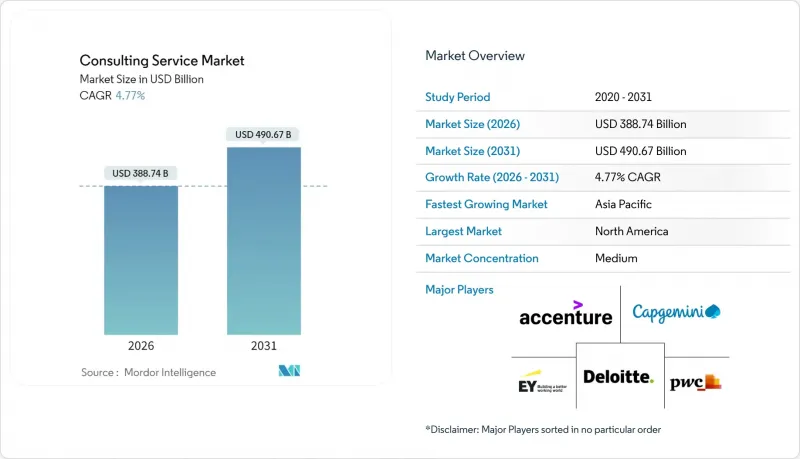
The market's stable expansion reflects a decisive pivot from traditional advisory toward technology-enabled, outcome-oriented engagement models. Board-level urgency around digital transformation, heightened regulatory scrutiny on environmental, social, and governance (ESG) performance, and intensifying cyber risk are funneling enterprise spending toward high-value consulting offerings. Large firms are broadening capability sets through acquisitions that plug expertise gaps in artificial intelligence (AI), cloud migration, and energy transition, while boutique specialists win mandates by offering deep domain knowledge and agile delivery. Hybrid engagement models that combine on-site and virtual delivery are normalizing, allowing firms to access global talent, lower project costs, and reduce travel-related carbon footprints. Competitive differentiation hinges on proprietary platforms, data-driven methodologies, and demonstrable impact metrics that tie fees to measurable client outcomes.
Global Consulting Service Market Trends and Insights
Accelerating Digital-Transformation Mandates
Enterprises are compressing multi-year modernization programs into shorter cycles, driving premium demand for consultants who can orchestrate cloud migration, data modernization, and advanced analytics at scale. Industry-specific cloud solutions allow sector customization, prompting consultants to blend process redesign with technology implementation. Healthcare providers are deploying telehealth ecosystems, manufacturers are embedding sensors for predictive maintenance, and financial institutions are rolling out real-time payment rails. Consulting firms respond with dedicated industry-cloud practices that cover architecture design, data migration, and compliance alignment, repositioning themselves as execution partners rather than purely strategic advisors. The shift elevates long-term annuity revenue from managed services that follow the initial transformation phase.
Heightened Post-Pandemic Operational-Efficiency Focus
Cost containment remains a board priority as supply-side inflation and wage pressure erode margins. Organizations demand quantifiable return-on-investment from consulting engagements, spurring outcome-based fee models tied to throughput gains, automation intensity or working-capital release. Assignments increasingly revolve around process mining, intelligent automation and lean restructuring of hybrid workforces. Consultants embed performance dashboards that track key performance indicators in real time, ensuring transparency and accelerating decision-making. This results-oriented mindset cements consulting firms as value-creation partners rather than discretionary spend items, strengthening wallet share among cost-conscious clients.
Client Cost-Cutting and In-House Capability Build
Economic caution is prompting enterprises to rebalance external spend toward strategic gaps only, while internal centers of excellence absorb routine advisory functions. Selective sourcing strategies emphasize value capture, pushing consultants to differentiate through proprietary tools, industry benchmarks and outcome guarantees. Simultaneously, firms offer co-sourcing models that embed consultants within client teams to transfer knowledge and speed capability maturation, preserving engagement opportunities despite budget restraint.
Other drivers and restraints analyzed in the detailed report include:
- Growing Regulatory Complexity in ESG and Risk
- Demand for Advisory on Gen-AI Governance
- Talent Scarcity and Wage Inflation
For complete list of drivers and restraints, kindly check the Table Of Contents.
Segment Analysis
Operations consulting captured 28.94% of the consulting service market share in 2025, underscoring persistent demand for process optimization across manufacturing, retail, and energy sectors. Technology Advisory is expanding at a 6.29% CAGR as enterprises seek expertise in AI governance, cloud transformation, and cyber-resilience. The market benefits from the convergence of technology and traditional management advisory, prompting firms to invest in end-to-end capabilities spanning strategy, implementation, and managed services.Technology Advisory engagements increasingly bundle cloud-migration road maps with cybersecurity safeguards and data-modernization blueprints. Firms integrate proprietary accelerators to compress timelines and lower risk, creating annuity revenue through managed cloud operations. Operations consulting remains relevant by embedding digital twins, process-mining analytics, and robotic process automation into classic lean toolkits. Cross-selling between Operations and Technology practices deepens wallet share and exemplifies the consulting service market's shift toward integrated transformation solutions.
The Healthcare and Life Sciences segment is forecast to post a 6.63% CAGR, outpacing all other verticals as digital therapeutics, remote patient monitoring, and AI-assisted drug discovery reshape operating models. BFSI retained 22.10% of the consulting service market size in 2025, reflecting sustained cybersecurity, regulatory compliance, and core-bank modernization projects. Consulting opportunities in energy and utilities concentrate on decarbonization strategy, grid modernization, and hydrogen ecosystem planning, reinforcing the sector's reliance on multidisciplinary advisory.
Heightened data-privacy regulation, patient-centric care models, and reimbursement shifts underpin healthcare consulting momentum. Firms combine regulatory know-how with technology enablement, guiding providers through electronic-health-record upgrades and cloud-based clinical trial platforms. In financial services, demand centers on real-time payment rails, digital identity, and environmental risk stress-testing. Cross-vertical synergies emerge as ESG disclosure rules and data-governance standards converge, expanding the market's addressable scope.
The Consulting Service Market Report is Segmented by Service Type (Operations, Strategy, Financial Advisory, Technology Advisory, Human-Capital, Risk and Compliance, Other Service Types), Client Industry (BFSI, Healthcare and Life Sciences, and More), Delivery Model (On-Site, Remote/Virtual, Hybrid), Organisation Size, and Geography. The Market Forecasts are Provided in Terms of Value (USD).
Geography Analysis
North America generated 40.62% of 2025 revenue, buoyed by high technology adoption, federal cybersecurity funding, and stringent financial services regulation. U.S. enterprises engage consultants for AI governance frameworks, zero-trust architecture implementation, and ESG compliance road maps. Canada contributes niche growth in energy-transition consulting, leveraging its resource-rich economy to test carbon-capture and hydrogen pilot schemes. Intensifying climate-related disclosure mandates sustains long-term consulting demand across both countries.
Asia-Pacific is the fastest-growing region, set to expand at a 6.92% CAGR through 2031, propelled by large-scale digital-infrastructure projects, e-government initiatives, and renewables build-out. China anchors regional demand with AI-infused supply-chain optimization and consumer banking digitization. Japan's emphasis on industrial robotics and Singapore's status as a financial-services innovation hub create fertile terrain for specialized consulting shops. India blends healthcare digitalization, manufacturing automation, and smart-city programs, reinforcing the consulting service market's momentum in the subcontinent.
Europe maintains steady growth, driven by energy-transition imperatives, data-privacy regulation and sustainability leadership. The Corporate Sustainability Reporting Directive compels companies to seek advisors who can meet stringent reporting timelines and assurance thresholds. Germany and France focus on Industry 4.0 productivity gains, while the Nordics pioneer circular-economy strategies that elevate demand for innovative operating-model rewiring. Middle East and Africa harness diversification policies and mega-infrastructure projects to attract global consulting expertise, whereas South America's natural-resource producers require ESG and operational-efficiency road maps to remain globally competitive.
- Deloitte Touche Tohmatsu Limited
- Accenture plc
- PricewaterhouseCoopers LLP
- Ernst & Young Global Limited
- KPMG International Cooperative
- Capgemini SE
- McKinsey & Company, Inc.
- Boston Consulting Group, Inc.
- Bain & Company, Inc.
- Roland Berger Holding GmbH & Co. KGaA
- A.T. Kearney, Inc.
- Simon-Kucher & Partners Strategy & Marketing Consultants GmbH
- OC&C Strategy Consultants LLP
- Gartner, Inc.
- Tata Consultancy Services Limited
- IBM Consulting (International Business Machines Corporation)
- Booz Allen Hamilton Holding Corporation
- CGI Inc.
- Infosys Consulting (Infosys Limited)
- Oliver Wyman Group (Marsh McLennan)
Additional Benefits:
- The market estimate (ME) sheet in Excel format
- 3 months of analyst support
TABLE OF CONTENTS
1 INTRODUCTION
- 1.1 Study Assumptions and Market Definition
- 1.2 Scope of the Study
2 RESEARCH METHODOLOGY
3 EXECUTIVE SUMMARY
4 MARKET LANDSCAPE
- 4.1 Market Overview
- 4.2 Market Drivers
- 4.2.1 Mainstream - Accelerating digital-transformation mandates
- 4.2.2 Mainstream - Heightened post-pandemic operational-efficiency focus
- 4.2.3 Mainstream - Growing regulatory complexity in ESG and risk
- 4.2.4 Mainstream - Rapid cloud and cybersecurity adoption
- 4.2.5 Under-the-radar - Demand for advisory on Gen-AI governance
- 4.2.6 Under-the-radar - Board-level pressure for Scope-3 value-chain decarbonisation
- 4.3 Market Restraints
- 4.3.1 Mainstream - Client cost-cutting and in-house capability build
- 4.3.2 Mainstream - Talent scarcity and wage inflation
- 4.3.3 Under-the-radar - Rising carbon-footprint scrutiny of travel-heavy projects
- 4.3.4 Under-the-radar - Vendor-lock-in concerns around proprietary consulting assets
- 4.4 Industry Value-Chain Analysis
- 4.5 Regulatory Landscape
- 4.6 Technological Outlook
- 4.7 Impact of Industry 4.0 and Digital-Transformation Practices
- 4.8 Industry Ecosystem Analysis
- 4.9 Key Regional Hotspots
- 4.10 Prevalent Business Models in Management Consulting
- 4.11 Porter's Five Forces Analysis
- 4.11.1 Bargaining Power of Buyers
- 4.11.2 Bargaining Power of Suppliers
- 4.11.3 Threat of New Entrants
- 4.11.4 Threat of Substitutes
- 4.11.5 Competitive Rivalry
5 MARKET SIZE AND GROWTH FORECASTS
- 5.1 By Service Type (Value)
- 5.1.1 Operations Consulting
- 5.1.2 Strategy Consulting
- 5.1.3 Financial Advisory
- 5.1.4 Technology Advisory
- 5.1.5 Human-Capital Consulting
- 5.1.6 Risk and Compliance Consulting
- 5.1.7 Other Service Types
- 5.2 By Client Industry (Value)
- 5.2.1 BFSI
- 5.2.2 Healthcare and Life Sciences
- 5.2.3 Energy and Utilities
- 5.2.4 Manufacturing and Automotive
- 5.2.5 ICT and Media
- 5.2.6 Public Sector
- 5.2.7 Consumer and Retail
- 5.2.8 Other Industries
- 5.3 By Delivery Model (Value)
- 5.3.1 On-site Consulting
- 5.3.2 Remote / Virtual Consulting
- 5.3.3 Hybrid Consulting
- 5.4 By Organisation Size (Value)
- 5.4.1 Large Enterprises
- 5.4.2 Small and Medium-sized Enterprises
- 5.5 By Geography (Value)
- 5.5.1 North America
- 5.5.1.1 United States
- 5.5.1.2 Canada
- 5.5.2 South America
- 5.5.2.1 Brazil
- 5.5.3 Europe
- 5.5.3.1 United Kingdom
- 5.5.3.2 Germany
- 5.5.3.3 France
- 5.5.3.4 Italy
- 5.5.4 Asia-Pacific (APAC)
- 5.5.5 Middle East and Africa
- 5.5.5.1 Middle East
- 5.5.5.1.1 Saudi Arabia
- 5.5.5.1.2 United Arab Emirates
- 5.5.5.2 Africa
- 5.5.5.2.1 South Africa
- 5.5.5.1 Middle East
- 5.5.1 North America
6 COMPETITIVE LANDSCAPE
- 6.1 Market Concentration
- 6.2 Strategic Moves
- 6.3 Market Share Analysis
- 6.4 Company Profiles (includes Global level Overview, Market level overview, Core Segments, Financials as available, Strategic Information, Market Rank/Share for key companies, Products and Services, and Recent Developments)
- 6.4.1 Deloitte Touche Tohmatsu Limited
- 6.4.2 Accenture plc
- 6.4.3 PricewaterhouseCoopers LLP
- 6.4.4 Ernst & Young Global Limited
- 6.4.5 KPMG International Cooperative
- 6.4.6 Capgemini SE
- 6.4.7 McKinsey & Company, Inc.
- 6.4.8 Boston Consulting Group, Inc.
- 6.4.9 Bain & Company, Inc.
- 6.4.10 Roland Berger Holding GmbH & Co. KGaA
- 6.4.11 A.T. Kearney, Inc.
- 6.4.12 Simon-Kucher & Partners Strategy & Marketing Consultants GmbH
- 6.4.13 OC&C Strategy Consultants LLP
- 6.4.14 Gartner, Inc.
- 6.4.15 Tata Consultancy Services Limited
- 6.4.16 IBM Consulting (International Business Machines Corporation)
- 6.4.17 Booz Allen Hamilton Holding Corporation
- 6.4.18 CGI Inc.
- 6.4.19 Infosys Consulting (Infosys Limited)
- 6.4.20 Oliver Wyman Group (Marsh McLennan)
7 MARKET OPPORTUNITIES AND FUTURE OUTLOOK
- 7.1 White-space and Unmet-Need Assessment

