PUBLISHER: Mordor Intelligence | PRODUCT CODE: 1940790

PUBLISHER: Mordor Intelligence | PRODUCT CODE: 1940790
Secondary Packaging - Market Share Analysis, Industry Trends & Statistics, Growth Forecasts (2026 - 2031)
The secondary packaging market was valued at USD 268.50 billion in 2025 and estimated to grow from USD 282.14 billion in 2026 to reach USD 361.46 billion by 2031, at a CAGR of 5.08% during the forecast period (2026-2031).
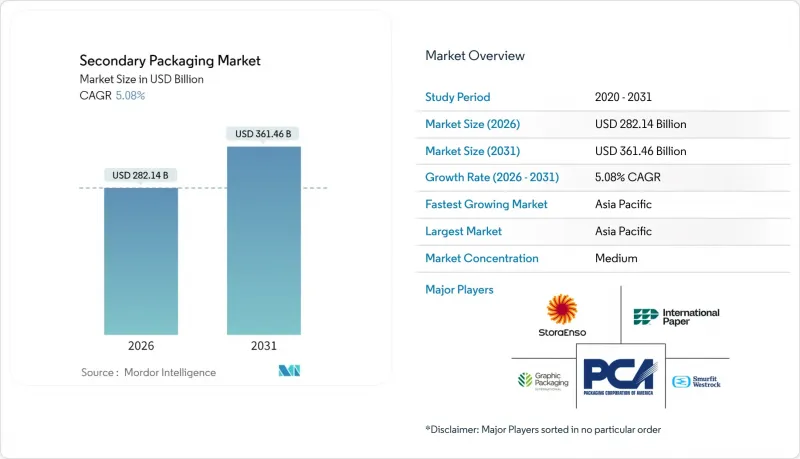
Rising e-commerce volumes, retailer zero-waste mandates, and brand-owner requests for shelf-ready packs underpin steady demand for corrugated solutions that already supply 80% of online-retail parcels. Automation-ready designs are gaining traction as 84% of consumer packaged-goods producers have deployed robotics on secondary lines, and the share is projected to reach 93% by 2027. Digital printing, valued at USD 26.3 billion in 2022, is on course to exceed USD 51.5 billion by 2032 and is helping converters manage SKU proliferation through on-demand customization. Asia-Pacific commands 41% of the secondary packaging market share, propelled by China's packaging-machinery suppliers whose global share rose from 20% to 35% in five years. Consolidation among global paper and board majors continues, yet European surplus capacity and a 15.3% drop in 2023 consumption create margin pressure that tempers pricing power.
Global Secondary Packaging Market Trends and Insights
E-commerce Boom Fueling Corrugated Demand
Corrugated cases already supply 80% of parcels shipped through online channels, and 2.71 billion consumers purchased goods digitally in 2024, turning the shipping box into a frontline branding asset. Fit-to-product technology is cutting void fill and material usage while lowering dimensional-weight charges for carriers. With the global corrugated segment projected to surpass USD 800 billion by 2034, converters are broadening portfolios to include insulated inserts and tamper-evident seals that address perishability and security concerns. Digital presses enable late-stage personalization so brands can deliver promotional messages inside the shipper, boosting unboxing engagement. Automation-friendly die cuts support robotic erecting and packing, accelerating throughput in high-volume fulfillment nodes. Sustainability credentials of paper fiber resonate with retailers that pledge to eliminate hard-to-recycle plastics from secondary packaging market offerings.
Shift to Automation-Ready Pack Formats
Labour scarcity and production-line efficiency goals spur investment in robotic pick-and-place, case packing, and palletizing equipment, pushing the global packaging-robot market from USD 3.8 billion in 2022 to an anticipated USD 7.5 billion by 2032. Standardized secondary pack footprints, stiffer board grades, and reinforced corner posts enable end-effectors to grasp boxes consistently at high speeds. Treasury Wine Estates' autonomous barrel-hall upgrade lifted throughput by 60%, illustrating the ROI available when packaging is engineered for hands-free handling. Equipment-as-a-Service contracts now spread capital outlays over multiyear terms, easing adoption for mid-sized converters. As predictive-maintenance software matures, downtime tied to case-erector jams or palletizer misfeeds falls, preserving uptime targets above 95%. Over the long term, automation-ready concepts will permeate the secondary packaging industry as robots move down the cost curve.
Surplus Paperboard Capacity in Europe
European mills cut output 12.8% in 2023 after consumption fell 15.3%, yet oversupply persists, keeping linerboard prices subdued and eroding profitability. High electricity costs compel temporary shutdowns, while recovered-paper values dropped nearly 25% in Q3 2024, reflecting muted demand for recycled furnish. Producers pursue mergers to rationalize capacity, but antitrust scrutiny prolongs timelines. Short-term price weakness discourages capital upgrades in corrugating plants, delaying deployment of lightweight high-performance board grades. Consequently, European converters hunting for export growth selectively invest in flexible corrugators that can pivot between flute profiles and optimize fiber usage.
Other drivers and restraints analyzed in the detailed report include:
- Brand-Owner Push for Shelf-Ready Solutions
- Online Grocery Growth in Emerging APAC
- Rising Cost Volatility of Recycled Fibre
For complete list of drivers and restraints, kindly check the Table Of Contents.
Segment Analysis
Corrugated boxes retained 41.35% of the secondary packaging market share in 2025 on the back of their proven structural performance and cost-efficiency across food, e-commerce, and industrial supply chains. Steady upgrades to high-stack strength fluting and coatings that tolerate humid warehouses reinforce the segment's leadership, while digital print, in line with corrugators, shortens lead times and lowers minimum-order quantities. Retailers favor right-sized shippers that reduce void fill, and box plants answer with new high-speed laser-scoring lines able to switch SKUs in under two minutes. Automation-compatible RSC and crash-lock designs support end-of-line robotics, trimming manual labor and keeping throughput above 35 cases per minute. Corrugated converters also deploy fit-to-product equipment that cuts board usage by up to 18%, aligning with zero-waste scorecards in grocery and general merchandise channels.
Returnable transit packaging (RTP) clocks the fastest 2026-2031 growth at 8.41% CAGR as large retailers and automotive OEMs seek circular logistics models that eliminate single-use fiber. Polypropylene foldable crates slash damage rates in produce moves and can cycle more than 100 trips, delivering favorable total cost of ownership. Toyota Material Handling Europe reported 74% solid-waste reduction and EUR 4.5 million in savings after migrating to RTP pools. European PPWR targets that all transport packs be reusable or recyclable by 2030 add regulatory tailwinds. Foam wraps, shrink sleeves, and films continue to evolve with higher puncture resistance to cope with same-day delivery handling, while premium folding cartons sustain niche demand in cosmetics and spirits through upscale graphics and renewable sourcing narratives.
The Secondary Packaging Market Report is Segmented by Product Type (Folding Cartons, Corrugated Boxes, Plastic Crates and Totes, Wraps and Films, and More), End-User Industry (Food, Beverage, Healthcare and Pharma, Consumer Electronics, Personal Care and Household Care, and More), and Geography (North America, Europe, South America, Asia-Pacific, Middle East, and Africa). The Market Forecasts are Provided in Terms of Value (USD).
Geography Analysis
Asia-Pacific captured 40.55% of the secondary packaging market size in 2025 and is forecast to post a 11.72% CAGR through 2031 as manufacturing output climbs and online retail penetration deepens. China's equipment suppliers raised their global share to 35%, enabling regional converters to install high-speed corrugators at attractive capital costs. India's packaged-food sector is moving from USD 32 billion in 2020 toward USD 55 billion by 2025, fueling demand for shelf-stable folding cartons and sturdy shipping cases. Vietnam's 900-plus packaging firms, clustered around Ho Chi Minh City, benefit from 15-20% annual growth in domestic e-commerce orders.
North America experiences robust parcel volumes and the reshoring of consumer-goods manufacturing, encouraging upgrades to robotic case-packing cells in both green- and brownfield warehouses. Retailers such as Walmart set circular-packaging targets that nudge suppliers to swap out polystyrene void fill for paper cushioning. In contrast, Europe grapples with over-capacity in paperboard that dragged consumption down 15.3% in 2023, although demand for folding cartons and sack-kraft showed resilience with 6.5% output growth.
Southeast Asia is projected to become the fourth-largest economic bloc by 2050, helped by tax incentives that draw global electronics and apparel brands to localize production. Middle East and Africa remain nascent yet promising, propelled by infrastructure investments and a youthful consumer base buying more online. Regulatory divergence is stark: the EU PPWR mandates full recyclability by 2030, whereas U.S. regulations vary by state and California's 25% single-use plastic reduction targets create a moving compliance landscape. Multinationals hedge risk by adopting globally compliant designs that can be fine-tuned with localized labeling.
- Smurfit Westrock
- Packaging Corporation of America (PCA)
- Stora Enso Oyj
- International Paper Company
- Graphic Packaging Holding Co.
- WestRock Company
- Sealed Air Corporation
- Reynolds Group Holdings
- Mondi Group
- Amcor plc
- DS Smith plc
- Sonoco Products Company
- Huhtamaki Oyj
- Crown Holdings Inc.
- Ball Corporation
- Tetra Pak
- Pratt Industries
- Nippon Paper Industries
- Rengo Co. Ltd.
Additional Benefits:
- The market estimate (ME) sheet in Excel format
- 3 months of analyst support
TABLE OF CONTENTS
1 INTRODUCTION
- 1.1 Study Assumptions and Market Definition
- 1.2 Scope of the Study
2 RESEARCH METHODOLOGY
3 EXECUTIVE SUMMARY
4 MARKET LANDSCAPE
- 4.1 Market Overview
- 4.2 Market Drivers
- 4.2.1 E-commerce boom fueling corrugated demand
- 4.2.2 Shift to automation-ready pack formats
- 4.2.3 Brand-owner push for shelf-ready solutions
- 4.2.4 Retailer's zero-waste mandates
- 4.2.5 On-line grocery growth in emerging APAC
- 4.2.6 Adoption of digital printing for SKU agility
- 4.3 Market Restraints
- 4.3.1 Surplus paperboard capacity in Europe
- 4.3.2 Rising cost volatility of recycled fibre
- 4.3.3 Persistent plastics-tax uncertainty
- 4.3.4 Cap-ex hurdle for robotics retrofits
- 4.4 Value / Supply-Chain Analysis
- 4.5 Regulatory Landscape
- 4.6 Technological Outlook
- 4.7 Porter's Five Forces
- 4.7.1 Bargaining Power of Buyers
- 4.7.2 Bargaining Power of Suppliers
- 4.7.3 Threat of New Entrants
- 4.7.4 Threat of Substitute Products and Services
- 4.7.5 Intensity of Competitive Rivalry
- 4.8 Impact of Geo-Political Scenarios on the Market
5 MARKET SIZE & GROWTH FORECASTS (VALUE, USD BN)
- 5.1 By Product Type
- 5.1.1 Folding Cartons
- 5.1.2 Corrugated Boxes
- 5.1.3 Plastic Crates and Totes
- 5.1.4 Wraps, Films and Shrink Sleeves
- 5.1.5 Returnable Transit Packaging (RTP)
- 5.2 By End-user Industry
- 5.2.1 Food
- 5.2.2 Beverage
- 5.2.3 Healthcare and Pharma
- 5.2.4 Consumer Electronics
- 5.2.5 Personal and Household Care
- 5.2.6 Industrial Goods
- 5.2.7 E-commerce and Logistics
- 5.3 By Geography
- 5.3.1 North America
- 5.3.1.1 United States
- 5.3.1.2 Canada
- 5.3.1.3 Mexico
- 5.3.2 South America
- 5.3.2.1 Brazil
- 5.3.2.2 Argentina
- 5.3.2.3 Rest of South America
- 5.3.3 Europe
- 5.3.3.1 Germany
- 5.3.3.2 United Kingdom
- 5.3.3.3 France
- 5.3.3.4 Italy
- 5.3.3.5 Spain
- 5.3.3.6 Russia
- 5.3.3.7 Rest of Europe
- 5.3.4 Asia-Pacific
- 5.3.4.1 China
- 5.3.4.2 Japan
- 5.3.4.3 India
- 5.3.4.4 South Korea
- 5.3.4.5 South-East Asia
- 5.3.4.6 Rest of APAC
- 5.3.5 Middle East and Africa
- 5.3.5.1 Middle East
- 5.3.5.1.1 Saudi Arabia
- 5.3.5.1.2 United Arab Emirates
- 5.3.5.1.3 Turkey
- 5.3.5.1.4 Rest of Middle East
- 5.3.5.2 Africa
- 5.3.5.2.1 South Africa
- 5.3.5.2.2 Nigeria
- 5.3.5.2.3 Rest of Africa
- 5.3.5.1 Middle East
- 5.3.1 North America
6 COMPETITIVE LANDSCAPE
- 6.1 Market Concentration
- 6.2 Strategic Moves
- 6.3 Market Share Analysis
- 6.4 Company Profiles (includes Global level Overview, Market level overview, Core Segments, Financials as available, Strategic Information, Market Rank/Share for key companies, Products and Services, and Recent Developments)
- 6.4.1 Smurfit Westrock
- 6.4.2 Packaging Corporation of America (PCA)
- 6.4.3 Stora Enso Oyj
- 6.4.4 International Paper Company
- 6.4.5 Graphic Packaging Holding Co.
- 6.4.6 WestRock Company
- 6.4.7 Sealed Air Corporation
- 6.4.8 Reynolds Group Holdings
- 6.4.9 Mondi Group
- 6.4.10 Amcor plc
- 6.4.11 DS Smith plc
- 6.4.12 Sonoco Products Company
- 6.4.13 Huhtamaki Oyj
- 6.4.14 Crown Holdings Inc.
- 6.4.15 Ball Corporation
- 6.4.16 Tetra Pak
- 6.4.17 Pratt Industries
- 6.4.18 Nippon Paper Industries
- 6.4.19 Rengo Co. Ltd.
7 MARKET OPPORTUNITIES & FUTURE OUTLOOK
- 7.1 White-space & Unmet-need Assessment
- 7.2 Investment Analysis

