PUBLISHER: Mordor Intelligence | PRODUCT CODE: 1940817

PUBLISHER: Mordor Intelligence | PRODUCT CODE: 1940817
System On Chip (SoC) - Market Share Analysis, Industry Trends & Statistics, Growth Forecasts (2026 - 2031)
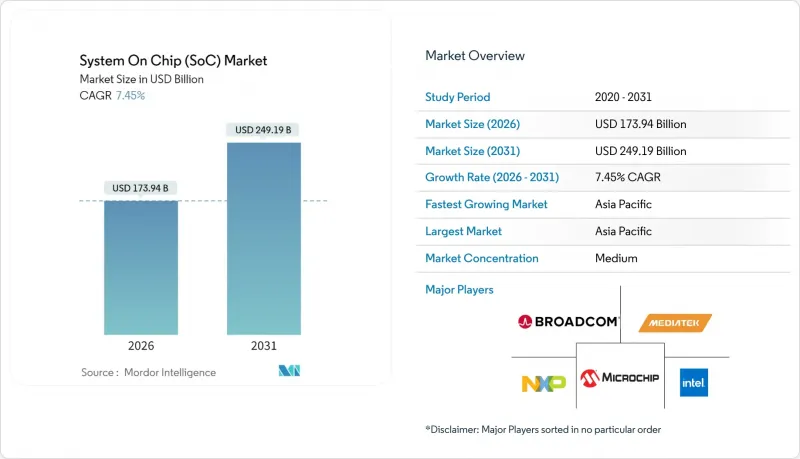
The system-on-chip market is expected to grow from USD 161.88 billion in 2025 to USD 173.94 billion in 2026 and is forecast to reach USD 249.19 billion by 2031 at 7.45% CAGR over 2026-2031.
Softer smartphone refresh cycles were offset by rapid adoption of edge-native AI inference and 5G client devices, keeping unit volumes stable and average die sizes larger. Tier-one automotive OEMs consolidated dozens of control units into centralized compute domains, lifting demand for multicore, ASIL-D capable SoCs. Hyperscalers continued to displace merchant silicon with in-house designs, widening the addressable opportunity for advanced packaging providers. Regional fab incentives in the United States, Japan, and the European Union funded capacity that tempered supply-chain risk and encouraged localized design-for-manufacture strategies.
Global System On Chip (SoC) Market Trends and Insights
Soaring Demand for 5G-Enabled Devices
The first wave of standalone 5G networks brought tighter uplink budgets and higher baseband complexity, prompting smartphone OEMs to embed AI tuning engines inside the modem subsystem. Qualcomm's Snapdragon 8 Elite coupled a Release 17-class modem with a 45 TOPS neural engine that lifted performance per watt by 45% versus its predecessor. MediaTek's Dimensity 9400 adopted a similar hierarchy, accelerating in-line video enhancement for premium handsets launched in early 2025. Companion modules targeting industrial routers replicated this integration, allowing sub-millisecond actuation in smart-factory cells without cloud round-trips. Consequently, handset and industrial gateway refreshes amplified the near-term revenue pulse across the system-on-chip market.
Rapid IoT and AI-Edge Proliferation
Distributed inference workloads pushed designers to blend general-purpose cores, DSPs, and neural accelerators on a single die. EdgeCortix's SAKURA-II delivered 40 TOPS at sub-10-watt draw for industrial cameras that inspect parts in line. Smart-city integrators retrofitted traffic-signal cabinets with microservers that compress video streams locally before dispatching metadata, slashing backhaul by 80%. The architectural pivot increased silicon content per node while shortening design cycles, which in turn elevated heterogeneous/fusion SoCs as the fastest growing slice of the system on chip market.
Escalating Sub-5 nm Design and Mask Costs
Mask-set expenses for TSMC's 2 nm node surpassed USD 30,000 per wafer in late 2024, 50% higher than 3 nm, and drove total project budgets for complex SoCs toward USD 100 million. Only a handful of fabless houses could underwrite such outlays, forcing the long-tail of designers onto mature nodes, limiting feature integration and flattening TAM growth for bleeding-edge EDA vendors.
Other drivers and restraints analyzed in the detailed report include:
- Automotive Shift to Centralized E/E Architectures
- Subsidy-Fuelled Regional Fab Build-Out
- Export-Control Driven Supply-Chain Fragility
For complete list of drivers and restraints, kindly check the Table Of Contents.
Segment Analysis
Digital SoC devices held 52.45% of 2025 revenue, reflecting their ubiquity in smartphones and general computing. Designers reused scalable IP libraries across tiers, smoothing cost curves and enabling rapid derivative launches. However, the arrival of chiplet-based stacking tolls the first structural challenge to monolithic digital supremacy. Heterogeneous/fusion SoCs-splicing CPU, GPU, NPU, and specialty accelerators on a single interposer-logged a 9.7% CAGR outlook, siphoning share from legacy digital formats. Mixed-signal variants remained pivotal where sensor fusion and power management intersected, such as in battery BMS controllers. RF/connectivity SoCs capitalized on expanded Wi-Fi 7 and 5G RedCap rollouts, while analog-centric devices anchored powertrain and industrial drive channels. The result is a transitional phase where the system-on-chip market preserves digital volume leadership yet directs incremental R&D to modular, domain-specific hybrids.
The architectural reshuffle also changed the foundry mix. Pure digital tape-outs gravitated to high utilization 7/6 nm lines, whereas early heterogeneous prototypes paired 5 nm logic dies with 16 nm analogue chiplets, nesting under TSMC's SoIC packaging flow. This partitioning lowered risk by sheltering analog IP from ultra-thin fin-width shrink penalties. Vendors emphasized standardization through the Universal Chiplet Interconnect Express (UCIe) specification, aiming to unleash a multi-sourced chiplet marketplace after 2026. As interoperability matures, the system-on-chip market is slated to witness an accelerated product-type turnover, compressing design cycles and amplifying die-to-package value capture.
Consumer electronics commanded 45.58% revenue in 2025 as handsets, wearables, and AR glasses refreshed on predictable 12-to-18-month cadences. Content gains came from larger ISP clusters that supported generative AI camera features. Yet, automotive overtook communications infrastructure as the fastest-growing sector, charting a 13.85% CAGR through 2031. The shift stemmed from software-defined vehicle roadmaps that centralize perception, domain control, and infotainment workloads on a limited number of vehicle compute nodes. Tier-ones began locking multi-year silicon supply agreements, curbing allocation risk and granting SoC houses unmatched demand visibility. The industrial and IoT segment maintained steady single-digit expansion, aided by brownfield retrofits that layered predictive-maintenance models atop PLCs.
In healthcare, regulatory clearances for in-body continuous-glucose monitors boosted volumes of ultra-low-power biomedical SoCs with integrated radios. Data-center demand evolved as hyperscalers such as AWS adopted internally developed Graviton4 CPUs, eroding merchant server-CPU TAM yet spurring co-packaged optics controllers inside racks. Communications infrastructure revenue benefited from 5G Advanced baseband upgrades, but margins compressed due to open-RAN pricing. Altogether, the system-on-chip market leaned on automotive and edge-AI IoT orders to cushion cyclicality in consumer handsets, showcasing its diversified demand mosaic across industries.
System On Chip Market is Segmented by Product Type (Digital SoC, Analog SoC, Mixed-Signal SoC, RF/Connectivity SoC, and More), End-User Industry (Consumer Electronics, Communications Infrastructure, Automotive, and More), Process Node (>=28 Nm, 16/14 Nm, 10/8 Nm, 7/6 Nm, and More), Application (Smartphones and Tablets, Edge-AI and IoT Devices, Servers and Data Centers, Automotive ADAS/Infotainment, and More), and Geography.
Geography Analysis
Asia-Pacific held 54.20% revenue in 2025 and continued to outpace all regions with a 9.75% CAGR to 2031. China's "Little Giant" subsidy track funded over 200 domestic SoC startups, each targeting vertical niches from low-orbit satellite modems to automotive lidar-signal processors. South Korean IDMs leveraged captive DRAM plus HBM production to bundle memory with compute tiles, tightening ecosystem stickiness. Taiwan's foundry corridor maintained process leadership, shipping the first risk wafers on 2 nm gate-all-around in Q2 2025, while Japanese fabs specialized in wide-bandgap power SoCs for EV traction inverters.
North America benefited from USD 20 billion of Intel investment in Ohio and a new packaging plant in New Mexico that entered pilot runs in April 2025. AWS rolled Graviton4-based instances across five U.S. availability zones after July 2024 and reported a 30% web-tier performance uplift, establishing a silicon flywheel that accelerates domestic design cycles. Government export-control updates did constrain bilateral trade with China, yet robust cloud and defense spending preserved a high single-digit CAGR for the region.
Europe pivoted around automotive silicon excellence. German OEMs locked multi-generational supply accords with Infineon and STMicroelectronics to secure ADAS compute, while the EU Chips Act committed EUR 43 billion (USD 47.9 billion) to double regional output capacity by 2030. France and Italy co-financed wafer-level packing lines for 3-DIC modules tailored to industrial automation systems, ensuring supply autonomy for Industry 4.0 rollouts. Collectively, these dynamics indicate that while Asia-Pacific retains numeric leadership, the system-on-chip market is evolving into a tri-polar supply landscape that balances resilience with scale.
- Advanced Micro Devices Inc.
- Apple Inc.
- Arm Holdings plc
- Broadcom Inc.
- Rockchip Electronics Co., Ltd.
- Google LLC (Tensor SoC)
- HiSilicon Technologies Co., Ltd.
- Infineon Technologies AG
- Intel Corporation
- Marvell Technology Inc.
- MediaTek Inc.
- Microchip Technology Inc.
- Nvidia Corporation
- NXP Semiconductors N.V.
- Qualcomm Technologies Inc.
- Realtek Semiconductor Corp.
- Renesas Electronics Corporation
- Samsung Electronics Co., Ltd. (System LSI)
- SiFive Inc.
- Silicon Labs Inc.
- STMicroelectronics N.V.
- Taiwan Semiconductor Manufacturing Company Limited
- Texas Instruments Incorporated
- Allwinner Technology Co., Ltd.
- UNISOC Technologies Co., Ltd.
Additional Benefits:
- The market estimate (ME) sheet in Excel format
- 3 months of analyst support
TABLE OF CONTENTS
1 INTRODUCTION
- 1.1 Study Assumptions and Market Definition
- 1.2 Scope of the Study
2 RESEARCH METHODOLOGY
3 EXECUTIVE SUMMARY
4 MARKET LANDSCAPE
- 4.1 Market Overview
- 4.2 Market Drivers
- 4.2.1 Soaring demand for 5G-enabled devices
- 4.2.2 Rapid IoT and AI-edge proliferation
- 4.2.3 Automotive shift to centralized E/E architectures
- 4.2.4 Subsidy-fuelled regional fab build-out
- 4.2.5 Chiplet-based heterogeneous integration momentum
- 4.2.6 Edge-native AI model inference needs
- 4.3 Market Restraints
- 4.3.1 Escalating <5 nm design and mask costs
- 4.3.2 Export-control driven supply-chain fragility
- 4.3.3 Immature chiplet interoperability standards
- 4.3.4 Thermal-density limits in high-end SoCs
- 4.4 Impact of Macroeconomic Factors
- 4.5 Value Chain Analysis
- 4.6 Regulatory Landscape
- 4.7 Technological Outlook
- 4.8 Porter's Five Forces Analysis
- 4.8.1 Bargaining Power of Suppliers
- 4.8.2 Bargaining Power of Buyers
- 4.8.3 Threat of New Entrants
- 4.8.4 Threat of Substitutes
- 4.8.5 Intensity of Competitive Rivalry
- 4.9 Chiplet Adoption and Disaggregation Trend Analysis
5 MARKET SIZE AND GROWTH FORECASTS (VALUE)
- 5.1 By Product Type
- 5.1.1 Digital SoC
- 5.1.2 Analog SoC
- 5.1.3 Mixed-signal SoC
- 5.1.4 RF / Connectivity SoC
- 5.1.5 Heterogeneous / Fusion SoC
- 5.2 By End-user Industry
- 5.2.1 Consumer Electronics
- 5.2.2 Communications Infrastructure
- 5.2.3 Automotive
- 5.2.4 Computing and Data Center
- 5.2.5 Industrial and IoT
- 5.2.6 Healthcare and Medical Devices
- 5.3 By Process Node
- 5.3.1 >=28 nm
- 5.3.2 16/14 nm
- 5.3.3 10/8 nm
- 5.3.4 7/6 nm
- 5.3.5 5/4/3 nm
- 5.3.6 2 nm and below / 3-DIC
- 5.4 By Application
- 5.4.1 Smartphones and Tablets
- 5.4.2 Edge-AI and IoT Devices
- 5.4.3 Servers and Data Centers
- 5.4.4 Automotive ADAS/Infotainment
- 5.4.5 Industrial Automation
- 5.4.6 Wearables and Smart Home
- 5.5 By Geography
- 5.5.1 North America
- 5.5.1.1 United States
- 5.5.1.2 Canada
- 5.5.2 South America
- 5.5.2.1 Brazil
- 5.5.2.2 Rest of South America
- 5.5.3 Europe
- 5.5.3.1 Germany
- 5.5.3.2 France
- 5.5.3.3 United Kingdom
- 5.5.3.4 Italy
- 5.5.3.5 Spain
- 5.5.3.6 Russia
- 5.5.3.7 Rest of Europe
- 5.5.4 Asia-Pacific
- 5.5.4.1 China
- 5.5.4.2 Japan
- 5.5.4.3 South Korea
- 5.5.4.4 Taiwan
- 5.5.4.5 India
- 5.5.4.6 Rest of Asia-Pacific
- 5.5.5 Middle East and Africa
- 5.5.5.1 Middle East
- 5.5.5.1.1 Saudi Arabia
- 5.5.5.1.2 United Arab Emirates
- 5.5.5.1.3 Turkey
- 5.5.5.1.4 Rest of Middle East
- 5.5.5.2 Africa
- 5.5.5.2.1 South Africa
- 5.5.5.2.2 Nigeria
- 5.5.5.2.3 Rest of Africa
- 5.5.5.1 Middle East
- 5.5.1 North America
6 COMPETITIVE LANDSCAPE
- 6.1 Market Concentration
- 6.2 Strategic Moves
- 6.3 Market Share Analysis
- 6.4 Company Profiles (includes Global-level Overview, Market-level Overview, Core Segments, Financials as available, Strategic Information, Market Rank/Share, Products and Services, Recent Developments)
- 6.4.1 Advanced Micro Devices Inc.
- 6.4.2 Apple Inc.
- 6.4.3 Arm Holdings plc
- 6.4.4 Broadcom Inc.
- 6.4.5 Rockchip Electronics Co., Ltd.
- 6.4.6 Google LLC (Tensor SoC)
- 6.4.7 HiSilicon Technologies Co., Ltd.
- 6.4.8 Infineon Technologies AG
- 6.4.9 Intel Corporation
- 6.4.10 Marvell Technology Inc.
- 6.4.11 MediaTek Inc.
- 6.4.12 Microchip Technology Inc.
- 6.4.13 Nvidia Corporation
- 6.4.14 NXP Semiconductors N.V.
- 6.4.15 Qualcomm Technologies Inc.
- 6.4.16 Realtek Semiconductor Corp.
- 6.4.17 Renesas Electronics Corporation
- 6.4.18 Samsung Electronics Co., Ltd. (System LSI)
- 6.4.19 SiFive Inc.
- 6.4.20 Silicon Labs Inc.
- 6.4.21 STMicroelectronics N.V.
- 6.4.22 Taiwan Semiconductor Manufacturing Company Limited
- 6.4.23 Texas Instruments Incorporated
- 6.4.24 Allwinner Technology Co., Ltd.
- 6.4.25 UNISOC Technologies Co., Ltd.
7 MARKET OPPORTUNITIES AND FUTURE OUTLOOK
- 7.1 White-space and Unmet-need Assessment

