PUBLISHER: Mordor Intelligence | PRODUCT CODE: 1940831

PUBLISHER: Mordor Intelligence | PRODUCT CODE: 1940831
Onion Seed - Market Share Analysis, Industry Trends & Statistics, Growth Forecasts (2026 - 2031)
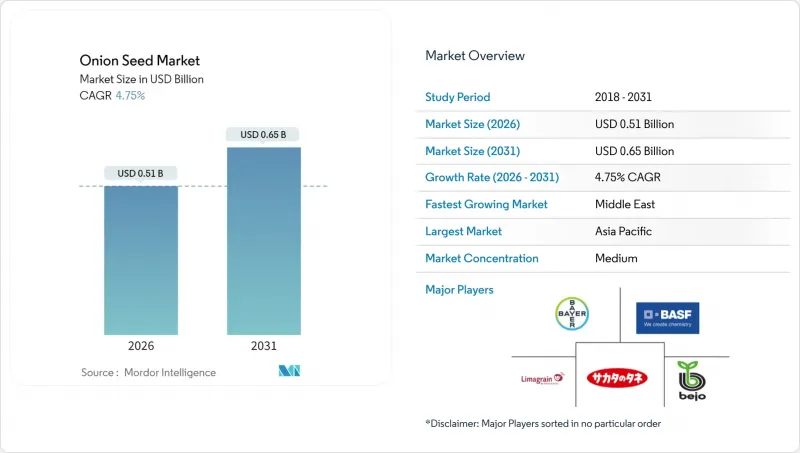
The Onion Seed Market was valued at USD 0.49 billion in 2025 and estimated to grow from USD 0.51 billion in 2026 to reach USD 0.65 billion by 2031, at a CAGR of 4.75% during the forecast period (2026-2031).
Steady hybrid-seed penetration, protected-cultivation expansion, and policy-led subsidy programs underpin demand momentum. Multinational seed producers deploy doubled-haploid platforms that shorten breeding cycles, while regional companies leverage localized germplasm to serve climate-specific niches. Commercial growers gravitate toward uniform bulbs that enable mechanized harvesting and cold-chain integration, boosting premium-seed uptake. Meanwhile, rising awareness of climate-resilient cultivars fuels adoption across drought-prone regions. E-commerce channels and digitally certified seed systems further widen market access by lowering distribution costs and ensuring provenance integrity.
Global Onion Seed Market Trends and Insights
Surge in Hybrid-Seed Adoption for Higher Uniform Yields
Hybrid onion seeds deliver yield premiums surpassing 25 % versus open-pollinated lines, prompting growers across India, China, and Ethiopia to transition despite higher upfront costs. Cytoplasmic male-sterility systems streamline F1 production, improving genetic purity and bulb uniformity that mechanized harvesters require. Government extension demonstrations amplify farmer confidence, triggering a multiplier effect on total seed demand. Export-oriented packers reward consistent bulb dimensions, reinforcing hybrid uptake in mature markets such as the United States and Spain. Nonetheless, growers in price-sensitive regions still weigh cost-benefit equations, especially where hybrid seed prices run three to five times higher than traditional options.
Rapid Expansion of Protected-Cultivation Acreage
Net-house and poly-house installations in India, China, and the Philippines expand at a 12 % annual pace, fostering year-round onion output with lower weather risk . Controlled environments favor short-cycle hybrids bred for tight canopy structure and high-density planting. Seed companies with germplasm tailored to elevated humidity and pathogen loads capture premium pricing opportunities. Smart greenhouse pilots in Luzon revealed 40 % yield lifts despite higher capital outlays, validating the economic rationale for premium seeds. As growers fine-tune fertigation and climate settings, seed traits linked to disease resistance and determinate growth become critical.
Low Hybrid-Seed Yields Due to Pollinator Decline
Honey-bee population drops slash hybrid onion seed production yields by nearly 30 % in California and the Netherlands, inflating per-unit costs and tightening global supply . Managed bumble-bee programs and supplemental hand pollination partially offset losses but raised production expenses. Climate variability shifts flowering windows, complicating bee-field synchronization. Seed companies collaborate with apiarists to improve stocking densities and habitat buffers, though success varies. Escalating costs threaten hybrid affordability for smallholders unless genetic or mechanical pollination alternatives mature quickly.
Other drivers and restraints analyzed in the detailed report include:
- Government Seed-Subsidy Programs in Asia-Pacific and Africa
- Rising Demand for Climate-Resilient Onion Cultivars
- High R&D Cost of CMS Restorer-Line Development
For complete list of drivers and restraints, kindly check the Table Of Contents.
Segment Analysis
Hybrid seeds captured 85.05% market share in 2025, reflecting commercial growers' preference for varieties that deliver consistent bulb characteristics and enhanced storage life compared to traditional alternatives. The dominance stems from cytoplasmic male sterility breeding systems that enable large-scale F1 hybrid production with predictable combining ability and heterosis expression. The segment dynamics reflect broader agricultural trends toward mechanization and post-harvest standardization that favor uniform hybrid varieties. Doubled-haploid breeding platforms accelerate hybrid development timelines, enabling seed companies to introduce varieties with enhanced disease resistance and climate adaptation more rapidly than conventional breeding approaches.
Open-pollinated varieties and hybrid derivatives represent the fastest-growing segment at 5.03% CAGR during 2026-2031, driven by organic farming expansion and smallholder farmers seeking lower-cost alternatives with acceptable performance characteristics. Open-pollinated varieties maintain relevance in subsistence farming systems and organic production where seed saving practices reduce input costs, though their market share continues declining as hybrid economics improve through scale and technology advancement.
The Onion Seed Market is Segmented by Breeding Technology (Hybrids, and Open Pollinated Varieties and Hybrid Derivatives) and by Geography (Africa, Asia-Pacific, Europe, Middle East, North America, and South America). The Market Forecasts are Provided in Terms of Value (USD) and Volume (Metric Tons).
Geography Analysis
Asia-Pacific leads the onion seed market with 28.12% share in 2025, propelled by extensive cultivation areas in India and China where government policies actively promote hybrid seed adoption through subsidy programs and technical extension services. The region demonstrates the fastest adoption of protected cultivation technologies, with net-house and poly-house infrastructure expanding at double-digit growth rates that create sustained demand for premium seed varieties optimized for controlled environments. India's target to increase kharif onion acreage by 27% in 2024 exemplifies the policy support driving market expansion, while China's focus on food security and agricultural modernization sustains investment in improved varieties and production systems.
The Middle East emerges as the fastest-growing regional market at 7.28% CAGR during 2026-2031, driven by food security initiatives and substantial investment in climate-controlled growing systems that demand specialized seed varieties. Saudi Arabia's Vision 2030 agricultural diversification strategy includes onion production targets that require advanced seed technologies capable of performing under extreme climatic conditions. Iran's position as a major onion producer creates substantial seed demand, though geopolitical factors and trade restrictions can create supply chain complexities for international seed companies seeking market access.
North America and Europe represent mature markets characterized by high hybrid penetration rates and emphasis on varieties optimized for mechanized production and extended storage. These regions prioritize disease resistance and quality traits over yield maximization, creating opportunities for premium seed varieties that command higher prices but serve smaller market volumes. The regulatory frameworks in these markets, including OECD (Organisation for Economic Co-operation and Development) seed certification schemes and ISTA (International Safe Transit Association) testing standards, create barriers to entry but also protect established market participants from low-quality competition.
- Bayer AG
- BASF SE
- Groupe Limagrain
- Sakata Seeds Corporation
- Bejo Zaden B.V.
- Syngenta AG
- Enza Zaden Beheer B.V.
- Rijk Zwaan Zaadteelt en Zaadhandel B.V.
- Takii and Co., Ltd.
- East-West Seed International B.V.
- UPL Limited
- Nong Woo Bio Co., Ltd.
- KWS SAAT SE & Co. KGaA
- Yuan Longping High-Tech Agriculture Co., Ltd.
- Namdhari Seeds Pvt. Ltd
Additional Benefits:
- The market estimate (ME) sheet in Excel format
- 3 months of analyst support
TABLE OF CONTENTS
1 EXECUTIVE SUMMARY AND KEY FINDINGS
2 REPORT OFFERS
3 INTRODUCTION
- 3.1 Study Assumptions and Market Definition
- 3.2 Scope of the Study
- 3.3 Research Methodology
4 KEY INDUSTRY TRENDS
- 4.1 Area Under Cultivation
- 4.2 Most Popular Traits
- 4.3 Breeding Techniques
- 4.4 Regulatory Framework
- 4.5 Value Chain and Distribution Channel Analysis
- 4.6 Market Drivers
- 4.6.1 Surge in hybrid-seed adoption for higher uniform yields
- 4.6.2 Rapid expansion of protected cultivation acreage
- 4.6.3 Government seed-subsidy programs in Asia-Pacific and Africa
- 4.6.4 Rising demand for climate-resilient onion cultivars
- 4.6.5 Commercialization of doubled-haploid breeding platforms
- 4.6.6 Digitally enabled B2B seed-ordering marketplaces
- 4.7 Market Restraints
- 4.7.1 Low hybrid-seed yields due to pollinator decline
- 4.7.2 High R&D cost of CMS restorer line development
- 4.7.3 Counterfeit / brown-bag seed circulation in emerging markets
- 4.7.4 Stringent varietal-registration rules slowing launches
5 MARKET SIZE AND GROWTH FORECASTS (VALUE AND VOLUME)
- 5.1 Breeding Technology
- 5.1.1 Hybrids
- 5.1.2 Open Pollinated Varieties and Hybrid Derivatives
- 5.2 Geography
- 5.2.1 Africa
- 5.2.1.1 By Breeding Technology
- 5.2.1.2 By Country
- 5.2.1.2.1 Egypt
- 5.2.1.2.2 Ethiopia
- 5.2.1.2.3 Ghana
- 5.2.1.2.4 Kenya
- 5.2.1.2.5 Nigeria
- 5.2.1.2.6 South Africa
- 5.2.1.2.7 Tanzania
- 5.2.1.2.8 Rest of Africa
- 5.2.2 Asia-Pacific
- 5.2.2.1 By Breeding Technology
- 5.2.2.2 By Country
- 5.2.2.2.1 Australia
- 5.2.2.2.2 Bangladesh
- 5.2.2.2.3 China
- 5.2.2.2.4 India
- 5.2.2.2.5 Indonesia
- 5.2.2.2.6 Japan
- 5.2.2.2.7 Myanmar
- 5.2.2.2.8 Philippines
- 5.2.2.2.9 Thailand
- 5.2.2.2.10 Vietnam
- 5.2.2.2.11 Rest of Asia-Pacific
- 5.2.3 Europe
- 5.2.3.1 By Breeding Technology
- 5.2.3.2 By Country
- 5.2.3.2.1 France
- 5.2.3.2.2 Germany
- 5.2.3.2.3 Italy
- 5.2.3.2.4 Netherlands
- 5.2.3.2.5 Poland
- 5.2.3.2.6 Romania
- 5.2.3.2.7 Russia
- 5.2.3.2.8 Spain
- 5.2.3.2.9 Turkey
- 5.2.3.2.10 Ukraine
- 5.2.3.2.11 United Kingdom
- 5.2.3.2.12 Rest of Europe
- 5.2.4 Middle East
- 5.2.4.1 By Breeding Technology
- 5.2.4.2 By Country
- 5.2.4.2.1 Iran
- 5.2.4.2.2 Rest of Middle East
- 5.2.5 North America
- 5.2.5.1 By Breeding Technology
- 5.2.5.2 By Country
- 5.2.5.2.1 Canada
- 5.2.5.2.2 Mexico
- 5.2.5.2.3 United States
- 5.2.5.2.4 Rest of North America
- 5.2.6 South America
- 5.2.6.1 By Breeding Technology
- 5.2.6.2 By Country
- 5.2.6.2.1 Argentina
- 5.2.6.2.2 Brazil
- 5.2.6.2.3 Rest of South America
- 5.2.1 Africa
6 COMPETITIVE LANDSCAPE
- 6.1 Key Strategic Moves
- 6.2 Market Share Analysis
- 6.3 Company Landscape
- 6.4 Company Profiles
- 6.4.1 Bayer AG
- 6.4.2 BASF SE
- 6.4.3 Groupe Limagrain
- 6.4.4 Sakata Seeds Corporation
- 6.4.5 Bejo Zaden B.V.
- 6.4.6 Syngenta AG
- 6.4.7 Enza Zaden Beheer B.V.
- 6.4.8 Rijk Zwaan Zaadteelt en Zaadhandel B.V.
- 6.4.9 Takii and Co., Ltd.
- 6.4.10 East-West Seed International B.V.
- 6.4.11 UPL Limited
- 6.4.12 Nong Woo Bio Co., Ltd.
- 6.4.13 KWS SAAT SE & Co. KGaA
- 6.4.14 Yuan Longping High-Tech Agriculture Co., Ltd.
- 6.4.15 Namdhari Seeds Pvt. Ltd
7 KEY STRATEGIC QUESTIONS FOR SEEDS CEOS

