
PUBLISHER: Mordor Intelligence | PRODUCT CODE: 1940832

PUBLISHER: Mordor Intelligence | PRODUCT CODE: 1940832
Africa Seed - Market Share Analysis, Industry Trends & Statistics, Growth Forecasts (2026 - 2031)
The Africa seed market is expected to grow from USD 3.12 billion in 2025 to USD 3.27 billion in 2026 and is forecast to reach USD 4.15 billion by 2031 at 4.86% CAGR over 2026-2031.
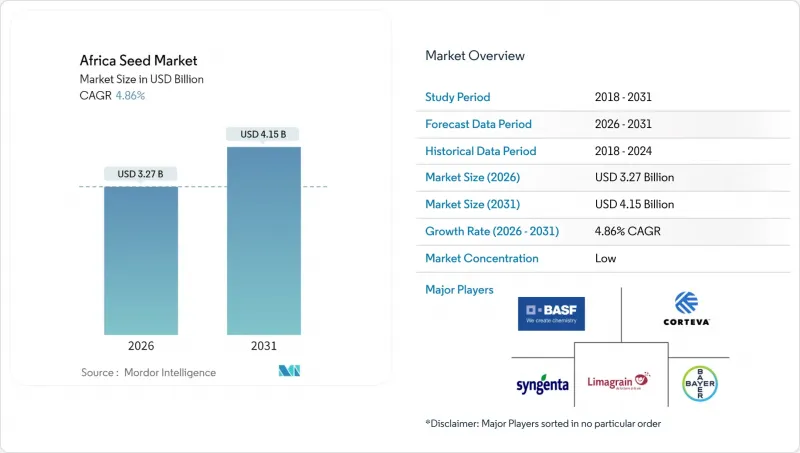
The projected expansion rests on four structural pillars: growing preference for hybrid and stress-tolerant genetics, the steady roll-out of government-funded seed-replacement schemes, ongoing expansion of irrigated acreage, and the landmark regional seed-law harmonization that came into force under the African Continental Free Trade Area in 2024. Digitally enabled micro-pack distribution has further lowered entry barriers for smallholder farmers, who account for roughly 80% of regional production, while early field trials of gene-edited crops promise an additional pipeline of climate-resilient varieties. Together, these forces are tilting the balance away from informal exchange networks toward structured commercial channels that emphasize quality assurance, traceability, and faster varietal turnover.
Africa Seed Market Trends and Insights
Rising Adoption of Hybrid and Stress-Tolerant Seed Varieties
Climate volatility is nudging farmers toward hybrids that deliver higher yield stability, drought tolerance, and pest resilience compared with traditional open-pollinated options. Nigeria documented a 35% jump in hybrid maize uptake during 2024, with stress-tolerant entries constituting 60% of new registrations. Multinationals and local breeders alike are now tailoring heat-tolerant wheat for Egypt's desert expansion and drought-resistant sorghum for the Sahel, deepening the hybrid pipeline across diverse agro-ecologies.
Government-Funded Input and Seed-Replacement Programs
Public programs remain a reliable pull factor. Nigeria's Anchor Borrowers Programme alone supplied 2.3 million metric tons of certified seed in 2024. Ethiopia funnels in annual seed vouchers to its Productive Safety Net Programme, directly linking social protection with varietal renewal. Tanzania aims for a significant replacement rate of traditional seed stocks by 2027, leveraging cooperatives to distribute subsidized packets. These schemes strengthen demand certainty for suppliers while enhancing genetic gains in the field.
Dominance of Informal Seed Systems Supplying Seed
Traditional seed systems continue supplying farmers with seed requirements across sub-Saharan Africa, limiting commercial seed market penetration despite the quality and yield advantages of certified varieties. Ethiopia's Central Statistical Agency reported that most smallholder farmers rely on farm-saved seeds and informal exchanges, constraining hybrid adoption rates. This preference stems from cultural practices, economic constraints, and risk-averse farming strategies that prioritize seed security over yield maximization. Tanzania's informal seed networks supply traditional crop varieties, creating parallel distribution systems that compete directly with commercial channels while maintaining genetic diversity but limiting productivity gains.
Other drivers and restraints analyzed in the detailed report include:
- Expansion of Irrigated Land and Protected Cultivation
- Regional Seed-Law Harmonization under AfCFTA
- Fragmented GMO Regulations Delaying Transgenic Approvals
For complete list of drivers and restraints, kindly check the Table Of Contents.
Segment Analysis
Hybrids dominate with 59.90% market share in 2025, driven by superior yield performance and increasing farmer awareness of productivity benefits. Open-pollinated varieties demonstrate faster growth at 4.89% CAGR through 2031, reflecting cost-conscious farmer preferences and breeding companies' focus on affordable variety development. Within hybrid categories, non-transgenic varieties maintain market leadership while transgenic hybrids gain traction in biotechnology-friendly countries like South Africa and Nigeria. Herbicide-tolerant hybrids show particular promise in mechanized farming systems, while insect-resistant varieties address pest pressure in cotton and maize production.
The breeding technology landscape reflects broader agricultural modernization trends, with farmers gradually transitioning from traditional varieties toward improved genetics. Kenya's experience demonstrates this evolution, where hybrid maize adoption increased, supported by government extension services and seed company demonstration plots, Kenya Agricultural and Livestock Research Organization.
The Africa Seed Market Report is Segmented by Breeding Technology (Hybrids and More), Cultivation Mechanism (Open Field and Protected Cultivation), Crop Type (Row Crops and Vegetables), and Geography (Egypt, Ethiopia, Ghana, and More). The Market Forecasts are Provided in Terms of Value (USD) and Volume (Metric Tons).
List of Companies Covered in this Report:
- Advanta Seeds - UPL
- BASF SE
- Bayer AG
- Corteva Agriscience
- Enza Zaden
- Groupe Limagrain
- Rijk Zwaan Zaadteelt en Zaadhandel B.V.
- Sakata Seeds Corporation
- Syngenta Group
- Takii and Co.,Ltd.
- East-West Seed
- Agricol Pty Ltd.
- Zambia Seed Company Limited (Zamseed)
- FICA SEEDS Ltd.
- S&W Seed Co.
Additional Benefits:
- The market estimate (ME) sheet in Excel format
- 3 months of analyst support
TABLE OF CONTENTS
1 EXECUTIVE SUMMARY AND KEY FINDINGS
2 REPORT OFFERS
3 INTRODUCTION
- 3.1 Study Assumptions and Market Definition
- 3.2 Scope of the Study
- 3.3 Research Methodology
4 KEY INDUSTRY TRENDS
- 4.1 Area Under Cultivation
- 4.1.1 Row Crops
- 4.1.2 Vegetables
- 4.2 Most Popular Traits
- 4.2.1 Cabbage and Peas
- 4.2.2 Corn and Wheat
- 4.2.3 Sorghum and Soybean
- 4.2.4 Tomato and Chilli
- 4.3 Breeding Techniques
- 4.3.1 Row Crops and Vegetable
- 4.4 Regulatory Framework
- 4.5 Value Chain and Distribution Channel Analysis
- 4.6 Market Drivers
- 4.6.1 Rising adoption of hybrid and stress-tolerant seed varieties
- 4.6.2 Government-funded input and seed-replacement programs
- 4.6.3 Expansion of irrigated land and protected cultivation
- 4.6.4 Regional seed-law harmonization under AfCFTA
- 4.6.5 Digital micro-pack seed sales via last-mile agro-dealers
- 4.6.6 Gene-edited indigenous crops entering national trials
- 4.7 Market Restraints
- 4.7.1 Dominance of informal seed systems supplying seed
- 4.7.2 Fragmented GMO regulations delaying transgenic approvals
- 4.7.3 Counterfeit seed eroding farmer trust
- 4.7.4 Rising hybrid-production costs
5 MARKET SIZE AND GROWTH FORECAST (VALUE AND VOLUME)
- 5.1 Breeding Technology
- 5.1.1 Hybrids
- 5.1.1.1 Non-Transgenic Hybrids
- 5.1.1.2 Transgenic Hybrids
- 5.1.1.2.1 Herbicide Tolerant Hybrids
- 5.1.1.2.2 Insect Resistant Hybrids
- 5.1.2 Open Pollinated Varieties and Hybrid Derivatives
- 5.1.1 Hybrids
- 5.2 Cultivation Mechanism
- 5.2.1 Open Field
- 5.2.2 Protected Cultivation
- 5.3 Crop Type
- 5.3.1 Row Crops
- 5.3.1.1 Fiber Crops
- 5.3.1.1.1 Cotton
- 5.3.1.1.2 Other Fiber Crops
- 5.3.1.2 Forage Crops
- 5.3.1.2.1 Alfalfa
- 5.3.1.2.2 Forage Corn
- 5.3.1.2.3 Forage Sorghum
- 5.3.1.2.4 Other Forage Crops
- 5.3.1.3 Grains and Cereals
- 5.3.1.3.1 Corn
- 5.3.1.3.2 Rice
- 5.3.1.3.3 Sorghum
- 5.3.1.3.4 Wheat
- 5.3.1.3.5 Other Grains and Cereals
- 5.3.1.4 Oilseeds
- 5.3.1.4.1 Canola, Rapeseed and Mustard
- 5.3.1.4.2 Soybean
- 5.3.1.4.3 Sunflower
- 5.3.1.4.4 Other Oilseeds
- 5.3.1.5 Pulses
- 5.3.1.1 Fiber Crops
- 5.3.2 Vegetables
- 5.3.2.1 Brassicas
- 5.3.2.1.1 Cabbage
- 5.3.2.1.2 Carrot
- 5.3.2.1.3 Cauliflower and Broccoli
- 5.3.2.1.4 Other Brassicas
- 5.3.2.2 Cucurbits
- 5.3.2.2.1 Cucumber and Gherkin
- 5.3.2.2.2 Pumpkin and Squash
- 5.3.2.2.3 Other Cucurbits
- 5.3.2.3 Roots and Bulbs
- 5.3.2.3.1 Garlic
- 5.3.2.3.2 Onion
- 5.3.2.3.3 Potato
- 5.3.2.3.4 Other Roots and Bulbs
- 5.3.2.4 Solanaceae
- 5.3.2.4.1 Chilli
- 5.3.2.4.2 Eggplant
- 5.3.2.4.3 Tomato
- 5.3.2.4.4 Other Solanaceae
- 5.3.2.5 Unclassified Vegetables
- 5.3.2.5.1 Asparagus
- 5.3.2.5.2 Lettuce
- 5.3.2.5.3 Okra
- 5.3.2.5.4 Peas
- 5.3.2.5.5 Spinach
- 5.3.2.5.6 Other Unclassified Vegetables
- 5.3.2.1 Brassicas
- 5.3.1 Row Crops
- 5.4 Country
- 5.4.1 Egypt
- 5.4.2 Ethiopia
- 5.4.3 Ghana
- 5.4.4 Kenya
- 5.4.5 Nigeria
- 5.4.6 South Africa
- 5.4.7 Tanzania
- 5.4.8 Rest of Africa
6 COMPETITIVE LANDSCAPE
- 6.1 Key Strategic Moves
- 6.2 Market Share Analysis
- 6.3 Company Landscape
- 6.4 Company Profiles (Includes Global Level Overview, Market Level Overview, Core Business Segments, Financials, Headcount, Key Information, Market Rank, Market Share, Products and Services, and Analysis of Recent Developments).
- 6.4.1 Advanta Seeds - UPL
- 6.4.2 BASF SE
- 6.4.3 Bayer AG
- 6.4.4 Corteva Agriscience
- 6.4.5 Enza Zaden
- 6.4.6 Groupe Limagrain
- 6.4.7 Rijk Zwaan Zaadteelt en Zaadhandel B.V.
- 6.4.8 Sakata Seeds Corporation
- 6.4.9 Syngenta Group
- 6.4.10 Takii and Co.,Ltd.
- 6.4.11 East-West Seed
- 6.4.12 Agricol Pty Ltd.
- 6.4.13 Zambia Seed Company Limited (Zamseed)
- 6.4.14 FICA SEEDS Ltd.
- 6.4.15 S&W Seed Co.
7 KEY STRATEGIC QUESTIONS FOR SEEDS CEOS

