
PUBLISHER: Mordor Intelligence | PRODUCT CODE: 2034991

PUBLISHER: Mordor Intelligence | PRODUCT CODE: 2034991
GRC Software - Market Share Analysis, Industry Trends & Statistics, Growth Forecasts (2026 - 2031)
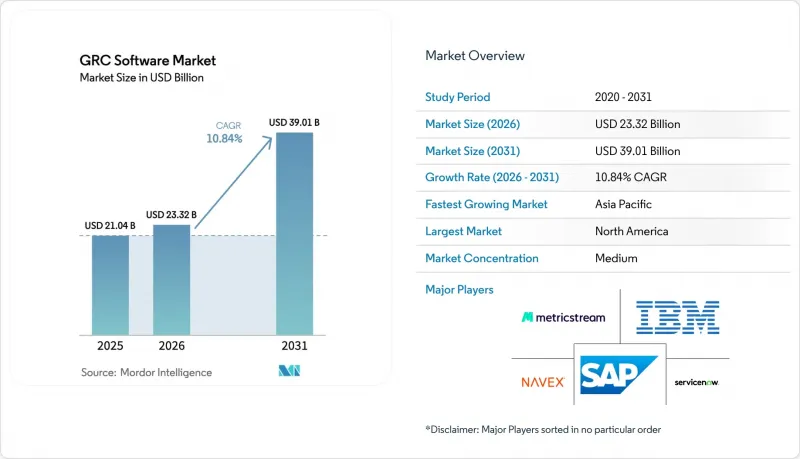
The Governance, Risk, and Compliance (GRC) Software market size was valued at USD 21.04 billion in 2025 and estimated to grow from USD 23.32 billion in 2026 to reach USD 39.01 billion by 2031, at a CAGR of 10.84% during the forecast period (2026-2031).
Heightened regulatory divergence, growing cyber-attack surfaces, and board-level demand for continuous controls monitoring are steering enterprises toward unified, cloud-native platforms that integrate policy, risk, and audit workflows in real time. Software components continue to dominate, yet double-digit expansion of managed services signals a preference for expert-led implementations that offset internal skills shortages. Cloud deployment is accelerating as firms seek collaborative oversight across globally distributed operations, while AI-driven analytics are turning the Governance, Risk, and Compliance (GRC) Software market from a reactive compliance outlay into a proactive risk-intelligence investment. Convergence of ESG, privacy, and operational-resilience mandates is also reshaping platform roadmaps, pushing vendors toward modular suites that embed carbon accounting, AI governance, and cyber-insurance evidence collection within a single pane of glass.
Global GRC Software Market Trends and Insights
Intensifying Global Data-Privacy Regulations
Cross-border data privacy mandates are multiplying, and stiff financial penalties are forcing multinationals to replace patchwork toolsets with end-to-end platforms that automate evidence gathering and breach notification. New regimes such as the Digital Operational Resilience Act enlarge the scope of reportable incidents and impose strict third-party oversight, prompting enterprises to consolidate data-mapping, consent management, and vendor-risk workflows inside a single Governance, Risk, and Compliance (GRC) Software market platform. The cascading nature of non-compliance-where a lapse in one jurisdiction can trigger parallel investigations elsewhere-elevates the value of real-time dashboards that surface control gaps by geography. Vendors are responding with policy libraries updated daily against more than 400 global statutes, while integrated workflow engines route remediation tasks to line-of-business owners. Platforms that deliver machine-readable audit trails are achieving faster regulator sign-offs and lowering external-audit fees, reinforcing a cycle of budget reallocation from manual spreadsheets to AI-augmented compliance hubs.
Proliferation of Cloud-Native Applications
Microservices, containers, and serverless architectures generate ephemeral resources that evade traditional audit snapshots, making continuous controls monitoring indispensable. Modern platforms now embed Kubernetes admission-controller hooks that validate policy at deploy time, streaming telemetry into risk models that recalculate heat maps every few seconds. This dynamic oversight is especially critical in Asia-Pacific, where digital-first start-ups deploy code hundreds of times per day and regulators are mandating operational-resilience disclosures. Real-time correlation of configuration drift, vulnerability posture, and compliance posture cuts mean-time-to-detect for policy violations from weeks to minutes, helping boards justify additional investment in the Governance, Risk, and Compliance (GRC) Software market. Cloud service providers are partnering with GRC vendors to publish compliance APIs that remove the need for agent installation, reducing onboarding friction for small teams. As a result, cloud-native integration has shifted evaluation criteria from checkbox support for a framework to latency, scale, and automated remediation depth.
Complexity and Cost of Multi-Jurisdictional Compliance
Fragmented rulebooks add overlapping documentation duties that inflate the total cost of compliance by USD 780 billion annually. Each divergence-be it reporting thresholds, retention periods, or risk-assessment cadences-multiplies tooling, process, and staffing demands. Multinationals that lack an orchestrated Governance, Risk, and Compliance (GRC) Software market backbone juggle separate instances for anti-corruption, privacy, and operational-resilience programs, creating data silos and audit fatigue. Platform unification drives up-front licensing fees yet delivers payback through reduced external-consultant spend and fewer regulatory fines. While regional harmonization efforts such as Basel III offer partial convergence, new country-specific regimes like France's Sapin II or Germany's Supply-Chain Act continue to proliferate, keeping cost pressures acute over the long term.
Other drivers and restraints analyzed in the detailed report include:
- Surge in Cyber-Insurance Underwriting Requirements
- Expansion of ESG Reporting Mandates
- Shortage of In-House GRC Domain Expertise
For complete list of drivers and restraints, kindly check the Table Of Contents.
Segment Analysis
Software retained a 71.65% revenue share in 2025 thanks to enterprise preference for integrated suites that consolidate risk, audit, privacy, and ESG modules. Yet services posted the fastest expected expansion at a 12.98% CAGR through 2031, underscoring a market shift toward outcome-based engagements that fuse technology enablement with subject-matter guidance. Managed service providers deploy platform accelerators, map controls to regional regulations, and operate continuous monitoring centers on behalf of clients with limited in-house staff. This hybrid delivery approach improves time-to-value for mid-sized buyers and shortens payback periods for large multinationals that must roll out across dozens of jurisdictions simultaneously. The Governance, Risk, and Compliance (GRC) Software market size for services is projected to climb steadily as vendors package advisory, configuration, and run-time operations into subscription bundles. Enhanced post-deployment analytics that benchmark control maturity across peer cohorts create cross-sell pathways for consulting arms eager to monetize insights through remediation roadmaps.
Platform suppliers are enriching software with AI-aided control mapping and natural-language policy ingestion, decreasing the manual effort requirement for baseline deployment. They also expose open APIs to facilitate ecosystem integrations with cyber range testing, e-discovery, and low-code workflow tools. This extensibility attracts partners that extend core capabilities, stimulating indirect revenue streams. Despite automation advances, complex configuration tasks-such as multi-ledger segregation of duties or fine-grained data-sovereignty partitioning-still require specialist input, ensuring that the services revenue pool remains buoyant. Over the forecast window, enterprise buyers are expected to allocate an increasing share of total program budgets to managed capabilities, reinforcing the dual-track expansion of software and services within the Governance, Risk, and Compliance (GRC) Software market.
Cloud deployments accounted for 62.90% of revenue in 2025 and are on course to register a 13.85% CAGR, reflecting enterprise appetite for elastic scalability and collaborative oversight. Continuous controls monitoring delivered as a service allows risk teams to interrogate real-time telemetry drawn from SaaS, infrastructure-as-a-service, and on-premises connectors without the capex burden of local hardware. This architecture underpins faster policy updates, automated compliance evidence collection, and remote audit access, qualities valued by distributed workforces. The Governance, Risk, and Compliance (GRC) Software market size for cloud solutions is forecast to outpace on-premises equivalents as integration blueprints mature and as vendors achieve compliance with stringent data-residency statutes through region-specific tenancy.
On-premises deployments will persist in segments such as defense, public safety, and critical infrastructure, where air-gapped environments remain mandatory. These buyers demand hardened appliances, internal API gateways, and offline reporting capabilities. Nonetheless, vendors are introducing containerized editions that can run either in customer data centers or sovereign clouds, blurring the deployment boundary. Migration roadmaps often begin with non-production workloads in hosted sandboxes before extending to regulated data sets once encryption, key management, and access-segregation standards are validated. Hybrid orchestration consoles provide unified dashboards spanning both modes, ensuring policy consistency and audit traceability across heterogeneous estates. Consequently, the Governance, Risk, and Compliance (GRC) Software market continues its transformation toward a "cloud when possible, on-prem where required" paradigm that balances performance, sovereignty, and cost.
Governance, Risk, and Compliance (GRC) Software Market Report is Segmented by Component (Software, and Services), Deployment Mode (Cloud, and On-Premises), Organization Size (Large Enterprises, and Small and Medium-Sized Enterprises), Vertical (BFSI, Healthcare and Life Sciences, Manufacturing, IT and Telecommunications, and More), and Geography (North America, South America, Europe, Asia-Pacific, and Middle East and Africa).
Geography Analysis
North America commanded 39.55% of 2025 revenue, underpinned by mature regulatory frameworks, deep cyber-insurance penetration, and a high incidence of shareholder litigation that drives board accountability. Federal agencies now expect near-real-time breach notification, compelling firms to adopt continuous monitoring and automated evidence management embedded in leading Governance, Risk, and Compliance (GRC) Software market platforms. Consolidation among technology and consulting providers has also accelerated regional uptake by offering bundled advisory plus SaaS subscriptions that streamline procurement cycles.
Europe maintains a structurally large user base due to pioneering legislation such as GDPR and the upcoming EU AI Act, which extends accountability to algorithmic transparency and lifecycle monitoring. Banks, insurers, and energy operators must now submit Digital Operational Resilience Act self-assessments, creating fresh demand for scenario-testing engines that model ICT failure propagation. The Governance, Risk, and Compliance (GRC) Software market share associated with European buyers is therefore reinforced by policy activism that stresses both consumer protection and systemic stability. Vendors differentiate through localized data-processing zones, multilingual policy libraries, and in-platform cross-border data transfer checks that align with Schrems II requirements.
Asia-Pacific is projected to achieve a 15.1% CAGR, the highest globally, fueled by rapid digitization, fintech innovation, and expanding carbon-trading schemes. Governments across China, Japan, Korea, and Singapore have launched sustainability disclosure standards that mirror, yet diverge from, European rules, prompting multinationals to favor configurable platforms capable of addressing multiple frameworks in parallel. Regional SMEs increasingly adopt pay-as-you-grow pricing to meet stringent supplier-qualification metrics imposed by global brands, funneling incremental volume into the Governance, Risk, and Compliance (GRC) Software market. Meanwhile, Latin America, the Middle East, and Africa are at earlier stages of adoption but display rising interest as foreign direct investors require documented governance controls before releasing capital.
- IBM Corporation
- SAP SE
- Oracle Corporation
- SAS Institute Inc.
- ServiceNow, Inc.
- Wolters Kluwer N.V. (Enablon)
- Thomson Reuters Corporation
- NAVEX Global, Inc.
- MetricStream, Inc.
- Diligent Corporation
- Riskonnect, Inc.
- Archer Technologies LLC (RSA)
- LogicGate, Inc.
- OneTrust, LLC
- Workiva Inc.
- Galvanize (A Diligent Company)
- Mitratech Holdings Inc.
- Ideagen PLC
- Sword GRC Limited
- SAI Global Pty Limited
- LogicManager, Inc.
- Quantivate, LLC
- ProcessGene Ltd.
- Continuity Logic, LLC
- RiskWatch International, LLC
Additional Benefits:
- The market estimate (ME) sheet in Excel format
- 3 months of analyst support
TABLE OF CONTENTS
1 INTRODUCTION
- 1.1 Study Assumptions and Market Definition
- 1.2 Scope of the Study
2 RESEARCH METHODOLOGY
3 EXECUTIVE SUMMARY
4 MARKET LANDSCAPE
- 4.1 Market Overview
- 4.2 Market Drivers
- 4.2.1 Intensifying global data-privacy regulations
- 4.2.2 Proliferation of cloud-native applications
- 4.2.3 Surge in cyber-insurance underwriting requirements
- 4.2.4 Expansion of ESG reporting mandates
- 4.2.5 AI-driven predictive analytics adoption in risk management
- 4.2.6 Board-level demand for "continuous controls monitoring"
- 4.3 Market Restraints
- 4.3.1 Complexity and cost of multi-jurisdictional compliance
- 4.3.2 Shortage of in-house GRC domain expertise
- 4.3.3 Regulatory uncertainty around AI governance
- 4.3.4 Vendor lock-in concerns in integrated suites
- 4.4 Value Chain Analysis
- 4.5 Regulatory Landscape
- 4.6 Technological Outlook
- 4.7 Impact of Macroeconomic Factors
- 4.8 Porter's Five Forces Analysis
- 4.8.1 Threat of New Entrants
- 4.8.2 Bargaining Power of Suppliers
- 4.8.3 Bargaining Power of Buyers
- 4.8.4 Threat of Substitutes
- 4.8.5 Competitive Rivalry
5 MARKET SIZE AND GROWTH FORECASTS (VALUE)
- 5.1 By Component
- 5.1.1 Software
- 5.1.2 Services
- 5.2 By Deployment Mode
- 5.2.1 Cloud
- 5.2.2 On-Premises
- 5.3 By Organization Size
- 5.3.1 Large Enterprises
- 5.3.2 Small and Medium-Sized Enterprises (SMEs)
- 5.4 By Vertical
- 5.4.1 Banking, Financial Services and Insurance (BFSI)
- 5.4.2 Healthcare and Life Sciences
- 5.4.3 Manufacturing
- 5.4.4 IT and Telecommunications
- 5.4.5 Government and Public Sector
- 5.4.6 Energy and Utilities
- 5.4.7 Retail and Consumer Goods
- 5.5 By Geography
- 5.5.1 North America
- 5.5.1.1 United States
- 5.5.1.2 Canada
- 5.5.1.3 Mexico
- 5.5.2 South America
- 5.5.2.1 Brazil
- 5.5.2.2 Argentina
- 5.5.2.3 Rest of South America
- 5.5.3 Europe
- 5.5.3.1 Germany
- 5.5.3.2 United Kingdom
- 5.5.3.3 France
- 5.5.3.4 Italy
- 5.5.3.5 Russia
- 5.5.3.6 Rest of Europe
- 5.5.4 Asia-Pacific
- 5.5.4.1 China
- 5.5.4.2 India
- 5.5.4.3 Japan
- 5.5.4.4 South Korea
- 5.5.4.5 Australia
- 5.5.4.6 Rest of Asia-Pacific
- 5.5.5 Middle East and Africa
- 5.5.5.1 Middle East
- 5.5.5.1.1 Saudi Arabia
- 5.5.5.1.2 United Arab Emirates
- 5.5.5.1.3 Turkey
- 5.5.5.1.4 Rest of Middle East
- 5.5.5.2 Africa
- 5.5.5.2.1 South Africa
- 5.5.5.2.2 Nigeria
- 5.5.5.2.3 Rest of Africa
- 5.5.5.1 Middle East
- 5.5.1 North America
6 COMPETITIVE LANDSCAPE
- 6.1 Market Concentration
- 6.2 Strategic Moves
- 6.3 Market Share Analysis
- 6.4 Company Profiles (includes Global level Overview, Market level overview, Core Segments, Financials as available, Strategic Information, Market Rank/Share for key companies, Products and Services, and Recent Developments)
- 6.4.1 IBM Corporation
- 6.4.2 SAP SE
- 6.4.3 Oracle Corporation
- 6.4.4 SAS Institute Inc.
- 6.4.5 ServiceNow, Inc.
- 6.4.6 Wolters Kluwer N.V. (Enablon)
- 6.4.7 Thomson Reuters Corporation
- 6.4.8 NAVEX Global, Inc.
- 6.4.9 MetricStream, Inc.
- 6.4.10 Diligent Corporation
- 6.4.11 Riskonnect, Inc.
- 6.4.12 Archer Technologies LLC (RSA)
- 6.4.13 LogicGate, Inc.
- 6.4.14 OneTrust, LLC
- 6.4.15 Workiva Inc.
- 6.4.16 Galvanize (A Diligent Company)
- 6.4.17 Mitratech Holdings Inc.
- 6.4.18 Ideagen PLC
- 6.4.19 Sword GRC Limited
- 6.4.20 SAI Global Pty Limited
- 6.4.21 LogicManager, Inc.
- 6.4.22 Quantivate, LLC
- 6.4.23 ProcessGene Ltd.
- 6.4.24 Continuity Logic, LLC
- 6.4.25 RiskWatch International, LLC
7 MARKET OPPORTUNITIES AND FUTURE OUTLOOK
- 7.1 White-space and Unmet-Need Assessment

