PUBLISHER: Mordor Intelligence | PRODUCT CODE: 2034994

PUBLISHER: Mordor Intelligence | PRODUCT CODE: 2034994
China Semiconductor Device - Market Share Analysis, Industry Trends & Statistics, Growth Forecasts (2026 - 2031)
The China semiconductor device market size was valued at USD 217.55 billion in 2025 and estimated to grow from USD 233.46 billion in 2026 to reach USD 332.17 billion by 2031, at a CAGR of 7.31% during the forecast period (2026-2031).
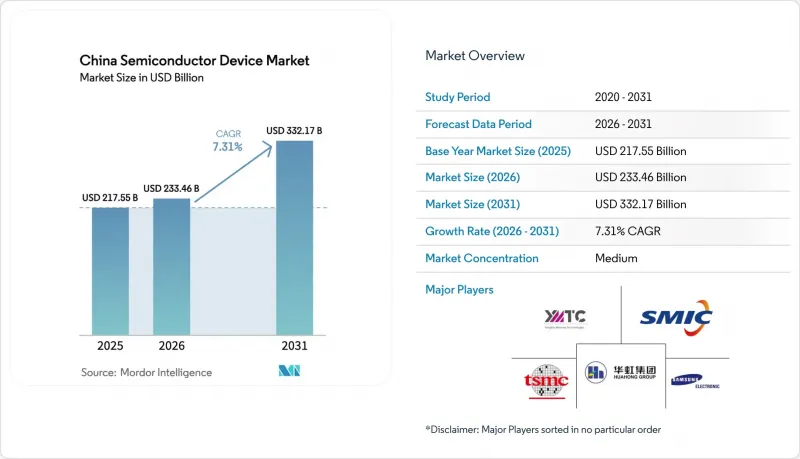
State-directed funding, vigorous private investment, and a policy mandate for technological self-sufficiency have turned the industry into a strategic priority. Rapid capacity additions at domestic foundries, breakthroughs in 3D NAND and advanced packaging, and rising demand from 5G, AI, and new-energy vehicles underpin the expansion. Tight export controls on extreme-ultraviolet (EUV) tools have slowed the migration to sub-10 nm nodes; yet, firms have redirected their efforts toward improving mature-node efficiency, compound semiconductors, and novel architectures that bypass EUV. Competitive pressure has led to increased consolidation, as exemplified by Empyrean-Xpeedic in EDA and YMTC's funding round, illustrating a trend toward scale, vertical integration, and IP accumulation.
China Semiconductor Device Market Trends and Insights
Accelerated "Made-in-China 2025" IC Capacity Expansion Programs
China expanded foundry capacity by 15% in 2024 and is scheduled to add another 14% in 2025 as SMIC, Huahong, and Nexchip ramp mature-node lines. Localization now stretches beyond fabrication to photoresist stripping and wet-clean tools, where domestic suppliers have achieved high usage rates. By 2027, China is projected to hold 31% of global 28 nm capacity, reshaping pricing at mature nodes. The program's success hinges on stable power, process-engineering talent, and second-source equipment lines that mitigate export-control exposure. Taken together, the rollout cements domestic supply for consumer, industrial, and automotive electronics, lifting utilization rates and margins across the ecosystem.
AI-Centric Edge-Computing Demand from Tier-1 Chinese Cloud Providers
Alibaba pledged CNY 380 billion (USD 52.9 billion) over 2025-2027 for AI-ready cloud infrastructure, while Tencent and Baidu announced comparable outlays. Demand spans GPUs, high-bandwidth memory, and network switch ASICs, channeling orders to local fabs and memory houses. DeepSeek's foundation model showcases China's ability to align software and hardware, easing reliance on foreign accelerators. Edge-AI workloads favor low-latency, on-premise compute, steering buyers toward domestically designed SOCs that comply with national data-sovereignty rules. The virtuous loop between hyperscaler capex and chip-level innovation is therefore a prime mid-term growth catalyst.
US Export-Control Entity-List Restrictions on EUV and EDA Tools
Washington's October 2024 and December 2024 rules bar shipment of EUV scanners, advanced deposition gear, and high-end EDA licenses to Chinese fabs. Domestic producers remain confined to 28 nm for mass production and must innovate around 7 nm proof-of-concept wafers without ASML EUV. Work-arounds include 2D-material transistors piloted at 1 nm gate length and advanced DUV multiple-patterning, but commercial yields are years away. Longer equipment lead-times, software license uncertainty, and compliance audits dampen the pace of node migration.
Other drivers and restraints analyzed in the detailed report include:
- Automotive-Grade SiC/GaN Adoption in NEV Powertrains
- National 5G Base-Station Build-Out Driving RF Front-End IC Uptake
- Talent Drain to Overseas Design Houses
For complete list of drivers and restraints, kindly check the Table Of Contents.
Segment Analysis
Integrated circuits accounted for 86.02% revenue in 2025, and their share is forecast to edge higher as AI, 5G, and server demand require larger die sizes and stacked V-cache solutions. Within the Chinese semiconductor market, integrated circuits are expected to expand at an 8.02% CAGR, adding more than USD 69.2 billion in new output by 2031. YMTC's 232-layer 3D NAND and CXMT's 80% DDR5 yield underscore momentum in memory, while SMIC's 12-inch lines run at 89.6% utilization on robust consumer and industrial demand.
Discrete power devices, optoelectronics, and sensors together occupy the remaining 13.98% share but are benefiting from NEV electrification and 5G optical-component pull. Domestic SiC diode capacity is doubling every 18 months, and VCSEL shipments for 3D sensing in smartphones are moving to local fabs. Although smaller in value, these categories contribute critical differentiation in automotive safety, smart-factory deployments, and AR/VR hardware, sustaining multi-segment resilience.
China Semiconductor Device Market is Segmented by Device Type (Discrete Semiconductors [Diodes, Transistors, and More], Optoelectronics [LEDs, Laser Diodes, and More], Sensors and MEMS [Pressure, Actuators, and More], and Integrated Circuits), Business Model (IDM, and Design/ Fabless Vendor), and End-Use Industry (Automotive, Communication, Consumer, Industrial, Computing/Data Storage, Data Center, AI, and Government).
List of Companies Covered in this Report:
- Semiconductor Manufacturing International Corp (SMIC)
- Taiwan Semiconductor Manufacturing Co (TSMC)
- Hua Hong Group
- Intel Corp
- Samsung Electronics Co Ltd
- SK Hynix Inc
- Micron Technology Inc
- Yangtze Memory Technologies Co (YMTC)
- JCET Group Co Ltd
- Advanced Micro Devices Inc
- Qualcomm Inc
- Broadcom Inc
- Nvidia Corp
- NXP Semiconductors NV
- Infineon Technologies AG
- STMicroelectronics NV
- Texas Instruments Inc
- Will Semiconductor Co Ltd
- Goodix Technology
- ASE Technology Holding Co
- Renesas Electronics Corp
- Rohm Co Ltd
Additional Benefits:
- The market estimate (ME) sheet in Excel format
- 3 months of analyst support
TABLE OF CONTENTS
1 INTRODUCTION
- 1.1 Study Assumptions and Market Definition
- 1.2 Scope of the Study
2 RESEARCH METHODOLOGY
3 EXECUTIVE SUMMARY
4 MARKET LANDSCAPE
- 4.1 Market Overview
- 4.2 Market Drivers
- 4.2.1 Accelerated "Made-in-China 2025" IC Capacity Expansion Programs
- 4.2.2 AI-centric Edge-Computing Demand from Tier-1 Chinese Cloud Providers
- 4.2.3 Automotive-grade SiC/GaN Adoption in NEV Powertrains
- 4.2.4 National 5G Base-station Build-out Driving RF-Front-End IC Uptake
- 4.2.5 Industrial Upgrade to "Industry 4.0" Smart-Factories
- 4.2.6 Post-pandemic rebound of AIoT-enabled consumer devices (smart wearables, AR/VR)
- 4.3 Market Restraints
- 4.3.1 US Export-control Entity-List Restrictions on EUV and EDA Tools
- 4.3.2 Talent Drain to Overseas Design Houses
- 4.3.3 Electricity-Intensive Fabs Facing Provincial Carbon-Quota Caps
- 4.3.4 Persistent Price Volatility of 300 mm Prime Wafers
- 4.4 Industry Value Chain Analysis
- 4.5 Regulatory Outlook
- 4.6 Technological Trends
- 4.7 Porter's Five Forces Analysis
- 4.7.1 Threat of New Entrants
- 4.7.2 Bargaining Power of Buyers
- 4.7.3 Bargaining Power of Suppliers
- 4.7.4 Threat of Substitutes
- 4.7.5 Intensity of Rivalry
- 4.8 Impact Assessment of Macroeconomic Factors
- 4.9 Semiconductor Foundry Landscape
- 4.9.1 Foundry Revenue and Share by Players
- 4.9.2 IDM vs Fabless Sales
- 4.9.3 Installed Wafer Capacity (by Fab Location)
5 MARKET SIZE AND GROWTH FORECASTS (VALUE)
- 5.1 By Device Type (Shipment Volume for Device Type is Complementary)
- 5.1.1 Discrete Semiconductors
- 5.1.1.1 Diodes
- 5.1.1.2 Transistors
- 5.1.1.3 Power Transistors
- 5.1.1.4 Rectifier and Thyristor
- 5.1.1.5 Other Discrete Devices
- 5.1.2 Optoelectronics
- 5.1.2.1 Light-Emitting Diodes (LEDs)
- 5.1.2.2 Laser Diodes
- 5.1.2.3 Image Sensors
- 5.1.2.4 Optocouplers
- 5.1.2.5 Other Device Types
- 5.1.3 Sensors and MEMS
- 5.1.3.1 Pressure
- 5.1.3.2 Magnetic Field
- 5.1.3.3 Actuators
- 5.1.3.4 Acceleration and Yaw Rate
- 5.1.3.5 Temperature and Others
- 5.1.4 Integrated Circuits
- 5.1.4.1 By Integrated Circuit Type
- 5.1.4.1.1 Analog
- 5.1.4.1.2 Micro
- 5.1.4.1.2.1 Microprocessors (MPU)
- 5.1.4.1.2.2 Microcontrollers (MCU)
- 5.1.4.1.2.3 Digital Signal Processors
- 5.1.4.1.3 Logic
- 5.1.4.1.4 Memory
- 5.1.4.2 By Technology Node (Shipment Volume Not Applicable)
- 5.1.4.2.1 < 3nm
- 5.1.4.2.2 3nm
- 5.1.4.2.3 5nm
- 5.1.4.2.4 7nm
- 5.1.4.2.5 16nm
- 5.1.4.2.6 28nm
- 5.1.4.2.7 > 28nm
- 5.1.4.1 By Integrated Circuit Type
- 5.1.1 Discrete Semiconductors
- 5.2 By Business Model
- 5.2.1 IDM
- 5.2.2 Design/ Fabless Vendor
- 5.3 By End-user Industry
- 5.3.1 Automotive
- 5.3.2 Communication (Wired and Wireless)
- 5.3.3 Consumer
- 5.3.4 Industrial
- 5.3.5 Computing/Data Storage
- 5.3.6 Data Center
- 5.3.7 AI
6 COMPETITIVE LANDSCAPE
- 6.1 Market Concentration
- 6.2 Strategic Moves
- 6.3 Market Share Analysis
- 6.4 Company Profiles (includes Global level Overview, Market level overview, Core Segments, Financials as available, Strategic Information, Market Rank/Share for key companies, Products and Services, and Recent Developments)
- 6.4.1 Semiconductor Manufacturing International Corp (SMIC)
- 6.4.2 Taiwan Semiconductor Manufacturing Co (TSMC)
- 6.4.3 Hua Hong Group
- 6.4.4 Intel Corp
- 6.4.5 Samsung Electronics Co Ltd
- 6.4.6 SK Hynix Inc
- 6.4.7 Micron Technology Inc
- 6.4.8 Yangtze Memory Technologies Co (YMTC)
- 6.4.9 JCET Group Co Ltd
- 6.4.10 Advanced Micro Devices Inc
- 6.4.11 Qualcomm Inc
- 6.4.12 Broadcom Inc
- 6.4.13 Nvidia Corp
- 6.4.14 NXP Semiconductors NV
- 6.4.15 Infineon Technologies AG
- 6.4.16 STMicroelectronics NV
- 6.4.17 Texas Instruments Inc
- 6.4.18 Will Semiconductor Co Ltd
- 6.4.19 Goodix Technology
- 6.4.20 ASE Technology Holding Co
- 6.4.21 Renesas Electronics Corp
- 6.4.22 Rohm Co Ltd
7 MARKET OPPORTUNITIES AND FUTURE OUTLOOK
- 7.1 White-space and Unmet-Need Assessment

