
PUBLISHER: Mordor Intelligence | PRODUCT CODE: 2035000

PUBLISHER: Mordor Intelligence | PRODUCT CODE: 2035000
Gigacasting - Market Share Analysis, Industry Trends & Statistics, Growth Forecasts (2026 - 2031)
gigacasting market size in 2026 is estimated at USD 229.12 million, growing from 2025 value of USD 0.16 billion with 2031 projections showing USD 1.38 billion, growing at 43.20% CAGR over 2026-2031.
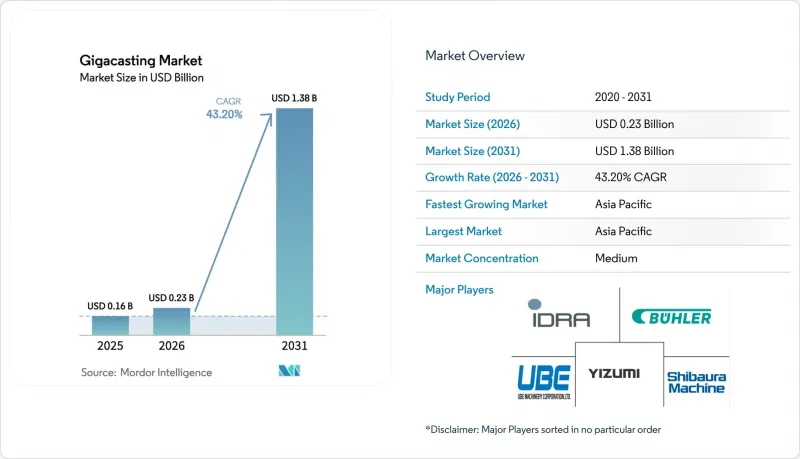
This rise underscores automakers' tight focus on large-format high-pressure die casting, which collapses scores of steel stampings into a handful of aluminum components. Tesla's move from 171 stamped parts to two rear under-body castings in the Model Y cut direct manufacturing expense by up to 40%. Similar cost-down examples, faster takt times, and stricter CO2 regulations continue to expand the gigacasting market footprint across every major production region. Passenger-car electrification, rising recycled-aluminum premiums, and modular press lines further amplify demand, while the shortage of skilled welders nudges OEMs toward highly automated casting cells.
Global Gigacasting Market Trends and Insights
Rapid Scale-up of BEV Production Volumes
Global BEV assembly plants are adding giga press cells faster than conventional weld lines. Hyundai earmarked USD 21 billion for North American electrification that includes high-tonnage casting lines at its Metaplant America complex . Ford re-tooled Cologne into an all-electric center using more than 600 robots to shorten body shop flow time. Battery housing demands deep, one-piece structures for crash and thermal performance, and gigacasting offers the shortest path to those geometries. As annual BEV volumes climb toward multi-million-unit levels, economies of scale lift the gigacasting market well beyond niche status.
Demand for Lightweight, Consolidated Vehicle Structures
Gigacasting lets automakers pull mass out of the body-in-white without sacrificing stiffness. Tesla's rear casting lowered part count by 70 components and saved material, welding, and logistics costs. Aluminum's high strength-to-weight ratio pairs with design freedom, so a single large casting can integrate crash-energy paths that once required dozens of stampings. Japanese Tier-one Ryobi is shifting capacity toward large aluminum castings, targeting 20% total-manufacturing-cost relief. Weight savings dovetail with stricter fleet-average CO2 limits and range expectations in battery vehicles. As more models adopt skateboard battery packs, under-body castings become natural enablers for load-path optimization and packaging efficiency.
High Upfront CAPEX for >= 6,000 t Presses
A single 9,000 t giga-press carries a price tag in the tens of millions. Volvo's Slovakian plant ordered twin IDRA units and budgeted EUR 855 million for the surrounding foundry, trim line, and infrastructure . Tier-one Nemak spent USD 18 million just to add two 4,500 t machines inside an existing facility-illustrating that even mid-range tonnage means deep pockets. Smaller brands struggle to amortize that spend over modest volumes, slowing widespread adoption and nudging the gigacasting market toward financially robust players.
Other drivers and restraints analyzed in the detailed report include:
- Per-part Cost & Takt-time Reductions vs. Multi-part Body-in-White
- Shortage of Skilled Welders Pushing OEMs to Casting Automation
- Energy-price-driven Aluminum-alloy Supply Tightness
For complete list of drivers and restraints, kindly check the Table Of Contents.
Segment Analysis
Body assemblies held 58.05% of the gigacasting market share in 2025 and remain core to most rollouts, yet battery and under-body castings are expanding at 46.20% CAGR. The gigacasting market size tied to battery housing is forecast to widen sharply as every BEV adopts a floor-mounted pack needing rapid heat dissipation and crash load pathways. Tesla's rear casting success story quickened the transition, while Handtmann installed Buhler Carat-610 cells to mass-produce pack frames for European EV programs.
Demand also grows for integrated tunnel castings that combine side rail, cross-member, and pack mounts in one pour. Engine and e-drive housings mark a transitional zone; internal-combustion castings taper while new e-motor mounts enter. Transmission castings decline as single-speed drivetrains rise. Niche aerospace and industrial uses surface in R&D pipelines, but automotive applications overwhelmingly steer the near-term gigacasting market.
Aluminum retained 73.85% of 2025 revenue due to its favorable mix of weight, cost, and scrap-loop efficiency. Even so, magnesium's 45.60% CAGR positions it as the stand-out gainer. Research published by SAE shows high-temperature Mg alloys holding structural integrity at 300 °C, opening doors for motor-inverter mounts. Concurrently, new super-ductile Al-Si-Mg grades meet crash performance while enabling thinner sections in giga-press molds.
Steel suppliers defend their share through advanced castable steels for battery enclosures; ArcelorMittal unveiled prototypes promising comparable crash metrics with easier recycling. Titanium or zinc remain niche options due to cost or density penalties. Whether aluminum keeps its lead will rest on scrap availability, energy prices, and multi-alloy press capabilities.
The Gigacasting Market Report is Segmented by Application (Body Assemblies, Under-body/Battery Housings, and More), Material (Aluminum Alloys, Magnesium Alloys, and More), Vehicle Type (Passenger Cars, Light Commercial Vehicles, and More), Press Tonnage (6, 000 To 8, 000 T, 8, 001 To 10, 000 T, and More), Geography (North America, South America, and More). The Market Forecasts are Provided in Terms of Value (USD).
Geography Analysis
Asia-Pacific held 48.40% of 2025 revenue and is projected to expand at 47.90% CAGR to 2031, powered by China's dominance in lithium-ion battery supply and rapidly scaling BEV assembly capacity. Chinese foundries already operate multiple 6,000-8,000 t presses for local OEMs, and Ryobi aims for 20% cost relief by producing large aluminum castings in Hiroshima. Japan and South Korea add momentum through supplier-led investments and Hyundai's USD 21 billion North American electrification commitment, which still leverages Asian equipment design. India remains at an early stage but offers policy support for EV supply-chain localization, suggesting future upside for regional giga-press installations.
North America follows with a concentrated wave of OEM capex that underpins the gigacasting market. Ford's USD 2 billion Cologne Electric Vehicle Center overhaul and USD 5.6 billion BlueOval City complex integrate large-tonnage casting cells for next-generation pickups and crossovers. General Motors earmarked USD 4 billion for U.S. plant upgrades to reach 2-million-unit annual output, much of which relies on single-piece aluminum structures. Aluminum billet supply is a constraint, as the United States faces a 4 million t shortfall that keeps Canadian imports critical.
Europe balances strict carbon policy with elevated power prices, shaping a nuanced adoption curve. Volvo's Kosice site committed EUR 855 million for twin 9,000 t IDRA presses to start production in 2026. Germany's premium OEM cluster advances digital-twin foundries but must manage electricity-cost volatility. South America contributes limited volumes today, while Gulf energy exporters explore vertically integrated aluminum and casting projects; both regions hinge on foreign direct investment from global automakers seeking diversified footprints.
- Tier-1 Suppliers
- OEMs
Additional Benefits:
- The market estimate (ME) sheet in Excel format
- 3 months of analyst support
TABLE OF CONTENTS
1 Introduction
- 1.1 Study Assumptions & Market Definition
- 1.2 Scope of the Study
2 Research Methodology
3 Executive Summary
4 Market Landscape
- 4.1 Market Overview
- 4.2 Market Drivers
- 4.2.1 Rapid scale-up of BEV production volumes
- 4.2.2 Demand for lightweight, consolidated vehicle structures
- 4.2.3 Per-part cost & takt-time reductions vs. multi-part body-in-white
- 4.2.4 Shortage of skilled welders pushing OEMs to casting automation
- 4.2.5 Carbon-credit premiums for high-recycled-content aluminum
- 4.2.6 Modular / re-configurable Giga-Press lines enabling low-volume variants
- 4.3 Market Restraints
- 4.3.1 High upfront CAPEX for greater than or equals 6,000 t presses
- 4.3.2 Energy-price-driven aluminum-alloy supply tightness
- 4.3.3 Collision-repair complexities inflating insurance premiums
- 4.3.4 Elevated scrap & porosity risks in above 12,000 t castings
- 4.4 Value / Supply-Chain Analysis
- 4.5 Regulatory Landscape
- 4.6 Technological Outlook
- 4.7 Porter's Five Forces
- 4.7.1 Threat of New Entrants
- 4.7.2 Bargaining Power of Buyers
- 4.7.3 Bargaining Power of Suppliers
- 4.7.4 Threat of Substitutes
- 4.7.5 Competitive Rivalry
5 Market Size & Growth Forecasts (Value (USD))
- 5.1 By Application
- 5.1.1 Body Assemblies
- 5.1.2 Under-body/Battery Housings
- 5.1.3 Engine and e-Drive Parts
- 5.1.4 Transmission and Driveline Parts
- 5.1.5 Others
- 5.2 By Material
- 5.2.1 Aluminum Alloys
- 5.2.2 Magnesium Alloys
- 5.2.3 Advanced High-Strength Steel (AHSS) Castings
- 5.2.4 Other Non-ferrous Alloys
- 5.3 By Vehicle Type
- 5.3.1 Passenger Cars
- 5.3.2 Light Commercial Vehicles
- 5.3.3 Medium & Heavy Commercial Vehicles
- 5.4 By Press Tonnage
- 5.4.1 6,000 to 8,000 t
- 5.4.2 8 001 to 10 000 t
- 5.4.3 Above 10,000 t
- 5.5 By Geography
- 5.5.1 North America
- 5.5.1.1 United States
- 5.5.1.2 Canada
- 5.5.1.3 Rest of North America
- 5.5.2 South America
- 5.5.2.1 Brazil
- 5.5.2.2 Argentina
- 5.5.2.3 Rest of South America
- 5.5.3 Europe
- 5.5.3.1 Germany
- 5.5.3.2 United Kingdom
- 5.5.3.3 France
- 5.5.3.4 Italy
- 5.5.3.5 Spain
- 5.5.3.6 Rest of Europe
- 5.5.4 Asia Pacific
- 5.5.4.1 China
- 5.5.4.2 Japan
- 5.5.4.3 India
- 5.5.4.4 South Korea
- 5.5.4.5 Rest of Asia Pacific
- 5.5.5 Middle East and Africa
- 5.5.5.1 Saudi Arabia
- 5.5.5.2 United Arab Emirates
- 5.5.5.3 Egypt
- 5.5.5.4 Turkey
- 5.5.5.5 South Africa
- 5.5.5.6 Rest of Middle East and Africa
- 5.5.1 North America
6 Competitive Landscape
- 6.1 Market Concentration
- 6.2 Strategic Moves
- 6.3 Market Share Analysis
- 6.4 Company Profiles (includes Global Level Overview, Market Level Overview, Core Segments, Financials as Available, Strategic Information, Market Rank/Share for Key Companies, Products and Services, SWOT Analysis, and Recent Developments)
- 6.4.1 Tier-1 Suppliers
- 6.4.1.1 IDRA Srl (subsidiary of LK Technology)
- 6.4.1.2 Buhler Group
- 6.4.1.3 Haitian Die-Casting
- 6.4.1.4 Shibaura Machine Co.
- 6.4.1.5 UBE Machinery Corporation
- 6.4.1.6 Yizumi Holdings
- 6.4.1.7 Aisin Corporation
- 6.4.1.8 Handtmann Group
- 6.4.1.9 Ryobi Die Casting
- 6.4.1.10 Gestamp
- 6.4.1.11 Chongqing Dajiang Millison Die Casting Co., Ltd.
- 6.4.1.12 Guangdong Hongtu Technology
- 6.4.1.13 Chuzhou Duoli Automotive Technology
- 6.4.2 OEMs
- 6.4.2.1 Tesla Inc.
- 6.4.2.2 Toyota Motor Corporation
- 6.4.2.3 Hyundai Motor Company
- 6.4.2.4 Ford Motor Company
- 6.4.2.5 General Motors Company
- 6.4.2.6 Volvo Car AB
- 6.4.1 Tier-1 Suppliers
7 Market Opportunities & Future Outlook
- 7.1 White-space & Unmet-Need Assessment

