
PUBLISHER: Mordor Intelligence | PRODUCT CODE: 2035008

PUBLISHER: Mordor Intelligence | PRODUCT CODE: 2035008
Influencer Marketing Market - Market Share Analysis, Industry Trends & Statistics, Growth Forecasts (2026 - 2031)
The influencer marketing market size in 2026 is estimated at USD 40.51 billion, growing from 2025 value of USD 31.07 billion with 2031 projections showing USD 152.56 billion, growing at 30.36% CAGR over 2026-2031.
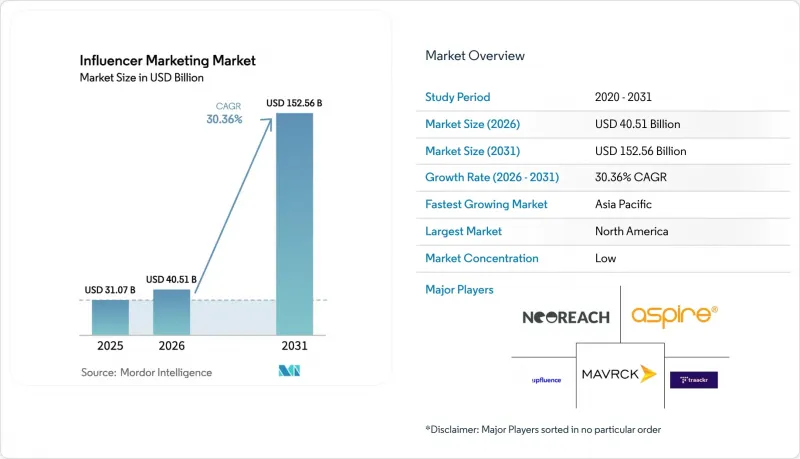
Brand owners now treat creator partnerships as a strategic acquisition lever rather than an experimental spend. Finance teams approve multi-year allocations because blended customer-acquisition costs fall when even a modest portion of budgets shifts from paid search to creators. In North America, which commands a 35% slice of the influencer marketing market, robust attribution stacks and clear disclosure rules let marketers prove ROI with confidence . Asia-Pacific supplies the steepest incremental lift as social-commerce super-apps compress discovery, engagement, and checkout into one scroll, making the channel a measurable revenue driver.
Global Influencer Marketing Market Trends and Insights
Growing Dominance of Short-Form Video Platforms in Brand Budgets
Short-form vertical clips now attract the largest portion of incremental creator spend, with TikTok and Instagram Reels absorbing most 2024 budget expansions. A 5.7% average engagement rate and a 2.9% conversion rate have convinced advertisers to lean on video for both awareness and sales lifts. Beauty brands redirected nearly two-fifths of their digital budgets to short-form assets after "get-ready-with-me" content triggered launch sell-outs. Because algorithms reward content quality over follower scale, mid-tier and nano creators achieve broader reach, improving inventory liquidity and driving effective CPMs downward.
Adoption of AI-Driven Creator Matching And Dynamic Pricing Engines
Machine-learning models now score audience overlap, sentiment, and conversion history, reducing partner discovery cycles by 64% and improving return on ad spend by 28%. Dynamic pricing converts fixed fees into performance-based payouts that fluctuate with engagement. Consumer-electronics launches employing the model saw faster sell-through of limited editions, validating AI-assisted decisioning for P and L-oriented marketers.
Creator Fraud and Bot Engagement Eroding ROI in Emerging Markets
Fake-follower rates rose to 18% in parts of Southeast Asia and Latin America in 2024 . Apparel campaigns uncovered inflated comment volumes with negligible conversions, leading to mid-flight audits and budget clawbacks. Verification costs climbed 42% as platforms inserted biometric and behavioral checks, yet fraud operators also evolved, making authenticity an ongoing arms race. Contracts now withhold up to 30% of payouts until third-party audits certify engagement quality.
Other drivers and restraints analyzed in the detailed report include:
- Integration of Social-Commerce APIs Driving Attribution-Linked Spend
- Rise of Nano/Micro Influencer Networks for Hyper-local Campaigns
- Third-Party Cookie Deprecation Delaying Cross-Channel Attribution
For complete list of drivers and restraints, kindly check the Table Of Contents.
Segment Analysis
Micro influencers accounted for 39.35% of the influencer marketing market size, equal to USD 12.23 billion in 2025. Engagement superiority over mega personalities persuades consumer brands to assign launch duties to micro pools. Nano creators produce smaller reach but sustain click-through rates above 4%, encouraging performance teams to reallocate testing budgets from paid search. Agencies adopt CRM-style tooling to manage hundreds of nano relationships without raising labor overhead.
Mega influencers remain brand-equity levers for tent-pole events, yet their relative share slipped 3.2 points last year. Macro influencers fill the consideration stage, especially for complex B2B solutions. A software company enlisted 20 macro reviewers to explain a new SaaS release and lifted lead-form completions by 32%. Tier selection thus aligns with funnel position, supporting diversified creator portfolios within the influencer marketing market.
Instagram held a 29.25% platform share, translating into USD 9.09 billion, but TikTok challenges the incumbent with a 36.85% CAGR outlook. TikTok's discovery feed allows small voices to achieve viral reach, exemplified by a gardening tip that collected 2 million views from a 15,000-follower account. Advertisers elevated TikTok from pilot to core once SKU-level sell-outs could be traced to live-link carts.
YouTube protects its long-form niche; a home-appliance brand used 20-minute creator demos to cut returns by 18%, saving service costs. Facebook maintains relevance among over-40 audiences who trust closed-group testimonials. LinkedIn is gaining ground in financial services, where thought-leader creators drive webinar sign-ups. The platform mosaic forces marketers to build modular creative so that stories remain coherent across multiple feeds in the influencer marketing market.
Influencer Marketing Market is Segmented by Influencer Type (Nano Influencers (1k-10k), Micro Influencers (10k-100k), and More), Social Media Channel (Instagram, Tiktok, and More), Application (Campaign Management, Search and Discovery, and More), End User (Retail and E-Commerce, Fashion and Lifestyle, and More), by Geography. The Market Forecasts are Provided in Terms of Value (USD).
Geography Analysis
North America generated USD 10.74 billion of 2025 spend and integrates creator metrics directly into business-intelligence systems. Federal Trade Commission rules require conspicuous sponsorship labels, prompting platforms to automate disclosures, which reduces post-campaign legal risk. Seventy-seven percent of enterprises embed creators into omnichannel plans, moving the influencer marketing market from test budgets to core line items. Early deployment of server-side tagging counters cookie loss and keeps cross-device attribution viable.
Asia-Pacific exhibits a 33.90% CAGR outlook. Super-apps blend chat, payment, and video, fostering live-commerce sessions that compress awareness and conversion into one interaction. Chinese streams often attract six-figure audiences, propelling immediate inventory sell-outs. South Korean beauty houses now debut new items through creator collaborations before store placement, speeding revenue realization. India's multilingual terrain favors nano networks: a telco in Tamil markets outperformed Hindi campaigns after engaging 300 local voices. Hyper-local execution, therefore, magnifies impact within the influencer marketing market.
Europe moves under a strict governance framework shaped by the Digital Services Act . Platforms introduced consent logs and age-appropriate defaults, raising engineering overhead yet supplying brands with clear compliance roadmaps. Sweden shows early adoption of AI-supported compliance plug-ins, while Southern states offer runway as broadband spreads. The United Kingdom maintains parallel standards and channels luxury-goods spend into creator collaborations that routinely over-subscribe launches. European technical rigor prompts vendors to export compliance know-how, influencing global product design in the influencer marketing market.
- Upfluence
- Aspire.io
- Mavrck
- NeoReach
- Traackr Inc.
- Webfluential.com
- Hypetap
- IZEA Worldwide Inc.
- Meltwater
- CreatorIQ
- Klear
- Tagger Media
- Impact.com
- Captiv8
- HypeAuditor
- Influence.co
- Julius Influencer Marketing
- Brandwatch
- Grapevine
- Linqia
- Post for Rent
- CreatorStack
- Modash
- Lumanu
- Grin
Additional Benefits:
- The market estimate (ME) sheet in Excel format
- 3 months of analyst support
TABLE OF CONTENTS
1 INTRODUCTION
- 1.1 Study Assumptions and Market Definition
- 1.2 Scope of the Study
2 RESEARCH METHODOLOGY
3 EXECUTIVE SUMMARY
4 MARKET LANDSCAPE
- 4.1 Market Overview
- 4.2 Market Drivers
- 4.2.1 Growing Dominance of Short-Form Video Platforms (TikTok, Reels) in Brand Budgets (North America and Asia)
- 4.2.2 Adoption of AI-Driven Creator Matching and Dynamic Pricing Engines by SaaS Platforms (US, EU)
- 4.2.3 Integration of Social Commerce APIs Driving Attribution-Linked Spend (SEA and MENA)
- 4.2.4 Rise of Nano/Micro Influencer Networks for Hyper-local Campaigns (India, Brazil, Africa)
- 4.2.5 Regulatory Push for Transparent Ad and Brand Safety Tools (EU, US)
- 4.2.6 Shift Toward Outcome-based Pay-per-Campaign Pricing among DTC Brands
- 4.3 Market Restraints
- 4.3.1 Creator Fraud and Bot Engagement Eroding ROI in Emerging Markets
- 4.3.2 Third-Party Cookie Deprecation Delaying Cross-Channel Attribution
- 4.3.3 Fragmented Data Standards Limiting Inter-platform Benchmarking
- 4.3.4 Intense Price Competition from Point-Solution Start-ups
- 4.4 Technological Outlook
- 4.5 Porter's Five Forces Analysis
- 4.5.1 Bargaining Power of Buyers
- 4.5.2 Bargaining Power of Suppliers
- 4.5.3 Threat of New Entrants
- 4.5.4 Threat of Substitutes
- 4.5.5 Intensity of Competitive Rivalry
5 MARKET SIZE AND GROWTH FORECASTS (VALUE)
- 5.1 By Influencer Type
- 5.1.1 Nano Influencers (1k-10k)
- 5.1.2 Micro Influencers (10k-100k)
- 5.1.3 Macro Influencers (100k-1M)
- 5.1.4 Mega/Celebrity Influencers (>1M)
- 5.2 By Social Media Channel
- 5.2.1 Instagram
- 5.2.2 TikTok
- 5.2.3 YouTube
- 5.2.4 Facebook
- 5.2.5 Twitter
- 5.2.6 LinkedIn
- 5.2.7 Others (Snap, Pinterest, Twitch)
- 5.3 By Application
- 5.3.1 Campaign Management
- 5.3.2 Search and Discovery
- 5.3.3 Analytics and Reporting
- 5.3.4 Product Seeding
- 5.3.5 Compliance and Fraud Detection
- 5.3.6 Others
- 5.4 By End User
- 5.4.1 Retail and E-commerce
- 5.4.2 Fashion and Lifestyle
- 5.4.3 Travel and Hospitality
- 5.4.4 Food and Beverage
- 5.4.5 Gaming and Entertainment
- 5.4.6 Health and Fitness
- 5.4.7 Others
- 5.5 By Geography
- 5.5.1 North America
- 5.5.1.1 United States
- 5.5.1.2 Canada
- 5.5.1.3 Mexico
- 5.5.2 South America
- 5.5.2.1 Brazil
- 5.5.2.2 Argentina
- 5.5.2.3 Rest of South America
- 5.5.3 Europe
- 5.5.3.1 Germany
- 5.5.3.2 United Kingdom
- 5.5.3.3 France
- 5.5.3.4 Italy
- 5.5.3.5 Spain
- 5.5.3.6 Rest of Europe
- 5.5.4 Asia-Pacific
- 5.5.4.1 China
- 5.5.4.2 Japan
- 5.5.4.3 South Korea
- 5.5.4.4 India
- 5.5.4.5 Rest of Asia-Pacific
- 5.5.5 Middle East and Africa
- 5.5.5.1 United Arab Emirates
- 5.5.5.2 Saudi Arabia
- 5.5.5.3 South Africa
- 5.5.5.4 Rest of Middle East and Africa
- 5.5.1 North America
6 COMPETITIVE LANDSCAPE
- 6.1 Strategic Developments
- 6.2 Vendor Positioning Analysis
- 6.3 Company Profiles (includes Global level Overview, Market level overview, Core Segments, Financials as available, Strategic Information, Products and Services, and Recent Developments)
- 6.3.1 Upfluence
- 6.3.2 Aspire.io
- 6.3.3 Mavrck
- 6.3.4 NeoReach
- 6.3.5 Traackr Inc.
- 6.3.6 Webfluential.com
- 6.3.7 Hypetap
- 6.3.8 IZEA Worldwide Inc.
- 6.3.9 Meltwater
- 6.3.10 CreatorIQ
- 6.3.11 Klear
- 6.3.12 Tagger Media
- 6.3.13 Impact.com
- 6.3.14 Captiv8
- 6.3.15 HypeAuditor
- 6.3.16 Influence.co
- 6.3.17 Julius Influencer Marketing
- 6.3.18 Brandwatch
- 6.3.19 Grapevine
- 6.3.20 Linqia
- 6.3.21 Post for Rent
- 6.3.22 CreatorStack
- 6.3.23 Modash
- 6.3.24 Lumanu
- 6.3.25 Grin
7 MARKET OPPORTUNITIES AND FUTURE OUTLOOK
- 7.1 White-space and Unmet-needs Assessment

