
PUBLISHER: Mordor Intelligence | PRODUCT CODE: 2035014

PUBLISHER: Mordor Intelligence | PRODUCT CODE: 2035014
5G Private Network - Market Share Analysis, Industry Trends & Statistics, Growth Forecasts (2026 - 2031)
The 5G Private Network Market size is expected to grow from USD 3.06 billion in 2025 to USD 4.35 billion in 2026 and is forecast to reach USD 25.25 billion by 2031 at 42.15% CAGR over 2026-2031.
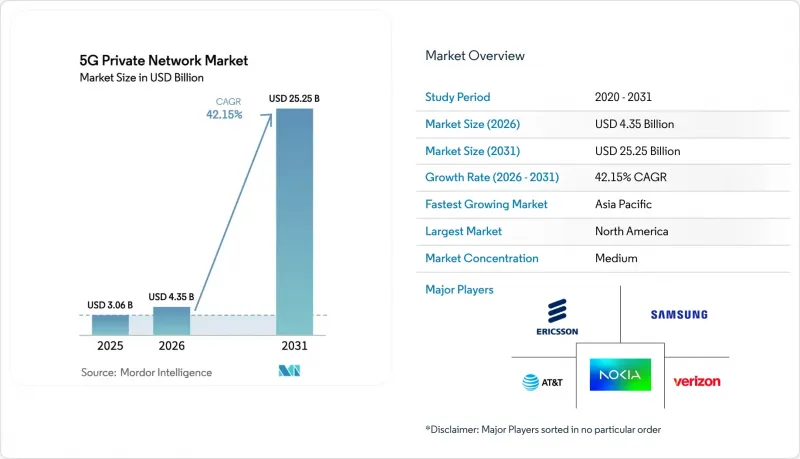
Growing preference for deterministic cellular connectivity over Wi-Fi, the global roll-out of 5G Standalone cores, and liberalized local-licence spectrum schemes underpin this expansion. Declining prices of 5G industrial IoT modules and small cells further lower entry barriers, allowing mid-tier manufacturers, ports, and utilities to justify new deployments. Strategic collaborations between network vendors and hyperscalers accelerate adoption by bundling managed services with edge compute for data-sovereign workloads. Together, these forces position the 5G private network market for sustained double-digit growth while reshaping enterprise connectivity strategies across regions and verticals.
Global 5G Private Network Market Trends and Insights
Mature 5G SA Core Availability for Enterprise SASE Integration
Cloud-native 5G Standalone cores now ship with built-in SASE functions, allowing enterprises to apply zero-trust policies across OT and IT domains from a single pane of glass. Ericsson and Google Cloud jointly run 5G Core-as-a-Service, giving manufacturers elastic scaling without on-site EPC specialists. Microsoft mirrors this model by embedding a full 5G core inside Azure Stack Edge so that regulated facilities can retain data on-prem while managing the network from the Azure portals. Unified identity, segmentation, and traffic optimisation cut integration time for multi-site factories and logistics hubs. Early adopters report faster rollout cycles and reduced maintenance overhead because policy updates propagate automatically to every site. Together, these efficiencies raise the attainable ROI threshold, broadening the addressable base for the 5G private network market.
700 MHz, CBRS & Local-Licence Spectrum Liberalisation
Shared and lightly licensed spectrum unlocks private networks for entities that do not own nationwide mobile concessions. The FCC's expanded CBRS rules lengthen transmission windows and trim Dynamic Protection zones, giving utilities and campuses predictable radio conditions. Japan's local 5G model has already issued 153 Sub-6 GHz licences, proving that simplified processes can fast-track enterprise networks. NTIA data show more than 270,000 new CBRS device activations since 2021, many in rural manufacturing clusters. Access to affordable spectrum lowers total cost of ownership, pressures operators to offer wholesale slices, and propels the 5G private network market toward wider vertical adoption.
Scarcity of Multi-Band Certified 5G Devices for Vertical-Specific Use Cases
Enterprises often require devices that roam across Sub-6 GHz and mmWave bands while meeting stringent safety or sterility norms. Yet only a handful of suppliers certify rugged tablets, cameras, or AR headsets across all target bands, forcing hybrid network designs that raise support costs. Healthcare deployments struggle even more because medical device approvals add another regulatory layer. Until broader certification coverage emerges, device scarcity will temper the pace at which new verticals join the 5G private network market.
Other drivers and restraints analyzed in the detailed report include:
- Falling Price of 5G-Industrial IoT Modules & Private-RAN Small Cells
- Edge-Native 5G Network-as-a-Service Offers from Hyperscalers
- Complex Systems-Integration Skill Gap at Mid-Tier Integrators
For complete list of drivers and restraints, kindly check the Table Of Contents.
Segment Analysis
Hardware commanded 47.20% of the 5G private network market in 2025, reflecting the upfront spend on radios, evolved packet cores, and edge compute clusters. Yet, Services are projected to grow at a 44.10% CAGR, outpacing equipment sales as enterprises favour managed lifecycle models. Nokia finds 78% of customers achieve payback within six months when adopting a service-led rollout, thanks to faster commissioning and continuous optimisation. The shift also mirrors the spread of cloud-native orchestration, which moves value from boxes to software and support. As complexity rises, managed detection and response, performance tuning, and application onboarding become core revenue streams. Consequently, Services will narrow the revenue gap with Hardware by 2030, reshaping vendor monetisation across the 5G private network market.
Software sits between the two, providing policy control, network slicing, and digital twin analytics that translate radio data into business insights. Low-code orchestration lets OT engineers spin up slices for new production lines without ticketing an operator. Over time, Software margins are likely to exceed both Hardware and Services, but their growth pace will track platform adoption curves. Together, these dynamics ensure the 5G private network industry remains a multi-revenue-stream arena where integration value grows fastest.
Sub-6 GHz held 61.10% share of the 5G private network market size in 2025 because one-kilometre cell radii suit large plants, mines, and campuses. Rugged handhelds and sensors also favour mid-band because antenna footprints stay small. mmWave, while confined to tens-of-metre footprints, posts a 43.80% CAGR as factories deploy high-definition machine vision and AR maintenance at workstations. Hybrid deployments emerge, mid-band provides blanket coverage, mmWave overlays pump gigabits to assembly cells. Open-RAN roadmaps that support dual-band radios promise to simplify such mixed topologies, boosting uptake.
This nuanced spectrum play widens vendor differentiation. RAN suppliers with beamforming optimisations for reflective indoor spaces win mmWave bids, whereas incumbents strong in macro radio planning dominate Sub-6 GHz tenders. Over the forecast horizon, mmWave's share will rise yet remain below mid-band because many brownfield plants cannot justify dense small-cell grids. Even so, the combined spectrum toolkit cements private 5G as a superior upgrade path over Wi-Fi 7 for industrial digitalisation.
The 5G Private Network Market Report is Segmented by Component (Hardware, Software, and Services), Frequency (Sub-6 GHz, Mmwave [More Than 24 GHz]), Enterprise Size (Small and Medium Enterprises, and Large Enterprises), Vertical (Manufacturing, Energy and Utilities, Transportation and Logistics, Oil and Gas, Healthcare, Defense and Public Safety, and More), and Geography.
Geography Analysis
North America captured 30.50% of the 5G private network market in 2025, thanks to ready CBRS spectrum, early IIoT pilots, and strong federal funding for critical-infrastructure modernisation. Manufacturing clusters in the Midwest and Gulf Coast rapidly migrate from Wi-Fi because cellular provides interference-immune mobility for autonomous robots. Public-safety agencies also invest, with Verizon offering dedicated 5G slices for first responders across 29 cities, ensuring priority communications during congestion.
Asia-Pacific is forecast to record a 44.00% CAGR, narrowing the leadership gap by 2031. Japan's regulator issues dedicated local-licence spectrum in both Sub-6 GHz and 4.7 GHz bands, prompting more than 150 enterprise networks within two years. China pilots 5.5G (5G-Advanced) features such as deterministic scheduling and RedCap devices, underpinning large-scale campus deployments in automotive and mining. Emerging economies like India ride the Production-Linked Incentive scheme to embed private 5G in new semiconductor fabs and logistics parks, further boosting regional momentum.
Europe follows with a slower but steady uptake as spectrum fees remain higher and industrial policy varies by member state. Nonetheless, initiatives like Germany's Industrie 4.0 subsidies and France's smart-city pilots keep demand rising. The Port of Riga's private 5G for autonomous sea drones proves how EU maritime corridors can extend coverage 100 miles offshore, a feat unviable with Wi-Fi links. South America and the Middle East & Africa remain in nascent stages, yet early oil, gas, and mining proofs hint at rising demand once device availability widens. Taken together, regional dynamics ensure the 5G private network market gains depth as well as breadth over the forecast horizon.
- Telefonaktiebolaget LM Ericsson
- Nokia Corporation
- Huawei Technologies Co., Ltd.
- Samsung Electronics Co., Ltd.
- ZTE Corporation
- Cisco Systems, Inc.
- Juniper Networks, Inc.
- Qualcomm Technologies, Inc.
- NEC Corporation
- NTT Ltd./NTT DOCOMO
- Verizon Communications Inc.
- ATandT Inc.
- Deutsche Telekom AG
- Mavenir Systems Inc.
- Altiostar (Rakuten)
- Rakuten Symphony
- Fujitsu Limited
- Siemens AG
- Bosch Rexroth AG
- Amazon Web Services Inc.
Additional Benefits:
- The market estimate (ME) sheet in Excel format
- 3 months of analyst support
TABLE OF CONTENTS
1 INTRODUCTION
- 1.1 Study Assumptions and Market Definition
- 1.2 Scope of the Study
2 RESEARCH METHODOLOGY
3 EXECUTIVE SUMMARY
4 MARKET LANDSCAPE
- 4.1 Market Overview
- 4.2 Market Drivers
- 4.2.1 Mature 5G SA core availability for enterprise SASE integration
- 4.2.2 700 MHz, CBRS and local-licence spectrum liberalisation
- 4.2.3 Falling price of 5G-Industrial IoT modules and private-RAN small cells
- 4.2.4 Edge-native 5G network-as-a-service offers from hyperscalers
- 4.2.5 New IT/OT cybersecurity mandates in critical infrastructure
- 4.2.6 Vendor financing programs for brownfield industrial retrofits
- 4.3 Market Restraints
- 4.3.1 Scarcity of multi-band certified 5G devices for vertical-specific use cases
- 4.3.2 Fragmented global spectrum frameworks delaying roaming interoperability
- 4.3.3 Complex systems-integration skill gap at mid-tier integrators
- 4.3.4 Prolonged ROI cycles for brownfield process-automation retrofits
- 4.4 Value/Supply-Chain Analysis
- 4.5 Technological Outlook
- 4.6 Regulatory Landscape
- 4.7 Porter's Five Forces Analysis
- 4.7.1 Threat of New Entrants
- 4.7.2 Bargaining Power of Buyers/Consumers
- 4.7.3 Bargaining Power of Suppliers
- 4.7.4 Threat of Substitute Products
- 4.7.5 Intensity of Competitive Rivalry
5 MARKET SIZE AND GROWTH FORECASTS (VALUE)
- 5.1 By Component
- 5.1.1 Hardware
- 5.1.2 Software
- 5.1.3 Services
- 5.2 By Frequency
- 5.2.1 Sub-6 GHz
- 5.2.2 mmWave (More than 24 GHz)
- 5.3 By Enterprise Size
- 5.3.1 Small and Medium Enterprises
- 5.3.2 Large Enterprises
- 5.4 By Vertical
- 5.4.1 Manufacturing
- 5.4.2 Energy and Utilities
- 5.4.3 Transportation and Logistics
- 5.4.4 Oil and Gas
- 5.4.5 Healthcare
- 5.4.6 Defense and Public Safety
- 5.4.7 Enterprises and Campus
- 5.5 By Geography
- 5.5.1 North America
- 5.5.1.1 United States
- 5.5.1.2 Canada
- 5.5.1.3 Mexico
- 5.5.2 South America
- 5.5.2.1 Brazil
- 5.5.2.2 Argentina
- 5.5.2.3 Rest of South America
- 5.5.3 Europe
- 5.5.3.1 Germany
- 5.5.3.2 United Kingdom
- 5.5.3.3 France
- 5.5.3.4 Italy
- 5.5.3.5 Spain
- 5.5.3.6 Russia
- 5.5.3.7 Rest of Europe
- 5.5.4 Asia-Pacific
- 5.5.4.1 China
- 5.5.4.2 Japan
- 5.5.4.3 South Korea
- 5.5.4.4 India
- 5.5.4.5 Australia
- 5.5.4.6 Rest of Asia-Pacific
- 5.5.5 Middle East and Africa
- 5.5.5.1 Saudi Arabia
- 5.5.5.2 United Arab Emirates
- 5.5.5.3 South Africa
- 5.5.5.4 Rest of Middle East and Africa
- 5.5.1 North America
6 COMPETITIVE LANDSCAPE
- 6.1 Market Concentration
- 6.2 Strategic Moves
- 6.3 Market Share Analysis
- 6.4 Company Profiles (includes Global level Overview, Market level overview, Core Segments, Financials as available, Strategic Information, Market Rank/Share for key companies, Products and Services, and Recent Developments)
- 6.4.1 Telefonaktiebolaget LM Ericsson
- 6.4.2 Nokia Corporation
- 6.4.3 Huawei Technologies Co., Ltd.
- 6.4.4 Samsung Electronics Co., Ltd.
- 6.4.5 ZTE Corporation
- 6.4.6 Cisco Systems, Inc.
- 6.4.7 Juniper Networks, Inc.
- 6.4.8 Qualcomm Technologies, Inc.
- 6.4.9 NEC Corporation
- 6.4.10 NTT Ltd./NTT DOCOMO
- 6.4.11 Verizon Communications Inc.
- 6.4.12 ATandT Inc.
- 6.4.13 Deutsche Telekom AG
- 6.4.14 Mavenir Systems Inc.
- 6.4.15 Altiostar (Rakuten)
- 6.4.16 Rakuten Symphony
- 6.4.17 Fujitsu Limited
- 6.4.18 Siemens AG
- 6.4.19 Bosch Rexroth AG
- 6.4.20 Amazon Web Services Inc.
7 MARKET OPPORTUNITIES AND FUTURE OUTLOOK
- 7.1 White-space and Unmet-Need Assessment

