
PUBLISHER: Mordor Intelligence | PRODUCT CODE: 2035039

PUBLISHER: Mordor Intelligence | PRODUCT CODE: 2035039
Data Center Services - Market Share Analysis, Industry Trends & Statistics, Growth Forecasts (2026 - 2032)
The data center service market size is expected to grow from USD 148.31 billion in 2025 to USD 172.2 billion in 2026 and is forecast to reach USD 422.16 billion by 2032 at 16.12% CAGR over 2026-2032.
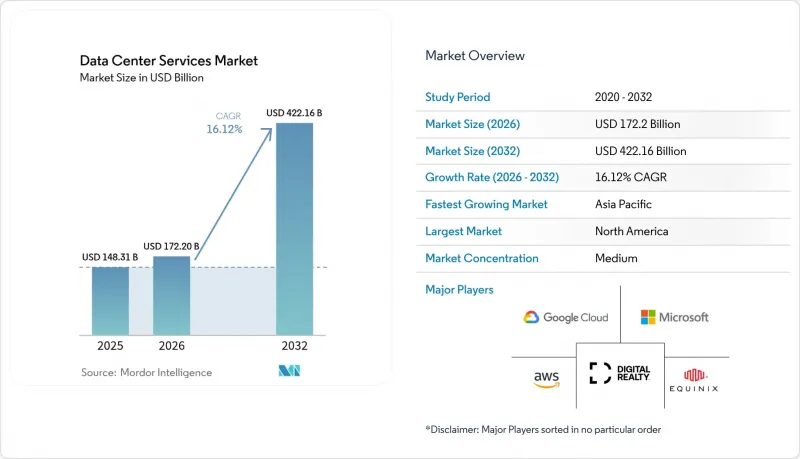
Enterprises are shifting from capital-heavy ownership toward service consumption models that provide rapid scalability, especially as artificial intelligence workloads require specialized cooling and power densities that outstrip traditional on-premise capabilities. Colocation remains the anchor of the data center service market, yet cloud and virtual data center services are gaining momentum as organizations embrace cloud-native architectures for agility. Competitive intensity is rising as colocation specialists and hyperscale cloud providers converge on hybrid solutions, while supply-chain constraints for high-power components and skilled labor shortages create operational friction. Regulatory localization and water-usage limitations are forcing providers to re-engineer facility designs, driving the uptake of liquid-cooling technologies that enable higher rack densities and improved energy efficiency.
Global Data Center Services Market Trends and Insights
Increase in Expenditure on Data Center Technology
Organizations now view infrastructure spending as a competitive differentiator rather than a pure cost center, allocating larger budgets to outsourced models that unlock instant scalability. The trend gained prominence after Microsoft committed USD 30 billion to AI infrastructure in partnership with BlackRock, underscoring how hyperscalers leverage external capital to accelerate deployments. Higher spending levels accelerate adoption of edge nodes and AI inference engines that would otherwise be constrained by traditional procurement cycles. Service providers benefit because clients prefer managed environments that reduce deployment time while ensuring technology currency. Consequently, the data center service market experiences sustained demand for colocation and managed hosting that integrate cutting-edge GPU clusters with advanced cooling.
Surge in Cloud and Hyperscale Expansion
Cloud providers are building regional zones to satisfy latency expectations and sovereign data rules, creating overflow demand that local service partners can monetize. Oracle's USD 8 billion investment in Japan exemplifies the push toward sovereign cloud capacity that meets compliance while maintaining global reach. The expansion diffuses capacity across multiple cities rather than concentrating it in mega-farms, allowing enterprises to architect multi-region resiliency strategies. For service vendors, partnering with hyperscalers opens cross-connect revenue streams and drives the data center service market toward integrated hybrid offerings that bundle cloud on-ramps with local interconnection.
Data Privacy and Security Concerns
High-profile breaches make enterprises cautious about outsourcing sensitive workloads, particularly in finance and healthcare where penalties are severe. Providers must invest in zero-trust architectures and transparent incident-response processes, raising operating costs that can erode margins. Smaller operators struggle to match the security depth of global peers, leading some customers to consolidate with larger brands that offer certified environments. The issue slows migrations yet also pushes the data center service market toward higher-value security services embedded within infrastructure subscriptions.
Other drivers and restraints analyzed in the detailed report include:
- AI-Driven Workload Orchestration and Optimization
- Data-Sovereignty Regulations Driving Local Facilities
- Skilled Workforce Shortage in Advanced Operations
For complete list of drivers and restraints, kindly check the Table Of Contents.
Segment Analysis
Colocation services generated 44.72% of the data center service market size in 2025, reflecting demand for carrier-neutral sites that offer direct cloud on-ramps and rich interconnection. Cloud and virtual data center services, however, are forecast to expand at a 16.94% CAGR, supported by organizations that prefer operational expenditure and elastic scaling. Colocation retains appeal for latency-sensitive workloads and compliance-driven deployments, sustaining steady contracts even as cloud uptake accelerates. Managed hosting stabilizes as mid-market enterprises offload routine infrastructure tasks, while disaster recovery and backup enjoy niche growth amid stricter data-protection mandates.
Data center infrastructure management tools have become essential across all service types, providing real-time insight into power, cooling, and asset utilization. Professional and consulting services deepen client relationships by guiding migration roadmaps and regulatory audits. Service portfolios therefore evolve from single-rack leasing to integrated suites that blend physical footprint, virtual machines, and advisory support. This composite approach anchors customer stickiness and keeps the data center service market positioned for multi-year expansion.
Tier III facilities accounted for 54.73% of the data center service market share in 2025, striking a pragmatic middle ground between cost efficiency and fault tolerance. They host mainstream corporate workloads that tolerate minimal downtime yet avoid Tier IV premiums. Tier IV sites, targeting financial trading and critical healthcare systems, are expected to post a 16.02% CAGR as zero-interrupt architectures gain favor. Tier I and Tier II facilities lose share except for test labs and archival storage.
Operators are segmenting campuses by tier, enabling clients to align application resilience with budget. Liquid cooling is filtering into Tier III halls to accommodate AI clusters without upgrading the entire site to Tier IV. This modular tiering maximizes utilization and broadens the appeal of mixed-tier campuses, reinforcing market diversity while offering customers granular cost-performance trade-offs.
The Data Center Service Market Report is Segmented Type of Service (Managed Hosting Service, Colocation Service and More), Tier Standard (Tier I and II, Tier IV and More), End-User Industry (BFSI, Healthcare and More), Deployment Model (On-Premise Data Centers, Hyperscale and More), and Geography (North America, Asia-Pacific and More). Market Forecasts are Provided in Terms of Value (USD).
Geography Analysis
North America retained the largest portion of the data center service market in 2025, buoyed by hyperscale investments like Microsoft and BlackRock's USD 30 billion AI-infrastructure program. Established connectivity hubs, abundant capital, and mature regulatory frameworks sustain regional leadership. Challenges arise from water-use restrictions in the southwest, spurring adoption of liquid or dry-cooling solutions. Canada offers renewably powered alternatives, attracting AI training clusters that demand continuous megawatt loads.
Asia-Pacific recorded the fastest growth, driven by widespread digitization and sovereign data policies. Oracle's USD 8 billion sovereign cloud build in Japan and NTT's USD 1.5 billion expansion in India underscore the region's momentum. China emphasizes domestic processing for security reasons, favoring local providers. India benefits from government payment systems and biometric identity programs that necessitate compute at scale, while Southeast Asia positions itself as a bridge between global enterprises and local consumers.
Europe's trajectory is influenced by GDPR and escalating sustainability mandates. Operators must navigate fragmented national regulations while meeting renewable-energy quotas, creating scope for specialized compliance hosting. Middle East and Africa emerge as new frontiers, with the UAE, Saudi Arabia, and Kenya unveiling large-scale projects like the USD 544 million Microsoft-du facility and geothermal-powered campuses. Strategic positioning between continents enables these markets to serve as inter-regional hubs, further broadening the geographical footprint of the data center service market.
- Equinix Inc.
- Digital Realty Trust Inc.
- Amazon Web Services (AWS)
- Microsoft Corporation (Azure)
- Google LLC (Google Cloud)
- Alibaba Cloud
- Tencent Cloud
- IBM Corporation
- Fujitsu Limited
- NTT Communications
- Hewlett Packard Enterprise Company
- Dell Inc.
- Cisco Systems Inc.
- Vertiv Co.
- Singapore Telecommunications Limited (Singtel)
- Iron Mountain Inc.
- Cyxtera Technologies
- CoreSite Realty Corporation
- Capgemini SE
- Kyndryl Holdings Inc.
- Rackspace Technology
- OVHcloud
- ATandT Inc.
- Switch Inc.
- EdgeConneX
Additional Benefits:
- The market estimate (ME) sheet in Excel format
- 3 months of analyst support
TABLE OF CONTENTS
1 INTRODUCTION
- 1.1 Study Assumptions and Market Definition
- 1.2 Scope of the Study
2 RESEARCH METHODOLOGY
3 EXECUTIVE SUMMARY
4 MARKET LANDSCAPE
- 4.1 Market Overview
- 4.2 Market Drivers
- 4.2.1 Increase in Expenditure on Data Center Technology
- 4.2.2 Rising Data Center Complexities Due to Scalability
- 4.2.3 Surge in Cloud and Hyperscale Expansion
- 4.2.4 Data-Sovereignty Regulations Driving Local Facilities
- 4.2.5 Liquid Cooling Adoption Enabling Higher Rack Densities
- 4.2.6 AI-Driven Workload Orchestration and Optimization
- 4.3 Market Restraints
- 4.3.1 Data Privacy and Security Concerns
- 4.3.2 Skilled Workforce Shortage in Advanced Operations
- 4.3.3 Water-Usage Restrictions for Cooling
- 4.3.4 Supply-Chain Bottlenecks for High-Power Components
- 4.4 Value / Supply-Chain Analysis
- 4.5 Regulatory Landscape
- 4.6 Investment and Fund-Raising Trends
- 4.7 Porter's Five Forces Analysis
- 4.7.1 Bargaining Power of Suppliers
- 4.7.2 Bargaining Power of Consumers
- 4.7.3 Threat of New Entrants
- 4.7.4 Intensity of Competitive Rivalry
- 4.7.5 Threat of Substitute Products
5 MARKET SIZE AND GROWTH FORECASTS
- 5.1 By Type of Service
- 5.1.1 Managed Hosting Service
- 5.1.2 Colocation Service
- 5.1.3 Cloud / Virtual Data Center Services
- 5.1.4 Disaster Recovery and Backup Services
- 5.1.5 Data Center Infrastructure Management (DCIM) Services
- 5.1.6 Professional and Consulting Services
- 5.2 By Tier Standard
- 5.2.1 Tier I and II
- 5.2.2 Tier III
- 5.2.3 Tier IV
- 5.3 By End-User Industry
- 5.3.1 BFSI
- 5.3.2 Healthcare
- 5.3.3 Retail and E-commerce
- 5.3.4 Manufacturing
- 5.3.5 IT and Telecom
- 5.3.6 Government and Public Sector
- 5.3.7 Media and Entertainment
- 5.3.8 Others
- 5.4 By Deployment Model
- 5.4.1 On-Premise Facilities
- 5.4.2 Colocation Facilities
- 5.4.3 Hyperscale/Self-built Facilities
- 5.5 By Geography
- 5.5.1 North America
- 5.5.1.1 United States
- 5.5.1.2 Canada
- 5.5.1.3 Mexico
- 5.5.2 South America
- 5.5.2.1 Brazil
- 5.5.2.2 Argentina
- 5.5.2.3 Rest of South America
- 5.5.3 Europe
- 5.5.3.1 United Kingdom
- 5.5.3.2 Germany
- 5.5.3.3 France
- 5.5.3.4 Italy
- 5.5.3.5 Spain
- 5.5.3.6 Russia
- 5.5.3.7 Rest of Europe
- 5.5.4 Asia-Pacifc
- 5.5.4.1 China
- 5.5.4.2 Japan
- 5.5.4.3 India
- 5.5.4.4 South Korea
- 5.5.4.5 Australia and New Zealand
- 5.5.4.6 Rest of Asia-Pacifc
- 5.5.5 Middle East and Africa
- 5.5.5.1 Middle East
- 5.5.5.1.1 Saudi Arabia
- 5.5.5.1.2 United Arab Emirates
- 5.5.5.1.3 Turkey
- 5.5.5.1.4 Rest of Middle East
- 5.5.5.2 Africa
- 5.5.5.2.1 South Africa
- 5.5.5.2.2 Nigeria
- 5.5.5.2.3 Kenya
- 5.5.5.2.4 Rest of Africa
- 5.5.5.1 Middle East
- 5.5.1 North America
6 COMPETITIVE LANDSCAPE
- 6.1 Market Share Analysis
- 6.2 Company Profiles (includes Global level Overview, Market level overview, Core Segments, Financials as available, Strategic Information, Market Rank/Share for key companies, Products and Services, and Recent Developments)
- 6.2.1 Equinix Inc.
- 6.2.2 Digital Realty Trust Inc.
- 6.2.3 Amazon Web Services (AWS)
- 6.2.4 Microsoft Corporation (Azure)
- 6.2.5 Google LLC (Google Cloud)
- 6.2.6 Alibaba Cloud
- 6.2.7 Tencent Cloud
- 6.2.8 IBM Corporation
- 6.2.9 Fujitsu Limited
- 6.2.10 NTT Communications
- 6.2.11 Hewlett Packard Enterprise Company
- 6.2.12 Dell Inc.
- 6.2.13 Cisco Systems Inc.
- 6.2.14 Vertiv Co.
- 6.2.15 Singapore Telecommunications Limited (Singtel)
- 6.2.16 Iron Mountain Inc.
- 6.2.17 Cyxtera Technologies
- 6.2.18 CoreSite Realty Corporation
- 6.2.19 Capgemini SE
- 6.2.20 Kyndryl Holdings Inc.
- 6.2.21 Rackspace Technology
- 6.2.22 OVHcloud
- 6.2.23 ATandT Inc.
- 6.2.24 Switch Inc.
- 6.2.25 EdgeConneX
7 MARKET OPPORTUNITIES AND FUTURE OUTLOOK
- 7.1 White-space and Unmet-Need Assessment

