
PUBLISHER: Mordor Intelligence | PRODUCT CODE: 2035120

PUBLISHER: Mordor Intelligence | PRODUCT CODE: 2035120
India CCTV - Market Share Analysis, Industry Trends & Statistics, Growth Forecasts (2026 - 2031)
The India CCTV market size was valued at USD 4.8 billion in 2025 and estimated to grow from USD 5.75 billion in 2026 to reach USD 14.25 billion by 2031, at a CAGR of 19.88% during the forecast period (2026-2031).
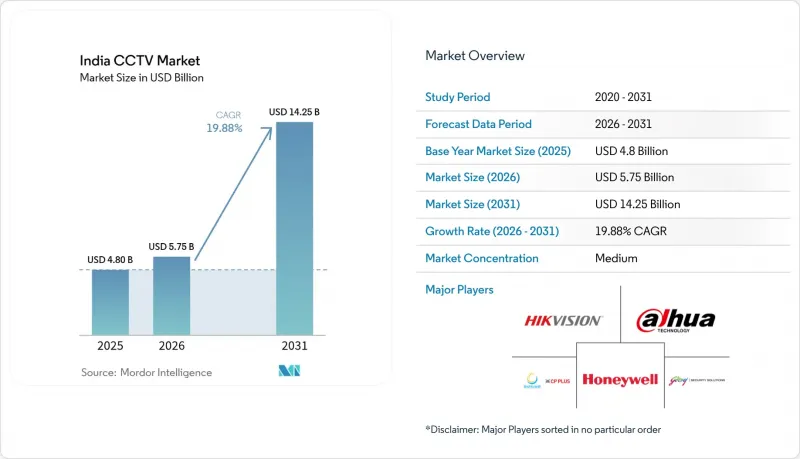
Smart Cities Mission rollouts, mandatory public-safety regulations, and a push for indigenous manufacturing, spurred by the STQC certification mandate, fuel the current growth. These initiatives aim to enhance urban infrastructure, improve public safety, and promote self-reliance in technology manufacturing, creating a favorable environment for market expansion. Additionally, the government's focus on digital transformation and smart infrastructure development further accelerates the adoption of advanced technologies in urban planning and public safety systems.
With 76,000 cameras installed in 100 cities and ongoing upgrades at airports and metros, demand remains robust. The deployment of surveillance systems in urban areas and transportation hubs underscores the growing emphasis on security and operational efficiency, further driving the market's momentum. Moreover, the integration of advanced analytics and artificial intelligence in these systems is expected to enhance their effectiveness, contributing to sustained growth in the forecast period.
India CCTV Market Trends and Insights
Government Smart-City Surveillance Push
The Smart Cities Mission elevated surveillance from reactive policing to predictive city management. With 90% of projects worth INR 1.44 trillion (USD 16.06 billion) finalized by March 2025, 76,000 cameras now integrate with command-and-control centers that funnel data to traffic, waste, and emergency modules. Standardized procurement favors suppliers able to meet interoperability benchmarks. Cloud-hosted platforms, such as Madhya Pradesh's Integrated Control and Command Centre, illustrate resource optimization across utilities. The same backbone supports predictive analytics that pre-empt congestion and criminal activity, reinforcing steady demand across the India CCTV market.
Mandatory Surveillance Regulations for Public Spaces
State legislation is turning CCTV expenditure into a compliance item. Karnataka's Public Safety Enforcement Act requires establishments with 500-plus monthly footfall to connect cameras to police networks, impacting roughly 10,000 Bengaluru outlets. Similar statutes follow Supreme Court directives for police-station coverage, exposing non-compliance gaps that spur immediate procurement. specifications standardize frame rates, encryption, and retention periods, elevating product quality while weeding out sub-standard imports.
High Total Cost of Ownership for Multi-Site Rollouts
Large networks incur costs far beyond hardware, covering maintenance, bandwidth, and cloud storage that can outstrip initial capital outlay within three years. Dispersed sites often need satellite or private fiber links costing INR 50,000-100,000 yearly per location. High-definition video can generate several terabytes monthly, pushing enterprises toward edge storage or higher-tier cloud plans. Skilled labor shortages in tier-2 and tier-3 cities inflate installation fees and delay commissioning. These dynamics slow adoption among SMEs and may cap the expansion speed of the India CCTV market in less bankable segments.
Other drivers and restraints analyzed in the detailed report include:
- Rapid Infrastructure Expansion of Airports and Metro Systems
- AI-Driven Compliance and Safety Analytics Adoption
- Rising Privacy and Data-Protection Obligations (DPDP Act)
For complete list of drivers and restraints, kindly check the Table Of Contents.
Segment Analysis
Analog units retained a 51.65% share of the India CCTV market in 2025, supported by cost-sensitive public-sector tenders and legacy coaxial cabling. IP models reached 40.55% share thanks to remote monitoring and PoE convenience. PTZ cameras contributed 5.85%, addressing large-area coverage in airports and oil terminals. AI-enabled smart cameras, although niche, are forecast to expand at a 20.55% CAGR, directly lifting the India CCTV market size for intelligent endpoints.
Low acquisition cost and ease of swap-out keep analog in play, yet STQC rules that took effect in April 2025 push buyers toward cyber-secure, upgradeable devices. Domestic firms such as Aditya Infotech and Prama Hikvision now bundle on-device analytics and secure boot to comply with the Ministry of Electronics mandates. AI-ready models thereby erode analog headroom, reshaping future India CCTV market share trajectories.
The India CCTV Market Report is Segmented by Type (Analog Cameras, IP Cameras, PTZ Cameras, AI-Enabled Smart Cameras), End-User Verticals (Government, Industrial and Manufacturing, BFSI, Transportation and Logistics, Residential and Smart Homes, Retail and Hospitality, Healthcare and Education), Connectivity (Wired and Wireless), and Region. The Market Forecasts are Provided in Terms of Value (USD).
List of Companies Covered in this Report:
- HIKVISION Digital Technology Co. Ltd (Hikvision India)
- Dahua Technology India Pvt. Ltd
- Aditya Infotech Ltd (CP Plus)
- Honeywell Commercial Security
- Godrej Security Solutions
- Axis Video Systems India Pvt. Ltd
- Bosch Security Systems India
- D-Link India Limited
- Videocon Industries Limited
- Zicom Electronic Security Systems
- Electronic Eye Systems
- Vantage Security Ltd
- Vintron Informatics Ltd
- Digitals India Security Products Pvt. Ltd
- Total Surveillance Solutions Pvt. Ltd
- HFCL Ltd
- Prizor Viztech Limited
- Dixon Technologies (India) Limited
- Sparsh Securitech Pvt. Ltd
- Qubo (Hero Electronix Private Limited)
- Uniview Technology India
- Samsung Hanwha Techwin India
Additional Benefits:
- The market estimate (ME) sheet in Excel format
- 3 months of analyst support
TABLE OF CONTENTS
1 INTRODUCTION
- 1.1 Study Assumptions and Market Definition
- 1.2 Scope of the Study
2 RESEARCH METHODOLOGY
3 EXECUTIVE SUMMARY
4 MARKET LANDSCAPE
- 4.1 Market Overview
- 4.2 Market Drivers
- 4.2.1 Government smart-city surveillance push
- 4.2.2 Mandatory surveillance regulations for public spaces
- 4.2.3 Rapid infrastructure expansion of airports and metros
- 4.2.4 AI-driven compliance and safety analytics adoption
- 4.2.5 Shift toward indigenous manufacturing post STQC/BIS norms
- 4.2.6 Solar-powered edge CCTV deployments in rural schemes
- 4.3 Market Restraints
- 4.3.1 High total cost of ownership for multi-site rollouts
- 4.3.2 Rising privacy and data-protection obligations (DPDP Act)
- 4.3.3 Cyber-security certification burden slowing launches
- 4.3.4 Semiconductor and import restrictions disrupting supply
- 4.4 Industry Value Chain Analysis
- 4.5 Regulatory Landscape
- 4.6 Technological Outlook
- 4.6.1 AI video analytics and VSaaS
- 4.6.2 Edge-based low-power cameras
- 4.7 Porter's Five Forces Analysis
- 4.7.1 Bargaining Power of Suppliers
- 4.7.2 Bargaining Power of Buyers/Consumers
- 4.7.3 Threat of New Entrants
- 4.7.4 Threat of Substitutes
- 4.7.5 Intensity of Competitive Rivalry
- 4.8 Domestic Production vs Imports
- 4.9 Impact of Macroeconomic Factors on the Market
5 MARKET SIZE AND GROWTH FORECASTS (VALUE)
- 5.1 By Type
- 5.1.1 Analog Cameras
- 5.1.2 IP Cameras (Non-PTZ)
- 5.1.3 PTZ Cameras
- 5.1.4 AI-enabled Smart Cameras
- 5.2 By End-user Verticals
- 5.2.1 Government
- 5.2.2 Industrial and Manufacturing
- 5.2.3 BFSI
- 5.2.4 Transportation and Logistics
- 5.2.5 Residential and Smart Homes
- 5.2.6 Retail and Hospitality
- 5.2.7 Healthcare and Education
- 5.2.8 Other End-user Verticals
- 5.3 By Connectivity
- 5.3.1 Wired
- 5.3.2 Wireless (Wi-Fi/4G/5G)
- 5.4 By Region
- 5.4.1 North India
- 5.4.2 South India
- 5.4.3 East India
- 5.4.4 West India
- 5.4.5 Central India
6 COMPETITIVE LANDSCAPE
- 6.1 Market Concentration
- 6.2 Strategic Moves
- 6.3 Market Share Analysis
- 6.4 Company Profiles (includes Global level Overview, Market level overview, Core Segments, Financials as available, Strategic Information, Market Rank/Share for key companies, Products and Services, and Recent Developments)
- 6.4.1 HIKVISION Digital Technology Co. Ltd (Hikvision India)
- 6.4.2 Dahua Technology India Pvt. Ltd
- 6.4.3 Aditya Infotech Ltd (CP Plus)
- 6.4.4 Honeywell Commercial Security
- 6.4.5 Godrej Security Solutions
- 6.4.6 Axis Video Systems India Pvt. Ltd
- 6.4.7 Bosch Security Systems India
- 6.4.8 D-Link India Limited
- 6.4.9 Videocon Industries Limited
- 6.4.10 Zicom Electronic Security Systems
- 6.4.11 Electronic Eye Systems
- 6.4.12 Vantage Security Ltd
- 6.4.13 Vintron Informatics Ltd
- 6.4.14 Digitals India Security Products Pvt. Ltd
- 6.4.15 Total Surveillance Solutions Pvt. Ltd
- 6.4.16 HFCL Ltd
- 6.4.17 Prizor Viztech Limited
- 6.4.18 Dixon Technologies (India) Limited
- 6.4.19 Sparsh Securitech Pvt. Ltd
- 6.4.20 Qubo (Hero Electronix Private Limited)
- 6.4.21 Uniview Technology India
- 6.4.22 Samsung Hanwha Techwin India
7 MARKET OPPORTUNITIES AND FUTURE OUTLOOK
- 7.1 White-space and Unmet-Need Assessment

