
PUBLISHER: Mordor Intelligence | PRODUCT CODE: 2035128

PUBLISHER: Mordor Intelligence | PRODUCT CODE: 2035128
Japan Facility Management - Market Share Analysis, Industry Trends & Statistics, Growth Forecasts (2026 - 2031)
The Japan Facility Management Market size is expected to grow from USD 62.99 billion in 2025 to USD 64.56 billion in 2026 and is forecast to reach USD 73.66 billion by 2031 at 2.5% CAGR over 2026-2031.
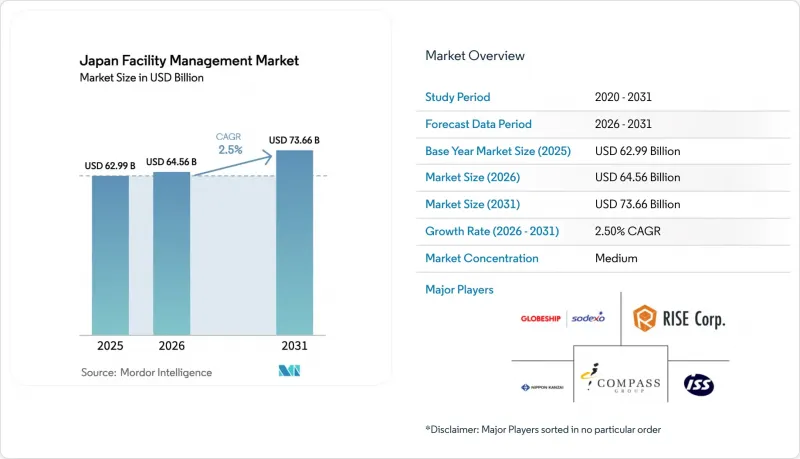
A maturing demand base, persistent labor shortages, and higher input costs are slowing topline expansion, yet structural reforms are nudging the industry toward technology-enabled service integration, seismic retrofitting programs, and mandatory energy-efficiency upgrades. Hard Services retained dominance, but Soft Services are outpacing the overall market as occupiers raise expectations for hospitality-style amenities, workplace wellness, and data-driven quality control. Outsourced contracts continue to gain traction because clients wish to transfer operational risk, comply with stricter ESG disclosure rules, and access specialized skillsets without capital outlay, especially as record construction-material inflation of 32-35% since 2021 squeezes internal budgets. Competitive intensity is escalating as legacy providers consolidate to defend scale while technology-first entrants leverage IoT sensors, AI-powered analytics, and mobile work order platforms to reduce site visits and combat workforce constraints. These intertwined forces keep the Japan facility management market on a deliberate but unmistakably modernizing path.
Japan Facility Management Market Trends and Insights
Urbanisation and Population Growth in Major Metros
Rapid metropolitan concentration is swelling service volumes and complexity across the Japan facility management market as rural depopulation funnels residents and businesses into Tokyo, Osaka, and Nagoya. Commercial real-estate investment in Tokyo alone exceeded JPY 4 trillion in 2025, prompting landlords to upgrade office stock with smart-building infrastructure, wellness amenities, and flexible layouts that raise the operational bar for facility managers. Dense portfolios let providers deploy standardized IoT-enabled building systems and AI-driven predictive maintenance tools across clusters, extracting data-led efficiencies while meeting higher occupant expectations. Urban campuses are thus becoming living laboratories where scalable, technology-rich models are refined before wider rollout. This dynamic, in turn, accelerates consolidation as firms chase critical mass to serve multi-site contracts while absorbing escalating compliance and ESG reporting obligations. Cumulatively, metropolitan growth adds 0.8 percentage points to forecast CAGR, underscoring its pivotal role in sustaining the Japan facility management market.
Aging Building Stock Driving Seismic and Sustainability Retrofits
Roughly 65% of Japan's office inventory now exceeds 20 years of age, pushing owners toward simultaneous seismic reinforcement and decarbonization projects to comply with the amended Building Energy Efficiency Act and achieve net-zero emissions by 2050. Facility management contracts increasingly bundle long-horizon retrofitting oversight, energy-performance monitoring, and tenant liaison into integrated offerings. Providers that command both structural engineering know-how and energy-analytic capability are winning multi-year engagements to safeguard asset value while ensuring operational continuity. Client appetite for turnkey coordination-from design consultation through commissioning and ongoing performance verification-magnifies the role of data governance and remote monitoring. As these opportunities widen, aging stock contributes the single-largest positive lift (+0.9%) to the Japan facility management market CAGR.
Rising Labour Costs Amid Ageing Workforce
The facility management payroll base is swelling faster than revenue growth. Wage hikes were implemented by 85.6% of companies in 2024, yet median increases of 3% failed to ease recruitment gaps as retirement accelerates. Labor-shortage bankruptcies hit a record 350 during the same year, with construction and logistics insolvencies disrupting subcontracting networks feeding facility operations. Providers must now layer retraining incentives, retention bonuses, and automation investments onto cost structures already burdened by inflation in materials. The squeeze erodes margins and knocks 0.6 percentage points off the Japan facility management market CAGR.
Other drivers and restraints analyzed in the detailed report include:
- Growth in Outsourcing to Integrated FM Contracts
- Regulatory Drivers Specific to Labour and Safety Standards
- Stringent Bid-Price Caps in Public FM Tenders
For complete list of drivers and restraints, kindly check the Table Of Contents.
Segment Analysis
Hard Services accounted for 60.10% of the Japan facility management market share in 2025. They encompass asset management, MEP and HVAC maintenance, fire-safety systems, and other technical functions essential for operational resilience. Demand remains steady because aging assets must meet tighter seismic and energy-efficiency codes, pushing asset owners to adopt predictive maintenance regimes and retro-commissioning campaigns. Asset-performance dashboards and digital twins help providers prioritize interventions, while IoT-enabled sensors deliver real-time condition data that reduces unscheduled downtime. The Japan facility management market size for Hard Services is expected to expand moderately as providers shift from reactive repairs to outcome-based contracts tied to uptime and energy-saving metrics.
Soft Services, covering cleaning, security, office support, catering, and concierge functions, are growing at a 4.72% CAGR to 2031, faster than Hard Services. Occupier expectations for wellness, hygiene, and hospitality-style amenity packages raise the strategic weight of Soft Services and justify premium pricing. Digital work-order platforms and robotics-such as autonomous floor scrubbers-are improving productivity and mitigating labor constraints. Providers able to fuse hospitality skills with data-driven quality control gain competitive leverage, broadening the revenue mix and accelerating integration across service silos within the Japan facility management market.
Japan Facility Management Market is Segmented by Service Type (Hard Services and Soft Services), Offering Type (In-House and Outsourced), End-User Industry (Commercial, Hospitality, Institutional and Public Infrastructure, Healthcare, Industrial and Process, and Other End-User Industries). The Market Forecasts are Provided in Terms of Value (USD).
List of Companies Covered in this Report:
- Globeship Sodexo
- Compass Group Japan
- RISE Corp. Tokyo
- Nippon Kanzai Co.
- ISS Facility Services Japan
- Aramark Facilities Services Japan
- G4S Facilities Management Japan
- SECOM Co., Ltd.
- Tokai Building Maintenance Co., Ltd.
- Yamato Facility Co., Ltd.
- Kanden Facilities
- MC Facilities
- Sagawa Express (FM Division)
- Asahi Facilities Inc.
- Tokyu Community Corporation
- Mitsubishi Estate Property Management
- Kajima Building Systems
- ALSOK (Sohgo Security Services)
- JLL Japan
- CBRE Group Japan
Additional Benefits:
- The market estimate (ME) sheet in Excel format
- 3 months of analyst support
TABLE OF CONTENTS
1 INTRODUCTION
- 1.1 Study Assumptions and Market Definition
- 1.2 Scope of the Study
2 RESEARCH METHODOLOGY
3 EXECUTIVE SUMMARY
4 MARKET LANDSCAPE
- 4.1 Market Overview
- 4.1.1 Current Occupancy Rates
- 4.1.2 Profitability Rates of Major FM Players
- 4.1.3 Workforce Indicators - Labor Participation
- 4.1.4 Facility Management Market Share (%), by Service Type
- 4.1.5 Facility Management Market Share (%), by Hard Services
- 4.1.6 Facility Management Market Share (%), by Soft Services
- 4.1.7 Urbanization and Population Growth in Major Metros
- 4.1.8 Sector Investment Priorities in Japan's Infrastructure Pipeline
- 4.1.9 Regulatory Drivers Specific to Labour and Safety Standards
- 4.2 Market Drivers
- 4.2.1 Urbanisation and population growth in major metros
- 4.2.2 Profitability rates of major FM players
- 4.2.3 Current occupancy rates
- 4.2.4 Regulatory drivers specific to labour and safety standards
- 4.2.5 Growth in outsourcing to Integrated FM contracts
- 4.2.6 Aging building stock driving seismic and sustainability retrofits
- 4.3 Market Restraints
- 4.3.1 Workforce indicators - labour participation
- 4.3.2 Sector investment priorities in infrastructure pipeline
- 4.3.3 Rising labour costs amid ageing workforce
- 4.3.4 Stringent bid-price caps in public FM tenders
- 4.4 Value Chain Analysis
- 4.5 PESTEL Analysis
- 4.6 Regulatory and Legislative Framework for Market Entrants
- 4.7 Impact of Macroeconomic Indicators on FM Demand
- 4.8 Porter's Five Forces Analysis
- 4.8.1 Bargaining Power of Suppliers
- 4.8.2 Bargaining Power of Buyers
- 4.8.3 Threat of New Entrants
- 4.8.4 Threat of Substitute Services
- 4.8.5 Intensity of Competitive Rivalry
- 4.9 Investment and Funding Analysis
5 MARKET SIZE AND GROWTH FORECASTS (VALUES)
- 5.1 By Service Type
- 5.1.1 Hard Services
- 5.1.1.1 Asset Management
- 5.1.1.2 MEP and HVAC Services
- 5.1.1.3 Fire Systems and Safety
- 5.1.1.4 Other Hard FM Services
- 5.1.2 Soft Services
- 5.1.2.1 Office Support and Security
- 5.1.2.2 Cleaning Services
- 5.1.2.3 Catering Services
- 5.1.2.4 Other Soft FM Services
- 5.1.1 Hard Services
- 5.2 By Offering Type
- 5.2.1 In-house
- 5.2.2 Outsourced
- 5.2.2.1 Single FM
- 5.2.2.2 Bundled FM
- 5.2.2.3 Integrated FM
- 5.3 By End-user Industry
- 5.3.1 Commercial (IT and Telecom, Retail and Warehouses, etc.)
- 5.3.2 Hospitality (Hotels, Eateries, Large-scale Restaurants)
- 5.3.3 Institutional and Public Infrastructure (Govt, Education, Transportation)
- 5.3.4 Healthcare (Public and Private Facilities)
- 5.3.5 Industrial and Process (Manufacturing, Energy, Mining)
- 5.3.6 Other End-user Industries (Multi-housing, Entertainment, Sports and Leisure)
6 COMPETITIVE LANDSCAPE
- 6.1 Market Concentration
- 6.2 Strategic Moves
- 6.3 Market Share Analysis
- 6.4 Company Profiles (includes Global level Overview, Market level overview, Core Segments, Financials as available, Strategic Information, Market Rank/Share for key companies, Products and Services, and Recent Developments)
- 6.4.1 Globeship Sodexo
- 6.4.2 Compass Group Japan
- 6.4.3 RISE Corp. Tokyo
- 6.4.4 Nippon Kanzai Co.
- 6.4.5 ISS Facility Services Japan
- 6.4.6 Aramark Facilities Services Japan
- 6.4.7 G4S Facilities Management Japan
- 6.4.8 SECOM Co., Ltd.
- 6.4.9 Tokai Building Maintenance Co., Ltd.
- 6.4.10 Yamato Facility Co., Ltd.
- 6.4.11 Kanden Facilities
- 6.4.12 MC Facilities
- 6.4.13 Sagawa Express (FM Division)
- 6.4.14 Asahi Facilities Inc.
- 6.4.15 Tokyu Community Corporation
- 6.4.16 Mitsubishi Estate Property Management
- 6.4.17 Kajima Building Systems
- 6.4.18 ALSOK (Sohgo Security Services)
- 6.4.19 JLL Japan
- 6.4.20 CBRE Group Japan
7 MARKET OPPORTUNITIES AND FUTURE TRENDS
- 7.1 White-space and Unmet-Need Assessment
- 7.2 Technology-led Integrated FM (IoT, BMS, AI-based Predictive Maintenance)
- 7.3 ESG-compliant FM Solutions Demand
- 7.4 Future Service-Model Shifts (Outcome-based Contracts)

