
PUBLISHER: Mordor Intelligence | PRODUCT CODE: 2035145

PUBLISHER: Mordor Intelligence | PRODUCT CODE: 2035145
Semiconductor Logistics - Market Share Analysis, Industry Trends & Statistics, Growth Forecasts (2026 - 2031)
The Semiconductor Logistics Market size was valued at USD 79.32 billion in 2025 and estimated to grow from USD 86.55 billion in 2026 to reach USD 133.87 billion by 2031, at a CAGR of 9.12% during the forecast period (2026-2031).
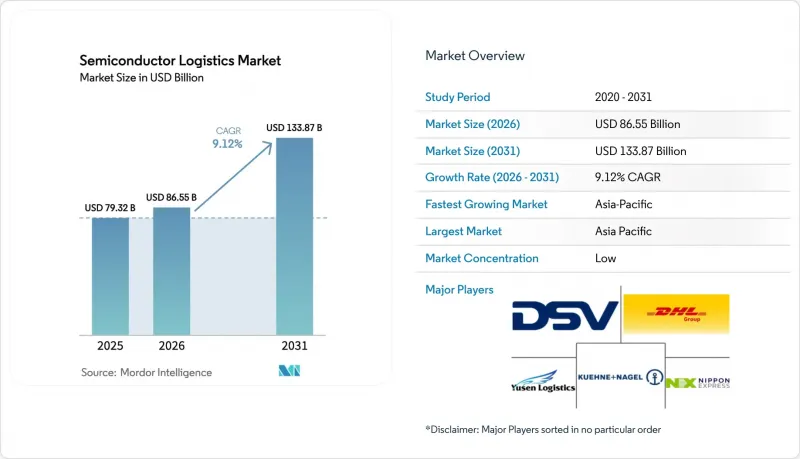
The growth outlook reflects historic fab construction activity, government incentive programs, and intensifying demand for artificial-intelligence hardware that requires rapid, contamination-free material flows. Transportation services remain the backbone of the semiconductor logistics market, yet value-added services such as specialist packaging, export-control documentation, and compliance auditing are expanding fastest as manufacturers seek integrated supply-chain partners. Capacity investments in Class A clean-room vehicles, cold-chain networks for extreme-ultraviolet (EUV) chemicals, and AI-enabled routing platforms are reshaping competitive dynamics. At the same time, trusted-partner supply-chain policies in the United States, Europe, and Japan are redrawing traditional Asia-centric trade lanes, compelling logistics providers to establish regional hubs near new fab clusters while maintaining high service standards that align with national-security requirements.
Global Semiconductor Logistics Market Trends and Insights
Accelerated Fab Expansion in the United States and Europe
Eighteen new fabs slated for 2025-2026 in the Americas, Japan, and Europe are reshaping global logistics corridors. Projects such as TSMC's Arizona campus and Intel's multi-state capacity expansions require contamination-free trucking networks to deliver ultra-high-purity gases, photoresists, and wafer pods on strict just-in-time schedules. Traditional long-haul routes are being supplemented by regional "milk-run" circuits that loop among fabs, supplier distribution centers, and specialized trans-load facilities. Logistics providers are investing in ISO Class 5-compatible trailers and on-board particulate sensing to meet these service levels. Real-estate developers are co-locating semiconductor-grade warehouses near Phoenix, Columbus, and Dresden, creating new nodes that shorten lead times and reduce air-freight reliance. The resulting demand surge for Class A trucks and certified drivers underpins a measurable uplift in the semiconductor logistics market.
Surging Wafer-Level Packaging Outsourcing in Southeast Asia
Rapid outsourcing of advanced packaging drives point-to-point lanes across Malaysia, Vietnam, and the Philippines. ASE Technology's Penang expansion to 3.4 million ft2 and 6,000 staff has tripled outbound shipments of temperature-sensitive substrates. Amkor's USD 1.6 billion Bac Ninh facility adds 200,000 m2 of clean-room space dedicated to system-in-package modules, amplifying inbound flows of lead frames, laminate, and under-fill chemicals. These projects demand bonded consolidation warehouses, ISO 14001-compliant road fleets, and 24/7 customs-broker desks to manage zone returns and partial shipments. Southeast Asian governments are streamlining free-trade-zone rules and investing in dual-view X-ray scanners at airports to accelerate clearance of semiconductor cargo, further stimulating the semiconductor logistics market.
Tight Capacity for Class A Clean-Room Trucks & Containers
Back-to-back fab announcements have outpaced specialty-fleet growth. Clean-room-equipped trailer builders report order backlogs exceeding 18 months, while operators face double-digit price inflation for ISO Class 5 liners. Some shippers charter mobile soft-wall clean rooms inside standard trailers as stop-gap measures, yet these solutions add loading complexity and reduce cube utilization. With every new advanced node requiring tighter particle thresholds, the supply-demand imbalance for specialty vehicles continues to constrain the semiconductor logistics market.
Other drivers and restraints analyzed in the detailed report include:
- AI-Enabled Dynamic Routing and ETA Visibility Platforms
- Government Subsidies for Trusted-Partner Supply Chains
- Persistent Shortage of Certified DG/ESD-Trained Manpower
For complete list of drivers and restraints, kindly check the Table Of Contents.
Segment Analysis
Transportation services held 58.93% of the semiconductor logistics market in 2025 as fabs, OSATs, and OEMs depend on time-definite, contamination-free movement of high-value cargo. Road fleets dominate intra-regional lanes where just-in-time plant replenishment requires sub-hour transit precision, while dedicated freighters and charter flights secure global capacity for masks, EUV machines, and critical spares. Korean Air alone operates 23 wide-body freighters dedicated to semiconductors, equal to a 6% share of global capacity for this vertical. The segment's scale gives carriers bargaining power with airports and ground handlers for priority slots and secure-tarmac clearance, reinforcing its primacy within the semiconductor logistics market size.
Value-added services posted the fastest segmental CAGR of 4.08% through 2031 as supply-chain complexity raises demand for customs brokerage, bonded warehousing, and export-control consulting. Providers that offer packaging kitting, ESD audit services, and sub-fab MRO replenishment win long-term contracts from foundries keen to minimize vendor count. As fabs outsource more non-core activities, logistics firms embed technicians on-site to manage tool-move coordination, enabling higher-margin revenue streams and diversifying away from low-yield pure transportation.
Non-cold-chain services accounted for 76.70% of the semiconductor logistics market size in 2025, covering finished chips, tooling, and mainstream materials that tolerate ambient conditions. Multi-modal hubs integrate bonded warehouses with ESD-safe staging areas to aggregate loads bound for diverse geographies, optimizing line-haul economics. Yet demand for cold-chain lanes is rising swiftly at a 4.78% CAGR as EUV photoresists, specialty gases, and advanced polymers impose tight thermal envelopes. DHL's EUR 2 billion (USD 2.20 billion) investment in GDP-compliant hubs positions the firm to capture this specialized growth, easing a key capacity bottleneck that threatened to slow the semiconductor logistics market.
The Semiconductor Logistics Market Report is Segmented by Function (Transportation, Warehousing & Distribution, and More), Mode of Operation (Cold-Chain Logistics, Non-Cold-Chain Logistics), Destination (Domestic, International), Product Type (Raw Materials & Chemicals, and More), and Geography (North America, South America, Asia-Pacific, Europe, Middle East and Africa). The Market Forecasts are Provided in Terms of Value (USD).
Geography Analysis
Asia-Pacific maintains its dominant position with 43.10% market share in 2025 and leads regional growth at 4.85% CAGR through 2031, driven by its integrated semiconductor ecosystem and strategic supply chain diversification initiatives. Taiwan's foundry leadership, anchored by TSMC's 54% global market share and nearly 90% of advanced chip production, drives significant logistics flows that require specialized clean-room transportation and temperature-controlled handling for EUV chemicals. South Korea's memory dominance, led by Samsung and SK Hynix, is generating substantial logistics volumes as both expand HBM production, with Samsung increasing output 2.5 times in 2024 and SK Hynix investing KRW 10 trillion in high-end storage products. Southeast Asian markets are experiencing accelerated growth as semiconductor companies diversify operations, with Malaysia generating approximately USD 130 billion annually from semiconductor exports while Vietnam attracts major packaging investments like Amkor's USD 1.6 billion facility in Bac Ninh. The region's logistics infrastructure faces a projected USD 60 billion investment gap to meet future trade demands, with countries enhancing transport infrastructure and establishing specialized semiconductor logistics hubs to maintain competitive advantages.
North America demonstrates robust growth momentum driven by unprecedented government investment and strategic reshoring initiatives under the CHIPS Act's USD 52.7 billion allocation. TSMC's USD 65 billion Arizona investment represents the largest foreign manufacturing project in U.S. history, with three fabs creating approximately 6,000 high-tech jobs and establishing new domestic logistics corridors for advanced semiconductor production. Intel's nearly USD 90 billion domestic investment spans multiple states, supported by USD 8.5 billion in CHIPS funding, and is creating integrated logistics networks that serve automotive, defense, and AI markets. The region benefits from established logistics infrastructure and regulatory frameworks, though faces higher operational costs with U.S. facilities costing approximately 10% more to build and up to 35% higher operating costs compared to Asian counterparts. Workforce development initiatives, including Intel's USD 65 million CHIPS funding for training programs, address critical skills shortages while establishing sustainable talent pipelines for semiconductor logistics operations.
Europe emerges as a strategic growth market through coordinated industrial policy and substantial public investment in semiconductor manufacturing capabilities. Germany's Silicon Saxony region serves as a model integrated ecosystem, while the European Chips Act targets increasing regional production from sub-10% to 20% by 2030 through strategic investments in domestic manufacturing Deloitte US. Major investments include onsemi's USD 2 billion silicon carbide facility in the Czech Republic, targeting energy-efficient semiconductors for electric vehicles and renewable energy applications, with potential to generate over USD 270 million annually for Czech GDP onsemi. The region's logistics infrastructure benefits from established automotive supply chains and regulatory frameworks including GDPR and environmental certifications, while DHL's EUR 2 billion (USD 2.20 billion) health logistics investment enhances specialized transportation capabilities for semiconductor chemicals and materials. European semiconductor logistics growth aligns with sustainability mandates and circular economy principles, creating opportunities for green logistics solutions and carbon-neutral transportation networks.
List of Companies Covered in this Report:
- DHL Supply Chain and Global Forwarding
- Kuehne + Nagel
- Nippon Express
- DSV
- Yusen Logistics
- UPS Supply Chain Solutions
- FedEx Logistics
- CEVA Logistics
- Omni Logistics
- Dimerco
- NNR Global Logistics
- MOL Logistics
- AIT Worldwide Logistics
- Kintetsu World Express, Inc.
- Logistics Plus Inc.
- CCS-Express
- Buske Logistics
- K Line Logistics
- Javelin Logistics Company, Inc.
- Three Way Logistics
Additional Benefits:
- The market estimate (ME) sheet in Excel format
- 3 months of analyst support
TABLE OF CONTENTS
1 Introduction
- 1.1 Study Assumptions and Market Definition
- 1.2 Scope of the Study
2 Research Methodology
3 Executive Summary
4 Market Landscape
- 4.1 Market Overview
- 4.2 Market Drivers
- 4.2.1 Accelerated fab expansion in the United States and Europe
- 4.2.2 Surging wafer-level packaging outsourcing in Southeast Asia
- 4.2.3 Shift toward near-foundry "milk-run" logistics models
- 4.2.4 Cold-chain compliance for EUV photolithography chemicals
- 4.2.5 Government subsidies for trusted-partner supply chains
- 4.2.6 AI-enabled dynamic routing and ETA visibility platforms
- 4.3 Market Restraints
- 4.3.1 Tight capacity for Class A clean-room trucks and containers
- 4.3.2 Volatile jet-fuel surcharges on chartered freighters
- 4.3.3 Persistent shortage of certified DG/ESD-trained manpower
- 4.3.4 Export-control licensing delays for China-bound tools
- 4.4 Value / Supply-Chain Analysis
- 4.5 Regulatory Landscape
- 4.6 Technological Outlook
- 4.7 Porter's Five Forces Analysis
- 4.7.1 Threat of New Entrants
- 4.7.2 Bargaining Power of Buyers
- 4.7.3 Bargaining Power of Suppliers
- 4.7.4 Threat of Substitute Services
- 4.7.5 Intensity of Competitive Rivalry
- 4.8 Impact of COVID-19 and Geopolitical Disruptions
5 Market Size and Growth Forecasts (Value)
- 5.1 By Function
- 5.1.1 Transportation
- 5.1.1.1 Roadways
- 5.1.1.2 Railways
- 5.1.1.3 Water and Seaways
- 5.1.1.4 Airways
- 5.1.2 Warehousing and Distribution
- 5.1.3 Value-Added Services (Packaging, Customs, Brokerage, Others)
- 5.1.1 Transportation
- 5.2 By Mode of Operation
- 5.2.1 Cold-Chain Logistics
- 5.2.2 Non-Cold-Chain Logistics
- 5.3 By Destination
- 5.3.1 Domestic
- 5.3.2 International
- 5.4 By Product type
- 5.4.1 Raw Materials and Chemicals
- 5.4.2 Wafers (Bare and Processed)
- 5.4.3 Packaging Materials
- 5.4.4 Finished Semiconductor Products
- 5.4.5 Others (Photo masks and reticles, Specialty consumables, etc.)
- 5.5 By Geography
- 5.5.1 North America
- 5.5.1.1 United States
- 5.5.1.2 Canada
- 5.5.1.3 Mexico
- 5.5.2 South America
- 5.5.2.1 Brazil
- 5.5.2.2 Peru
- 5.5.2.3 Chile
- 5.5.2.4 Argentina
- 5.5.2.5 Rest of South America
- 5.5.3 Asia-Pacific
- 5.5.3.1 India
- 5.5.3.2 China
- 5.5.3.3 Japan
- 5.5.3.4 Australia
- 5.5.3.5 South Korea
- 5.5.3.6 South East Asia (Singapore, Malaysia, Thailand, Indonesia, Vietnam, and Philippines)
- 5.5.3.7 Rest of Asia-Pacific
- 5.5.4 Europe
- 5.5.4.1 United Kingdom
- 5.5.4.2 Germany
- 5.5.4.3 France
- 5.5.4.4 Spain
- 5.5.4.5 Italy
- 5.5.4.6 BENELUX (Belgium, Netherlands, and Luxembourg)
- 5.5.4.7 NORDICS (Denmark, Finland, Iceland, Norway, and Sweden)
- 5.5.4.8 Rest of Europe
- 5.5.5 Middle East and Africa
- 5.5.5.1 United Arab of Emirates
- 5.5.5.2 Saudi Arabia
- 5.5.5.3 South Africa
- 5.5.5.4 Nigeria
- 5.5.5.5 Rest of Middle East And Africa
- 5.5.1 North America
6 Competitive Landscape
- 6.1 Market Concentration
- 6.2 Strategic Moves
- 6.3 Market Share Analysis
- 6.4 Company Profiles (includes Global Level Overview, Market Level Overview, Core Segments, Financials as available, Strategic Information, Market Rank/Share for key companies, Products and Services, and Recent Developments)
- 6.4.1 DHL Supply Chain and Global Forwarding
- 6.4.2 Kuehne + Nagel
- 6.4.3 Nippon Express
- 6.4.4 DSV
- 6.4.5 Yusen Logistics
- 6.4.6 UPS Supply Chain Solutions
- 6.4.7 FedEx Logistics
- 6.4.8 CEVA Logistics
- 6.4.9 Omni Logistics
- 6.4.10 Dimerco
- 6.4.11 NNR Global Logistics
- 6.4.12 MOL Logistics
- 6.4.13 AIT Worldwide Logistics
- 6.4.14 Kintetsu World Express, Inc.
- 6.4.15 Logistics Plus Inc.
- 6.4.16 CCS-Express
- 6.4.17 Buske Logistics
- 6.4.18 K Line Logistics
- 6.4.19 Javelin Logistics Company, Inc.
- 6.4.20 Three Way Logistics
7 Market Opportunities and Future Outlook
- 7.1 White-Space and Unmet-Need Assessment

