
PUBLISHER: Mordor Intelligence | PRODUCT CODE: 2035166

PUBLISHER: Mordor Intelligence | PRODUCT CODE: 2035166
Pet Hotels - Market Share Analysis, Industry Trends & Statistics, Growth Forecasts (2026 - 2031)
The pet hotels market size in 2026 is estimated at USD 6.47 billion, growing from 2025 value of USD 6.00 billion with 2031 projections showing USD 9.45 billion, growing at 7.86% CAGR over 2026-2031.
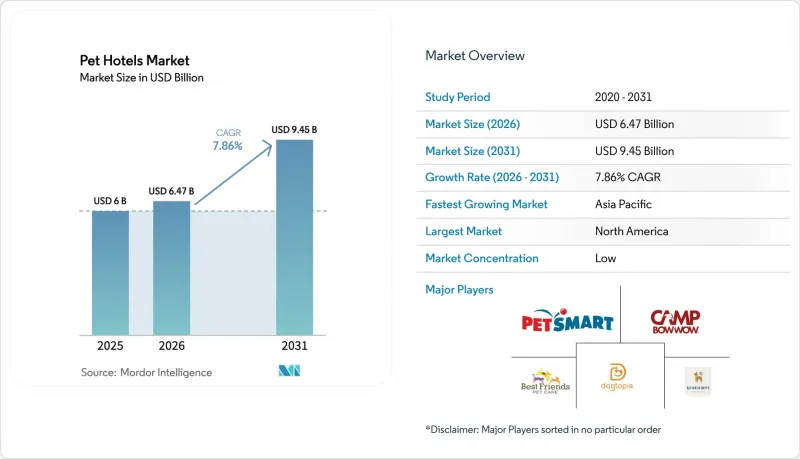
Robust growth stems from a steady rise in global pet ownership, higher discretionary income, and the willingness of owners to purchase hotel-grade services such as webcam monitoring and climate-controlled suites. North America retains spending leadership, yet Asia-Pacific has become the most dynamic region owing to rising urban affluence and smaller household sizes. Digital booking is shifting share toward mobile platforms, while franchise roll-outs supply rapid capacity and recognizable brand standards. At the same time, tightening welfare regulations, escalating urban rents, and labour-intensive care models encourage consolidation among operators that can fund modern facilities and meet compliance requirements.
Global Pet Hotels Market Trends and Insights
Rising Pet-Humanization and Premium Care
The growing trend of pet owners treating their animals as integral family members has led to increased spending on premium services, including hotel-level accommodations that ensure safety and enrichment. Young adults, particularly those aged 18-34 in the United States, are at the forefront of this shift, driving consistent demand for value-added offerings such as webcam access, tailored activity schedules, and on-site wellness packages. The pet care market has demonstrated resilience to economic fluctuations, with the American Pet Products Association emphasizing the robust global expenditure on pets in 2024. This humanization of pets has also bolstered ancillary revenue streams, including spa treatments and behavioural coaching, thereby increasing average stay values and encouraging service providers to adopt premium market positioning.
Aggressive Franchise Roll-Outs by Pet-Specialty Chains
Franchising provides established branding, streamlined operational frameworks, and access to investment capital, addressing key challenges faced by small independent operators. Camp Bow Wow, with a network exceeding 200 locations, demonstrates strong financial performance and operational stability with minimal unit closures. Similarly, Dogtopia, managing over 250 centers, adopts a daycare-focused model that ensures consistent weekday revenue streams. The scalability of these franchises enables cost efficiencies through bulk procurement, strengthens brand visibility via national marketing initiatives, and drives uniform service quality, fostering customer confidence across extensive geographic markets.
High Fixed Costs and Labor-Intensive Model
Pet hotels are encountering escalating operational expenses due to the enforcement of strict staff-to-animal ratios, emergency preparedness measures, and the installation of specialized ventilation systems. These requirements significantly increase labor and depreciation costs. Although median franchise revenues may appear robust, they often obscure narrow operating margins after factoring in payroll, insurance, and compliance with regulatory standards, as reported by Vetted Biz. Additionally, the industry faces intensified competition for skilled handlers due to labor shortages. Location-specific assets further expose businesses to risks from natural disasters, which can disrupt operations and occupancy for extended periods.
Other drivers and restraints analyzed in the detailed report include:
- Digital, Mobile-First Booking Platforms
- Airport-Adjacent "Pre-Flight" Pet Hotels
- Regulatory Patchwork
For complete list of drivers and restraints, kindly check the Table Of Contents.
Segment Analysis
Dogs contribued 62.02% of 2025 revenue, reflecting their social nature and owners' preference for communal play yards and tailored activity plans. The pet hotels market size for dogs is expected to grow steadily, but at a pace below the overall average, as penetration is already high. Cats, however, will deliver the fastest 9.24% CAGR, aided by urban apartment living and specialized stress-reduction suites that appeal to feline behaviour. Operators have started dedicating separate wings or ventilation zones to minimise canine scent, thereby lifting occupancy and yield for cat units. Other pet categories-birds, reptiles, and small mammals-though niche, command premium nightly rates because few facilities invest in species-specific enclosures and veterinary protocols. Wealthy owners of exotic animals are willing to pre-pay multi-week blocks, adding predictable revenue during off-peak seasons.
The growth of cat boarding signals a shift away from traditional neighbour check-ins toward professional care with webcam access and vertical playgrounds. Younger owners cite peace of mind and emergency readiness as reasons to book formal accommodation. In the dog segment, luxury suites with private patios and splash pools differentiate brands, while behavioural training add-ons strengthen loyalty. Small-animal offerings often partner with exotic-vet practices, allowing referral traffic and cross-selling of medical services at premium margins.
Overnight boarding retained a 53.21% share of the pet hotels market size in 2025 because vacation and business travel remain core demand drivers. Yet daycare services are expanding at 11.06% CAGR as hybrid work schedules and resumed office commutes spur weekday visitation. High-frequency daycare patrons offer operators steady cash flows comparable to gym memberships. Multi-visit packages reduce effective customer-acquisition costs and feed ancillary grooming or retail sales. Grooming itself provides vital smoothing of seasonal occupancy dips, while training classes differentiate premium sites and deepen owner engagement.
Facilities positioned around dense employment hubs now dedicate equal floor space to daytime playrooms outfitted with reinforced flooring and odour control. Some chains extend evening pick-up hours to match commuter patterns, boosting convenience and pricing power. The daycare surge also elevates labour demand for canine coaches who organise enrichment programmes, yet improved utilisation offsets staffing costs. Combined boarding-plus-daycare bundles further enhance average spend and extend stay durations.
Pet Hotels Market is Segmented by Pet Type (Dogs, Cats, and Other Pets), Service Type (Overnight Boarding, Daycare, and More), Hotel Category (Luxury, Standard, and More), Distribution Channel (Online Bookings and Offline / Walk-In), and Region (North America, South America, and More). The Market Forecasts are Provided in Terms of Value (USD).
Geography Analysis
In 2024, North America generated nearly half of the global revenues. In Canada, urban centers such as Toronto and Vancouver have adopted a premium market positioning, driving increased demand for daycare services due to the prevalence of high-rise living. Conversely, Mexico's growing middle class represents significant growth potential. However, the absence of purpose-built facilities in many municipalities creates opportunities for early entrants with franchise support to establish a foothold. While the USDA Animal Welfare Act provides a standardized regulatory framework at the federal level, varying state-level requirements necessitate adaptable compliance strategies.
Asia-Pacific is the fastest-growing territory, expected to log a 10.29% CAGR through 2031. Urbanisation, single-occupancy housing, and rising disposable income underpin growth in China, Japan, and Australia. Chinese tier-1 cities exhibit luxury bias, with boutique hotels featuring in-room smart devices and bilingual caretaker staff. Japan's ageing population lavishes attention on companion animals, fuelling demand for wellness-oriented hotels offering physiotherapy and hydrotherapy. Australian operators innovate with large outdoor play zones reflecting domestic pet culture. South Korean and Southeast Asian markets remain nascent but show swift pet adoption, prompting international franchise entrants to adapt menus to local dietary preferences.
Europe maintains solid momentum as welfare regulation standardises quality expectations. The European Commission's 2025 dog and cat rules-mandating microchipping and veterinary oversight-raise operational thresholds that favour professional chains able to document compliance. The United Kingdom, Germany, and France anchor regional spend, while BENELUX and Nordic countries represent lucrative luxury niches due to high per-capita income. Belgium-based Pet Service Holding NV, through a series of acquisitions, has significantly boosted its revenue and is now setting its sights on expansion in Germany and Eastern Europe.
- PetSmart (PetsHotel)
- Camp Bow Wow
- Dogtopia
- Best Friends Pet Care
- K9 Resorts Luxury Pet Hotel
- Petco (Overnight Services)
- Rover
- Wag Hotels
- Paradise 4 Paws
- Hanrob Pet Hotels
- Jet Pet Resort
- Pet Palace Resorts
- D Pet Hotels
- Barkley Pet Hotel & Day Spa
- Posh Pet Hotel
- Pet Suites Resort
- Stay-N-Play Pet Ranch
- Urban Tails Dubai
- Pawspace India
- Club Pet Singapore
- H.I.S Dog & Cat Hotel Tokyo
- PetBacker
- The Dog House
- La Nucia
Additional Benefits:
- The market estimate (ME) sheet in Excel format
- 3 months of analyst support
TABLE OF CONTENTS
1 Introduction
- 1.1 Study Assumptions & Market Definition
- 1.2 Scope of the Study
2 Research Methodology
3 Executive Summary
4 Market Landscape
- 4.1 Market Overview
- 4.2 Market Drivers
- 4.2.1 Rising pet-humanization & willingness to pay for hotel-grade care
- 4.2.2 Aggressive franchise roll-outs by pet-specialty chains (PetSmart, Dogtopia, Camp Bow Wow)
- 4.2.3 Digital, mobile-first booking platforms driving >35 % of 2025 reservations
- 4.2.4 Airport-adjacent "pre-flight" pet hotels integrating with airline check-in systems
- 4.2.5 Subscription wellness bundles (grooming + daycare + boarding) boosting recurring revenue
- 4.2.6 Climate-controlled, HEPA-filtered suites meeting extreme-weather pet-safety standards
- 4.3 Market Restraints
- 4.3.1 High fixed costs & labor-intensive operations
- 4.3.2 Regulatory patchwork (zoning, animal-welfare rules)
- 4.3.3 Rising real-estate rents in urban cores
- 4.3.4 Short-notice cancellations increasing capacity risk
- 4.4 Value / Supply-Chain Analysis
- 4.5 Regulatory Landscape
- 4.6 Technological Outlook
- 4.7 Porter's Five Forces
- 4.7.1 Threat of New Entrants
- 4.7.2 Bargaining Power of Suppliers
- 4.7.3 Bargaining Power of Buyers
- 4.7.4 Threat of Substitutes
- 4.7.5 Industry Rivalry
5 Market Size & Growth Forecasts (Value)
- 5.1 By Pet Type
- 5.1.1 Dogs
- 5.1.2 Cats
- 5.1.3 Other Pets (birds, small mammals, exotics)
- 5.2 By Service Type
- 5.2.1 Overnight Boarding
- 5.2.2 Daycare
- 5.2.3 Grooming
- 5.2.4 Training & Behaviour
- 5.2.5 Ancillary (transport, spa, veterinary check-ups)
- 5.3 By Hotel Category
- 5.3.1 Luxury
- 5.3.2 Standard
- 5.3.3 Boutique / Themed
- 5.3.4 Economy / Budget
- 5.4 By Distribution Channel
- 5.4.1 Online Bookings
- 5.4.2 Offline / Walk-in
- 5.5 By Region
- 5.5.1 North America
- 5.5.1.1 Canada
- 5.5.1.2 United States
- 5.5.1.3 Mexico
- 5.5.2 South America
- 5.5.2.1 Brazil
- 5.5.2.2 Peru
- 5.5.2.3 Chile
- 5.5.2.4 Argentina
- 5.5.2.5 Rest of South America
- 5.5.3 Asia-Pacific
- 5.5.3.1 India
- 5.5.3.2 China
- 5.5.3.3 Japan
- 5.5.3.4 Australia
- 5.5.3.5 South Korea
- 5.5.3.6 South East Asia
- 5.5.3.7 Rest of Asia-Pacific
- 5.5.4 Europe
- 5.5.4.1 United Kingdom
- 5.5.4.2 Germany
- 5.5.4.3 France
- 5.5.4.4 Spain
- 5.5.4.5 Italy
- 5.5.4.6 BENELUX
- 5.5.4.7 NORDICS
- 5.5.4.8 Rest of Europe
- 5.5.5 Middle East and Africa
- 5.5.5.1 United Arab Emirates
- 5.5.5.2 Saudi Arabia
- 5.5.5.3 South Africa
- 5.5.5.4 Nigeria
- 5.5.5.5 Rest of Middle East and Africa
- 5.5.1 North America
6 Competitive Landscape
- 6.1 Market Concentration
- 6.2 Strategic Moves
- 6.3 Market Share Analysis
- 6.4 Company Profiles (includes Global level Overview, Market level overview, Core Segments, Financials as available, Strategic Information, Market Rank/Share for key companies, Products & Services, and Recent Developments)
- 6.4.1 PetSmart (PetsHotel)
- 6.4.2 Camp Bow Wow
- 6.4.3 Dogtopia
- 6.4.4 Best Friends Pet Care
- 6.4.5 K9 Resorts Luxury Pet Hotel
- 6.4.6 Petco (Overnight Services)
- 6.4.7 Rover
- 6.4.8 Wag Hotels
- 6.4.9 Paradise 4 Paws
- 6.4.10 Hanrob Pet Hotels
- 6.4.11 Jet Pet Resort
- 6.4.12 Pet Palace Resorts
- 6.4.13 D Pet Hotels
- 6.4.14 Barkley Pet Hotel & Day Spa
- 6.4.15 Posh Pet Hotel
- 6.4.16 Pet Suites Resort
- 6.4.17 Stay-N-Play Pet Ranch
- 6.4.18 Urban Tails Dubai
- 6.4.19 Pawspace India
- 6.4.20 Club Pet Singapore
- 6.4.21 H.I.S Dog & Cat Hotel Tokyo
- 6.4.22 PetBacker
- 6.4.23 The Dog House
- 6.4.24 La Nucia
7 Market Opportunities & Future Outlook
- 7.1 White-space & Unmet-Need Assessment

