
PUBLISHER: Mordor Intelligence | PRODUCT CODE: 2043853

PUBLISHER: Mordor Intelligence | PRODUCT CODE: 2043853
Data Loss Prevention (DLP) - Market Share Analysis, Industry Trends & Statistics, Growth Forecasts (2026 - 2031)
The Data loss prevention (DLP) market size expanded from USD 33.26 billion in 2025, to USD 42.87 billion in 2026, and will touch USD 111.98 billion by 2031, rising at a 21.17% CAGR during 2026-2031.
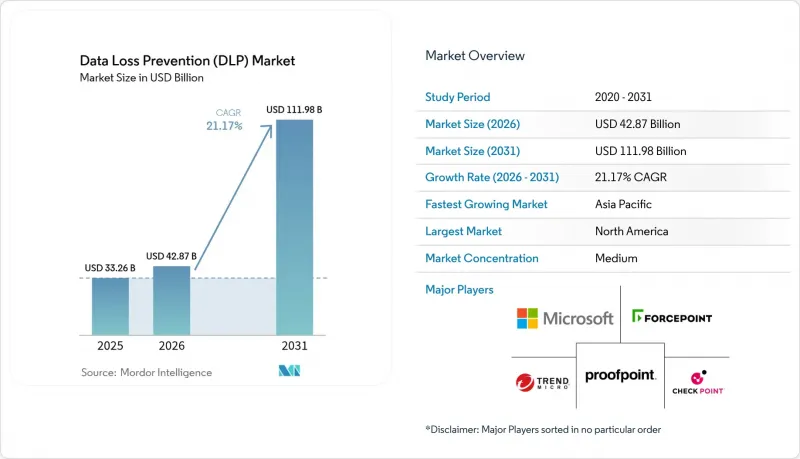
Penalty escalation under GDPR 2.0 and amended CCPA rules now assigns material cost to every breached record, so boards approve bigger DLP budgets. Gen-AI copilots have opened new exfiltration paths inside chat prompts, changing threat models from file-centric to conversation-centric vectors. Sovereign-cloud mandates in China, Russia, India, and the European Union require on-shore processing, so global companies run parallel DLP policies that respect local cryptographic-key custody. Vendors answer this complexity by merging cloud-access security broker, data-security-posture-management, and DLP functions inside one console, lowering false-positive rates and shortening deployment cycles. As a result, cloud deployments now dominate new spending, and endpoint agents outpace network appliances.
Global Data Loss Prevention (DLP) Market Trends and Insights
Escalating Cyber-Breach Fines Under GDPR 2.0 and CCPA Amendments
In 2025, European regulators imposed a substantial EUR 1.2 billion in fines under the GDPR, marking a significant 22% increase compared to the previous year. This rise underscores the growing enforcement of data protection regulations across the region. A notable case involved a EUR 530 million fine levied against TikTok, which highlighted the increasing scrutiny on cross-border data transfers and compliance with GDPR requirements. Meanwhile, California's updated CCPA, which came into effect in January 2025, introduced new provisions allowing private class actions. This change has the potential to expose companies to unlimited damages, further emphasizing the importance of robust data protection measures. With penalties reaching as high as 4% of a company's global turnover, chief information security officers are now compelled to implement advanced real-time Data Loss Prevention (DLP) measures. These controls are designed to prevent data exfiltration proactively, ensuring that legal thresholds are not breached and organizations remain compliant with evolving regulations.
Hybrid-Work Data Sprawl Raising Endpoint and Cloud Risk
In 2024, Fortinet found that 77% of organizations encountered insider incidents, and nearly half deemed their current DLP tools ineffective. The rise of bring-your-own-device programs and unmanaged file-sharing apps has significantly expanded avenues for potential data leakage, making it increasingly difficult for organizations to safeguard sensitive information. With enterprises now averaging 4.3 infrastructure-as-a-service platforms, achieving unified labeling and maintaining consistent data protection policies across platforms has become a considerable challenge. Highlighting the financial stakes involved, the IBM Security breach report pegged the average breach cost at a staggering USD 4.88 million, underscoring the need for robust preventive measures. As a result, boards are now prioritizing prevention strategies over post-incident forensics to mitigate risks and reduce potential losses.
Complexity and Skills Gap in Multi-Cloud Roll-Outs
In 2024, ISC2 identified a significant 3.5 million-person shortfall in the cybersecurity workforce, highlighting the growing demand for skilled professionals in this field. Data-protection roles, in particular, are in high demand, commanding an 18% salary premium due to their critical importance in safeguarding sensitive information. Each hyperscale cloud platform, including AWS, Azure, and Google Cloud, employs its own distinct policy syntax, which creates challenges for engineers attempting to map labels across these platforms. This lack of standardization often forces firms to operate dual DLP (Data Loss Prevention) stacks for an extended period of up to twelve months during migration processes. Consequently, this approach results in a doubling of both operational expenses and associated risks, further complicating the migration process.
Other drivers and restraints analyzed in the detailed report include:
- Convergence of DLP with CASB and DSPM Platforms
- AI-Assisted Policy Tuning Slashing False-Positive Rates
- High TCO for Legacy On-Prem Policies
For complete list of drivers and restraints, kindly check the Table Of Contents.
Segment Analysis
Cloud deployments held 67.31% of Data loss prevention (DLP) market revenue in 2025 and are forecast to climb at 21.23% CAGR to 2031, highlighting how elastic compute and global points of presence favor inline API inspection. On-prem appliances stay relevant for defense and nuclear operators that forbid cloud egress, yet rising TLS 1.3 usage reduces the visibility of passive taps, pushing even regulated firms toward cloud proxies with customer-managed keys.
Elastic scale also drives unit pricing lower. Zscaler processes more than 300 billion daily transactions, so each incremental user costs cents, not dollars. Hybrid models route SaaS traffic to cloud proxies while keeping file-server coverage on-premise, but policy drift emerges without federated management. Vendors are therefore embedding unified consoles that push the same label grammar to both environments.
While network tools accounted for 34.23% of the 2025 revenue, endpoint agents are set to experience the swiftest growth, boasting a projected CAGR of 23.91% through 2031. This surge is largely fueled by the rising prominence of laptops, smartphones, and IoT sensors, which increasingly operate beyond traditional perimeter controls. As remote work continues to be the norm, the market size for data loss prevention (DLP) solutions tied to these endpoints is anticipated to see a significant uptick, driven by the growing need for robust security measures to protect sensitive data in decentralized work environments.
Digital Guardian monitors clipboard, USB, and printing activities, even in offline mode, proactively blocking any transfers that breach established policies. This comprehensive monitoring ensures that data remains secure, even when devices are disconnected from the network. Meanwhile, CrowdStrike enhances the DLP's efficacy by linking alerts to malware indicators, thereby expediting the response time and improving overall threat mitigation. Although network appliances are still vital for air-gapped military laboratories, leading vendors are updating their signature packs to maintain relevance in these specialized environments. However, it's evident that the growth trajectory is heavily skewed towards the endpoint segment, reflecting the broader shift in security priorities as organizations adapt to evolving technological landscapes.
The Data Loss Prevention (DLP) Market Report is Segmented by Deployment (On-Premise, and Cloud-Based), Solution (Network DLP, Endpoint DLP, and More), End-User Industry (BFSI, IT and Telecom, Government and Defense, Healthcare, Retail and Logistics, and More), Application (Cloud Storage Security, Email and Collaboration Protection, and More), and Geography. The Market Forecasts are Provided in Terms of Value (USD).
Geography Analysis
In 2025, North America accounted for a significant 40.12% of the total revenue, showcasing its dominance in the market. In 2024, the United States recorded a staggering 3,205 breach incidents, which impacted 353 million individuals. This alarming surge in breach volume has heightened urgency at the board level for implementing robust and effective controls to mitigate risks and ensure compliance. Both Canada's PIPEDA and Mexico's INAI regulations mandate firms to issue breach notices within a tight 72-hour window. As a result, companies are increasingly adopting continuous monitoring practices to proactively identify vulnerabilities and sidestep potential statutory penalties that could arise from non-compliance.
Asia-Pacific is emerging as a dominant player in the market, boasting an impressive 23.62% CAGR, which highlights its rapid growth trajectory. China's Personal Information Protection Law, India's Digital Personal Data Protection Act, and Japan's APPI amendments are collectively amplifying the stakes for data localization and compliance in the region [MEITY.GOV.IN]. These regulatory developments are compelling businesses to adapt their operations to meet stringent localization requirements. IBM projects a robust 31.5% annual growth in sovereign cloud spending across the region, driven by increasing demand for secure and compliant data storage solutions. This trend is fueling the adoption of Data Loss Prevention (DLP) platforms, particularly those offering in-country key management capabilities to address regulatory and security concerns.
Europe, under the stringent watch of GDPR, continues to maintain its position as a regulatory leader, levying fines totaling EUR 1.2 billion in 2025. The Schrems II ruling has introduced significant complexities for U.S. data transfers, creating challenges for multinational corporations operating in the region. In response, these organizations are bolstering their security measures by incorporating advanced client-side encryption and utilizing EU-hosted keys to ensure compliance with GDPR requirements. Notably, in 2024, the U.K., Spain, and Italy intensified their enforcement actions, further emphasizing the importance of adhering to data protection regulations. This escalation has led to a heightened demand for policy engines capable of blocking data transfers to regions outside the EEA, ensuring that businesses remain compliant while safeguarding sensitive information.
- Broadcom Inc.
- Microsoft Corporation
- GTB Technologies, Inc.
- CoSoSys SRL
- Digital Guardian LLC
- Forcepoint LLC
- Proofpoint, Inc.
- Zscaler, Inc.
- Trend Micro Incorporated
- Check Point Software Technologies Ltd.
- Cisco Systems, Inc.
- Palo Alto Networks, Inc.
- CrowdStrike Holdings, Inc.
- Netskope, Inc.
- Trellix Corporation
- Spirion LLC
- Safetica, a.s.
- Code42 Software, Inc.
- Nightfall AI, Inc.
- Cyera, Inc.
- Fortinet, Inc.
Additional Benefits:
- The market estimate (ME) sheet in Excel format
- 3 months of analyst support
TABLE OF CONTENTS
1 INTRODUCTION
- 1.1 Study Assumptions and Market Definition
- 1.2 Scope of the Study
2 RESEARCH METHODOLOGY
3 EXECUTIVE SUMMARY
4 MARKET LANDSCAPE
- 4.1 Market Overview
- 4.2 Market Drivers
- 4.2.1 Escalating Cyber-Breach Fines Under GDPR 2.0 and CCPA Amendments
- 4.2.2 Hybrid-Work Data Sprawl Raising Endpoint and Cloud Risk
- 4.2.3 Convergence of DLP with CASB and DSPM Platforms
- 4.2.4 AI-Assisted Policy Tuning Slashing False-Positive Rates
- 4.2.5 Zero-Trust and SASE Road Maps Mandating Integrated DLP
- 4.2.6 Gen-AI Code Copilots Creating New Exfiltration Vectors
- 4.3 Market Restraints
- 4.3.1 Complexity and Skills Gap in Multi-Cloud Roll-Outs
- 4.3.2 High TCO for Legacy On-Prem Policies
- 4.3.3 Privacy-by-Design Push Limiting Deep Content Inspection
- 4.3.4 Sovereign-Cloud Mandates Fragmenting Global Policy Sets
- 4.4 Industry Value-Chain Analysis
- 4.5 Regulatory Landscape
- 4.6 Technological Outlook
- 4.7 Porter's Five Forces Analysis
- 4.7.1 Bargaining Power of Buyers
- 4.7.2 Bargaining Power of Suppliers
- 4.7.3 Threat of New Entrants
- 4.7.4 Threat of Substitutes
- 4.7.5 Competitive Rivalry
5 MARKET SIZE AND GROWTH FORECASTS (VALUE)
- 5.1 By Deployment
- 5.1.1 On-Premise
- 5.1.2 Cloud-Based
- 5.2 By Solution
- 5.2.1 Network DLP
- 5.2.2 Endpoint DLP
- 5.2.3 Storage / Datacenter DLP
- 5.2.4 Others
- 5.3 By End-User Industry
- 5.3.1 BFSI
- 5.3.2 IT and Telecom
- 5.3.3 Government and Defense
- 5.3.4 Healthcare
- 5.3.5 Retail and Logistics
- 5.3.6 Manufacturing
- 5.3.7 Others
- 5.4 By Application
- 5.4.1 Cloud Storage Security
- 5.4.2 Email and Collaboration Protection
- 5.4.3 IP Protection and Source-Code Governance
- 5.4.4 Others
- 5.5 By Geography
- 5.5.1 North America
- 5.5.1.1 United States
- 5.5.1.2 Canada
- 5.5.1.3 Mexico
- 5.5.2 South America
- 5.5.2.1 Brazil
- 5.5.2.2 Argentina
- 5.5.2.3 Rest of South America
- 5.5.3 Europe
- 5.5.3.1 Germany
- 5.5.3.2 United Kingdom
- 5.5.3.3 France
- 5.5.3.4 Italy
- 5.5.3.5 Spain
- 5.5.3.6 Rest of Europe
- 5.5.4 Asia-Pacific
- 5.5.4.1 China
- 5.5.4.2 India
- 5.5.4.3 Japan
- 5.5.4.4 South Korea
- 5.5.4.5 Australia and New Zealand
- 5.5.4.6 Rest of Asia-Pacific
- 5.5.5 Middle East
- 5.5.5.1 Saudi Arabia
- 5.5.5.2 United Arab Emirates
- 5.5.5.3 Turkey
- 5.5.5.4 Rest of Middle East
- 5.5.6 Africa
- 5.5.6.1 South Africa
- 5.5.6.2 Nigeria
- 5.5.6.3 Egypt
- 5.5.6.4 Rest of Africa
- 5.5.1 North America
6 COMPETITIVE LANDSCAPE
- 6.1 Market Concentration
- 6.2 Strategic Moves
- 6.3 Market Share Analysis
- 6.4 Company Profiles (includes Global Level Overview, Market Level Overview, Core Segments, Financials as available, Strategic Information, Market Rank/Share, Products and Services, Recent Developments)
- 6.4.1 Broadcom Inc.
- 6.4.2 Microsoft Corporation
- 6.4.3 GTB Technologies, Inc.
- 6.4.4 CoSoSys SRL
- 6.4.5 Digital Guardian LLC
- 6.4.6 Forcepoint LLC
- 6.4.7 Proofpoint, Inc.
- 6.4.8 Zscaler, Inc.
- 6.4.9 Trend Micro Incorporated
- 6.4.10 Check Point Software Technologies Ltd.
- 6.4.11 Cisco Systems, Inc.
- 6.4.12 Palo Alto Networks, Inc.
- 6.4.13 CrowdStrike Holdings, Inc.
- 6.4.14 Netskope, Inc.
- 6.4.15 Trellix Corporation
- 6.4.16 Spirion LLC
- 6.4.17 Safetica, a.s.
- 6.4.18 Code42 Software, Inc.
- 6.4.19 Nightfall AI, Inc.
- 6.4.20 Cyera, Inc.
- 6.4.21 Fortinet, Inc.
7 MARKET OPPORTUNITIES AND FUTURE OUTLOOK
- 7.1 White-Space and Unmet-Need Assessment

