PUBLISHER: Mordor Intelligence | PRODUCT CODE: 2043864

PUBLISHER: Mordor Intelligence | PRODUCT CODE: 2043864
Caviar - Market Share Analysis, Industry Trends & Statistics, Growth Forecasts (2026 - 2031)
The caviar market size is expected to grow from USD 415.03 million in 2025 to USD 446.90 million in 2026 and is forecast to reach USD 664.33 million by 2031 at an 8.25% CAGR over 2026-2031.
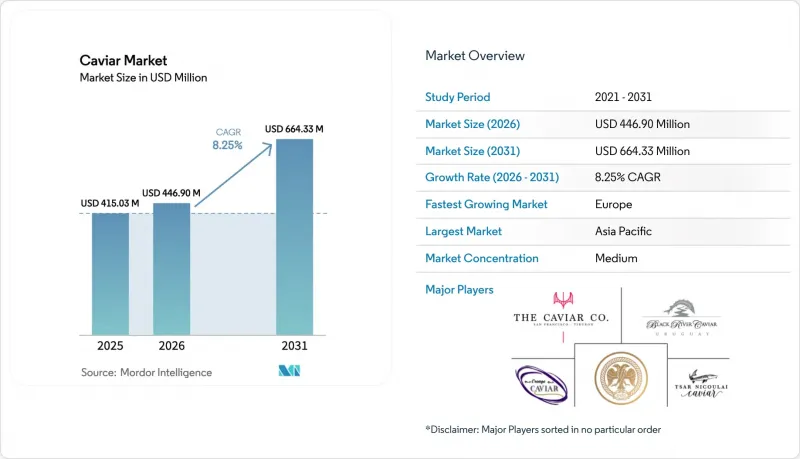
Advancements in aquaculture, a global cold-chain expansion, and rising disposable incomes in regions such as the Asia Pacific and the Middle East are accelerating growth in the caviar market by empowering farm-raised producers to bypass traditional importers through digital platforms. Highlighting the significance of these advancements, the U.S. Department of Agriculture notes China's extensive network: with 230 million m3 dedicated to refrigerated storage and 432,000 temperature-controlled vehicles, the nation can ensure same-day delivery for premium perishables. On the production side, Vietnam inaugurated a sturgeon farm capable of housing a million fish in 2025. Concurrently, Spain's AZTI has introduced a DNA-based sex determination method, slashing juvenile rearing costs by a notable 40%. While farmed roe is projected to dominate the caviar market with a 92.82% share of the 2025 volume, wild quotas, albeit regulated, are on an upward trajectory, expected to grow at a 9.78% CAGR. This cautious reopening of fisheries by Caspian states is under the watchful eye of CITES. Beyond traditional avenues, the caviar market has found its way into airlines, luxury hotels, and e-commerce platforms, broadening its consumer base well past niche boutiques. These innovations are reinforcing structural competitiveness within the caviar market.
Global Caviar Market Trends and Insights
Aquaculture advancements improve quality of farmed caviar
Ultrasound-guided maturity sensors in recirculating aquaculture systems have reduced production cycle variability by 30%, strengthening efficiency across the caviar market. This advancement allows producers to harvest roe with optimal lipid profiles, achieving a texture comparable to that of wild-caught roe. In a significant move, Vietnam, as reported by its Ministry of Agriculture and Rural Development, is set to commission a 1-million-fish sturgeon farm by 2025. This venture, the largest single-site investment in the sector, aims for an ambitious target of 50 tonnes of annual output by 2028. In 2025, AZTI introduced a groundbreaking DNA-based sex determination method. This innovation empowers hatcheries to identify and cull male fish at the fingerling stage, a significant leap from the previous 3-year feed investment. As a result, hatcheries can reduce juvenile rearing costs by 40% and optimize tank space for revenue-generating females. Iran's Fisheries Organization, eyeing a 200-tonne caviar production by 2026, is strategically leveraging state-subsidized feed and tax incentives to regain share in the global caviar market. This move aims to reclaim market share that was lost during the Caspian moratorium. In Sweden, Arctic Roe has pioneered a non-lethal milking technique that improves sustainability metrics within the caviar market. This method permits multiple harvests from the same fish over a decade, slashing the effective cost per kilogram by 25% when juxtaposed with traditional slaughter methods. Meanwhile, Fourier-transform infrared spectroscopy has emerged as a game-changer. It offers real-time insights into ovarian fat content, enabling tailored finishing diets. This innovation not only curbs lipid oxidation but also extends the refrigerated shelf life of products from 6 to 9 days, all without the need for pasteurization.
Growth of E-commerce and direct-to-consumer logistics
Digital platforms have streamlined the traditional distribution model in the caviar market, once reliant on importers, wholesalers, and retailers, into a single, swift shipment. This shift has allowed participants in the caviar market to capture margins that previously inflated retail prices by 60% to 80%. In 2024, Quince ventured into online caviar sales, debuting Royal Osetra caviar at USD 125 per tin. They offered a promotional price of USD 100 for purchases of two or more tins, effectively undercutting specialty-store prices by 30% to 40%. Brooklyn's Pearl Street Caviar boasts next-day delivery across the contiguous U.S., ensuring cold-chain integrity with gel-pack insulation, rated for 18 hours at ambient temperatures up to 32°C. The Food and Drug Administration's New Era of Smarter Food Safety Blueprint, rolled out in 2024, emphasizes digital traceability for high-risk foods, caviar included. It mandates QR codes linking to blockchain-verified harvest dates and CITES export permits. By 2023, China's cold-chain infrastructure expanded to 230 million cubic meters of refrigerated storage and 432,000 temperature-controlled vehicles, strengthening logistics across the caviar market . This advancement enabled Kaluga Queen to deliver orders in Shanghai within 4 hours of harvest. In Abu Dhabi, Emirates AquaTech poured over USD 100 million into a vertically integrated facility, reflecting consolidation trends in the caviar market. This facility processes, tins, and ships its Yasa brand caviar (priced at approximately USD 200 per 100 grams) within 48 hours of extraction, deftly sidestepping European re-export hubs.
High prices limit access for mass consumers globally
Premium Beluga caviar commands retail prices exceeding USD 200 for just 30 grams, limiting accessibility across the broader caviar market, making it unaffordable for median-income households in many regions. This pricing confines its volume growth primarily to high-net-worth individuals. Sturia's Beluga is priced at EUR 172 for 30 grams and surpasses EUR 1,000 for 200 grams. Meanwhile, Emirates AquaTech's Yasa brand is available for around USD 200 per 100 grams, a price point that restricts repeat purchases to the top 5% of earners. Data from the Bank of America Institute, dated January 2025, reveals that U.S. luxury spending per household has seen a year-on-year decline for 10 straight quarters, continuing through Q4 2024. While luxury fashion took a hit, down 12% in 2023 and another 9% in 2024, high-end travel and hotel expenditures managed to outshine the retail sector. According to FAO Fisheries and Aquaculture, feed costs for sturgeon aquaculture hover around USD 2.50 per kilogram. Given that a female sturgeon needs 8 to 12 years of feeding before its first harvest, this translates to a break-even price close to USD 80 for 100 grams. Such tight margins leave scant opportunity for downmarket expansion. Thailand's Sturgeon Farm, located in Hua Hin, faces a hefty monthly electricity bill of USD 9,000. This cost is essential to maintain their recirculating systems at a steady 21°C and to keep winter rooms between 6°C and 15°C. These fixed expenses act as a barrier, preventing any price reductions, even as production ramps up. Quince's Royal Osetra, priced at USD 125 per tin, sets the lower limit for premium caviar pricing. Yet, this price is still a staggering 10 times the per-gram cost of wild-caught salmon roe, making it less appealing to budget-conscious seafood enthusiasts.
Other drivers and restraints analyzed in the detailed report include:
- Luxury food trends drive premium caviar product demand
- Growth in hospitality sector supports fine food markets
- Illegal poaching disrupts wild sturgeon population sustainability
For complete list of drivers and restraints, kindly check the Table Of Contents.
Segment Analysis
Beluga, with its 15-to-20-year maturation cycle and distinctive pearl-gray roe, accounted for 36.96% of caviar market revenue in 2025. Sevruga, forecasted to grow at a 9.80% CAGR through 2031, is set to experience the fastest species-level growth within the caviar market. Producers are optimizing 7-year cycles and targeting mid-tier buyers. Osetra, a favorite among Michelin-starred chefs, is celebrated for its nutty flavor profile and medium-sized grains, making it a perfect pairing with blinis and creme fraiche. Sterlet and Hackleback cater to entry-level consumers and catering operations, prioritizing cost over prestige. Meanwhile, other species like paddlefish and hybrid crosses are innovating through selective breeding, shortening maturation times. Kaluga-Amur hybrids now reach harvest weight in 6 years, compared to 10 years for purebred Kaluga.
CITES has implemented universal labeling requirements, mandating details like species code, source, origin, year, processor code, and lot identifier on every tin. While these regulations have heightened compliance costs, they've simultaneously bolstered consumer trust in the authenticity of farm-raised products. Iran's Fisheries Organization has set a 2026 target of 200 tonnes, distributing 60% to Beluga and 40% to Osetra. They're leveraging state subsidies to undercut Chinese pricing by 15% to 20%. In Sweden, Arctic Roe has pioneered non-lethal milking for Siberian sturgeon. This innovation permits repeat harvests over a decade and slashes the effective cost per kilogram by 25%. Since 2005, a U.S. ban on Caspian beluga imports has shifted demand towards farm-raised substitutes. Notably, Tsar Nicoulai's 2024 acquisition of Sterling Caviar has consolidated 40% of the domestic Beluga-substitute production. To address the 21% mislabeling rate found in European markets in 2023, TRAFFIC is piloting genetic traceability tools, such as mitochondrial DNA sequencing.
Fresh caviar, known for its delicate texture and lack of thermal processing, accounted for 49.74% of the 2025 volume. Frozen formats are projected to grow at a 10.03% CAGR through 2031 due to high-pressure processing, which preserves organoleptic qualities and extends shelf life. A barramundi caviar study showed pasteurization at 60°C-65°C extended refrigerated shelf life to over 21 days, compared to under 7 days for unpasteurized products. High-pressure processing at 600 megapascals achieved similar microbial reduction without texture degradation. Food and Drug Administration guidelines for reduced-oxygen-packaged caviar require a 6-log reduction of Clostridium botulinum, achievable through pasteurization at 90°C for 10 minutes or validated HPP protocols. The UK Food Standards Agency sets a default 10-day shelf life for vacuum-packed chilled foods stored at 3°C-8°C unless processors validate factors like salt concentration above 3.5% or water activity below 0.97.
Airline catering and cruise-line operations use dried, pressed, and pasteurized formats for ambient-stable inventory. Denmark's CaviArt produces kelp-based caviar with a 12-month shelf life, supplying 70%-80% of Danish restaurant caviar. The Food and Drug Administration's 2024 New Era of Smarter Food Safety Blueprint emphasizes digital traceability and cold-chain sensors, increasing compliance costs by 5% but reducing spoilage by 15%-20%. In January 2024, Modern Plant Based Foods launched vegan Kaviar in Wasabi, Original, and Salmon flavors, with an 8-to-10-month refrigerated shelf life, targeting e-commerce and restaurants. Xoma AB and Arctic Roe of Scandinavia plan to develop vegetarian caviar from Caulerpa algae, with pilot production set for late 2026.
The Caviar Market is Segmented by Species (Sevruga, Osetra, Beluga, Sterlet, and More), Form (Fresh, Frozen, and Dried/Pressed/Pasteurized), Source (Farm-Roe and Wild-Caught), Distribution Channel (On-Trade, and Off-Trade), and Geography (North America, Europe, Asia-Pacific, South America, and Middle East and Africa). The Market Forecasts are Provided in Terms of Value (USD) and Volume (Tons).
Geography Analysis
In 2025, the Asia Pacific accounted for 35.43% of global caviar market revenue, driven by China's role as the top producer and a growing consumer. Kaluga Queen produces 260 tonnes annually, about 35% of global supply, while Chinese exports reached 276 tonnes worth USD 82.7 million in 2023. The EU sourced 84% of its caviar imports from China in 2020, highlighting Beijing's supply chain dominance. Thailand's Royal Project launched the Silapacheep Caviar brand, featured at the 2022 APEC Leaders' Summit, elevating domestic production. Japan's Miyazaki Prefecture targets affluent consumers with locally sourced caviar priced at JPY 12,000 (USD 80) per 20 grams. Singapore serves as a distribution hub for Southeast Asia, re-exporting to Indonesia, Malaysia, and the Philippines under cold-chain protocols, ensuring 48-hour delivery. India, an emerging market, sees imports concentrated in Mumbai and Delhi five-star hotels, with per-capita consumption 50 times lower than China's, signaling long-term potential.
Europe is projected to grow at a 9.56% CAGR through 2031, led by heritage markets in France, Italy, and Spain leveraging Protected Geographical Indication frameworks. France, the largest producer of farmed Siberian sturgeon caviar, supplies Michelin-starred restaurants through Sturia, with prices reaching EUR 1,000 for 200 grams. Post-Brexit customs delays have increased UK logistics costs by 10%, creating opportunities for domestic aquaculture in Scotland and Wales. Germany, the fourth-largest importer globally, saw prominent imports in 2024, with Berlin and Munich specialty stores reporting 15% growth in 2024. Belgium, a re-export hub, expanded Antwerp's cold-storage capacity in 2023 to handle luxury goods.
North America's retail sales are rising, led by the U.S., with Canada contributing. Tsar Nicoulai's 2024 acquisition of Sterling Caviar consolidated 40% of U.S. farm-raised output, enabling direct supply to Whole Foods and Williams Sonoma. Mexico's luxury hotels in Cancun, Los Cabos, and Mexico City have adopted caviar as a signature amenity, with imports up 25% year-on-year in 2024, according to the Mexico Secretariat of Economy. The Middle East and Africa are growing rapidly, driven by ultra-high-net-worth populations and expanding hospitality. Emirates AquaTech in Abu Dhabi invested over USD 100 million in a facility targeting 35 tonnes annually under its Yasa brand. Dubai added 1,500 food establishments in early 2024, many featuring caviar. South Africa and Morocco are piloting sturgeon aquaculture, aiming for 10 to 15 tonnes annually by 2028, though regulatory frameworks lag behind CITES-compliant markets in Europe and North America.
List of Companies Covered in this Report:
- The Caviar Co.
- Black River Caviar
- Russian Caviar House
- L'Osage Caviar Company
- Tsar Nicoulai Caviar
- Sasanian Caviar
- Caviar Blanc
- Sepehr Dad Caviar GmbH
- Caviar Creator
- Labeyrie Fine Foods
- Petrossian
- Agroittica Lombarda
- Attilus Caviar
- Caviar Russe
- Volzhenka
- Imperia Caviar LLC
- Sturia Caviar
- Marky's Caviar
- 8 Gems Pte Ltd.
- California Caviar Co.
Additional Benefits:
- The market estimate (ME) sheet in Excel format
- 3 months of analyst support
TABLE OF CONTENTS
1 INTRODUCTION
- 1.1 Study Assumptions and Market Definition
- 1.2 Scope of the Study
2 RESEARCH METHODOLOGY
3 EXECUTIVE SUMMARY
4 MARKET LANDSCAPE
- 4.1 Market Overview
- 4.2 Market Drivers
- 4.2.1 Health benefits awareness increases caviar's nutritional appeal
- 4.2.2 Growth of e-commerce and direct-to-consumer logistics
- 4.2.3 Aquaculture advancements improve quality of farmed caviar
- 4.2.4 Luxury food trends drive premium caviar product demand
- 4.2.5 Growth in hospitality sector supports fine food markets
- 4.2.6 Rising disposable incomes support luxury food preferences
- 4.3 Market Restraints
- 4.3.1 High prices limit access for mass consumers globally
- 4.3.2 Illegal poaching disrupts wild sturgeon population sustainability
- 4.3.3 Limited shelf life affects distribution and profitability
- 4.3.4 Substitutes like soy pearls impact caviar market share
- 4.4 Consumer Behaviour Analysis
- 4.5 Regulatory Landscape
- 4.6 Technological Outlook
- 4.7 Porter's Five Forces
- 4.7.1 Threat of New Entrants
- 4.7.2 Bargaining Power of Buyers
- 4.7.3 Bargaining Power of Suppliers
- 4.7.4 Threat of Substitutes
- 4.7.5 Intensity of Competitive Rivalry
5 MARKET SIZE AND GROWTH FORECASTS (VALUE AND VOLUME)
- 5.1 Species
- 5.1.1 Beluga
- 5.1.2 Osetra
- 5.1.3 Sevruga
- 5.1.4 Sterlet
- 5.1.5 Hackleback/Other Sturgeon
- 5.1.6 Other Types
- 5.2 Form
- 5.2.1 Fresh
- 5.2.2 Frozen
- 5.2.3 Dried/Pressed/Pasturised
- 5.3 Source
- 5.3.1 Farm-Roe
- 5.3.2 Wild-Caught
- 5.4 Distribution Channel
- 5.4.1 On-trade
- 5.4.2 Off-trade
- 5.5 Geography
- 5.5.1 North America
- 5.5.1.1 United States
- 5.5.1.2 Canada
- 5.5.1.3 Mexico
- 5.5.1.4 Rest of North America
- 5.5.2 Europe
- 5.5.2.1 United Kingdom
- 5.5.2.2 Germany
- 5.5.2.3 France
- 5.5.2.4 Italy
- 5.5.2.5 Spain
- 5.5.2.6 Sweden
- 5.5.2.7 Belgium
- 5.5.2.8 Poland
- 5.5.2.9 Netherlands
- 5.5.2.10 Rest of Europe
- 5.5.3 Asia-Pacific
- 5.5.3.1 China
- 5.5.3.2 Japan
- 5.5.3.3 India
- 5.5.3.4 Thailand
- 5.5.3.5 Singapore
- 5.5.3.6 Indonesia
- 5.5.3.7 South Korea
- 5.5.3.8 Australia
- 5.5.3.9 New Zealand
- 5.5.3.10 Rest of Asia Pacific
- 5.5.4 South America
- 5.5.4.1 Brazil
- 5.5.4.2 Argentina
- 5.5.4.3 Peru
- 5.5.4.4 Colombia
- 5.5.4.5 Chile
- 5.5.4.6 Rest of South America
- 5.5.5 Middle East and Africa
- 5.5.5.1 South Africa
- 5.5.5.2 Nigeria
- 5.5.5.3 Egypt
- 5.5.5.4 Morocco
- 5.5.5.5 Turkey
- 5.5.5.6 Rest of Middle East and Africa
- 5.5.1 North America
6 COMPETITIVE LANDSCAPE
- 6.1 Market Concentration
- 6.2 Strategic Moves
- 6.3 Market Ranking Analysis
- 6.4 Company Profiles
- 6.4.1 The Caviar Co.
- 6.4.2 Black River Caviar
- 6.4.3 Russian Caviar House
- 6.4.4 L'Osage Caviar Company
- 6.4.5 Tsar Nicoulai Caviar
- 6.4.6 Sasanian Caviar
- 6.4.7 Caviar Blanc
- 6.4.8 Sepehr Dad Caviar GmbH
- 6.4.9 Caviar Creator
- 6.4.10 Labeyrie Fine Foods
- 6.4.11 Petrossian
- 6.4.12 Agroittica Lombarda
- 6.4.13 Attilus Caviar
- 6.4.14 Caviar Russe
- 6.4.15 Volzhenka
- 6.4.16 Imperia Caviar LLC
- 6.4.17 Sturia Caviar
- 6.4.18 Marky's Caviar
- 6.4.19 8 Gems Pte Ltd.
- 6.4.20 California Caviar Co.
7 MARKET OPPORTUNITIES AND FUTURE OUTLOOK

