
PUBLISHER: Mordor Intelligence | PRODUCT CODE: 2043879

PUBLISHER: Mordor Intelligence | PRODUCT CODE: 2043879
Electric Three-Wheeler - Market Share Analysis, Industry Trends & Statistics, Growth Forecasts (2026 - 2031)
The electric three-wheeler market size was valued at USD 3.65 billion in 2025 and estimated to grow from USD 4.2 billion in 2026 to reach USD 8.47 billion by 2031, at a CAGR of 15.08% during the forecast period (2026-2031).
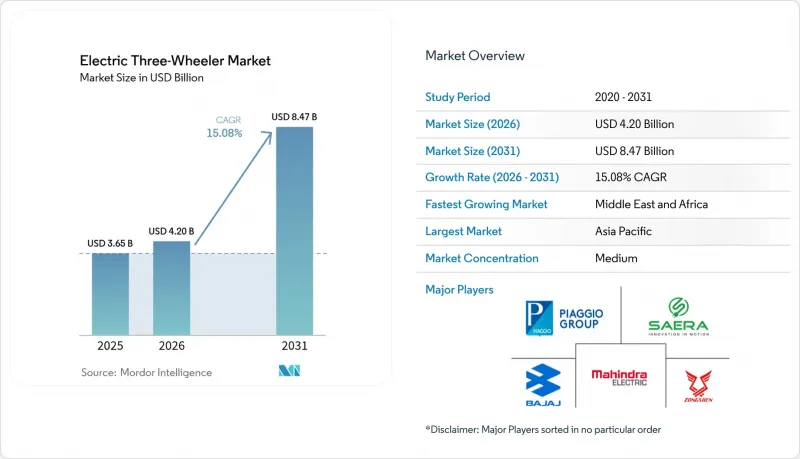
Rapid policy convergence, breakthrough total-cost-of-ownership parity, and a deepening pool of financing mechanisms are pulling demand forward in both passenger and goods carrier use cases. India's PM E-DRIVE and the proposed FAME-III programme, the United States Inflation Reduction Act commercial credits, and the EU Fit-for-55 package together sharpen the pricing edge that already exists in high-utilisation fleets. On the supply side, lithium-ion pack prices fell 12% year-over-year in 2024, narrowing the cost delta with lead-acid systems and accelerating the technology transition. Infrastructure innovation also plays a defining role: as of October 2025, Battery Smart, an Indian battery swapping network, has completed 50 million battery swaps at its 1,400 stations, reducing downtime for commercial drivers from hours to mere minutes.
Global Electric Three-Wheeler Market Trends and Insights
Extended Purchase Incentives Drive Market Acceleration
Coordinated subsidy regimes cut acquisition costs sharply. India earmarked INR 4,100 crore (USD 492 million) for electric three-wheelers under the FAME-III proposal, with phased reductions designed to prevent abrupt demand cliffs. Similar momentum builds in the US and EU, creating predictable policy horizons that support factory capacity investment. Historical evidence shows a multiplier of up to 10 times on sales during earlier incentive rounds. The resulting certainty lowers financing costs and steadies the electric three-wheeler market across regions.
E-commerce Last-mile Transformation Reshapes Demand Patterns
Surging parcel volumes are driving logistics operators to shift from two-wheelers to higher-payload three-wheelers in the Electric Three-Wheeler Market. Commercial users realise operating costs up to 2.5x lower than internal-combustion alternatives, directly boosting driver income in emerging markets. Western retailers are also testing electric quadricycles, signalling spill-over into non-Asian cities, while swap-ready batteries further enhance asset utilisation by cutting downtime to under two minutes.
Sparse Dedicated 3-W Charging Infrastructure
India operates 11,000 public chargers, barely 1% of the 1.3 million units required by 2030 in the Electric Three-Wheeler Market. Fault rates exceeding 17% dent user trust, and "charging deserts" appear even in mature regions such as Great Britain. Swap hubs provide a partial remedy, yet scale-up depends on standardisation and concessional capital flows.
Other drivers and restraints analyzed in the detailed report include:
- Rapid TCO Parity Achievement Accelerates Adoption
- Rising Li-ion Energy Density Enables Performance Breakthroughs
- Li-ion Price Volatility Creates Working-Capital queeze
For complete list of drivers and restraints, kindly check the Table Of Contents.
Segment Analysis
Passenger carriers commanded 81.65% of the electric three-wheeler market in 2025, underpinned by an entrenched shared-mobility culture in South-Asian megacities. Yet, goods carriers generate the fastest expansion at an 18.60% CAGR, reflecting the boom in last-mile logistics. The electric three-wheeler market size attributable to goods movement will thus widen rapidly through 2031.
Higher utilisation rates amplify total-cost-of-ownership benefits, encouraging fleet operators to adopt finance-plus-swap bundles that slash downtime. Rider earnings in markets such as Kenya already exceed combustion equivalents, confirming the commercial appeal. Passenger services will still post steady unit volumes, although competitive pressure from ride-hailing apps tempers their growth trajectory.
Lead-acid packs held a 63.90% share in 2025 thanks to their low entry cost, but lithium-ion systems will outpace with a 20.75% CAGR to 2031. The electric three-wheeler market share of lithium-ion batteries rises as price declines intersect with rising energy-density benchmarks. CATL's battery cost reduction from USD 110 per kWh in mid-2023 to USD 56 by mid-2024 represents a fundamental shift in technology economics that accelerates lithium-ion adoption.
LFP chemistries, offering safer thermal characteristics, gain traction in municipal and courier fleets seeking predictable duty cycles. Premium passenger operators favour high-energy nickel-rich packs that extend range above 200 km, as demonstrated by Montra Super Auto's 203 km rating.
The Electric Three-Wheeler Market Report is Segmented by End Use (Passenger Carrier and Goods Carrier), Battery Type (Lithium-Ion and Lead Acid), Power Output (Less Than 2kW, 2 -4 KW, 4 - 6 KW, and Above 6 KW), Charging Model (Fixed (Plug-In) Charging and Battery Swapping), and Geography. The Market Forecasts are Provided in Terms of Value (USD) and Volume (Units).
Geography Analysis
Asia-Pacific dominated the electric three-wheeler market with a 72.10% share in 2025. India alone sold 580,000 units in 2023, a 65% year-over-year surge on the back of FAME-II grants. Chinese suppliers, buoyed by domestic EV oversupply, channel surplus capacity into Southeast Asia, including a USD 150 million Indonesian plant by Yadea. Thailand's target of 1,450 swap stations supporting 650,000 two-wheelers by 2030 underscores state-backed infrastructure momentum.
The Middle East and Africa is the fastest-growing region at 19.55% CAGR. The UAE's penetration jumped from 0.7% in 2021 to 13% in 2023 amid 2050 net-zero goals. African markets adopt two- and three-wheelers as primary income generators; Rwanda leverages solar-powered swap hubs to overcome grid bottlenecks. Europe and North America record more measured uptake. Micro-EV imports face rising tariffs, potentially doubling prices for models such as the Eli ZERO in United States fleets. Nevertheless, urban freight initiatives and low-speed zones open niches for compact three-wheelers, sustaining 11.41% CAGR in North America.
- Mahindra Electric Mobility Ltd
- Bajaj Auto Ltd
- Piaggio & C. SpA
- YC Electric Vehicle Pvt Ltd
- Saera Electric Auto Pvt Ltd
- Kinetic Green Energy & Power Solutions Ltd
- Terra Motors Corp
- Lohia Auto Industries
- Omega Seiki Mobility
- ATUL Auto Ltd
- Euler Motors
- Altigreen Propulsion Labs
- Biliti Electric Inc
- Olectra Greentech Ltd
- TVS Motor Company Ltd
- Bodo Vehicle Group Co Ltd
- E-Tuk Factory BV
- Goenka Electric Motor Vehicles Pvt Ltd
- Chongqing Zongshen Vehicle Co Ltd
Additional Benefits:
- The market estimate (ME) sheet in Excel format
- 3 months of analyst support
TABLE OF CONTENTS
1 Introduction
- 1.1 Study Assumptions & Market Definition
- 1.2 Scope of the Study
2 Research Methodology
3 Executive Summary
4 Market Landscape
- 4.1 Market Overview
- 4.2 Market Drivers
- 4.2.1 Extended purchase incentives
- 4.2.2 E-commerce last-mile boom
- 4.2.3 Rapid TCO parity
- 4.2.4 Rising Li-ion energy density and price fall
- 4.2.5 Fin-tech micro-leasing platforms
- 4.2.6 Battery-swap corridor build-outs
- 4.3 Market Restraints
- 4.3.1 Sparse dedicated 3-W charging infrastructure
- 4.3.2 Li-ion price volatility & working-capital squeeze
- 4.3.3 Fragmented retrofit & homologation rules
- 4.3.4 Heightened safety-recall reputation risk
- 4.4 Value / Supply-Chain Analysis
- 4.5 Regulatory Landscape
- 4.6 Technological Outlook
- 4.7 Porter's Five Forces
- 4.7.1 Threat of New Entrants
- 4.7.2 Bargaining Power of Buyers
- 4.7.3 Bargaining Power of Suppliers
- 4.7.4 Threat of Substitutes
- 4.7.5 Intensity of Competitive Rivalry
5 Market Size & Growth Forecasts (Value and Volume)
- 5.1 By End Use
- 5.1.1 Passenger Carrier
- 5.1.2 Goods Carrier
- 5.2 By Battery Type
- 5.2.1 Lithium-ion
- 5.2.2 Lead Acid
- 5.3 By Power Output (kW)
- 5.3.1 Less than 2 kW
- 5.3.2 2 - 4 kW
- 5.3.3 4 - 6 kW
- 5.3.4 Above 6 kW
- 5.4 By Charging Model
- 5.4.1 Fixed (Plug-in) Charging
- 5.4.2 Battery Swapping
- 5.5 By Geography
- 5.5.1 North America
- 5.5.1.1 United States
- 5.5.1.2 Canada
- 5.5.1.3 Rest of North America
- 5.5.2 South America
- 5.5.2.1 Brazil
- 5.5.2.2 Argentina
- 5.5.2.3 Rest of South America
- 5.5.3 Europe
- 5.5.3.1 Germany
- 5.5.3.2 United Kingdom
- 5.5.3.3 France
- 5.5.3.4 Italy
- 5.5.3.5 Spain
- 5.5.3.6 Russia
- 5.5.3.7 Rest of Europe
- 5.5.4 Asia-Pacific
- 5.5.4.1 China
- 5.5.4.2 India
- 5.5.4.3 Japan
- 5.5.4.4 South Korea
- 5.5.4.5 ASEAN (Indonesia, Thailand, Vietnam, Philippines, Malaysia)
- 5.5.4.6 Rest of Asia-Pacific
- 5.5.5 Middle East & Africa
- 5.5.5.1 Middle East
- 5.5.5.1.1 GCC (Saudi Arabia, UAE, Qatar, Oman, Kuwait, Bahrain)
- 5.5.5.1.2 Turkey
- 5.5.5.1.3 Rest of Middle East
- 5.5.5.2 Africa
- 5.5.5.2.1 South Africa
- 5.5.5.2.2 Nigeria
- 5.5.5.2.3 Kenya
- 5.5.5.2.4 Rest of Africa
- 5.5.5.1 Middle East
- 5.5.1 North America
6 Competitive Landscape
- 6.1 Market Concentration
- 6.2 Strategic Moves
- 6.3 Market Share Analysis
- 6.4 Company Profiles (includes Global Level Overview, Market Level Overview, Core Segments, Financials as Available, Strategic Information, Market Rank/Share for Key Companies, Products and Services, SWOT Analysis, and Recent Developments)
- 6.4.1 Mahindra Electric Mobility Ltd
- 6.4.2 Bajaj Auto Ltd
- 6.4.3 Piaggio & C. SpA
- 6.4.4 YC Electric Vehicle Pvt Ltd
- 6.4.5 Saera Electric Auto Pvt Ltd
- 6.4.6 Kinetic Green Energy & Power Solutions Ltd
- 6.4.7 Terra Motors Corp
- 6.4.8 Lohia Auto Industries
- 6.4.9 Omega Seiki Mobility
- 6.4.10 ATUL Auto Ltd
- 6.4.11 Euler Motors
- 6.4.12 Altigreen Propulsion Labs
- 6.4.13 Biliti Electric Inc
- 6.4.14 Olectra Greentech Ltd
- 6.4.15 TVS Motor Company Ltd
- 6.4.16 Bodo Vehicle Group Co Ltd
- 6.4.17 E-Tuk Factory BV
- 6.4.18 Goenka Electric Motor Vehicles Pvt Ltd
- 6.4.19 Chongqing Zongshen Vehicle Co Ltd
7 Market Opportunities & Future Outlook
- 7.1 White-space & Unmet-Need Assessment

