PUBLISHER: Mordor Intelligence | PRODUCT CODE: 2043880

PUBLISHER: Mordor Intelligence | PRODUCT CODE: 2043880
United States Microgreens - Market Share Analysis, Industry Trends & Statistics, Growth Forecasts (2026 - 2031)
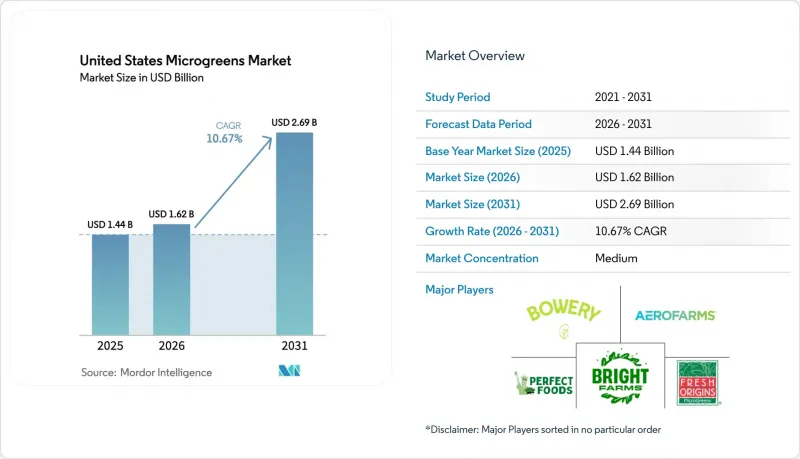
The United States microgreens market is projected to expand from USD 1.44 billion in 2025 and USD 1.62 billion in 2026 to USD 2.69 billion by 2031, registering a CAGR of 10.67% between 2026 to 2031. Advancements in protected cultivation technologies, the increasing adoption of functional foods, and cost reductions achieved through automation drive this growth.
Vertical farming makes a significant contribution to national output, underscoring its importance in meeting urban demand while conserving resources such as land and water. Broccoli microgreens lead the market, supported by studies linking glucoraphanin content to sulforaphane bioavailability, which appeals to premium consumers and product developers. Retailers are expanding private-label offerings, while online grocery platforms are reducing the time from harvest to table to just a few hours, ensuring fresher products and minimizing waste. Despite challenges such as energy price fluctuations and food safety compliance, the integration of artificial intelligence (AI) controls, renewable energy contracts, and federal grants is helping to stabilize margins and attract new investments.
United States Microgreens Market Trends and Insights
Accelerated Shift Toward Protected Cultivation Infrastructure
Federal and state incentive programs are allocating significant funding to greenhouses and vertical farms, reducing transportation distances and enabling year-round production. Pennsylvania has allocated USD 3 million through its Redevelopment Capital Assistance Program for a 1.5-million-square-foot BrightFarms greenhouse, slated for completion in 2024. This greenhouse will replace lettuce currently transported from Arizona with locally grown produce near Philadelphia. Little Leaf Farms, LLC, announced plans in June 2025 for a USD 75 million campus in Tennessee, projected to open in 2026 and create 318 regional jobs. The United States Department of Agriculture's Urban Agriculture and Innovative Production grants support investments in climate-control systems, irrigation infrastructure, and post-harvest cooling equipment, which would otherwise pose financial challenges. These initiatives have collectively reduced shelf-arrival times from five days to less than twenty-four hours, while protecting growers from risks such as western droughts and wildfire smoke that threaten open-field agriculture. As more states implement controlled-environment tax credits, the United States microgreens market is projected to continue concentrating near major population centers, reflecting broader structural shifts observed across the global microgreens market.
Rising Demand From Health-Conscious Consumers and Functional-Food Brands
Consumers seeking nutrition supported by scientific evidence are increasingly turning to microgreens, which offer higher concentrations of vitamins, minerals, and phytochemicals per gram compared to mature plants. In 2023, a human trial conducted at Oregon State University identified sulforaphane metabolites in urine within three hours of consuming a single 16-gram serving. Functional food brands are incorporating freeze-dried microgreens into powders and nutrition bars, with claims that one teaspoon provides the nutritional equivalent of eight cups of vegetables. The United States microgreens market is benefiting from an increase in repeat purchases among health-conscious households. Retailers and online platforms are further driving this trend through educational displays, social media cooking tutorials, and loyalty program incentives, which encourage trial and foster habitual consumption.
Pest and Pathogen Susceptibility in Dense Indoor Production
Dense canopy layers, warm temperatures, and high humidity increase the likelihood of bacterial and fungal outbreaks, which can lead to costly product recalls. The Food and Drug Administration's Produce Safety Rule requires zero detectable generic Escherichia coli in 100 milliliters of irrigation water by 2025 for large farms, with phased deadlines for smaller farms. According to Penn State Extension, damping-off diseases caused by Rhizoctonia and Botrytis are the primary threats to yields in commercial microgreens production. Mitigation strategies include the use of ultraviolet-treated water, redundant filtration systems, beneficial insects, and ATP bioluminescence swabs, which add USD 0.10-0.20 per kilogram to operating costs. Additionally, supermarkets are increasingly requiring third-party audits, which many undercapitalized farms find difficult to afford. This has led to a concentration of distribution among larger, well-funded players, thereby limiting the overall growth of the United States microgreens market.
Other drivers and restraints analyzed in the detailed report include:
- Expansion of Farm-to-Table Restaurant Partnerships
- AI-Driven Yield-Optimization Platforms Lowering Unit Costs
- Volatile Supply of Certified-Organic Seeds
For complete list of drivers and restraints, kindly check the Table Of Contents.
Segment Analysis
Broccoli microgreens accounted for 24.1% of the United States microgreens market share in 2025, establishing themselves as the largest variety-based contributor. Their short fifteen-day crop cycle, high yields, and mild flavor facilitate efficient production planning and seamless integration into menus. Peer-reviewed studies indicate that a 16-gram serving provides approximately 100 micromoles of sulforaphane equivalent, enhancing its appeal among functional food consumers. Retailers often pair broccoli microgreens with avocado or chickpea spreads in ready-to-eat packs, which command price premiums of USD 0.50-0.75 per ounce. Additionally, restaurants use these microgreens as garnishes to increase nutrient density without affecting texture, further driving volume growth.
Amaranth microgreens are anticipated to achieve the fastest growth, with a 12.8% CAGR from 2026 to 2031. Their nutritional profile, including iron levels of approximately 1.7 milligrams per 100 grams and vitamin C concentrations exceeding 35 milligrams per 100 grams, appeals to formulators targeting anti-anemia and immune-support claims. The bright red stems and earthy flavor make amaranth a visually appealing garnish, particularly popular among health-conscious millennials. While growers report slightly uneven germination compared to broccoli, higher average selling prices offset potential yield losses. The increasing use of amaranth in smoothie powders and athlete meal plans is projected to drive its adoption in direct-to-consumer subscription boxes, further expanding its presence in the United States microgreens market.
The United States Microgreens Market Report is Segmented by Type (Broccoli, Lettuce and Chicory, Basil, Fennel, Carrots, Radish, Amaranth, and More), by Sales Channel (Hypermarket and Supermarkets, Restaurants and Foodservice, and More), and by Farming Method (Indoor Horizontal Farming, Vertical Farming, Commercial Greenhouses, and More). The Market Forecasts are Provided in Terms of Value (USD).
List of Companies Covered in this Report:
- Fresh Origins, LLC (Sun Capital Partners)
- Bowery Farming Inc.
- AeroFarms, Inc.
- Perfect Foods, Inc.
- BrightFarms, Inc. (Cox Enterprises, Inc.)
- Shenandoah Growers, Inc. (Soli Organic Inc.)
- 80 Acres Farms, Inc
- Little Leaf Farms, LLC
- The Chef's Garden, Inc.
- GoodLeaf Community Farms Limited
- Farmbox Greens
- Metro Microgreens, LLC
- Quantum Microgreens, LLC
- Florida Microgreens, LLC
- Greenbelt Microgreens Ltd.
Additional Benefits:
- The market estimate (ME) sheet in Excel format
- 3 months of analyst support
TABLE OF CONTENTS
1 Introduction
- 1.1 Study Assumptions and Market Definition
- 1.2 Scope of the Study
2 Research Methodology
3 Executive Summary
4 Market Landscape
- 4.1 Market Overview
- 4.2 Market Drivers
- 4.2.1 Accelerated shift toward protected cultivation infrastructure
- 4.2.2 Rising demand from health-conscious consumers and functional-food brands
- 4.2.3 Expansion of farm-to-table restaurant partnerships
- 4.2.4 Supermarket private-label roll-outs boosting retail shelf space
- 4.2.5 Surging adoption of freeze-dried microgreens as nutrient concentrates
- 4.2.6 AI-driven yield-optimization platforms lowering unit costs
- 4.3 Market Restraints
- 4.3.1 Pest and pathogen susceptibility in dense indoor production
- 4.3.2 Volatile supply of certified-organic seeds
- 4.3.3 Grid-energy price volatility undermining vertical-farm margins
- 4.3.4 Scarcity of skilled technicians and agronomists
- 4.4 Regulatory Landscape
- 4.5 Technological Outlook
- 4.6 Porter's Five Forces Analysis
- 4.6.1 Bargaining Power of Suppliers
- 4.6.2 Bargaining Power of Buyers
- 4.6.3 Threat of New Entrants
- 4.6.4 Threat of Substitute Products
- 4.6.5 Intensity of Competitive Rivalry
5 Market Size and Growth Forecasts (Value)
- 5.1 By Type
- 5.1.1 Broccoli
- 5.1.2 Lettuce and Chicory
- 5.1.3 Basil
- 5.1.4 Fennel
- 5.1.5 Carrots
- 5.1.6 Radish
- 5.1.7 Amaranth
- 5.1.8 Arugula
- 5.1.9 Beets
- 5.1.10 Mustard
- 5.1.11 Kale
- 5.1.12 Cress and Chard
- 5.2 By Sales Channel
- 5.2.1 Hypermarkets and Supermarkets
- 5.2.2 Restaurants and Foodservice
- 5.2.3 Direct-to-Consumer Subscription
- 5.2.4 Farmers Markets
- 5.2.5 Online Grocery
- 5.3 By Farming Method
- 5.3.1 Indoor Horizontal Farming
- 5.3.2 Vertical Farming
- 5.3.3 Commercial Greenhouses
- 5.3.4 Hydroponic Grow Cabinets
6 Competitive Landscape
- 6.1 Market Concentration
- 6.2 Strategic Moves
- 6.3 Market Share Analysis
- 6.4 Company Profiles (Includes Global Level Overview, Market Level Overview, Core Segments, Financials as Available, Strategic Information, Market Rank/Share for Key Companies, Products and Services, and Recent Developments)
- 6.4.1 Fresh Origins, LLC (Sun Capital Partners)
- 6.4.2 Bowery Farming Inc.
- 6.4.3 AeroFarms, Inc.
- 6.4.4 Perfect Foods, Inc.
- 6.4.5 BrightFarms, Inc. (Cox Enterprises, Inc.)
- 6.4.6 Shenandoah Growers, Inc. (Soli Organic Inc.)
- 6.4.7 80 Acres Farms, Inc
- 6.4.8 Little Leaf Farms, LLC
- 6.4.9 The Chef's Garden, Inc.
- 6.4.10 GoodLeaf Community Farms Limited
- 6.4.11 Farmbox Greens
- 6.4.12 Metro Microgreens, LLC
- 6.4.13 Quantum Microgreens, LLC
- 6.4.14 Florida Microgreens, LLC
- 6.4.15 Greenbelt Microgreens Ltd.
7 Market Opportunities and Future Outlook

