PUBLISHER: Mordor Intelligence | PRODUCT CODE: 2043895

PUBLISHER: Mordor Intelligence | PRODUCT CODE: 2043895
Long Term Care - Market Share Analysis, Industry Trends & Statistics, Growth Forecasts (2026 - 2031)
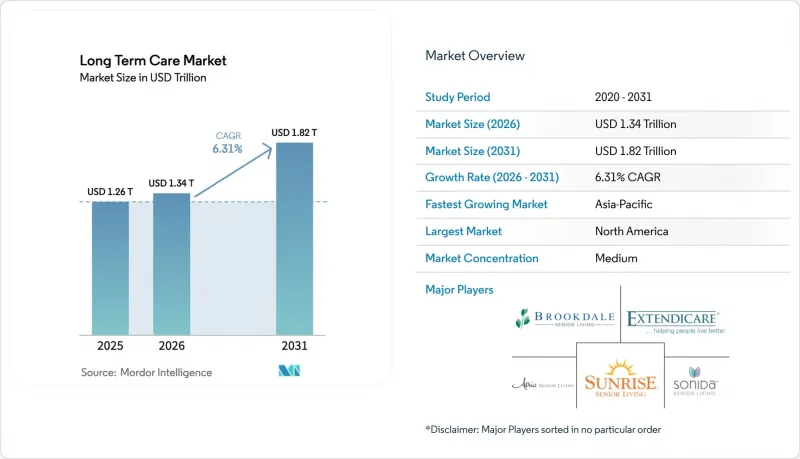
The Long Term Care Market size is expected to grow from USD 1.26 trillion in 2025 to USD 1.34 trillion in 2026 and is forecast to reach USD 1.82 trillion by 2031 at 6.31% CAGR over 2026-2031.
Growth reflects deliberate policy moves that redirect spending toward home- and community-based models, greater reliance on remote-monitoring technology, and payer migration to value-based contracts. Medicaid home- and community-based services (HCBS) outlays surpassed institutional care in fiscal 2024, freeing capacity in lower-cost settings and spurring demand for AI-enabled care coordination. Private insurers are embedding functional-outcome clauses into contracts, which compresses margins for operators lacking demonstrable quality metrics. Wage inflation, coupled with electronic health-record (EHR) mandates, adds cost pressure but also accelerates consolidation among providers that can leverage scale for technology procurement.
Global Long Term Care Market Trends and Insights
Favorable Long-Term Care Insurance Plans
Hybrid life policies with chronic-illness riders registered a 19% sales jump in 2024 as U.S. tax incentives under Section 7702B allowed pre-tax premium payment. Insurers now bundle nurse hotlines and caregiver training, lowering claim frequency by steering policyholders to home settings. Japan maintained a 10% beneficiary co-pay in its 2025 premium reset, protecting affordability and sustaining provider revenue. France raised monthly Allocation Personnalisee d'Autonomie allowances and pegged future increases to inflation, anchoring purchasing power for highly dependent seniors. Collectively, these measures enlarge the long term care market by broadening coverage and stabilizing demand.
Growing Elderly Population Driving Service Uptake
China's cohort aged 60 plus reached 21.1% of population in 2024 and is growing 3.2% annually, outpacing institutional capacity. South Korea's 2025 "Silver Town" program subsidizes integrated senior-living complexes, channeling private capital into new supply. Italy, where 28.6% of residents were 65 plus in 2024, leans on migrant caregivers amid regional service gaps. These demographics intensify demand across the long term care market, particularly in community settings that delay or replace nursing-home stays. Operators able to scale home services stand to capture rising volumes.
Skilled Nursing & Caregiver Workforce Shortages
Certified nursing assistant vacancies in U.S. skilled-nursing facilities hit 13% in 2025, forcing 40% cost premiums for contract labor and eroding margins. The Bureau of Labor Statistics forecasts 22% growth in demand for home-health aides from 2024-2034, dwarfing the 3% all-occupation average. Germany reported 47,000 open care positions in 2024 and is fast-tracking visas for Filipino and Vietnamese nurses. Japan projects a 690,000-worker deficit by 2040 and is investing in robotics to offset shortages. Persistent staffing gaps restrict capacity expansion across the long term care market.
Other drivers and restraints analyzed in the detailed report include:
- Government Incentives for Home & Community-Based Care
- AI-Enabled Remote Monitoring & Predictive Analytics
- Rising Inflation-Driven Wage Pressures on Facility Operators
For complete list of drivers and restraints, kindly check the Table Of Contents.
Segment Analysis
Home Healthcare generated the largest slice of the long term care market size, claiming 44.56% of 2025 revenue on the strength of Medicare's home-health benefit that served 3.4 million enrollees in 2024. Average 60-day episode costs of USD 3,200 compare favorably to USD 15,000 hospital readmission expenses, aligning payer incentives with patient preferences. Agencies with robust EHRs illustrate lower readmission rates, positioning themselves for shared-savings bonuses under value-based contracts. Adult Day-Care Centers, though smaller, are forecast to expand at 9.25% annually to 2031, the fastest clip in the long term care market; 2024 attendance rose 11% as programs added memory-care tracks and door-to-door transport. Their hybrid structure permits caregivers to stay employed, delaying costly institutionalization.
Nursing Care facilities continue to struggle with sub-80% occupancy and Medicaid rate lag, yet specialized dementia units command premiums that partially offset labor inflation. Assisted Living appeals to private-pay households seeking autonomy, with tiered-service models unbundling amenities to capture revenue. Hospice, a smaller slice of the long term care market share, drew USD 22.4 billion in 2024 but faces stricter oversight on length of stay. CMS's 2024 GUIDE dementia-care model pays a monthly care-management fee across service lines, rewarding operators that integrate home health, day care, and respite offerings and demonstrate quality improvements.
The Long Term Care Market Report is Segmented by Service (Home Healthcare, Hospice, Nursing Care, Assisted Living Facilities and More), Payer (Public, Private Insurance, Out-Of-Pocket / Self-Funded and More), Age Group (0-29 Years, 30-64 Years, 65 - 74 Years and More) and Geography (North America, Europe, Asia-Pacific, The Middle East and Africa, and South America). The Market Forecasts are Provided in Terms of Value (USD).
Geography Analysis
North America led the long term care market with 40.53% of 2025 spending, driven by the United States' USD 450 billion outlay in 2024. Federal payers dominate institutional nursing and home-health reimbursement, but private pay shoulders assisted living and continuing-care retirement community fees. Canada's provincial home-care programs pursue integrated medical-social models, yet vast rural provinces contend with staffing shortages that inflate unit costs. Mexico logged fewer than 1,000 licensed nursing homes in 2025 and launched a pilot to train community health workers and pay stipends to family caregivers.
Asia-Pacific is the fastest-growing region at an 8.21% CAGR, propelled by Japan's mature insurance system, China's subsidy for in-home robotics, and South Korea's Silver Town initiative. Japan spent JPY 11.2 trillion (USD 75 billion) on long-term care in fiscal 2024, 70% for in-home and day-care services. China selected 15 cities in 2025 for robot deployments that support rural elders where labor is scarce. India's nascent long term care market attracted USD 180 million private equity in senior living during 2024 but remains fragmented.
Europe commands significant share through Germany, the United Kingdom, France, Italy, and Spain. Germany lifted Pflegeversicherung benefits by 5% in 2025 and added coverage for mild cognitive impairment, expanding eligibility to 180,000 people. The United Kingdom tightens means testing, pushing costs onto families and spurring private-pay home-care demand. France expanded its APA benefit in 2024, preserving household purchasing power. Italy's southern provinces rely on migrant caregivers in the informal economy, reflecting regional disparities.
Elsewhere, the Gulf Cooperation Council invests in senior-living campuses for expatriate and national populations. Brazil's 2024 national long-term care policy sets federal standards and co-finance for municipal home-care expansion. Australia introduced a star-rating system and stepped-up inspections in 2024, lifting compliance costs but improving transparency.
- Amedisys Inc.
- Atria Senior Living
- Benesse Style Care
- Brookdale Senior Living
- Clariane SE
- Diversicare Healthcare Services
- Encompass Health (Home Health)
- Extendicare
- Genesis HealthCare
- Home Instead Inc.
- Interim HealthCare Inc.
- Kindred at Home
- LHC Group
- National Healthcare Corp.
- Orpea Group
- Revera
- Sonida Senior Living
- Sunrise Senior Living
- The Ensign Group
- VITAS Healthcare
Additional Benefits:
- The market estimate (ME) sheet in Excel format
- 3 months of analyst support
TABLE OF CONTENTS
1 Introduction
- 1.1 Study Assumptions & Market Definition
- 1.2 Scope of the Study
2 Research Methodology
3 Executive Summary
4 Market Landscape
- 4.1 Market Overview
- 4.2 Market Drivers
- 4.2.1 Favorable Long-Term-Care Insurance Plans
- 4.2.2 Growing Elderly Population Driving Service Uptake
- 4.2.3 Government Incentives for Home & Community-Based Care
- 4.2.4 AI-Enabled Remote Monitoring & Predictive Analytics
- 4.2.5 Integration of Smart-Home Robotics for Activities of Daily Living
- 4.2.6 Venture-Capital Funding of Home-Based Elder-Care Platforms
- 4.3 Market Restraints
- 4.3.1 Low Consumer Awareness in Emerging Economies
- 4.3.2 Skilled Nursing & Caregiver Workforce Shortages
- 4.3.3 Data-Privacy & Cyber-Risk Concerns for Connected Devices
- 4.3.4 Rising Inflation-Driven Wage Pressures on Facility Operators
- 4.4 Regulatory Landscape
- 4.5 Technological Outlook
- 4.6 Porter's Five Forces Analysis
- 4.6.1 Bargaining Power of Suppliers
- 4.6.2 Bargaining Power of Buyers
- 4.6.3 Threat of New Entrants
- 4.6.4 Threat of Substitutes
- 4.6.5 Intensity of Competitive Rivalry
5 Market Size & Growth Forecasts (Value, USD)
- 5.1 By Service
- 5.1.1 Home Healthcare
- 5.1.2 Hospice
- 5.1.3 Nursing Care
- 5.1.4 Assisted Living Facilities
- 5.1.5 Adult Day-Care Centers
- 5.1.6 Other Services
- 5.2 By Payer
- 5.2.1 Public
- 5.2.2 Private Insurance
- 5.2.3 Out-of-Pocket / Self-Funded
- 5.2.4 Managed-Care & Value-Based Contracts
- 5.3 By Age Group
- 5.3.1 0-29 Years
- 5.3.2 30-64 Years
- 5.3.3 65-74 Years
- 5.3.4 75-84 Years
- 5.3.5 85 Years & Above
- 5.4 By Geography
- 5.4.1 North America
- 5.4.1.1 United States
- 5.4.1.2 Canada
- 5.4.1.3 Mexico
- 5.4.2 Europe
- 5.4.2.1 Germany
- 5.4.2.2 United Kingdom
- 5.4.2.3 France
- 5.4.2.4 Italy
- 5.4.2.5 Spain
- 5.4.2.6 Rest of Europe
- 5.4.3 Asia-Pacific
- 5.4.3.1 China
- 5.4.3.2 Japan
- 5.4.3.3 India
- 5.4.3.4 South Korea
- 5.4.3.5 Australia
- 5.4.3.6 Rest of Asia-Pacific
- 5.4.4 Middle East and Africa
- 5.4.4.1 GCC
- 5.4.4.2 South Africa
- 5.4.4.3 Rest of Middle East and Africa
- 5.4.5 South America
- 5.4.5.1 Brazil
- 5.4.5.2 Argentina
- 5.4.5.3 Rest of South America
- 5.4.1 North America
6 Competitive Landscape
- 6.1 Market Concentration
- 6.2 Market Share Analysis
- 6.3 Company Profiles (includes Global level Overview, Market level overview, Core Segments, Financials as available, Strategic Information, Market Rank/Share for key companies, Products & Services, and Recent Developments)
- 6.3.1 Amedisys Inc.
- 6.3.2 Atria Senior Living
- 6.3.3 Benesse Style Care
- 6.3.4 Brookdale Senior Living
- 6.3.5 Clariane SE
- 6.3.6 Diversicare Healthcare Services
- 6.3.7 Encompass Health (Home Health)
- 6.3.8 Extendicare Inc.
- 6.3.9 Genesis Healthcare
- 6.3.10 Home Instead Inc.
- 6.3.11 Interim HealthCare Inc.
- 6.3.12 Kindred at Home
- 6.3.13 LHC Group
- 6.3.14 National Healthcare Corp.
- 6.3.15 Orpea Group
- 6.3.16 Revera Inc.
- 6.3.17 Sonida Senior Living
- 6.3.18 Sunrise Senior Living
- 6.3.19 The Ensign Group
- 6.3.20 VITAS Healthcare
7 Market Opportunities & Future Outlook
- 7.1 White-Space & Unmet-Need Assessment

