PUBLISHER: Mordor Intelligence | PRODUCT CODE: 2043916

PUBLISHER: Mordor Intelligence | PRODUCT CODE: 2043916
Bovine Tuberculosis Diagnosis - Market Share Analysis, Industry Trends & Statistics, Growth Forecasts (2026 - 2031)
The Bovine Tuberculosis Diagnosis Market size is projected to be USD 0.84 billion in 2025, USD 0.89 billion in 2026, and reach USD 1.18 billion by 2031, growing at a CAGR of 5.85% from 2026 to 2031.
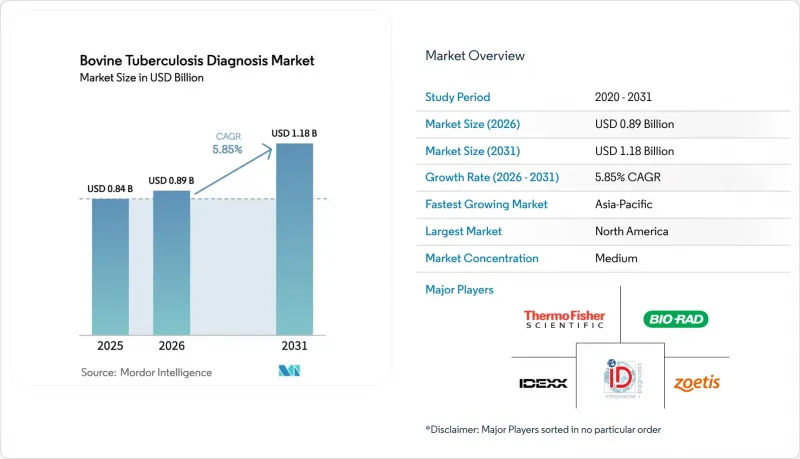
Expanding dairy and beef herds, stricter food-safety rules, and rising zoonotic-disease awareness keep testing volumes on a steady upward path. Mandatory surveillance in export-oriented dairies, compensation-backed culling programs, and government funding for molecular assays reinforce baseline demand. Molecular platforms-particularly PCR and emerging CRISPR assays-continue to gain favor because they detect infection earlier than the tuberculin skin test. At the same time, field-deployable AI-enabled readers, carbon-credit-linked "TB-free" labels, and integrated wildlife monitoring open new competitive frontiers.
Global Bovine Tuberculosis Diagnosis Market Trends and Insights
Increasing Prevalence of Zoonotic TB & Test-and-Slaughter Programs
Governments intensify surveillance as zoonotic transmission from unpasteurized milk raises public-health alarms. In South Asia, M. orygis now eclipses M. bovis in certain pockets, prompting expanded testing beyond cattle. Compensation-backed culling doubles testing touchpoints because animals undergo both screening and confirmatory assays. The United Kingdom alone paid millions in indemnities during 2024, underscoring how large the compulsory-testing pool has become.
Growing Global Cattle Population & Rising Demand for Animal-Sourced Protein
Rapid herd expansion in China, India, Brazil, and Mexico boosts routine surveillance loads. USDA data show that testing volumes are climbing in U.S. states with herd growth, echoing the link between demographic scale and diagnostic throughput. Producers increasingly view diagnostics as an insurance premium against whole-herd depopulation. Producers increasingly view preventive diagnostics not just as a regulatory obligation, but as a crucial risk management strategy, especially given the economic stakes of undetected tuberculosis leading to the potential depopulation of entire herds.
Limited Veterinary Infrastructure in Emerging Beef-Producing Belts
East-African studies highlight gaps in lab capacity, workforce training, and cold-chain logistics, all of which blunt molecular expansion. Smallholders far from laboratories default to skin tests, leaving early infections unchecked. Geographic disparities in testing quality and frequency arise from a shortage of trained veterinary personnel adept at complex diagnostic procedures. This shortfall notably impacts smallholder operations, which account for substantial portions of cattle populations in emerging markets.
Other drivers and restraints analyzed in the detailed report include:
- Mandatory Routine Screening in Export-Oriented Dairies
- Government Reimbursement for Advanced Molecular Tests
- High Cost & Cold-Chain Dependence of PCR Kits
For complete list of drivers and restraints, kindly check the Table Of Contents.
Segment Analysis
Traditional skin and interferon-gamma assays held 40.92% of the Bovine tuberculosis diagnosis market share in 2025 thanks to low price and regulatory familiarity. Yet molecular methods are tracking a 6.69% CAGR, outpacing legacy tests as producers prioritize earlier detection. CRISPR assays now deliver femtomolar sensitivity in roughly 80 minutes, narrowing the practicality gap with on-farm workflows. PCR still dominates molecular share because of well-established SOPs, while next-generation sequencing and CRISPR are carving niches in confirmatory testing. Traditional approaches remain essential screening tools, but their inability to flag subclinical cases sustains molecular momentum.
Demand for hybrid algorithms that pair AI-enhanced image scoring with antigen-based tests is climbing. These platforms augment accuracy while preserving affordability, an attractive compromise for mid-scale producers seeking incremental upgrades without overhauling lab infrastructure.
Dairy herds, tightly regulated for milk quality and export access, generated 68.18% of the Bovine tuberculosis diagnosis market size in 2025. Intensively managed operations test more often, making diagnostics integral to risk management. Buffalo and bison herds are expanding at a 6.66% CAGR, notably in India and the United States where conservation and commercial ranching overlap. Oral vaccine research in bison underscores the heightened vigilance around wildlife-livestock interfaces.
Beef cattle generally test less frequently, but pre-movement and export rules create periodic surges. Wildlife reservoirs-deer, elk, badgers-are attracting funding for surveillance, opening niche demand for non-invasive sampling tools.
The Bovine Tuberculosis Diagnosis Market Report is Segmented by Test Type (Serological Tests [ELISA Kits and More] and More), Animal Type (Dairy Cattle and More), Sample Type (Blood and More), End-User (Veterinary Reference Laboratories and More), and Geography (North America, Europe, Asia-Pacific, and More). The Market Forecasts are Provided in Terms of Value (USD).
Geography Analysis
North America led with 37.34% share in 2025, anchored by USDA's century-old eradication program that screens millions annually, generating roughly 7 cases per million cattle inspected. Government reimbursement removes price objections to PCR, encouraging rapid technology turnover. Canada's province-based zoning eliminated tests for animals from tuberculosis-free regions in 2024, illustrating how dynamic risk assessments reshape local demand.
Asia-Pacific is the fastest-growing region at a 6.48% CAGR. China's expanding commercial dairies and India's large smallholder network are both tightening disease controls, though infrastructure gaps linger. Harmonization work by the World Organisation for Animal Health is streamlining cross-border standards, making it easier for diagnostic suppliers to scale regionally.
Europe, backed by stringent animal-health directives, sustains robust demand. The UK's 2024 badger survey found prevalence rates up to 14.5% in some counties, keeping wildlife surveillance budgets intact. EU sustainability policies favor non-invasive testing and low-carbon livestock labels, fueling interest in environmental DNA kits and carbon-linked certification diagnostics.
- Abbott Laboratories
- AsureQuality
- bioMerieux
- Bionote
- Bio-Rad Laboratories
- Creative Diagnostics
- Enfer Group
- Hangzhou Frenovo Biotech Co., Ltd.
- IDEXX
- Innovative Diagnostics SAS (IDvet)
- Neogen
- QIAGEN
- Randox Food Diagnostics
- Sansure Biotech
- Thermo Fisher Scientific
- Zoetis
Additional Benefits:
- The market estimate (ME) sheet in Excel format
- 3 months of analyst support
TABLE OF CONTENTS
1 Introduction
- 1.1 Study Assumptions & Market Definition
- 1.2 Scope of the Study
2 Research Methodology
3 Executive Summary
4 Market Landscape
- 4.1 Market Overview
- 4.2 Market Drivers
- 4.2.1 Increasing prevalence of zoonotic TB & test-and-slaughter programs
- 4.2.2 Growing global cattle population & rising demand for animal-sourced protein
- 4.2.3 Mandatory routine screening in export-oriented dairies
- 4.2.4 Government reimbursement for advanced molecular tests
- 4.2.5 AI-enabled image-based field diagnostics gaining VC funding
- 4.2.6 Carbon-credit linked "low-methane, TB-free" certification premiums
- 4.3 Market Restraints
- 4.3.1 Limited veterinary infrastructure in emerging beef-producing belts
- 4.3.2 High cost & cold-chain dependence of PCR kits
- 4.3.3 Farmer resistance to mandatory culling despite compensation
- 4.3.4 Strain diversity causing false negatives in wildlife reservoirs
- 4.4 Supply Chain Analysis
- 4.5 Regulatory Landscape
- 4.6 Technological Outlook
- 4.7 Porter's Five Forces Analysis
- 4.7.1 Threat of New Entrants
- 4.7.2 Bargaining Power of Buyers
- 4.7.3 Bargaining Power of Suppliers
- 4.7.4 Threat of Substitutes
- 4.7.5 Intensity of Competitive Rivalry
5 Market Size & Growth Forecasts (Value)
- 5.1 By Test Type
- 5.1.1 Serological Tests
- 5.1.1.1 ELISA Kits
- 5.1.1.2 Agglutination / Lateral-flow
- 5.1.2 Molecular Diagnostic Tests
- 5.1.2.1 PCR
- 5.1.2.2 NGS & CRISPR-based Assays
- 5.1.3 Traditional Tests
- 5.1.3.1 Tuberculin Skin Test
- 5.1.3.2 Gamma-Interferon Assay
- 5.1.1 Serological Tests
- 5.2 By Animal Type
- 5.2.1 Dairy Cattle
- 5.2.2 Beef Cattle
- 5.2.3 Buffalo & Bison
- 5.3 By Sample Type
- 5.3.1 Blood
- 5.3.2 Milk
- 5.3.3 Tissue / Lesion
- 5.3.4 Fecal & Environmental Swab
- 5.4 By End-User
- 5.4.1 Veterinary Reference Laboratories
- 5.4.2 On-farm / Point-of-care Settings
- 5.4.3 Government Agencies & Animal Health Departments
- 5.4.4 Academic & Research Institutes
- 5.5 By Geography
- 5.5.1 North America
- 5.5.1.1 United States
- 5.5.1.2 Canada
- 5.5.1.3 Mexico
- 5.5.2 Europe
- 5.5.2.1 Germany
- 5.5.2.2 United Kingdom
- 5.5.2.3 France
- 5.5.2.4 Italy
- 5.5.2.5 Spain
- 5.5.2.6 Rest of Europe
- 5.5.3 Asia-Pacific
- 5.5.3.1 China
- 5.5.3.2 India
- 5.5.3.3 Japan
- 5.5.3.4 Australia
- 5.5.3.5 South Korea
- 5.5.3.6 Rest of Asia-Pacific
- 5.5.4 Middle East and Africa
- 5.5.4.1 GCC
- 5.5.4.2 South Africa
- 5.5.4.3 Rest of Middle East and Africa
- 5.5.5 South America
- 5.5.5.1 Brazil
- 5.5.5.2 Argentina
- 5.5.5.3 Rest of South America
- 5.5.1 North America
6 Competitive Landscape
- 6.1 Market Concentration
- 6.2 Competitive Benchmarking
- 6.3 Market Share Analysis
- 6.4 Company Profiles (includes Global level Overview, Market level overview, Core Segments, Financials as available, Strategic Information, Market Rank/Share for key companies, Products & Services, and Recent Developments)
- 6.4.1 Abbott Laboratories
- 6.4.2 AsureQuality
- 6.4.3 BioMerieux SA
- 6.4.4 Bionote
- 6.4.5 Bio-Rad Laboratories
- 6.4.6 Creative Diagnostics
- 6.4.7 Enfer Group
- 6.4.8 Hangzhou Frenovo Biotech Co., Ltd.
- 6.4.9 IDEXX Laboratories
- 6.4.10 Innovative Diagnostics SAS (IDvet)
- 6.4.11 Neogen Corporation
- 6.4.12 Qiagen N.V.
- 6.4.13 Randox Food Diagnostics
- 6.4.14 Sansure Biotech
- 6.4.15 Thermo Fisher Scientific Inc
- 6.4.16 Zoetis Inc
7 Market Opportunities & Future Outlook
- 7.1 White-space & Unmet-need Assessment

