PUBLISHER: Mordor Intelligence | PRODUCT CODE: 2043917

PUBLISHER: Mordor Intelligence | PRODUCT CODE: 2043917
Department Stores - Market Share Analysis, Industry Trends & Statistics, Growth Forecasts (2026 - 2031)
The department stores market size stood at USD 2.24 trillion in 2025, is projected to reach USD 2.29 trillion in 2026, and is expected to expand to USD 2.51 trillion by 2031, reflecting a 1.83% CAGR during 2026-2031.
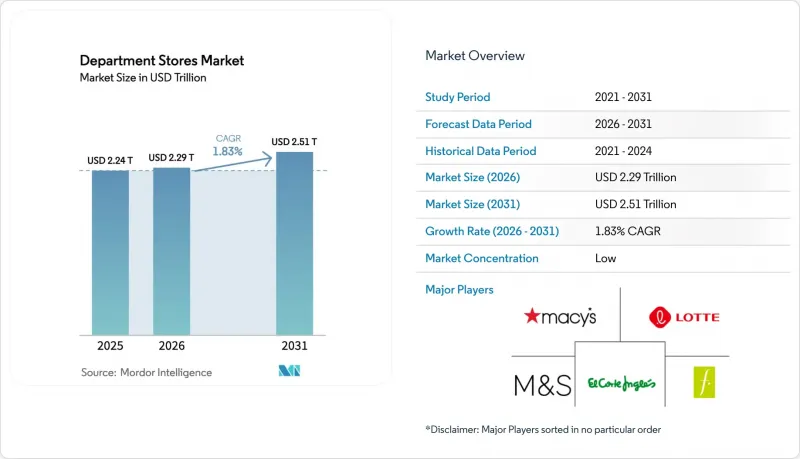
Store strategies in 2026 focus on experience-led floor plans, curated assortments, and service intensity that improves conversion and attachment rates, supported by renewed investment in store labor and visual standards. The share of U.S. retail transactions conducted online reached 16.4% in Q3 2025, reinforcing the role of stores as the primary venue for discovery, service, and immediate fulfillment in the department stores market. Operators are deepening omnichannel features such as store fulfillment for digital orders, buy online, pickup in store, and localized delivery windows to reduce shipping costs and improve speed. Off-price leaders continue to scale store fleets to capture value-seeking demand, while full-line banners focus on remodeling high-potential locations and upgrading supply chain nodes that serve unified commerce flows.
Global Department Stores Market Trends and Insights
Accelerated Repeat Purchases Through Omnichannel Integration
Department stores are connecting digital discovery with store-based services to streamline shopping journeys and drive repeat visits. Operators continue to prioritize buy online, pickup in store, and ship from store to reduce delivery times and increase conversion rates for high-intent baskets. Nordstrom enabled store fulfillment for Rack digital orders across more than 100 Rack locations in 2024, improving inventory turns while lowering last-mile expenses in dense trade areas. John Lewis expanded its delivery-from-store capabilities during FY2024/25 to maintain availability, reduce reliance on distribution centers, and enhance the in-store proposition through better service allocation. Macy's broadened its "Reimagine 125" program to elevate merchandising and staffing at a defined store cohort, and these locations outperformed the fleet on comparable sales in late 2025. As online's share of United States retail sales reached 16.4% in Q3 2025, integrated fulfillment and service continue to help the department stores market convert hybrid shoppers who expect speed, convenience, and consistent assortments across channels.
Recovery of Destination Shopping Trips After the Pandemic
Premium department stores are repositioning flagships as service-centric destinations to reinforce in-person visits and strengthen brand engagement. Selfridges completed a major beauty hall refurbishment that delivered higher appointment volumes and stronger category sales following reopening, which validated investment in clienteling and hands-on services. Macy's reported that elevated staffing and visual standards at "Reimagine 125" locations supported better traffic conversion and relative comp sales in 2025, which supports a focus on targeted upgrades over broad footprint growth. ICSC surveys in 2026 indicate that consumers continue to value in-store experiences in the post-pandemic period, which helps well-positioned centers maintain resilient performance relative to lower-tier venues. Department store operators are pairing service expansion with omnichannel features such as click-and-collect to improve trip productivity and support a balanced ticket mix. As a result, the department stores market benefits from a flight-to-quality pattern that concentrates traffic at top assets where experience, service, and brand curation are strongest.
Competitive Pressure From E-Commerce Pure-Play Retailers
Pure-play e-commerce retailers continue to drive pricing transparency and higher convenience expectations, putting pressure on margins for large-format department stores. With online sales representing a growing share of total retail activity, department stores are responding through omnichannel strategies, including same-day pickup, curated fittings, and personalized in-store service. Off-price banners and marketplace models help maintain value perception while managing inventory and markdown risks. Investments in unified merchandising, digital tools, and supply chain enhancements allow operators to sustain conversion amid rising online competition. Premium categories such as beauty and luxury services remain resilient, as experiential offerings and personalized clienteling drive a higher willingness to pay than for commoditized goods.
Other drivers and restraints analyzed in the detailed report include:
- Growing Middle-Class in APAC Driving Higher Discretionary Spending
- Off-Price Spin-Offs Attract Value-Oriented Consumers
- Declining Mall Foot Traffic in Mature Western Markets
For complete list of drivers and restraints, kindly check the Table Of Contents.
Segment Analysis
Apparel & Accessories accounted for 40.22% of 2025 revenue, while Softline is projected as the fastest-growing category with a 7.86% CAGR during 2026-2031 in the department stores market. The department stores market has leaned on home textiles, decor, and furnishings to capture at-home lifestyle upgrades that remain relevant in 2026. TJX's HomeGoods banner continues to add stores across the U.S., and fleet expansion is supported by opportunistic buying and high repeat intent among value-focused decorators. John Lewis reported outperformance in home-related categories alongside new brand partnerships, which signals durable demand for practical, design-forward products that are easy to maintain. Grocery-led banners in broader retail ecosystems reinforce multi-trip behaviors that benefit adjacent home lines, and food halls inside premium department stores can support visit frequency and incremental cross-category sales.
The department stores market also adapts to changing fashion dynamics through more flexible merchandising and service-led selling. Selfridges invested in immersive brand activations and enhanced beauty services during 2024-2025, which supported higher appointments and healthy category sell-through after the renovation. Department stores are broadening their circular and resale offerings in accessories, watches, and handbags to serve value- and sustainability-minded shoppers, complementing full-price newness with lifecycle options. Operators are also deepening private label where relevant to manage margin pressure and retain design control, especially in basics and seasonal accents within the department stores industry. Compliance frameworks for packaging, product safety, and environmental reporting are now embedded in buying and sourcing, and these requirements influence costs, lead times, and on-shelf claims across soft goods.
The Department Stores Market Report is Segmented by Product Type (Apparel & Accessories, FMCG, Hardline, Softline), Store Format (Full-Line, Off-Price, Discount, Luxury, Online Department Stores, Small-format/Neighborhood), Ownership Model (Publicly Listed, Private, Cooperative, State-Owned), and Geography (North America, South America, and Other). The Market Forecasts are Provided in Terms of Value (USD), Based On Availability.
Geography Analysis
North America accounted for 42.31% of 2025 revenue, and its growth profile remains steady as operators close underperforming stores and invest in omnichannel assets that drive conversion and speed in the department stores market. Macy's closed weaker locations and concentrated capex on a defined cohort of reimagined stores and a new automated fulfillment center that together back unified service promises across selling channels. Nordstrom expanded store fulfillment across Rack stores and reported stabilization in select subcategories as service, speed, and breadth converged. The online share of retail in the United States rose to 16.4% in Q3 2025, which keeps pressure on prices and logistics while reinforcing stores as the locus of experience in the department store market.
Asia-Pacific is projected to grow at a 6.86% CAGR through 2031, supported by urbanization, higher discretionary budgets, and service innovation anchored by leading domestic groups in Japan, Korea, and Southeast Asia. Isetan Mitsukoshi posted record operating profit for the nine months ended December 31, 2025, and expanded its app-based engagement to serve both domestic and inbound shoppers with culturally relevant content and support. Lotte Shopping is establishing an international headquarters in Singapore in 2026 and pursuing premium retail projects in Southeast Asia aligned with regional consumption growth. Central Retail reported new mall openings in Vietnam and planned renovations in Thailand for 2025, which strengthen anchor-tenant draw and footfall for department store banners in mixed-use projects. These efforts reflect integrated strategies that blend flagship experience with mobile-first engagement to grow the department stores market in APAC.
Europe remains a large and mature region with a focus on store refurbishments, digital capability upgrades, and category curation that aligns with local preferences in the department stores market. John Lewis reported improved profitability in FY2024/25 and outlined a plan to invest in stores, technology, and supply chain in FY2025/26 to reinforce service and assortment depth. Marks & Spencer delivered a strong FY2024/25 performance and continued to optimize its store network and product mix across food and general merchandise to meet changing shopper needs. El Corte Ingles continued multi-site upgrades in early 2025, with investments to modernize stores that support premium brands and service-led selling. Across EMEA, off-price and value channels also expand, including partnerships that extend store networks into the Middle East, such as TJX's strategic stake in Brands for Less, which adds to the region's accessible fashion and home offer.
- Macy's Inc.
- Kohl's Corp.
- Nordstrom Inc.
- Dillard's Inc.
- JCPenney
- Marks & Spencer Group
- John Lewis Partnership
- Selfridges & Co.
- Galeria Karstadt Kaufhof
- El Corte Ingles
- Isetan Mitsukoshi Holdings
- Takashimaya Co.
- Lotte Shopping
- Hyundai Department Store
- David Jones
- Myer Holdings
- Falabella S.A.
- Liverpool (El Puerto de Liverpool)
- Hudson's Bay Co.
- Central Department Store (Thailand)
- SM Store (Philippines)
Additional Benefits:
- The market estimate (ME) sheet in Excel format
- 3 months of analyst support
TABLE OF CONTENTS
1 Introduction
- 1.1 Study Assumptions & Market Definition
- 1.2 Scope of the Study
2 Research Methodology
3 Executive Summary
4 Market Landscape
- 4.1 Market Overview
- 4.2 Market Drivers
- 4.2.1 Omnichannel integration accelerates repeat purchasing
- 4.2.2 Post-pandemic rebound of destination shopping trips
- 4.2.3 Expanding middle class in APAC boosts discretionary spend
- 4.2.4 Off-price spin-outs capture value-seekers into the channel
- 4.2.5 AI-driven in-store personalization lifts conversion rates
- 4.2.6 Micro-fulfillment revenue from store back-of-house assets
- 4.3 Market Restraints
- 4.3.1 E-commerce pure-play price competition
- 4.3.2 Mall traffic contraction in mature Western markets
- 4.3.3 Inflation-driven margin pressure on merchandise mix
- 4.3.4 Scope-3 sustainability compliance costs
- 4.4 Value / Supply-Chain Analysis
- 4.5 Regulatory Landscape
- 4.6 Technological Outlook
- 4.7 Porter's Five Forces
- 4.7.1 Bargaining Power of Suppliers
- 4.7.2 Bargaining Power of Buyers
- 4.7.3 Threat of New Entrants
- 4.7.4 Threat of Substitutes
- 4.7.5 Competitive Rivalry
5 Market Size & Growth Forecasts
- 5.1 By Product Type
- 5.1.1 Apparel & Accessories
- 5.1.2 FMCG
- 5.1.3 Hardline
- 5.1.4 Softline
- 5.2 By Store Format
- 5.2.1 Full-line
- 5.2.2 Off-price
- 5.2.3 Discount
- 5.2.4 Luxury
- 5.2.5 Online Department Stores
- 5.2.6 Small-format / Neighborhood
- 5.3 By Ownership Model
- 5.3.1 Publicly Listed
- 5.3.2 Private
- 5.3.3 Cooperative
- 5.3.4 State-owned
- 5.4 By Geography
- 5.4.1 North America
- 5.4.1.1 United States
- 5.4.1.2 Canada
- 5.4.1.3 Mexico
- 5.4.2 South America
- 5.4.2.1 Brazil
- 5.4.2.2 Peru
- 5.4.2.3 Chile
- 5.4.2.4 Argentina
- 5.4.2.5 Rest of South America
- 5.4.3 Europe
- 5.4.3.1 United Kingdom
- 5.4.3.2 Germany
- 5.4.3.3 France
- 5.4.3.4 Spain
- 5.4.3.5 Italy
- 5.4.3.6 BENELUX
- 5.4.3.7 NORDICS
- 5.4.3.8 Rest of Europe
- 5.4.4 Asia-Pacific
- 5.4.4.1 India
- 5.4.4.2 China
- 5.4.4.3 Japan
- 5.4.4.4 Australia
- 5.4.4.5 South Korea
- 5.4.4.6 South-East Asia
- 5.4.4.7 Rest of Asia-Pacific
- 5.4.5 Middle East and Africa
- 5.4.5.1 United Arab Emirates
- 5.4.5.2 Saudi Arabia
- 5.4.5.3 South Africa
- 5.4.5.4 Nigeria
- 5.4.5.5 Rest of Middle East and Africa
- 5.4.1 North America
6 Competitive Landscape
- 6.1 Market Concentration
- 6.2 Strategic Moves
- 6.3 Market Share Analysis
- 6.4 Company Profiles (includes Global level Overview, Market level overview, Core Segments, Financials as available, Strategic Information, Market Rank/Share for key companies, Products & Services, and Recent Developments)
- 6.4.1 Macy's Inc.
- 6.4.2 Kohl's Corp.
- 6.4.3 Nordstrom Inc.
- 6.4.4 Dillard's Inc.
- 6.4.5 JCPenney
- 6.4.6 Marks & Spencer Group
- 6.4.7 John Lewis Partnership
- 6.4.8 Selfridges & Co.
- 6.4.9 Galeria Karstadt Kaufhof
- 6.4.10 El Corte Ingles
- 6.4.11 Isetan Mitsukoshi Holdings
- 6.4.12 Takashimaya Co.
- 6.4.13 Lotte Shopping
- 6.4.14 Hyundai Department Store
- 6.4.15 David Jones
- 6.4.16 Myer Holdings
- 6.4.17 Falabella S.A.
- 6.4.18 Liverpool (El Puerto de Liverpool)
- 6.4.19 Hudson's Bay Co.
- 6.4.20 Central Department Store (Thailand)
- 6.4.21 SM Store (Philippines)
7 Market Opportunities & Future Outlook
- 7.1 Experiential retail partnerships with entertainment & F&B brands
- 7.2 Retail-media monetization of first-party loyalty data

