PUBLISHER: Mordor Intelligence | PRODUCT CODE: 2043927

PUBLISHER: Mordor Intelligence | PRODUCT CODE: 2043927
Avocado Oil - Market Share Analysis, Industry Trends & Statistics, Growth Forecasts (2026 - 2031)
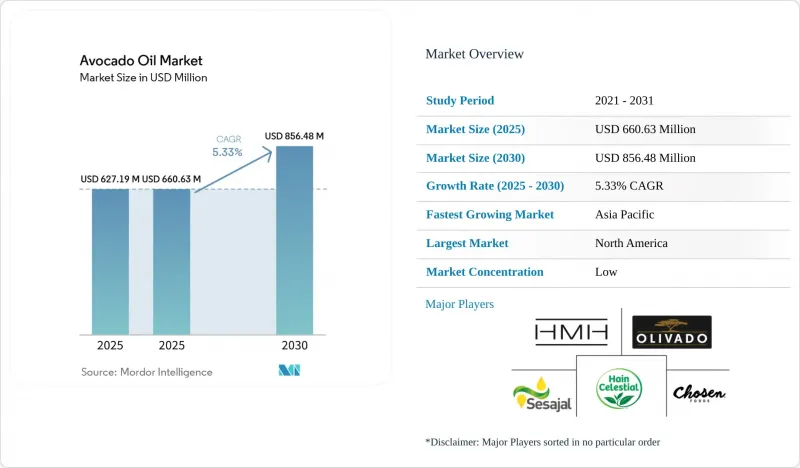
The global avocado oil market is witnessing consistent growth, increasing from USD 627.19 million in 2025 to USD 660.63 million in 2026, and is projected to reach USD 856.48 million by 2031, with a CAGR of 5.33% during 2026-2031.
This growth is primarily driven by the rising consumer preference for health-focused and functional edible oils, supported by growing awareness of the benefits of monounsaturated fats, antioxidants, and clean-label ingredients. Avocado oil is increasingly regarded as a premium, plant-based alternative to conventional oils, gaining traction among consumers seeking natural, minimally processed, and nutrient-rich food options. The shift away from heavily refined oils toward organic, non-GMO, and minimally processed alternatives further strengthens avocado oil's market position. Additionally, its high smoke point and versatility in various cooking applications enhance its appeal to a broader consumer base.
Global Avocado Oil Market Trends and Insights
Growing popularity of plant-based diets
The increasing adoption of plant-based diets is a key factor driving the growth of the avocado oil market. Consumers are progressively shifting toward plant-derived, nutrient-rich food options to support healthier and more sustainable lifestyles. Avocado oil, as a naturally sourced plant-based fat, aligns well with this trend due to its high content of monounsaturated fats, antioxidants, and clean-label attributes. These qualities make it a favorable alternative to animal-based fats and conventional cooking oils. This transition is particularly prominent in developed markets, where dietary preferences are moving toward flexitarian and vegan options. According to the Good Food Institute (GFI), 59% of households in the United States purchased plant-based foods in 2024, underscoring the widespread acceptance of plant-based consumption . As consumers increasingly prioritize natural ingredients, functional health benefits, and sustainability, avocado oil is being incorporated into everyday cooking, processed foods, and health-oriented product formulations, thereby sustaining demand and driving market growth.
Increasing awareness of healthy fats
Growing awareness of healthy fats is driving the avocado oil market as consumers become increasingly informed about the role of dietary fats in promoting overall health and wellness. Traditional perceptions linking fats to negative health outcomes are shifting, with greater recognition of the benefits of monounsaturated and unsaturated fats, which are associated with heart health, improved cholesterol levels, and anti-inflammatory effects. Avocado oil, rich in these healthy fats, along with vitamin E and antioxidants, is being viewed as a functional and heart-friendly alternative to conventional edible oils. This trend is further supported by health professionals, nutrition research, and clean-label initiatives, encouraging consumers to make more informed dietary choices. Consequently, avocado oil is gaining wider acceptance for both household use and product formulations, solidifying its position as a preferred option in the health-focused edible oils market.
High production costs
High production costs significantly restrain the growth of the avocado oil market, limiting its adoption and competitiveness compared to conventional edible oils. Avocado oil production is resource-intensive, requiring substantial quantities of avocados to produce relatively small volumes of oil, which increases raw material costs. Additionally, processes such as cold-pressing, sorting, grading, and quality control add to operational expenses, particularly for premium-grade oils. The reliance on specific avocado varieties and agricultural conditions further contributes to cost variability and supply constraints, making production less predictable. Furthermore, the use of advanced extraction technologies and compliance with certifications increases production and processing costs. Consequently, avocado oil is often priced higher than alternatives such as sunflower, soybean, or palm oil, reducing its accessibility for price-sensitive consumers and limiting its penetration in mass-market segments.
Other drivers and restraints analyzed in the detailed report include:
- High smoke point suitability
- Shift toward organic, clean-label, and minimally processed oils
- Climate sensitivity affecting avocado crop yields
For complete list of drivers and restraints, kindly check the Table Of Contents.
Segment Analysis
Extra-virgin avocado oil, which accounted for 46.12% of the market in 2025, emerged as a key driver of growth in the avocado oil industry. This was attributed to its premium quality, health benefits, and clean-label appeal. The segment's growth was primarily fueled by increasing consumer preference for minimally processed, nutrient-rich oils. Extra-virgin avocado oil, produced through cold-pressed extraction methods, retained high levels of monounsaturated fats, antioxidants, and vitamins. These attributes made it highly desirable for both household consumption and foodservice applications, where there was growing demand for high-performance cooking oils with a high smoke point and natural origin.
Refined avocado oil, anticipated to grow at a CAGR of 6.12% through 2031, is gaining popularity as an accessibility-focused segment, supporting the overall expansion of the avocado oil market. Refined avocado oil undergoes additional processing, resulting in a neutral taste, lighter color, and enhanced stability, making it well-suited for high-temperature cooking applications such as frying, grilling, and commercial food preparation. Its longer shelf life and reduced sensitivity to storage conditions further increase its appeal in retail and bulk distribution channels. Additionally, refined avocado oil is increasingly utilized as a base oil in blended formulations and processed foods, contributing to its consistent demand.
The Avocado Oil Market Report is Segmented by Type (Virgin Oil, Refined Oil, and Others), Extraction Type (Cold-Pressed/Mechanical, Solvent Extraction, and More), End-Use (Industrial, and Retail), and Geography (North America, Europe, Asia-Pacific, and More). The Market Forecasts are Provided in Both Value (USD) and Volume (Tons).
Geography Analysis
In 2025, North America accounted for 38.01% of the global avocado oil market value, maintaining its leading position. This dominance is supported by the mature health and wellness ecosystem in the United States and the established consumption of premium edible oils. Mexico plays a pivotal role as a major avocado producer and supply hub, ensuring consistent raw material availability and cost advantages across the region. According to the Agri-Food and Fisheries Information Service, Mexico's avocado production reached 2.76 million metric tons in 2024, underscoring its critical role in the global value chain . Additionally, the United States and Canada contribute to regional growth through increased retail penetration, product diversification, and the adoption of avocado oil in food processing and personal care applications, further solidifying North America's leadership in the market.
The Asia-Pacific region is projected to grow at a CAGR of 6.81% through 2031, making it the fastest-growing regional market for avocado oil. This growth is driven by rapid urbanization, changing dietary habits, and the rise of health-conscious consumers in countries such as China, India, Japan, and Australia. Increasing awareness of the benefits of healthy fats and natural oils, coupled with the expansion of modern retail infrastructure and e-commerce platforms, is enhancing product accessibility. Urban consumers are increasingly shifting from traditional cooking oils to premium and functional alternatives, including avocado oil.
Europe, South America, and the Middle East and Africa represent a diverse but strategically important landscape for the avocado oil market. In Europe, there is a growing focus on organic, non-GMO, and clean-label certifications, with consumers favoring sustainably sourced and high-quality oils, particularly in countries like Germany, the United Kingdom, and France. South America, led by Brazil and Argentina, benefits from its proximity to major avocado-producing countries such as Chile, Peru, and Colombia, which supports raw material availability and export potential. However, limited domestic processing infrastructure in South America continues to constrain value addition within the region.
- Hans Merensky Holdings (Pty) Ltd. (Westfalia Fruit)
- Sesajal S.A. de C.V.
- Olivado Ltd
- CalPure Foods Inc.
- La Tourangelle Inc.
- Chosen Foods LLC
- The Hain Celestial Group, Inc. (Spectrum Organics)
- Grove Avocado Oil (Avocado Oil NZ Ltd)
- Bella Vado
- BetterBody Foods
- Stonewall Kitchen LLC
- AvoHealth Ltd
- Kevala International LLC
- Cosmopolitan Food Group
- Fruittal LLC
- Ava Jane's Kitchen
- De La Rosa Real Foods & Vineyards
- BMA USA Inc.
- Sulu Organics LLC
- Agroindustrias Avoin SAC
Additional Benefits:
- The market estimate (ME) sheet in Excel format
- 3 months of analyst support
TABLE OF CONTENTS
1 INTRODUCTION
- 1.1 Study Assumptions and Market Definition
- 1.2 Scope of the Study
2 RESEARCH METHODOLOGY
3 EXECUTIVE SUMMARY
4 MARKET LANDSCAPE
- 4.1 Market Overview
- 4.2 Market Drivers
- 4.2.1 Growing popularity of plant-based diets
- 4.2.2 Increasing awareness of healthy fats
- 4.2.3 High smoke point suitability
- 4.2.4 Shift toward organic, clean-label, and minimally processed oils
- 4.2.5 Advancements in extraction and processing technology
- 4.2.6 Rising demand in gourmet and specialty foods
- 4.3 Market Restraints
- 4.3.1 High production costs
- 4.3.2 Climate sensitivity affecting avocado crop yields
- 4.3.3 Allergen concerns for sensitive consumers
- 4.3.4 Strong competition from established oils
- 4.4 Supply Chain Analysis
- 4.5 Regulatory Landscape
- 4.6 Technological Outlook
- 4.7 Porter's Five Forces Analysis
- 4.7.1 Threat of New Entrants
- 4.7.2 Bargaining Power of Buyers
- 4.7.3 Bargaining Power of Suppliers
- 4.7.4 Threat of Substitutes
- 4.7.5 Intensity of Competitive Rivalry
5 MARKET SIZE AND GROWTH FORECASTS (VALUE AND VOLUME)
- 5.1 By Type
- 5.1.1 Extra Virgin Oil
- 5.1.2 Virgin Oil
- 5.1.3 Refined Oil
- 5.1.4 Others
- 5.2 By Extraction Type
- 5.2.1 Cold-Pressed/Mechanical
- 5.2.2 Solvent Extraction
- 5.2.3 Supercritical CO? Extraction
- 5.2.4 Others
- 5.3 End-Use
- 5.3.1 Industrial
- 5.3.1.1 Food andBeverages
- 5.3.1.2 Personal Care and Cosmetics
- 5.3.1.3 Pharmaceuticals and Nutraceuticals
- 5.3.1.4 Others
- 5.3.2 Retail
- 5.3.2.1 Supermarkets and Hypermarkets
- 5.3.2.2 Convenience Stores
- 5.3.2.3 Specialty Stores
- 5.3.2.4 Online Retail
- 5.3.2.5 Others
- 5.3.1 Industrial
- 5.4 By Geography
- 5.4.1 North America
- 5.4.1.1 United States
- 5.4.1.2 Canada
- 5.4.1.3 Mexico
- 5.4.1.4 Rest of North America
- 5.4.2 Europe
- 5.4.2.1 Germany
- 5.4.2.2 United Kingdom
- 5.4.2.3 Italy
- 5.4.2.4 France
- 5.4.2.5 Spain
- 5.4.2.6 Netherlands
- 5.4.2.7 Rest of Europe
- 5.4.3 Asia-Pacific
- 5.4.3.1 China
- 5.4.3.2 India
- 5.4.3.3 Japan
- 5.4.3.4 Australia
- 5.4.3.5 Rest of Asia-Pacific
- 5.4.4 South America
- 5.4.4.1 Brazil
- 5.4.4.2 Argentina
- 5.4.5 Middle East and Africa
- 5.4.5.1 South Africa
- 5.4.5.2 Saudi Arabia
- 5.4.5.3 United Arab Emirates
- 5.4.1 North America
6 COMPETITIVE LANDSCAPE
- 6.1 Market Concentration
- 6.2 Strategic Moves
- 6.3 Market Positioning Analysis
- 6.4 Company Profiles (includes Global level Overview, Market level overview, Core Segments, Financials as available, Strategic Information, Market Rank/Share for key companies, Products and Services, and Recent Developments)
- 6.4.1 Hans Merensky Holdings (Pty) Ltd. (Westfalia Fruit)
- 6.4.2 Sesajal S.A. de C.V.
- 6.4.3 Olivado Ltd
- 6.4.4 CalPure Foods Inc.
- 6.4.5 La Tourangelle Inc.
- 6.4.6 Chosen Foods LLC
- 6.4.7 The Hain Celestial Group, Inc. (Spectrum Organics)
- 6.4.8 Grove Avocado Oil (Avocado Oil NZ Ltd)
- 6.4.9 Bella Vado
- 6.4.10 BetterBody Foods
- 6.4.11 Stonewall Kitchen LLC
- 6.4.12 AvoHealth Ltd
- 6.4.13 Kevala International LLC
- 6.4.14 Cosmopolitan Food Group
- 6.4.15 Fruittal LLC
- 6.4.16 Ava Jane's Kitchen
- 6.4.17 De La Rosa Real Foods & Vineyards
- 6.4.18 BMA USA Inc.
- 6.4.19 Sulu Organics LLC
- 6.4.20 Agroindustrias Avoin SAC
7 MARKET OPPORTUNITIES AND FUTURE OUTLOOK

