PUBLISHER: Mordor Intelligence | PRODUCT CODE: 2043928

PUBLISHER: Mordor Intelligence | PRODUCT CODE: 2043928
Potato Starch - Market Share Analysis, Industry Trends & Statistics, Growth Forecasts (2026 - 2031)
The Potato Starch Market size is expected to increase from USD 4.29 billion in 2025 to USD 4.54 billion in 2026 and reach USD 6.14 billion by 2031, growing at a CAGR of 6.22% over 2026-2031.
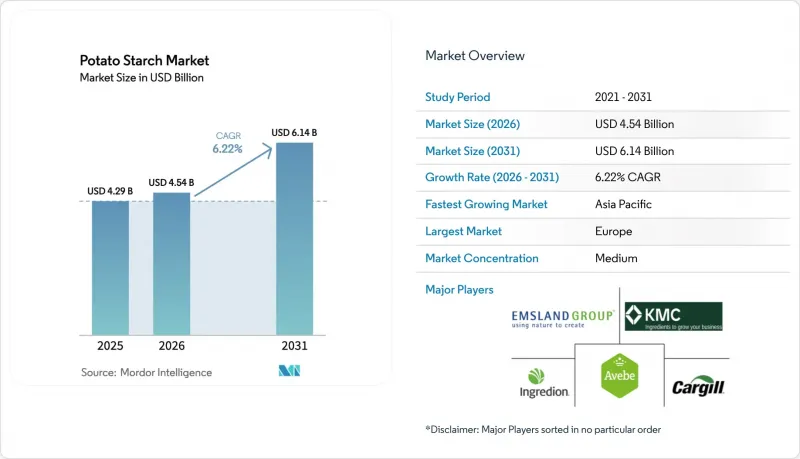
The market's expansion is fueled by food manufacturers aiming to balance clean-label requirements with functional performance. This trend is particularly significant as precision-fermentation platforms increasingly adopt ultra-low-protein grades as microbial feedstock. Specialty potato starch grades, designed to endure retort cycles, high-shear processing, and repeated freeze-thaw events, are replacing commodity native starch in applications such as sauces, ready meals, and plant-based cheese. Additionally, organic certification and non-GMO positioning have become critical price-resilient factors in categories like baby food, premium bakery products, and dairy alternatives. The competitive landscape is becoming more challenging as tapioca and pea starches offer similar melt-stretch and clarity properties at a lower cost. This competition is driving potato-starch suppliers to focus on improving process efficiency, innovating resistant starches, and implementing sustainability upgrades.
Global Potato Starch Market Trends and Insights
Growing popularity of gluten-free ingredients
Gluten-free product formulators are increasingly utilizing potato starch due to its excellent water-binding capacity and neutral flavor. This approach helps replicate the tender crumb and moisture retention typically provided by wheat gluten. Substituting 10-20% of ingredients with potato starch in gluten-free bread and cakes allows formulators to achieve a desirable texture while avoiding the pasty mouthfeel often associated with corn or rice starches. Additionally, potato starch offers anti-staling properties that extend the shelf life of packaged bakery goods. Its functional benefits are particularly significant in frozen gluten-free products, where its freeze-thaw stability prevents syneresis and preserves structural integrity throughout distribution cold chains. According to the Celiac Disease Foundation, by 2025, over 70% of individuals with celiac disease will remain undiagnosed, with no treatments available beyond a gluten-free diet. The prevalence of celiac disease in Western populations, coupled with the growing adoption of gluten-free diets for perceived health benefits, is expanding the market. This shift includes not only diagnosed patients but also health-conscious consumers willing to pay a premium for clean-label bakery alternatives. By blending potato starch with tapioca or corn starches, formulators can achieve an optimal balance. This combination integrates the rigid structure provided by corn with the elasticity of potato, enabling the development of multi-starch systems that meet both sensory and processing needs in high-volume gluten-free production lines.
Rising demand for processed and convenience foods
Urbanization and the increase in dual-income households are driving the demand for ready-to-eat meals, frozen entrees, and shelf-stable soups. These products depend on starches that can withstand retort sterilization, freeze-thaw cycles, and extended ambient storage without experiencing retrogradation or weeping. In 2024, the World Bank reported that 57.7% of the global population lived in urban areas. Potato starch, with its high amylopectin content (75-80% amylopectin compared to 20-25% amylose), creates smooth, glossy gels with minimal syneresis. This property makes it the preferred thickener for premium sauces, gravies, and dairy-alternative yogurts, where visual appeal and spoon-coating viscosity are key indicators of quality for consumers. The growing middle class in the Asia-Pacific region, particularly in China and India, is boosting demand for Western-style convenience foods such as instant noodles, snack bars, and microwaveable curries. These products utilize potato starch's dispersibility and low-temperature gelatinization (58-65°C) to ensure quick hydration and consistent texture during industrial batch processing. Processors value potato starch for its neutral pH (5-7) and lack of off-flavors, which simplify formulation across savory and sweet applications without the need for masking agents or flavor adjustments. The shift from traditional cooking to convenience foods is especially noticeable in Tier 2 and Tier 3 cities across Asia. In these areas, the expansion of modern retail and improvements in cold-chain infrastructure are enabling large-scale frozen food distribution. This trend is driving sustained growth in demand for functional starches, which help deliver restaurant-quality textures in meals reheated at home.
Volatility in raw-potato prices
FAO AgriPrice Monitor data indicates that by June 2026, potato prices rose 12.4% year-on-year. Processing-grade potatoes in the EU reached EUR 28.70 per 100 kg, reflecting a 9.2% increase, while US chipping stock prices increased by 14.6% to USD 32.40 per hundredweight. These price hikes have squeezed starch processor margins, prompting some operators to redirect lower-quality tubers from starch extraction to animal feed or biogas production. Climate-related yield disruptions, such as droughts in key European growing regions and excessive rainfall in North America, reduced average yields. Furthermore, post-harvest losses, driven by storage rot and mechanical damage during handling, surpassed historical norms. During the 2026 price spike, processors with fixed-price long-term contracts experienced margin erosion, while those relying on spot purchases faced rising input costs that outpaced their ability to pass them on to food manufacturers locked into annual supply agreements. The perishability of potatoes and their storage limitations, 6 to 9 months under controlled conditions, further exacerbate the volatility. Unlike grains, which can be stored for several years, potatoes cannot be stockpiled to buffer against price fluctuations.
Other drivers and restraints analyzed in the detailed report include:
- Growing adoption of plant-based and vegan ingredients
- Technological advances in extraction and processing
- Competition from alternative starches (corn, cassava, wheat)
For complete list of drivers and restraints, kindly check the Table Of Contents.
Segment Analysis
Forecasts indicate that modified potato starch will achieve a robust CAGR of 7.82% through 2031, significantly outpacing the overall growth of the potato starch market. This growth is primarily attributed to the superior performance of enzyme-treated and oxidized grades, which demonstrate exceptional resilience against sterilization, shear forces, and freeze-thaw cycles. Emsland's innovative ROxy reactor plays a pivotal role in this segment by enhancing the production of specialty starches while simultaneously reducing energy consumption by 12%. This advancement positions Emsland as a cost-competitive supplier in the market. Additionally, Roquette's breakthrough patent on resistant starch has increased the RS2 content to 66%, enabling the company to penetrate high-value niches such as gut health and pet nutrition, both of which command premium pricing.
In 2025, native potato starch maintained a dominant 64.96% share of revenues, driven by its strong appeal in clean-label applications, particularly in gluten-free bakery products and baby foods. The anticipated delisting of organic corn starch in the U.S. is expected to further strengthen this segment. However, unmodified grades of potato starch face limitations, such as susceptibility to retrogradation, which restricts their use in frozen entrees. To address these challenges, processors are adopting a dual-sourcing strategy that combines the label-friendly simplicity of native starch with the functional reliability of modified starch. This balanced approach is expected to remain a key trend in the market through 2031.
The Potato Starch Market Report is Segmented by Type (Native, Modified), Nature (Conventional, Organic), Application (Food and Beverages, Animal Feed, Pharmaceuticals, Cosmetics), and Geography (North America, Europe, Asia-Pacific, South America, MEA). Market Forecasts are Provided in Terms of Value (USD) and Volume (Tons).
Geography Analysis
In 2025, Europe accounted for 41.09% of the global potato-starch market share. This dominance was supported by production hubs in Northern and Western Europe, particularly in Germany, the Netherlands, Belgium, and Poland. These countries significantly contribute to global potato-starch output and benefit from cooperative processing models, proximity to high-value food and pharmaceutical clients, and subsidies under the EU's Common Agricultural Policy, which promote organic transitions and sustainable farming practices. Additionally, Commission Regulation 2017/2158 established acrylamide-mitigation benchmarks of 500 µg/kg for French fries and 750 µg/kg for potato crisps. This regulation requires processors to implement measures such as low-temperature blanching, asparaginase enzyme pretreatment, and careful variety selection. However, these compliance costs disproportionately impact smaller fry and bakery processors, particularly in Southern and Eastern Europe.
Between 2026 and 2031, the Asia-Pacific region is expected to grow at a notable 7.57% CAGR, the fastest among all regions. This growth is driven by urbanization, rising middle-class incomes, and increasing demand for Western-style convenience foods, such as instant noodles, frozen entrees, and snack bars. These products require starches with rapid hydration, freeze-thaw stability, and consistent texture for industrial processing. China and India present the largest growth opportunities, with Tier 2 and Tier 3 cities experiencing rapid expansion of modern retail and cold-chain infrastructure. These developments enable large-scale frozen-food distribution, driving sustained demand for functional starches. However, the region faces strong competition from tapioca starch. Thailand, which exports 5.3 million tonnes annually, representing 47% of global cassava-starch trade, offers a neutral flavor and superior freeze-thaw stability. With prices 15-25% lower than potato starch, tapioca is gaining market share in frozen ready-meals and vegan cheese applications, where its functional properties can substitute potato starch. The region's growth will depend on potato-starch suppliers differentiating through organic certifications, specialty modifications like resistant and pre-gelatinized starches, and partnerships with precision-fermentation platforms developing animal-free proteins that require ultra-low-protein starch as fermentation feedstock.
North America, South America, and the Middle East and Africa are emerging as growth areas. North America benefits from its established food-processing infrastructure, export markets for specialty potato products, and early adoption of precision-fermentation technologies, which drive niche demand for ultra-low-protein starch as microbial feedstock. For instance, Ingredion announced a USD 50 million investment in its Cedar Rapids, Iowa facility, targeting specialty industrial starches for the packaging and papermaking industries. This investment highlights a shift toward biodegradable packaging and circular-economy materials. In South America, the potato-starch industry faces challenges such as fragmented production, infrastructure limitations, and competition from cassava and corn starches. Meanwhile, the Middle East and Africa struggle with supply constraints due to water scarcity, limited cold-chain infrastructure, and reliance on imports to meet domestic demand. A regulatory change by the USDA National Organic Standards Board, which plans to phase out conventional corn starch from the National List by 2027, is expected to drive short-term demand for organic potato starch in North America. However, supply constraints and a 20-30% price premium over conventional grades may pose challenges.
- Royal Avebe U.A.
- Emsland Group
- Cargill, Incorporated
- Ingredion Incorporated
- KMC A/S-Kartoffelmelcentralen A.M.B.A.
- Roquette Freres
- Archer Daniels Midland Company
- Tate and Lyle PLC
- PEPEES S.A.
- Finnamyl Oy
- Tereos S.A.
- Lyckeby Starch
- China Essence Group
- Beidahuang Potato Industry Group
- Novidon B.V.
- Vimal PPCE
- Stagot Foods
- Huhhot Huaou Starch Products Co Ltd
- Inner Mongolia Nailun Agricultural Science and Technology Co. LTD
- Karup Kartoffelmelfabrik
Additional Benefits:
- The market estimate (ME) sheet in Excel format
- 3 months of analyst support
TABLE OF CONTENTS
1 INTRODUCTION
- 1.1 Study Assumptions and Market Definition
- 1.2 Scope of the Study
2 RESEARCH METHODOLOGY
3 EXECUTIVE SUMMARY
4 MARKET LANDSCAPE
- 4.1 Market Overview
- 4.2 Market Drivers
- 4.2.1 Growing popularity of gluten-free ingredients
- 4.2.2 Rising demand for processed and convenience foods
- 4.2.3 Growing adoption of plant-based and vegan ingredients
- 4.2.4 Technological advances in extraction and processing
- 4.2.5 Organic and non-GMO positioning
- 4.2.6 Demand for ultra-low-protein starch as precision-fermentation feedstock
- 4.3 Market Restraints
- 4.3.1 Volatility in raw-potato prices
- 4.3.2 Competition from alternative starches (corn, cassava, wheat)
- 4.3.3 EU acrylamide-mitigation cost burden on fry and bakery processors
- 4.3.4 Slow, high-cost certification pipeline for organic potato starch
- 4.4 Supply Chain Analysis
- 4.5 Regulatory Landscape
- 4.6 Technological Outlook
- 4.7 Porter's Five Forces
- 4.7.1 Threat of New Entrants
- 4.7.2 Bargaining Power of Buyers
- 4.7.3 Bargaining Power of Suppliers
- 4.7.4 Threat of Substitutes
- 4.7.5 Intensity of Competitive Rivalry
5 MARKET SIZE AND GROWTH FORECASTS (VALUE AND VOLUME)
- 5.1 By product Type
- 5.1.1 Native Potato Starch
- 5.1.2 Modified Potato Starch
- 5.2 By Nature
- 5.2.1 Conventional
- 5.2.2 Organic
- 5.3 By Application
- 5.3.1 Food and Beverages
- 5.3.1.1 Bakery and Confectionery
- 5.3.1.2 Snacks and Savory Products
- 5.3.1.3 Dairy Alternatives
- 5.3.1.4 Soups and Sauces
- 5.3.1.5 Meat and Seafood Processing
- 5.3.1.6 Others
- 5.3.2 Animal Feed and Pet Nutrition
- 5.3.3 Pharmaceuticals
- 5.3.4 Cosmetics and Personal Care
- 5.3.1 Food and Beverages
- 5.4 By Geography
- 5.4.1 North America
- 5.4.1.1 United States
- 5.4.1.2 Canada
- 5.4.1.3 Mexico
- 5.4.1.4 Rest of North America
- 5.4.2 Europe
- 5.4.2.1 United Kingdom
- 5.4.2.2 Germany
- 5.4.2.3 France
- 5.4.2.4 Italy
- 5.4.2.5 Spain
- 5.4.2.6 Russia
- 5.4.2.7 Sweden
- 5.4.2.8 Belgium
- 5.4.2.9 Poland
- 5.4.2.10 Netherlands
- 5.4.2.11 Rest of Europe
- 5.4.3 Asia-Pacific
- 5.4.3.1 China
- 5.4.3.2 Japan
- 5.4.3.3 India
- 5.4.3.4 Australia
- 5.4.3.5 Vietrnam
- 5.4.3.6 Rest of Asia-Pacific
- 5.4.4 South America
- 5.4.5 Middle East and Africa
- 5.4.1 North America
6 COMPETITIVE LANDSCAPE
- 6.1 Market Concentration
- 6.2 Strategic Moves
- 6.3 Market Ranking Analysis
- 6.4 Company Profiles (includes Global level Overview, Market level overview, Core Segments, Financials as available, Strategic Information, Market Rank/Share for key companies, Products and Services, and Recent Developments)
- 6.4.1 Royal Avebe U.A.
- 6.4.2 Emsland Group
- 6.4.3 Cargill, Incorporated
- 6.4.4 Ingredion Incorporated
- 6.4.5 KMC A/S-Kartoffelmelcentralen A.M.B.A.
- 6.4.6 Roquette Freres
- 6.4.7 Archer Daniels Midland Company
- 6.4.8 Tate and Lyle PLC
- 6.4.9 PEPEES S.A.
- 6.4.10 Finnamyl Oy
- 6.4.11 Tereos S.A.
- 6.4.12 Lyckeby Starch
- 6.4.13 China Essence Group
- 6.4.14 Beidahuang Potato Industry Group
- 6.4.15 Novidon B.V.
- 6.4.16 Vimal PPCE
- 6.4.17 Stagot Foods
- 6.4.18 Huhhot Huaou Starch Products Co Ltd
- 6.4.19 Inner Mongolia Nailun Agricultural Science and Technology Co. LTD
- 6.4.20 Karup Kartoffelmelfabrik
7 MARKET OPPORTUNITIES AND FUTURE OUTLOOK

