
PUBLISHER: Mordor Intelligence | PRODUCT CODE: 2043935

PUBLISHER: Mordor Intelligence | PRODUCT CODE: 2043935
Dehydrated Vegetables - Market Share Analysis, Industry Trends & Statistics, Growth Forecasts (2026 - 2031)
The dehydrated vegetables market was valued at USD 7.78 billion in 2025, reached USD 8.36 billion in 2026, and is projected to grow to USD 12.01 billion by 2031, registering a compound annual growth rate (CAGR) of 7.51% during 2026-2031.
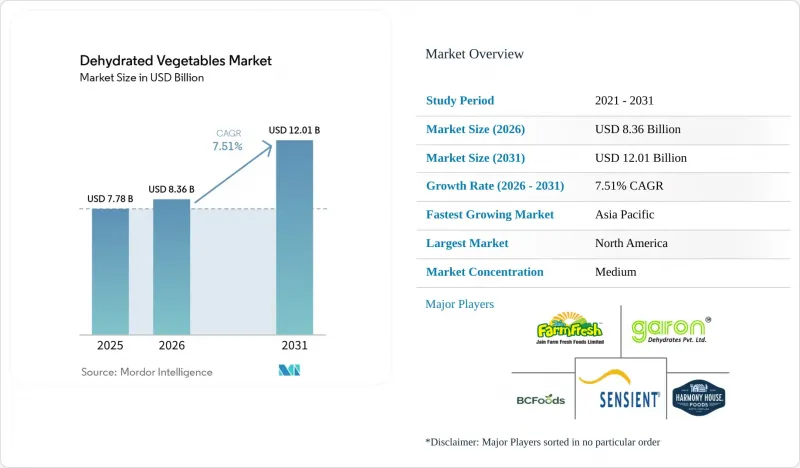
This growth is driven by the increasing preference for convenience-oriented food consumption and the rising demand for shelf-stable, easy-to-use ingredients in modern food systems. The market is supported by the growing popularity of ready-to-eat and ready-to-cook meals, where dehydrated vegetables help reduce preparation time while preserving flavor and nutritional content. Additionally, the trend toward clean-label and natural ingredients is boosting adoption, as these products typically require minimal additives and align with consumer preferences for transparency and simplicity in food products.
Global Dehydrated Vegetables Market Trends and Insights
Rising demand for convenience foods
The increasing demand for convenience foods is a significant driver of the global dehydrated vegetables market. Consumers are seeking quick and easy meal solutions that accommodate busy lifestyles. Dehydrated vegetables meet this demand by offering ready-to-use formats that reduce preparation time, eliminating tasks such as washing, peeling, and chopping. Their extended shelf life and ease of storage make them appealing to both households and foodservice operators, facilitating efficient meal planning and reducing food waste. Furthermore, the rising popularity of ready-to-eat and ready-to-cook products, including instant soups, noodles, meal kits, and snack mixes, is boosting the use of dehydrated vegetables as key ingredients. These vegetables provide consistent flavor, texture, and nutritional value, supporting their integration into modern food processing and meal solutions. This trend toward convenience-focused consumption continues to drive market growth, establishing dehydrated vegetables as an essential component in the food industry.
Clean label and natural ingredient trends
Trends toward clean labels and natural ingredients are a key driver of the global dehydrated vegetables market, as consumers increasingly value transparency, minimal processing, and recognizable ingredients in their food. Dehydrated vegetables align well with these preferences, as they generally require few additives or preservatives while maintaining their nutritional value and flavor. This makes them a popular choice for clean-label formulations in products such as soups, snacks, ready meals, and seasoning blends. The focus on natural and organic products is further supported by consumer behavior data. According to the International Food Information Council, in 2024, 36% of consumers in the United States preferred foods labeled as natural, organic, or healthy . This growing trend is prompting food manufacturers to replace artificial ingredients with minimally processed options like dehydrated vegetables, thereby driving their demand.
Quality degradation compared to fresh produce
Quality degradation compared to fresh produce remains a significant restraint in the global dehydrated vegetables market. The drying process can impact key sensory attributes, including texture, color, and flavor. Although dehydration extends shelf life, it often results in a softer or less crisp texture after rehydration, which may not replicate the mouthfeel of fresh vegetables. Additionally, some dehydration methods can cause color dulling or flavor loss due to the breakdown of volatile compounds during processing. These changes can reduce the acceptance of dehydrated vegetables in applications where freshness and sensory quality are essential, particularly in premium or minimally processed food segments. Consequently, some consumers and foodservice operators continue to favor fresh alternatives, creating challenges for the broader adoption of dehydrated formats despite their functional advantages.
Other drivers and restraints analyzed in the detailed report include:
- Growth in plant-based and vegan food products
- Growing awareness of food waste reduction
- Stringent food safety and labeling regulations
For complete list of drivers and restraints, kindly check the Table Of Contents.
Segment Analysis
The tomato segment accounted for 23.09% of the overall product-type revenue in 2025, maintaining its dominance in the global dehydrated vegetables market. This is attributed to its versatility, high consumption frequency, and widespread use across various food applications. Dehydrated tomatoes are a key ingredient in numerous products, including soups, sauces, instant meals, seasonings, snack mixes, and bakery fillings. Their role is critical for food manufacturers aiming to ensure consistent flavor and production efficiency. The dehydration process enhances the naturally rich umami taste of tomatoes, allowing for improved flavor profiles without significant reliance on artificial additives. This aligns with the growing consumer preference for clean-label and natural ingredients.
The onion segment is projected to grow at a CAGR of 8.56% through 2031, making it the fastest-growing category within the product-type segment. This growth is driven by onions' essential role as a base ingredient in global cuisines and their extensive use in processed food formulations. Dehydrated onions are widely utilized in products such as soups, sauces, ready meals, spice blends, and snack seasonings due to their robust flavor, ease of handling, and extended shelf life. These attributes make them highly valuable for food manufacturers seeking consistency and operational efficiency. Additionally, strong export momentum, particularly from major producing regions like India, supports this segment's growth. For example, according to the Agricultural and Processed Food Products Export Development Authority (APEDA), Gujarat's dehydrated white onion exports increased by 67% in the financial year 2023-24, reflecting rising global demand and enhanced supply capabilities.
The powder and flakes segment accounted for 42.89% of form-based revenue in 2025 and is projected to grow at a CAGR of 7.91% through 2031. This growth is attributed to their superior functionality, processing efficiency, and broad applicability within the food industry. These forms are particularly favored for their excellent solubility and dispersion properties, making them ideal for use in liquid and semi-solid food systems such as soups, sauces, dressings, and ready-to-eat meals. Their fine and uniform texture ensures consistent flavor distribution, a critical factor in large-scale food manufacturing. Furthermore, powders and flakes are easier to handle, measure, and store compared to bulkier or irregular forms, enhancing their compatibility with automated production lines and modern food processing technologies.
The slices and cuts segment is essential for rehydration-intensive applications, including camping meals, military rations, and emergency food supplies, where preserving the original shape, texture, and identity of vegetables after rehydration is crucial. These formats are particularly preferred in applications requiring visual appeal and a closer resemblance to fresh vegetables once prepared, thereby improving the overall eating experience in dehydrated meal solutions. Their effective rehydration capabilities, combined with the ability to retain structural integrity, make them well-suited for ready-to-cook meal kits, outdoor food products, and institutional catering, where both functionality and presentation are important. Whole pieces occupy a niche yet premium position in the market, often associated with high-quality, minimally processed offerings. These products cater to consumers seeking premium options that emphasize natural and less processed food attributes.
The Dehydrated Vegetables Market Report is Segmented by Product Type (Tomato, Potato, Onion and More), Form (Slices/Cuts, Minced/Granules, Whole Pieces, and Powder/Flakes), Drying Technology (Freeze Drying, Vacuum Drying, and More), Distribution Channel (Foodservice, and Retail) and Geography (North America, Europe, Asia-Pacific, and More). The Market Forecasts are Provided in Both Value (USD) and Volume (Tons).
Geography Analysis
North America accounted for 34.09% of the global dehydrated vegetables market value in 2025, maintaining its leading position due to its highly developed food processing ecosystem and strong demand for convenience-oriented food products. The widespread consumption of ready-to-eat and ready-to-cook meals, along with the high penetration of packaged and processed foods, continues to drive the adoption of dehydrated vegetables across various applications. Additionally, well-established supply chains, advanced dehydration technologies, and a focus on product standardization and quality consistency further support the region's market dominance. The mature retail and foodservice landscape in North America also benefits the market, as the long shelf life, ease of storage, and operational efficiency of dehydrated vegetables make them a preferred ingredient choice.
Asia-Pacific is projected to grow at the fastest CAGR of 9.03% through 2031, driven by rapid infrastructure development, increasing urbanization, and rising demand for convenience foods among the expanding middle-class population. Countries such as India are experiencing significant momentum, supported by strong government initiatives and investments in food processing capabilities. According to the India Brand Equity Foundation, India's food processing sector reached USD 354.5 billion in 2024, with policy incentives actively channeling investments into cold storage infrastructure and dehydration facilities . This growth is enhancing production capacity, reducing post-harvest losses, and strengthening the supply chain for dehydrated vegetables. Additionally, increasing awareness of convenience foods and the growing adoption of packaged meal solutions in urban centers are accelerating regional demand.
Europe, South America, and the Middle East and Africa collectively account for the remaining share of global demand, each exhibiting unique growth dynamics influenced by regional consumption patterns and industry structures. Europe demonstrates a strong preference for clean-label, natural, and minimally processed food ingredients, supporting the use of dehydrated vegetables in premium and health-focused applications. South America is experiencing gradual growth, driven by expanding food processing activities and the increasing incorporation of dehydrated ingredients in local cuisines. In the Middle East and Africa, rising demand is attributed to improving food distribution networks, increasing urbanization, and the need for shelf-stable food products in regions with challenging climatic conditions.
- Sensient Technologies Corp.
- Jain Farm Fresh Foods Ltd.
- BCFoods Inc.
- Harmony House Foods Inc.
- Garon Dehydrates Pvt. Ltd.
- Silva International, Inc.
- Aarkay Food Products Ltd.
- Kanegrade Ltd.
- Kraken Dry Foods Pvt. Ltd.
- Garlico Industries Ltd.
- Mercer Foods, LLC (A Thrive Co.)
- Seawind Foods
- Mother Earth Products
- Mevive International Food Ingredients
- Blife Srl
- Lasting Harvest Co., Ltd.
- Dehydrates Inc.
- The Morning Star Company
- Yesraj Agro Exports Pvt. Ltd.
- Paradise Fruits Solutions GmbH
Additional Benefits:
- The market estimate (ME) sheet in Excel format
- 3 months of analyst support
TABLE OF CONTENTS
1 INTRODUCTION
- 1.1 Study Assumptions and Market Definition
- 1.2 Scope of the Study
2 RESEARCH METHODOLOGY
3 EXECUTIVE SUMMARY
4 MARKET LANDSCAPE
- 4.1 Market Overview
- 4.2 Market Drivers
- 4.2.1 Rising demand for convenience foods
- 4.2.2 Clean label and natural ingredient trends
- 4.2.3 Growth in plant-based and vegan food products
- 4.2.4 Growing awareness of food waste reduction
- 4.2.5 Product versatility in culinary applications
- 4.2.6 Advancements in dehydration technologies
- 4.3 Market Restraints
- 4.3.1 Quality degradation compared to fresh produce
- 4.3.2 Stringent food safety and labeling regulations
- 4.3.3 Seasonal fluctuations and supply chain disruptions
- 4.3.4 Allergen and contamination risks during processing
- 4.4 Consumer Behaviour Analysis
- 4.5 Regulatory Landscape
- 4.6 Technological Outlook
- 4.7 Porter's Five Forces Analysis
- 4.7.1 Threat of New Entrants
- 4.7.2 Bargaining Power of Buyers
- 4.7.3 Bargaining Power of Suppliers
- 4.7.4 Threat of Substitutes
- 4.7.5 Intensity of Competitive Rivalry
5 MARKET SIZE AND GROWTH FORECASTS (VALUE AND VOLUME)
- 5.1 By Product Type
- 5.1.1 Tomato
- 5.1.2 Potato
- 5.1.3 Onion
- 5.1.4 Carrot
- 5.1.5 Peas
- 5.1.6 Other Vegetables
- 5.2 By Form
- 5.2.1 Slices/Cuts
- 5.2.2 Minced/Granules
- 5.2.3 Whole Pieces
- 5.2.4 Powder/Flakes
- 5.3 By Drying Technology
- 5.3.1 Freeze Drying
- 5.3.2 Vacuum Drying
- 5.3.3 Drum and Spray Drying
- 5.3.4 Others
- 5.4 By Distribution Channel
- 5.4.1 Foodservice
- 5.4.2 Retail
- 5.4.2.1 Supermarkets and Hypermarkets
- 5.4.2.2 Convenience Stores
- 5.4.2.3 Online Retail Stores
- 5.4.2.4 Others
- 5.5 By Geography
- 5.5.1 North America
- 5.5.1.1 United States
- 5.5.1.2 Canada
- 5.5.1.3 Mexico
- 5.5.1.4 Rest of North America
- 5.5.2 Europe
- 5.5.2.1 United Kingdom
- 5.5.2.2 Germany
- 5.5.2.3 France
- 5.5.2.4 Italy
- 5.5.2.5 Spain
- 5.5.2.6 Netherlands
- 5.5.2.7 Poland
- 5.5.2.8 Belgium
- 5.5.2.9 Sweden
- 5.5.2.10 Rest of Europe
- 5.5.3 Asia-Pacific
- 5.5.3.1 China
- 5.5.3.2 Japan
- 5.5.3.3 India
- 5.5.3.4 Australia
- 5.5.3.5 Indonesia
- 5.5.3.6 South Korea
- 5.5.3.7 Thailand
- 5.5.3.8 Singapore
- 5.5.3.9 Rest of Asia-Pacific
- 5.5.4 South America
- 5.5.4.1 Brazil
- 5.5.4.2 Argentina
- 5.5.4.3 Colombia
- 5.5.4.4 Chile
- 5.5.4.5 Peru
- 5.5.4.6 Rest of South America
- 5.5.5 Middle East and Africa
- 5.5.5.1 South Africa
- 5.5.5.2 Saudi Arabia
- 5.5.5.3 United Arab Emirates
- 5.5.5.4 Nigeria
- 5.5.5.5 Egypt
- 5.5.5.6 Morocco
- 5.5.5.7 Turkey
- 5.5.5.8 Rest of Middle East and Africa
- 5.5.1 North America
6 COMPETITIVE LANDSCAPE
- 6.1 Market Concentration
- 6.2 Strategic Moves
- 6.3 Market Share Analysis
- 6.4 Company Profiles (includes Global level Overview, Market level overview, Core Segments, Financials as available, Strategic Information, Market Rank/Share for key companies, Products and Services, and Recent Developments)
- 6.4.1 Sensient Technologies Corp.
- 6.4.2 Jain Farm Fresh Foods Ltd.
- 6.4.3 BCFoods Inc.
- 6.4.4 Harmony House Foods Inc.
- 6.4.5 Garon Dehydrates Pvt. Ltd.
- 6.4.6 Silva International, Inc.
- 6.4.7 Aarkay Food Products Ltd.
- 6.4.8 Kanegrade Ltd.
- 6.4.9 Kraken Dry Foods Pvt. Ltd.
- 6.4.10 Garlico Industries Ltd.
- 6.4.11 Mercer Foods, LLC (A Thrive Co.)
- 6.4.12 Seawind Foods
- 6.4.13 Mother Earth Products
- 6.4.14 Mevive International Food Ingredients
- 6.4.15 Blife Srl
- 6.4.16 Lasting Harvest Co., Ltd.
- 6.4.17 Dehydrates Inc.
- 6.4.18 The Morning Star Company
- 6.4.19 Yesraj Agro Exports Pvt. Ltd.
- 6.4.20 Paradise Fruits Solutions GmbH
7 MARKET OPPORTUNITIES AND FUTURE OUTLOOK

