PUBLISHER: Mordor Intelligence | PRODUCT CODE: 2043942

PUBLISHER: Mordor Intelligence | PRODUCT CODE: 2043942
Hand Cream - Market Share Analysis, Industry Trends & Statistics, Growth Forecasts (2026 - 2031)
The global hand cream market is experiencing steady growth, increasing from USD 0.89 billion in 2025 to USD 0.94 billion in 2026, and is projected to reach USD 1.29 billion by 2031, with a CAGR of 6.59% during 2026-2031.
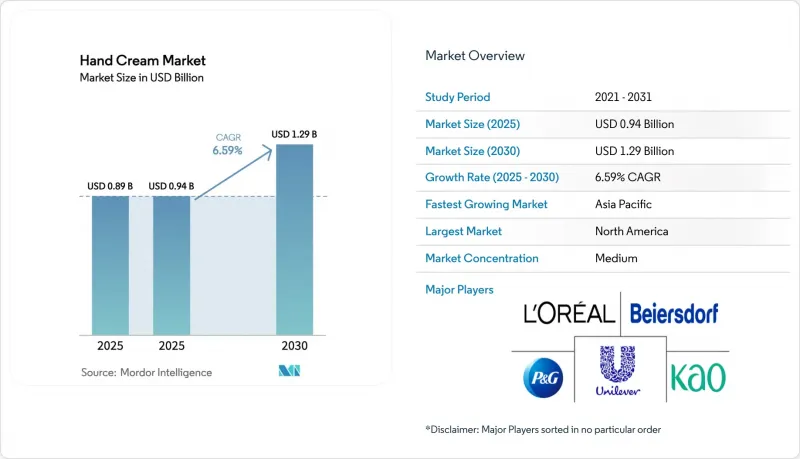
This growth is primarily driven by the rising incorporation of hand care into daily skincare routines, as consumers increasingly prioritize skin health beyond the face and body. The frequent use of handwashing and sanitizers has heightened concerns about dryness, irritation, and skin barrier damage, sustaining demand for moisturizing and reparative products. Additionally, consumer preferences are shifting toward multifunctional and performance-oriented products that provide benefits such as anti-aging, protection, and nourishment in a single application, further contributing to market growth.
Global Hand Cream Market Trends and Insights
Changing consumer hygiene habits
Changing consumer hygiene habits are driving the growth of the global hand cream market. Increased awareness of cleanliness and skin health has led to more frequent handwashing and sanitizer use in daily routines. While essential for hygiene, these practices often cause skin dryness, irritation, and weakened skin barriers, increasing the demand for regular hand moisturization and repair products. As hygiene practices become more integrated into daily life, hand creams are increasingly perceived as essential complementary products rather than occasional purchases. This trend is particularly prominent in developed markets, where awareness and product usage are well-established. For example, according to IfD Allensbach, approximately 19.9 million people in Germany aged 14 and over reported using specialized hand care products in 2025, underscoring the growing adoption of dedicated hand care solutions .
Demand for anti-aging and specialized solutions
The demand for anti-aging and specialized hand care solutions is increasing as consumers seek products that address visible signs of aging, such as wrinkles, fine lines, age spots, and loss of skin elasticity, beyond basic moisturization. Hands, being one of the most exposed parts of the body, are particularly prone to premature aging, driving the adoption of targeted formulations containing ingredients like retinol, hyaluronic acid, peptides, and SPF protection. This trend is further supported by the aging global population, which shows a growing preference for preventive and corrective skincare solutions to maintain a youthful appearance. For example, according to the Population Reference Bureau, Monaco had the highest proportion of individuals aged 65 and above in 2024, at 36%, followed by Japan at 29%, underscoring the expanding elderly demographic that fuels the demand for anti-aging products .
Strong competition from natural remedies
Strong competition from natural remedies serves as a significant restraint on the global hand cream market, as many consumers continue to prefer traditional, home-based skincare solutions over commercial products. Commonly available options such as coconut oil, aloe vera, shea butter, and other plant-based ingredients are often viewed as safer, more affordable, and free from synthetic chemicals, making them appealing alternatives to packaged hand creams. This trend is particularly evident in regions where cultural practices and herbal skincare traditions are well-established, limiting the market penetration of branded products. Furthermore, increasing awareness of clean beauty and ingredient transparency strengthens the preference for DIY and minimally processed solutions, as consumers prioritize control over the products they use on their skin.
Other drivers and restraints analyzed in the detailed report include:
- Demand for natural and organic ingredients
- Product innovation and advanced formulations
- Strict cosmetic/ingredient regulations
For complete list of drivers and restraints, kindly check the Table Of Contents.
Segment Analysis
Conventional hand cream products accounted for a dominant 75.27% market share in 2025, continuing to drive the global market due to their alignment with mass consumer needs, formulation familiarity, and widespread accessibility. These products are integral to daily skincare routines, effectively addressing common concerns such as dryness, roughness, and skin barrier damage, issues that are prevalent across various climates and lifestyles. Their formulations rely on clinically proven, widely trusted ingredients that deliver quick and visible results, reinforcing consumer confidence and encouraging habitual usage. Additionally, this segment benefits from its broad applicability across diverse end users, including individuals with frequent handwashing routines, working professionals, and those exposed to harsh environmental conditions, ensuring consistent usage frequency.
Organic hand creams are emerging as a key growth driver in the global hand cream market, projected to expand at a CAGR of 7.09% from 2026 to 2031, as consumer preferences increasingly shift toward safer, transparent, and environmentally conscious skincare solutions. This segment is strongly influenced by rising awareness of the potential long-term effects of synthetic chemicals, prompting consumers to seek products formulated with plant-based, non-toxic, and sustainably sourced ingredients. For instance, according to the National Sanitation Foundation (NSF), in 2024, 74% of Americans considered organic ingredients important in personal care products, highlighting a significant behavioral shift toward natural formulations . Furthermore, organic hand creams are associated with enhanced skin compatibility and a reduced risk of irritation, making them particularly appealing to individuals with sensitive skin or those seeking gentle, dermatologically aligned solutions.
Women accounted for 65.45% of global hand cream demand in 2025, maintaining their position as the dominant segment in the market. This dominance is attributed to the alignment of hand cream usage with evolving skincare behaviors, increased aesthetic awareness, and routine-based consumption patterns. Female consumers often engage in comprehensive skincare regimens, treating hand care as an integral part of overall skincare rather than an occasional or standalone need. This integration into daily routines fosters frequent and habitual product usage, sustaining demand over time. Additionally, the segment is driven by a strong tendency toward product experimentation and premiumization. Female consumers are more inclined to explore new formulations, textures, and ingredient claims, including natural and dermatologically tested variants.
Men's hand cream is emerging as the fastest-growing demographic segment, with a projected CAGR of 6.81% from 2026 to 2031. This growth is fueled by a notable shift in male grooming behaviors, where skincare has evolved beyond basic hygiene to encompass a more comprehensive personal care routine. Brands are responding to this trend by introducing male-specific hand creams featuring non-greasy textures, subtle or neutral fragrances, and functional benefits such as repair, protection, and quick absorption, catering to male preferences. The segment also benefits from its relatively low penetration, offering significant growth potential as first-time users adopt the category and transition into regular usage.
The Hand Cream Market Report is Segmented by Category (Conventional and Organic), End User (Women, Men, and Kids), Price Point (Mass and Premium), Distribution Channel (Supermarkets and Hypermarkets, Health and Beauty Stores, Online Retail Stores, and Other Distribution Channels), and Geography (North America, Europe, Asia-Pacific, South America, Middle East and Africa). The Market Forecasts are Provided in Terms of Value (USD).
Geography Analysis
North America accounted for 34.18% of the global hand cream market in 2025, maintaining its leading position due to a highly developed and organized retail ecosystem combined with strong consumer awareness of skincare and personal hygiene. The region, particularly the United States and Canada, is characterized by well-established distribution networks across supermarkets, pharmacies, specialty beauty stores, and online platforms, ensuring widespread product availability and accessibility. Consumers in this region demonstrate high engagement with skincare routines, with hand creams increasingly viewed as an essential part of daily personal care rather than a seasonal product. Additionally, the market benefits from continuous product innovation, strong brand presence, and early adoption of premium and specialized formulations, including anti-aging, therapeutic, and dermatologist-recommended products, which further sustains demand and reinforces regional dominance.
Asia-Pacific is the fastest-growing region, projected to expand at a CAGR of 8.04% from 2026 to 2031, driven by a combination of rising skincare awareness, evolving consumer lifestyles, and increasing influence of beauty trends. The region is witnessing a rapid shift toward preventive and routine-based skincare practices, where hand care is becoming an integral component. Markets such as China, India, Japan, and South Korea are experiencing strong demand for innovative, multifunctional, and skin-enhancing products, including brightening and anti-aging hand creams. Additionally, the growing penetration of digital platforms and social media influence is accelerating product awareness and adoption, particularly among younger consumers. The region's large and diverse population base, combined with increasing exposure to global beauty standards and product innovations, continues to create significant growth momentum, positioning Asia-Pacific as a key future growth engine.
Europe's hand cream market is driven by stringent regulatory frameworks and high product quality standards, which play a crucial role in building consumer trust and confidence. Regulations governing ingredient safety, labeling, and product claims ensure that consumers have access to safe, reliable, and high-quality formulations, encouraging consistent usage and brand loyalty. South America and the Middle East and Africa represent emerging growth opportunities, supported by improving awareness of personal care, gradual expansion of retail infrastructure, and increasing exposure to global beauty trends. These regions are witnessing rising adoption of hand creams as part of daily grooming routines, particularly in urban areas, creating untapped potential for market expansion and long-term growth.
- L'Oreal S.A.
- Unilever plc
- Beiersdorf AG
- Kenvue Inc. (Neutrogena)
- The Procter & Gamble Company (Olay)
- Kao Corporation
- Shiseido Company, Ltd.
- The Estee Lauder Companies Inc.
- L'Occitane Group S.A.
- Natura &Co (The Body Shop)
- Clarins Group
- Weleda AG
- Burt's Bees (The Clorox Company)
- Mary Kay Inc.
- LG Household & Health Care Ltd.
- Bath & Body Works, Inc.
- Shanghai Jahwa United Co., Ltd.
- Eveline Cosmetics
- Innisfree Corporation
- Jurlique International
Additional Benefits:
- The market estimate (ME) sheet in Excel format
- 3 months of analyst support
TABLE OF CONTENTS
1 INTRODUCTION
- 1.1 Study Assumptions and Market Definition
- 1.2 Scope of the Study
2 RESEARCH METHODOLOGY
3 EXECUTIVE SUMMARY
4 MARKET LANDSCAPE
- 4.1 Market Overview
- 4.2 Market Drivers
- 4.2.1 Changing consumer hygiene habits
- 4.2.2 Demand for anti-aging and specialized solutions
- 4.2.3 Demand for natural and organic ingredients
- 4.2.4 Product innovation and advanced formulations
- 4.2.5 Influence of social media and beauty trends
- 4.2.6 Shift toward multi?benefit and functional hand care
- 4.3 Market Restraints
- 4.3.1 Strong competition from natural remedies
- 4.3.2 Strict cosmetic/ingredient regulations
- 4.3.3 Consumer perception and behavioral barriers
- 4.3.4 Supply?chain and formulation constraints
- 4.4 Consumer Behavior Analysis
- 4.5 Regulatory Landscape
- 4.6 Technological Outlook
- 4.7 Porter's Five Forces Analysis
- 4.7.1 Threat of New Entrants
- 4.7.2 Bargaining Power of Buyers
- 4.7.3 Bargaining Power of Suppliers
- 4.7.4 Threat of Substitutes
- 4.7.5 Intensity of Competitive Rivalry
5 MARKET SIZE AND GROWTH FORECASTS (VALUE AND VOLUME)
- 5.1 By Category
- 5.1.1 Conventional
- 5.1.2 Organic
- 5.2 By End-User
- 5.2.1 Women
- 5.2.2 Men
- 5.2.3 Kids
- 5.3 By Price Point
- 5.3.1 Mass
- 5.3.2 Premium
- 5.4 By Distribution Channel
- 5.4.1 Supermarkets and Hypermarkets
- 5.4.2 Health and Beauty Stores
- 5.4.3 Online Retail Stores
- 5.4.4 Other Distribution Channels
- 5.5 By Geography
- 5.5.1 North America
- 5.5.1.1 United States
- 5.5.1.2 Canada
- 5.5.1.3 Mexico
- 5.5.1.4 Rest of North America
- 5.5.2 Europe
- 5.5.2.1 Germany
- 5.5.2.2 United Kingdom
- 5.5.2.3 Italy
- 5.5.2.4 France
- 5.5.2.5 Spain
- 5.5.2.6 Netherlands
- 5.5.2.7 Poland
- 5.5.2.8 Belgium
- 5.5.2.9 Sweden
- 5.5.2.10 Rest of Europe
- 5.5.3 Asia-Pacific
- 5.5.3.1 China
- 5.5.3.2 India
- 5.5.3.3 Japan
- 5.5.3.4 Australia
- 5.5.3.5 Indonesia
- 5.5.3.6 South Korea
- 5.5.3.7 Thailand
- 5.5.3.8 Singapore
- 5.5.3.9 Rest of Asia-Pacific
- 5.5.4 South America
- 5.5.4.1 Brazil
- 5.5.4.2 Argentina
- 5.5.4.3 Colombia
- 5.5.4.4 Chile
- 5.5.4.5 Peru
- 5.5.4.6 Rest of South America
- 5.5.5 Middle East and Africa
- 5.5.5.1 South Africa
- 5.5.5.2 Saudi Arabia
- 5.5.5.3 United Arab Emirates
- 5.5.5.4 Nigeria
- 5.5.5.5 Egypt
- 5.5.5.6 Morocco
- 5.5.5.7 Turkey
- 5.5.5.8 Rest of Middle East and Africa
- 5.5.1 North America
6 COMPETITIVE LANDSCAPE
- 6.1 Market Concentration
- 6.2 Strategic Moves
- 6.3 Market Share Analysis
- 6.4 Company Profiles (includes Global level Overview, Market level overview, Core Segments, Financials as available, Strategic Information, Market Rank/Share for key companies, Products and Services, and Recent Developments)
- 6.4.1 L'Oreal S.A.
- 6.4.2 Unilever plc
- 6.4.3 Beiersdorf AG
- 6.4.4 Kenvue Inc. (Neutrogena)
- 6.4.5 The Procter & Gamble Company (Olay)
- 6.4.6 Kao Corporation
- 6.4.7 Shiseido Company, Ltd.
- 6.4.8 The Estee Lauder Companies Inc.
- 6.4.9 L'Occitane Group S.A.
- 6.4.10 Natura &Co (The Body Shop)
- 6.4.11 Clarins Group
- 6.4.12 Weleda AG
- 6.4.13 Burt's Bees (The Clorox Company)
- 6.4.14 Mary Kay Inc.
- 6.4.15 LG Household & Health Care Ltd.
- 6.4.16 Bath & Body Works, Inc.
- 6.4.17 Shanghai Jahwa United Co., Ltd.
- 6.4.18 Eveline Cosmetics
- 6.4.19 Innisfree Corporation
- 6.4.20 Jurlique International
7 MARKET OPPORTUNITIES AND FUTURE OUTLOOK

