PUBLISHER: Mordor Intelligence | PRODUCT CODE: 2043945

PUBLISHER: Mordor Intelligence | PRODUCT CODE: 2043945
Night Creams - Market Share Analysis, Industry Trends & Statistics, Growth Forecasts (2026 - 2031)
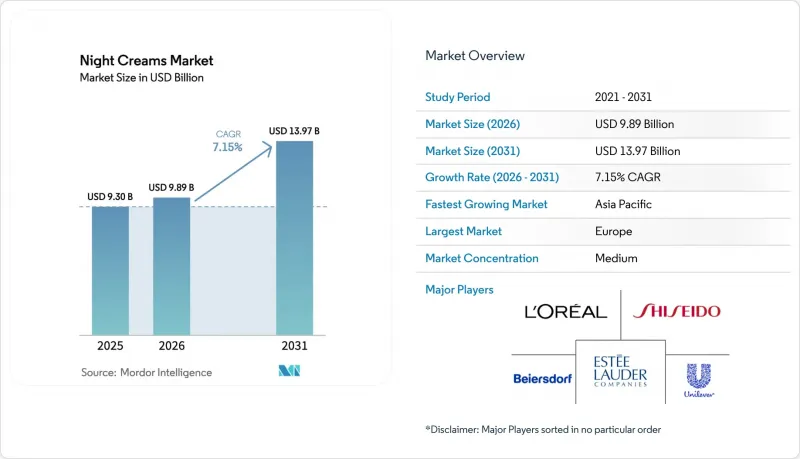
The night creams market size was valued at USD 9.30 billion in 2025 and is estimated to grow from USD 9.89 billion in 2026 to reach USD 13.97 billion by 2031, at a CAGR of 7.15% during the forecast period (2026-2031).
Consumer interest in overnight skin repair, new regulatory developments regarding allergen labeling, and the growing popularity of simplified skincare routines with multi-benefit products are driving this trend. Advances in technology, particularly in encapsulation and delivery systems aligned with chronobiology (the study of biological rhythms), are enhancing the effectiveness of targeted night treatments compared to traditional moisturizers. Digital commerce plays a critical role in product discovery and repeat purchases, with social-commerce platforms accelerating the conversion of awareness into quick sales. Mid-tier brands offering clinically validated products at affordable prices are narrowing the gap between prestige and mass-market segments. However, challenges such as counterfeit products and stricter ingredient regulations continue to impact supply chain stability and consumer trust in brands.
Global Night Creams Market Trends and Insights
Rising concern about skin aging pushing demand for overnight repair products
Demographic shifts are influencing the anti-aging skincare market, which is expected to experience substantial growth in the coming years. Younger generations, particularly Generation Z and Millennials, are increasingly adopting preventive night-care routines in their early twenties. This represents a departure from the corrective approach traditionally favored by older consumers. The emphasis on prevention is driving demand for products such as retinoid-based night creams, peptide complexes, and ceramide-rich formulations aimed at delaying visible signs of aging rather than reversing them. For instance, Elizabeth Arden's recently launched Retinol plus High-Performance Retinoid Ceramide Capsules combine encapsulated retinol with high-performance retinoid and ceramides to minimize irritation while promoting cell turnover during sleep. The economic implications are notable: older consumers are willing to pay premium prices for products with clinically validated efficacy, whereas younger consumers prioritize ingredient transparency and endorsements from dermatologists. This creates a dual value proposition that brands need to address strategically.
Growing awareness that skin regeneration is higher at night, boosting interest in dedicated night routines
Circadian dermatology has transitioned from an academic concept to a commercial focus, driven by peer-reviewed research showing that epidermal permeability, DNA repair, and collagen synthesis peak between 11 PM and 4 AM. No7's Future Renew Damage Reversal Night Cream, launched in 2024, incorporates chronopeptide technology to align active ingredient delivery with nocturnal repair cycles. Independent clinical trials have demonstrated noticeable improvements in skin elasticity within four weeks of use. This scientific foundation is reshaping consumer education, encouraging brands to focus on content marketing that highlights the biological rationale for specialized night formulations instead of generic moisturizers. As a result, the basic moisturizer category is gradually declining, as consumers increasingly view night creams as essential components of effective skincare routines. Shiseido's Vital Perfection Overnight Firming Treatment, introduced in 2025, uses Vital Perfection 8 (VP8) technology to address resilience loss during sleep, further strengthening the connection between circadian biology and product differentiation.
Proliferation of counterfeit and grey-market night creams eroding brand trust and undercutting legitimate players
Counterfeit cosmetics represent a significant illicit market in South Korea. These products, including night creams, often contain harmful substances such as beryllium oxide, heavy metals, and bacterial contaminants, posing serious health risks to consumers. The United Kingdom Intellectual Property Office has reported a rise in counterfeit cosmetics purchases, leading to financial losses for legitimate brands. Online marketplaces and social media platforms have accelerated the distribution of counterfeit products that closely replicate premium packaging. In response, South Korea's Ministry of Food and Drug Safety and the Korea Intellectual Property Office have implemented artificial intelligence-powered monitoring systems to identify counterfeit listings. However, enforcement efforts remain inconsistent across jurisdictions. Strategic initiatives include investments in anti-counterfeit packaging technologies such as holograms, quick response codes, and blockchain-based authentication. The global anti-counterfeit packaging market is expected to witness significant growth. Brands that do not protect their intellectual property or educate consumers on authentication methods risk losing trust and market share to grey-market operators permanently.
Other drivers and restraints analyzed in the detailed report include:
- Shift from basic moisturizers to targeted dermal night-care as consumers seek result-oriented products
- Expansion of multi-benefit night creams making night creams central to routines
- Health concerns over potentially harmful or irritating ingredients
For complete list of drivers and restraints, kindly check the Table Of Contents.
Segment Analysis
Multi-benefit night creams are growing at a compound annual growth rate (CAGR) of 7.92% through 2031, surpassing single-benefit formulations, which held a 63.43% market share in 2025. This growth is driven by consumer demand for products that combine hydration, anti-aging, brightening, and barrier repair in a single application. The "skinimalism" movement, which advocates for simplified skincare routines with a focus on essential products, is significantly influencing consumer preferences. A majority of consumers now prefer streamlined regimens, with many opting for multitasking skincare products over the past year. For example, Medik8's Crystal Retinal Ceramide Eye, launched in 2025, reflects this trend by combining stable retinal with ceramides to address fine lines, dark circles, and barrier integrity simultaneously. Clinical trials have shown a notable reduction in crow's feet depth within weeks of use. Similarly, CeraVe's Skin Renewing Night Cream, reformulated in 2024, features encapsulated retinol, niacinamide, and three essential ceramides, demonstrating how mass-market brands are incorporating high-performance ingredients traditionally associated with premium brands. This shift highlights a competitive focus on product performance rather than cost alone.
For brands, the strategic implications are clear: those unable to validate the effectiveness of multi-benefit products through peer-reviewed studies or dermatologist endorsements risk losing relevance in the market. Consumers are increasingly examining ingredient lists and seeking transparency regarding active ingredient concentrations and delivery mechanisms. Despite these evolving consumer expectations, the regulatory framework for this market segment remains consistent. Both single- and multi-benefit formulations must comply with the same safety and labeling standards under the regulatory frameworks of the European Union (EU), United States (US), and Association of Southeast Asian Nations (ASEAN).
Combination skin formulations are projected to grow at a Compound Annual Growth Rate (CAGR) of 8.43% through 2031, reflecting a shift from the traditional dry-oily categorization to more detailed dermatological segmentation. This approach addresses mixed concerns, such as T-zone oiliness combined with cheek dryness. In 2025, normal skin formulations accounted for 27.94% of the market share, driven by their broad appeal and lower risk of adverse reactions. However, the fastest growth is observed in specialized variants targeting combination, acne-prone, and wrinkle-prone skin types. Dry skin formulations maintain a significant market share, particularly in colder climates and among older consumers, while oily skin variants are gaining popularity in humid regions like Southeast Asia and among younger demographics prone to sebum overproduction.
There is a strategic opportunity in developing adaptive formulations that cater to varying skin conditions across different facial zones. This requires advanced emulsion technologies and zone-specific active ingredient delivery. For example, Elizabeth Arden's Retinol plus High-Performance Retinoid (HPR) Ceramide Capsules, launched in 2025, address combination skin by combining encapsulated retinol with high-performance retinoid and ceramides. This formulation minimizes irritation in sensitive areas while enhancing cell turnover in more resilient zones. Similarly, No7's Future Renew Damage Reversal Night Cream, introduced in 2024, uses chronopeptide technology to synchronize active ingredient delivery with nocturnal repair cycles, achieving measurable improvements in skin elasticity across multiple skin types within four weeks.
The Night Creams Market Report is Segmented by Function (Single Benefit and Multi Benefit), Skin Concern (Normal Skin, Dry Skin, Combination Skin, and Other Skin Concerns), Price Range (Mass, and Premium), Distribution Channel (Supermarkets and Hypermarkets, Health and Beauty Stores, and More), and Geography (North America, Europe, Asia-Pacific, and More). The Market Forecasts are Provided in Terms of Value (USD).
Geography Analysis
Europe accounted for 33.21% of the market share in 2025, led by Germany, France, and the United Kingdom. The implementation of the European Union (EU) Cosmetics Regulation Omnibus VIII amendments on May 1, 2026, introduced stricter allergen labeling for 80 fragrance substances and accelerated the phase-out of microplastics between 2027 and 2035. Germany's focus on dermatologically tested formulations and France's leadership in prestige skincare innovation have created a competitive environment where clinical efficacy and sensory appeal coexist. Meanwhile, the United Kingdom's post-Brexit regulatory changes, such as the oxybenzone restriction effective January 2026, have added compliance challenges for brands operating across Europe. Emerging markets like Spain, the Netherlands, Poland, Belgium, and Sweden are also witnessing growth, driven by rising disposable incomes, increased awareness of circadian skincare, and the expansion of clean-beauty retailers such as Douglas and Sephora. Regulatory developments are significant, with brands reformulating to eliminate microplastics, parabens, and controversial preservatives gaining a competitive advantage over those facing compliance-related product delistings and reputational risks.
The Asia-Pacific region is the fastest-growing market, with a projected compound annual growth rate (CAGR) of 8.08% through 2031. Growth is driven by rising disposable incomes in China and India, innovation in Korean beauty (K-beauty) pipelines in South Korea, and Japan's advancements in chronobiology-based formulations, such as KANEBO's night-repair product lines. In China, the expanding middle class and the rise of e-commerce platforms like Tmall and Douyin are making premium night creams more accessible. India's Honasa Consumer (Mamaearth) achieved a valuation of USD 1.2 billion by focusing on transparent ingredient sourcing and direct-to-consumer models that resonate with younger, digitally savvy consumers. South Korea's efforts to combat counterfeit cosmetics, including the deployment of artificial intelligence (AI) powered monitoring systems by the Ministry of Food and Drug Safety and the Korea Intellectual Property Office in 2025, are critical for protecting brand equity in a market affected by a USD 970 million illicit cosmetics trade.
North America, South America, and the Middle East and Africa collectively present significant opportunities. In North America, the United States leads the market due to high per-capita skincare spending and the popularity of dermatologist-recommended brands like CeraVe and Neutrogena. In Canada, demand for barrier-repair formulations containing ceramides and hyaluronic acid is driven by the colder climate, while Mexico benefits from a growing middle class and its proximity to United States distribution networks, positioning it as a high-growth market. In South America, Brazil dominates the market, supported by a strong beauty culture and the increasing adoption of K-beauty and Japanese beauty (J-beauty) routines. Emerging markets such as Argentina, Colombia, Chile, and Peru are characterized by affordability and accessibility as key purchase drivers. In the Middle East, Saudi Arabia and the United Arab Emirates exhibit strong demand for luxury night creams, driven by high disposable incomes and a preference for prestige brands. Meanwhile, markets like South Africa, Nigeria, Egypt, Morocco, and Turkey face challenges such as fragmented distribution and underdeveloped e-commerce infrastructure, which also present opportunities for brands willing to invest in market development.
- L'Oreal S.A.
- The Estee Lauder Companies Inc.
- Shiseido Company Limited
- Beiersdorf AG
- Unilever plc
- The Procter & Gamble Co.
- Johnson & Johnson
- Kenvue Inc.
- KOSE Corporation
- Natura &Co
- Chanel S.A.
- Clarins Group
- Mary Kay Inc.
- Revlon Inc.
- DECIEM
- Honasa Consumer Ltd.
- Lotus Herbals Pvt. Ltd.
- Eveline Cosmetics
- Weleda AG
- Oriflame Holding AG
Additional Benefits:
- The market estimate (ME) sheet in Excel format
- 3 months of analyst support
TABLE OF CONTENTS
1 INTRODUCTION
- 1.1 Study Assumptions and Market Definition
- 1.2 Scope of the Study
2 RESEARCH METHODOLOGY
3 EXECUTIVE SUMMARY
4 MARKET LANDSCAPE
- 4.1 Market Overview
- 4.2 Market Drivers
- 4.2.1 Rising concern about skin aging pushing demand for overnight repair products
- 4.2.2 Growing awareness that skin regeneration is higher at night, boosting interest in dedicated night routines
- 4.2.3 Shift from basic moisturizers to targeted dermal night-care as consumers seek result-oriented products
- 4.2.4 Expansion of multi-benefit night creams making night creams central to routines
- 4.2.5 Technological advances in actives increasing efficacy and differentiation
- 4.2.6 Strong consumer shift toward clean, natural, and organic formulations in night creams
- 4.3 Market Restraints
- 4.3.1 Proliferation of counterfeit and grey-market night creams eroding brand trust and undercutting legitimate players
- 4.3.2 Health concerns over potentially harmful or irritating ingredients
- 4.3.3 Stringent and evolving cosmetic regulations increasing compliance complexity
- 4.3.4 Rising scrutiny of certain chemical UV filters, preservatives, and microplastics, prompting reformulation and delistings
- 4.4 Consumer Behaviour Analysis
- 4.5 Regulatory Outlook
- 4.6 Porter's Five Forces
- 4.6.1 Threat of New Entrants
- 4.6.2 Bargaining Power of Buyers
- 4.6.3 Bargaining Power of Suppliers
- 4.6.4 Threat of Substitute Products
- 4.6.5 Intensity of Competitive Rivalry
5 MARKET SIZE AND GROWTH FORECASTS (VALUE)
- 5.1 By Function
- 5.1.1 Single Benefit
- 5.1.2 Multi Benefit
- 5.2 By Skin Concern
- 5.2.1 Normal Skin
- 5.2.2 Dry Skin
- 5.2.3 Combination Skin
- 5.2.4 Other Skin Concern (Oily Skin, Wrinkle-Prone Skin, Acne-Prone Skin)
- 5.3 By Price Range
- 5.3.1 Mass
- 5.3.2 Premium
- 5.4 By Distribution Channel
- 5.4.1 Supermarkets and Hypermarkets
- 5.4.2 Health and Beauty Stores
- 5.4.3 Online Retail Stores
- 5.4.4 Other Distribution Channels
- 5.5 By Geography
- 5.5.1 North America
- 5.5.1.1 United States
- 5.5.1.2 Canada
- 5.5.1.3 Mexico
- 5.5.1.4 Rest of North America
- 5.5.2 Europe
- 5.5.2.1 Germany
- 5.5.2.2 United Kingdom
- 5.5.2.3 Italy
- 5.5.2.4 France
- 5.5.2.5 Spain
- 5.5.2.6 Netherlands
- 5.5.2.7 Poland
- 5.5.2.8 Belgium
- 5.5.2.9 Sweden
- 5.5.2.10 Rest of Europe
- 5.5.3 Asia-Pacific
- 5.5.3.1 China
- 5.5.3.2 India
- 5.5.3.3 Japan
- 5.5.3.4 Australia
- 5.5.3.5 Indonesia
- 5.5.3.6 South Korea
- 5.5.3.7 Thailand
- 5.5.3.8 Singapore
- 5.5.3.9 Rest of Asia-Pacific
- 5.5.4 South America
- 5.5.4.1 Brazil
- 5.5.4.2 Argentina
- 5.5.4.3 Colombia
- 5.5.4.4 Chile
- 5.5.4.5 Peru
- 5.5.4.6 Rest of South America
- 5.5.5 Middle East and Africa
- 5.5.5.1 South Africa
- 5.5.5.2 Saudi Arabia
- 5.5.5.3 United Arab Emirates
- 5.5.5.4 Nigeria
- 5.5.5.5 Egypt
- 5.5.5.6 Morocco
- 5.5.5.7 Turkey
- 5.5.5.8 Rest of Middle East and Africa
- 5.5.1 North America
6 COMPETITIVE LANDSCAPE
- 6.1 Market Concentration
- 6.2 Strategic Moves
- 6.3 Market Ranking Analysis
- 6.4 Company Profiles (includes Global-level Overview, Market-level Overview, Core Segments, Financials (if available), Strategic Information, Market Rank/Share, Products and Services, Recent Developments)
- 6.4.1 L'Oreal S.A.
- 6.4.2 The Estee Lauder Companies Inc.
- 6.4.3 Shiseido Company Limited
- 6.4.4 Beiersdorf AG
- 6.4.5 Unilever plc
- 6.4.6 The Procter & Gamble Co.
- 6.4.7 Johnson & Johnson
- 6.4.8 Kenvue Inc.
- 6.4.9 KOSE Corporation
- 6.4.10 Natura &Co
- 6.4.11 Chanel S.A.
- 6.4.12 Clarins Group
- 6.4.13 Mary Kay Inc.
- 6.4.14 Revlon Inc.
- 6.4.15 DECIEM
- 6.4.16 Honasa Consumer Ltd.
- 6.4.17 Lotus Herbals Pvt. Ltd.
- 6.4.18 Eveline Cosmetics
- 6.4.19 Weleda AG
- 6.4.20 Oriflame Holding AG
7 MARKET OPPORTUNITIES AND FUTURE OUTLOOK

