PUBLISHER: Mordor Intelligence | PRODUCT CODE: 2043971

PUBLISHER: Mordor Intelligence | PRODUCT CODE: 2043971
Polyhydroxyalkanoates Packaging - Market Share Analysis, Industry Trends & Statistics, Growth Forecasts (2025 - 2030)
The Polyhydroxyalkanoates (PHA) Packaging Market size is estimated at 24.52 Thousand tons in 2025, and is expected to reach 68.54 Thousand tons by 2030, at a CAGR of 22.82% during the forecast period (2025-2030).
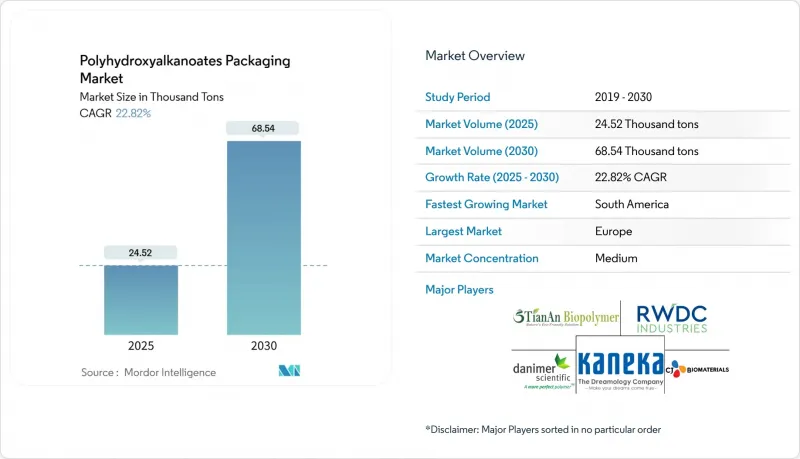
Regulatory bans on single-use plastics, large-scale cost breakthroughs from third-generation feedstocks, and brand owners' sustainability commitments are combining to accelerate demand. Europe's regulatory push, South America's feedstock advantage, and rapid innovations in processing are shaping competitive positioning. Rigid applications are consolidating early demand, while high-growth foam and fiber formats signal the next wave of adoption. Producers that scale marine-degradable grades, secure waste-based feedstocks, and lock in brand contracts are positioned to capture a disproportionate share of the expansion.
Global Polyhydroxyalkanoates Packaging Market Trends and Insights
Ban on Single-Use Plastics in OECD Markets
Legislation in the European Union, Canada, and several U.S. states mandates clear phase-out schedules for conventional items, including straws, cutlery, and takeaway containers. Brand owners are replacing banned formats with PHA grades that meet the ISO 17088 compostability requirements, allowing for global material harmonization. Demand visibility enables producers to justify multi-line fermentation expansions, and international retailers are rolling out the same specifications across developing markets to reduce material complexity.
Subsidies for Compostable Biopolymers in Europe
Fee reductions under Germany's Packaging Act and extended producer responsibility credits in France lower effective PHA costs by up to 25% when lifecycle compliance fees are included. Additional credits in the Netherlands and Denmark for marine-degradable materials further improve relative economics, incentivizing converters to switch lines ahead of the 2027 review of EU packaging rules.
High Capital Intensity of PHA Fermentation Plants
Commercial plants require USD 150-200 million for fermentation and downstream purification, a figure well above typical converter investments. The specialized equipment base and extended construction cycles limit project finance options for newer entrants. As a result, expansion lags demand, keeping supply tight and reinforcing premium pricing until larger balance sheets commit capital.
Other drivers and restraints analyzed in the detailed report include:
- Food-Grade Certifications Accelerating Brand Adoption
- Rapid Cost Decline from Gen-3 Feedstocks
- Limited Barrier Properties vs. EVOH Laminates
For complete list of drivers and restraints, kindly check the Table Of Contents.
Segment Analysis
Rigid formats account for 38.91% of the PHA packaging market share in 2024 and continue to anchor early demand given regulatory bans on petroleum clamshells, trays, and hinged lids. The material's structural strength, moderate barrier performance, and compatibility with existing thermoforming lines ease converter transition costs. Foam formats, enabled by new chemical blowing agents, post the highest 24.59% CAGR as they replace expanded polystyrene in protective transit and takeaway items. Producers targeting this niche are reporting stable order backlogs, and municipal composters highlight PHA foam's rapid disintegration in aerobic systems, supporting household collection pilots. Flexible films remain the second-largest format, thanks to the polymer's uniform melt flow and low sealing temperatures, which deliver process energy savings. Paperboard coatings are gaining popularity as mills seek compostable moisture barriers, a trend supported by joint trials between corrugators and biopolymer suppliers.
Progress in coatings and adhesive grades is opening adjacent revenue streams. Specialty suppliers are blending PHA with starch and cellulose to create heat-seal layers for e-commerce mailers that eliminate the need for plastic liners. Rigid format producers are also experimenting with in-mold labels using PHA-based inks to keep mono-material status. Continual improvements in pellet consistency and thermal stability are lowering downtime during changeovers, a key factor for mass-production sites. Collectively, these advances help the PHA packaging market broaden addressable applications while deepening adoption in its early beachheads.
The PHA Packaging Market Report is Segmented by Product Form (Rigid Packaging, Flexible Films, Coated Paperboard, Foam, and More), End-Use Industry (Food Service, Food and Beverage Retail, Personal Care and Cosmetics, Pharmaceutical and Biomedical, and More), Processing Technology (Film Extrusion, Injection Molding, Blow Molding, Thermoforming, and More), and Geography. The Market Forecasts are Provided in Terms of Volume (Tons).
Geography Analysis
Europe, with a 32.92% share in 2024, remains the anchor region, supported by the Packaging and Packaging Waste Regulation's compostable carve-outs and widespread access to industrial composting. Municipal waste audits reveal increasing biopolymer capture rates, and subsidy frameworks are narrowing the price differential with petrochemical plastics. Suppliers are clustering their capacity around feedstock hubs in France, Italy, and the Netherlands to shorten logistics and secure sugar beet and whey waste streams. Brand owners in Germany and Scandinavia are piloting mono-material PHA sleeves for beverage multipacks, reinforcing regional leadership.
South America posts the fastest 24.49% CAGR, driven by Brazil's tax credits on fermentation equipment imports and abundant sugarcane residue. State development banks offer low-interest loans that lower capital hurdles, attracting joint ventures between domestic agro-processors and multinational packaging converters. Argentina's expansion of bagasse processing yields low-cost feedstock streams, making Buenos Aires a budding export hub. Regulatory clarity follows the revisions to Brazil's National Solid Waste Policy, which include compostable targets that align public procurement with biopolymer uptake.
The Asia-Pacific region exhibits balanced dynamics: China scales up its fermentation capacity alongside state-backed methane-to-PHA pilots, while Japan's electronics sector demands high-purity grades for component packaging. North America benefits from recent FDA clearances and corporate zero-waste pledges, though higher labor costs keep some capacity offshore. The Middle East and Africa remain in the early stages, yet refinery diversification strategies in the Gulf include biopolymer lines, and agricultural economies from Kenya to Egypt are exploring PHA mulch film projects. Collectively, these regional vectors underpin the long-run expansion of the PHA packaging market.
- Danimer Scientific Inc.
- CJ Biomaterials Inc.
- RWDC Industries Ltd.
- Kaneka Corporation
- TianAn Biologic Materials Co. Ltd.
- Bluepha Co. Ltd.
- TotalEnergies Corbion PLA B.V.
- Yield10 Bioscience Inc.
- PHAbuilder Biotech Co. Ltd.
- Newlight Technologies Inc.
- Full Cycle Bioplastics Inc.
- Bioextrax AB
- Biomer PHA GmbH
- Shangdong TianSen Biotech Co. Ltd.
- Tepha Inc. (Becton Dickenson)
- Mango Materials Inc.
- Seegro Inc.
- Nodax PHA LLC
- Paques Biomaterials B.V.
- PolyFerm Canada Inc.
- Novamont S.p.A.
- NaturePlast SAS
- Eranova SAS
- Kaneka Biopolymers Vietnam Co. Ltd.
- Genecis Bioindustries Inc.
Additional Benefits:
- The market estimate (ME) sheet in Excel format
- 3 months of analyst support
TABLE OF CONTENTS
1 INTRODUCTION
- 1.1 Study Assumptions and Market Definition
- 1.2 Scope of the Study
2 RESEARCH METHODOLOGY
3 EXECUTIVE SUMMARY
4 MARKET LANDSCAPE
- 4.1 Market Overview
- 4.2 Market Drivers
- 4.2.1 Ban on Single-Use Plastics in OECD Markets
- 4.2.2 Subsidies for Compostable Biopolymers in Europe
- 4.2.3 Food-Grade Certifications Accelerating Brand Adoption
- 4.2.4 Rapid Cost Decline from Gen-3 Feedstocks
- 4.2.5 Retailer's Net-Zero Packaging Mandates
- 4.2.6 Expansion of Decentralised Anaerobic Digestion Capacity
- 4.3 Market Restraints
- 4.3.1 High Capital Intensity of PHA Fermentation Plants
- 4.3.2 Limited Barrier Properties vs. EVOH Laminates
- 4.3.3 Supply-Chain Dependence on Cane and Corn Feedstock Volatility
- 4.3.4 Fragmented Industrial Composting Infrastructure
- 4.4 Industry Value Chain Analysis
- 4.5 Regulatory Landscape
- 4.6 Technological Outlook
- 4.7 Impact of Macroeconomic Factors
- 4.8 Porter's Five Forces Analysis
- 4.8.1 Threat of New Entrants
- 4.8.2 Bargaining Power of Suppliers
- 4.8.3 Bargaining Power of Buyers
- 4.8.4 Threat of Substitutes
- 4.8.5 Competitive Rivalry
5 MARKET SIZE AND GROWTH FORECASTS (VALUE)
- 5.1 By Product Form
- 5.1.1 Rigid Packaging
- 5.1.2 Flexible Films
- 5.1.3 Coated Paperboard
- 5.1.4 Foam
- 5.1.5 Other Product Forms
- 5.2 By End-Use Industry
- 5.2.1 Food Service
- 5.2.2 Food and Beverage Retail
- 5.2.3 Personal Care and Cosmetics
- 5.2.4 Pharmaceutical and Biomedical
- 5.2.5 Industrial and Agriculture
- 5.3 By Processing Technology
- 5.3.1 Film Extrusion
- 5.3.2 Injection Molding
- 5.3.3 Blow Molding
- 5.3.4 Thermoforming
- 5.3.5 Fibre Spinning
- 5.4 By Geography
- 5.4.1 North America
- 5.4.1.1 United States
- 5.4.1.2 Canada
- 5.4.1.3 Mexico
- 5.4.2 South America
- 5.4.2.1 Brazil
- 5.4.2.2 Argentina
- 5.4.2.3 Rest of South America
- 5.4.3 Europe
- 5.4.3.1 Germany
- 5.4.3.2 United Kingdom
- 5.4.3.3 France
- 5.4.3.4 Italy
- 5.4.3.5 Spain
- 5.4.3.6 Russia
- 5.4.3.7 Rest of Europe
- 5.4.4 Asia-Pacific
- 5.4.4.1 China
- 5.4.4.2 Japan
- 5.4.4.3 India
- 5.4.4.4 South Korea
- 5.4.4.5 South-East Asia
- 5.4.4.6 Rest of Asia-Pacific
- 5.4.5 Middle East and Africa
- 5.4.5.1 Middle East
- 5.4.5.1.1 Saudi Arabia
- 5.4.5.1.2 United Arab Emirates
- 5.4.5.1.3 Turkey
- 5.4.5.1.4 Rest of Middle East
- 5.4.5.2 Africa
- 5.4.5.2.1 South Africa
- 5.4.5.2.2 Nigeria
- 5.4.5.2.3 Rest of Africa
- 5.4.5.1 Middle East
- 5.4.1 North America
6 COMPETITIVE LANDSCAPE
- 6.1 Market Concentration
- 6.2 Strategic Moves
- 6.3 Market Share Analysis
- 6.4 Company Profiles (includes Global level Overview, Market level overview, Core Segments, Financials as available, Strategic Information, Market Rank/Share for key companies, Products and Services, and Recent Developments)
- 6.4.1 Danimer Scientific Inc.
- 6.4.2 CJ Biomaterials Inc.
- 6.4.3 RWDC Industries Ltd.
- 6.4.4 Kaneka Corporation
- 6.4.5 TianAn Biologic Materials Co. Ltd.
- 6.4.6 Bluepha Co. Ltd.
- 6.4.7 TotalEnergies Corbion PLA B.V.
- 6.4.8 Yield10 Bioscience Inc.
- 6.4.9 PHAbuilder Biotech Co. Ltd.
- 6.4.10 Newlight Technologies Inc.
- 6.4.11 Full Cycle Bioplastics Inc.
- 6.4.12 Bioextrax AB
- 6.4.13 Biomer PHA GmbH
- 6.4.14 Shangdong TianSen Biotech Co. Ltd.
- 6.4.15 Tepha Inc. (Becton Dickenson)
- 6.4.16 Mango Materials Inc.
- 6.4.17 Seegro Inc.
- 6.4.18 Nodax PHA LLC
- 6.4.19 Paques Biomaterials B.V.
- 6.4.20 PolyFerm Canada Inc.
- 6.4.21 Novamont S.p.A.
- 6.4.22 NaturePlast SAS
- 6.4.23 Eranova SAS
- 6.4.24 Kaneka Biopolymers Vietnam Co. Ltd.
- 6.4.25 Genecis Bioindustries Inc.
7 MARKET OPPORTUNITIES AND FUTURE OUTLOOK
- 7.1 White-space and Unmet-need Assessment

