PUBLISHER: Mordor Intelligence | PRODUCT CODE: 2043986

PUBLISHER: Mordor Intelligence | PRODUCT CODE: 2043986
South America Banking-as-a-Service - Market Share Analysis, Industry Trends & Statistics, Growth Forecasts (2026 - 2031)
The South America Banking-as-a-Service Market size is projected to expand from USD 0.4 billion in 2025 and USD 0.5 billion in 2026 to USD 1.5 billion by 2031, registering a CAGR of 23.70% between 2026 to 2031.
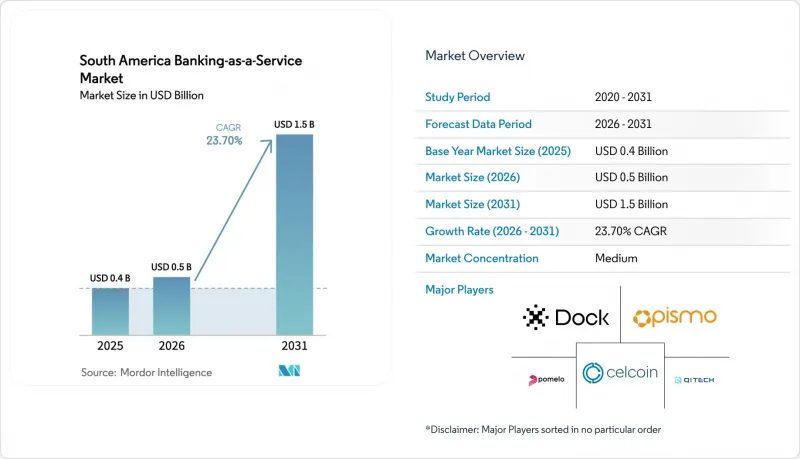
Expansion is underpinned by Brazil's leadership in instant payments via Pix, the maturation of Open Finance mandates, and the shift of non-banks toward API-first embedded finance models that place credit, treasury, and insurance within digital journeys at checkout or in merchant dashboards. The regulatory environment continues to formalize BaaS governance and third-party risk controls, which support scale for well-capitalized platforms and intensify due diligence expectations for service-taking entities. Competitive intensity is rising as fintech companies use BaaS rails to compress lending spreads and accelerate product release cycles, crowding incumbents out of value-added services, issuer processing, and cross-border treasury use cases. Tokenization pilots, led by Brazil's Drex program and stablecoin integrations with core banking, are preparing the ecosystem for programmable money and real-time settlement across local and cross-border flows in the next phase of the South America banking-as-a-service market.
South America Banking-as-a-Service Market Trends and Insights
Real-time Payment Rails Enable Embedded Finance
Brazil's Pix system reached 174 million users by early 2025 and processed close to 7.9 billion transactions per month by December 2025, which shifted person-to-business flows ahead of peer-to-peer as instant account-to-account payments became standard in retail checkout and bill pay. The Central Bank's launch of Pix Automatico in June 2025 added recurring debit functionality under a single consent, enabling subscription billing for users without credit cards and deepening embedded payment experiences within consumer and SME apps. At the same time, Open Finance data-sharing in Brazil has enabled scaling of consents and API calls, allowing providers to embed credit lines, working capital, and insurance into merchant dashboards that run on top of Pix and other rails. Regional momentum supports similar trajectories, with Colombia's real-time initiatives advancing and Peru's interoperability mandates driving wallet adoption, strengthening on-ramps for embedded finance in retail and services. The South America banking-as-a-service market continues to rely on instant rails to compress payment latency, reduce acceptance costs, and unlock data-driven underwriting at the point of need across large enterprise and SME use cases.
Card Modernization Drives Issuer-Processing Demand
Recurring payments through Pix Automatico intensify competition with stored-card credentials, which have accelerated network investment in tokenization, NFC acceptance, and virtual-card provisioning for subscription and mobility scenarios in Brazil and Chile. Visa's acquisition of Pismo in 2024 brought cloud-native issuer processing and next-generation core capabilities under Visa's distribution, enabling banks and fintechs to modernize card lifecycles and authorization logic with modular APIs at a regional scale. BIN sponsorship demand has risen among non-banks seeking co-branded and white-label issuance without fully licensed banking infrastructure, reinforcing issuer-processing platforms that bundle risk controls, real-time decisioning, and fraud tooling into turnkey stacks for the South America banking-as-a-service market. As contactless modernization remains uneven, software POS and issuer-generated virtual card numbers help fill acceptance gaps while supporting e-commerce and corporate expense use cases that keep card economics viable where A2A substitution intensifies. Over 2026, issuer-processing momentum is sustained by product-code updates, enterprise upgrades, and hybrid journeys that blend cards with instant payments to optimize acceptance, risk, and customer experience for the South America banking-as-a-service market.
Regulatory Heterogeneity Increases Scaling Complexity
Licensing thresholds, capital floors, data-residency mandates, and participant definitions differ by jurisdiction, which forces BaaS providers to maintain parallel entities and compliance stacks rather than passport a single authorization across South America. In Brazil, all payment institutions must obtain prior authorization and comply with strengthened oversight under the 2025-2026 regulatory priorities, which also formalize governance expectations for BaaS operations. Chile concluded open finance regulation under its Fintech Law, with phased implementation beginning in April 2026 and subsequent deadlines through 2029 that require staged compliance programs for payment initiators, banks, card issuers, and other actors. Peru's supervisory authorities have initiated work on open finance but have yet to publish definitive technical standards, leaving market participants to build connectors against uncertain API endpoints and prolonging time to market. The South America banking-as-a-service market must also reconcile LGPD cross-border data rules and sectoral AML obligations in Brazil when architecting cloud footprints and data flows that must remain compliant across multiple jurisdictions.
Other drivers and restraints analyzed in the detailed report include:
- Tokenized Money Pilots Enable Programmability
- Pix Features Intensify KYC/Fraud Orchestration
- Instant-Payment Liabilities Elevate Operating Risk
For complete list of drivers and restraints, kindly check the Table Of Contents.
Segment Analysis
Payment gateways commanded 36.8% of the 2025 value as the default rail for Pix, card, and boleto acceptance across ecommerce, marketplaces, and mobility, while embedded finance software is projected to post a 24.8% CAGR through 2031, the fastest among product segments within the South America banking-as-a-service market. Brazil's Open Finance framework, with expanding data-sharing consents and API usage, enables non-banks to embed credit, insurance, and treasury directly in operational dashboards, shortening decision cycles and allowing merchant users to bypass legacy interfaces. Platform providers such as Dock and QI Tech have scaled Pix transaction processing and credit issuance, demonstrating how horizontal API stacks power embedded journeys for financial and non-financial brands in the South America banking-as-a-service market. Core banking and bank account APIs continue to anchor wallet launches and neobank onboarding, while lending APIs use Open Finance data to refine alternative underwriting at a lower cost than traditional bureau-dependent approaches. As embedded models compress payment costs and combine transaction and behavioral data, margins expand in ways that pure gateways cannot replicate, which reinforces a shift from commodity routing to data-rich financial workflows.
The regulatory arc supports this transition, with Brazil setting out priorities for 2025-2026 that formalize BaaS obligations and strengthen third-party risk controls, which favor licensed platforms capable of sustained investment in compliance and cybersecurity. Embedded finance providers are also integrating programmable money through partnerships with Matera and Circle to unify BRL, USD, and USDC balances in real-time ledgers that connect local Pix rails to global liquidity for cross-border payments in the South America banking-as-a-service market. On the demand side, merchants seek end-to-end solutions that bundle checkout, reconciliation, settlement, and working-capital advances, which tilts share capture toward embedded software rather than standalone gateways over the forecast period. The result is a durable outperformance of embedded finance software as data-network effects improve underwriting and fraud models across more touchpoints, lifting unit economics and retention. Embedded software's leadership is expected to consolidate as recurring payments and tokenized assets deploy at scale, creating new programmable workflows that sit upstream of payment authorization and settlement.
Large enterprises retained 64.4% of the 2025 value due to incumbent banking relationships, integration budgets, and the need for high availability and auditability, while SMEs are projected to grow at 23.4% CAGR on the back of low-code onboarding, consumption-based pricing, and embedded credit that reduces collateral friction in the South America banking-as-a-service market. Regulatory modernization in Brazil and active Open Finance adoption enable SME-focused providers to pull verified income and transaction histories, accelerating approvals and reducing operating costs, thereby strengthening SME demand for turnkey BaaS offerings. Public policy in Brazil has emphasized inclusion and credit expansion, and multilateral analysis underscores how fast payments contribute to SME digitalization and access to working capital. In Peru, SME modernization is supported by core-banking SaaS adoption, such as Mibanco's migration to Temenos, which aims to achieve faster time-to-market and improved experiences at scale. These threads reinforce SME-led momentum for the South America banking-as-a-service market, where embedded apps bundle invoicing, collections, and financing into a single interface, reducing churn.
Enterprises continue to value vertically integrated platforms capable of meeting security and compliance demands while coexisting with ERP and legacy cores, which advantages providers with proven SLAs and multi-country credentialing. SMEs, by contrast, adopt out-of-the-box stacks that roll up KYC, AML, payment initiation, and reconciliation with minimal development overhead in the South America banking-as-a-service market. Open Finance data portability and credit portability, which are set to expand in 2026, will sharpen competition for SME refinancing and workflow ownership across payments and treasury. Over the forecast horizon, enterprise and SME adoption paths diverge in tooling and governance needs but converge on hybrid orchestration across instant payments, cards, and programmable balances, driving share gains for platforms with deep API catalogs.
The South America Banking As A Service Market Report is Segmented by Product Type (Payment Gateway, Core Banking, Lending, Embedded Finance Software, Others), Enterprise Size (Large Enterprises, Smes), End User (Banks, Fintechs, Others), Component (Platform/Infrastructure, Services), and Geography (Brazil, Peru, Chile, Argentina, Rest of South America). Market Forecasts are in Value (USD).
List of Companies Covered in this Report:
- Dock (Brazil)
- Pismo (a Visa company)
- FitBank
- QI Tech
- Pomelo
- Zoop
- Banco Topazio (BaaS)
- Matera
- Celcoin
- Bankly
- Mambu
- Temenos
- Galileo Financial Technologies
- Marqeta
- Belvo
- Sensedia
- IDwall
- CAF (Combate a Fraude)
- Quod
- Banco Rendimento
- Inswitch
Additional Benefits:
- The market estimate (ME) sheet in Excel format
- 3 months of analyst support
TABLE OF CONTENTS
1 Introduction
- 1.1 Study Assumptions & Market Definition
- 1.2 Scope of the Study
2 Research Methodology
3 Executive Summary
4 Market Landscape
- 4.1 Market Overview
- 4.2 Market Drivers
- 4.2.1 Real-time payment rails enable embedded finance
- 4.2.2 Open Finance mandates accelerate API partnerships
- 4.2.3 Banks monetize infrastructure via BaaS models
- 4.2.4 Card modernization drives issuer-processing demand
- 4.2.5 Tokenized money pilots enable programmability
- 4.2.6 Pix features intensify KYC/fraud orchestration
- 4.3 Market Restraints
- 4.3.1 Regulatory heterogeneity increases scaling complexity
- 4.3.2 Instant-payment liabilities elevate operating risk
- 4.3.3 Divergent standards burden regional interoperability
- 4.3.4 A2A rails compress card economics
- 4.4 Value / Supply-Chain Analysis
- 4.5 Regulatory Landscape
- 4.6 Technological Outlook
- 4.7 South America-specific Market Analyses
- 4.7.1 Real-time payments and Open Finance readiness by country (Brazil, Argentina, Chile, Peru, RoSA)
- 4.7.2 CBDC/Tokenized deposits in Brazil (Drex): implications for BaaS stack design
- 4.7.3 BIN sponsorship and card scheme enablement map (issuers/sponsors, onboarding timelines)
- 4.7.4 KYC/AML and fraud frameworks for instant payments (Pix MED 4.1) and platform implications
- 4.7.5 Data residency & cloud-compliance considerations for multi-country deployments
- 4.7.6 Payment orchestration and cash-in/cash-out networks for SA embedded finance
- 4.8 Porter's Five Forces Analysis
- 4.8.1 Competitive Rivalry
- 4.8.2 Threat of New Entrants
- 4.8.3 Bargaining Power of Suppliers
- 4.8.4 Bargaining Power of Buyers
- 4.8.5 Threat of Substitutes
5 Market Size & Growth Forecasts
- 5.1 By Product Type
- 5.1.1 Payment Gateway
- 5.1.2 Bank Account/Core Banking
- 5.1.3 Lending and Credit Services
- 5.1.4 Embedded Finance Software
- 5.1.5 Other Product Types
- 5.2 By Enterprise Size
- 5.2.1 Large Enterprises
- 5.2.2 Small & Medium Enterprises (SMEs)
- 5.3 By End User
- 5.3.1 Banks
- 5.3.2 Fintech Corporations
- 5.3.3 Other End Users
- 5.4 By Component
- 5.4.1 Platform / Infrastructure
- 5.4.2 Services (Compliance, KYC, Fraud, etc.)
- 5.5 By Geography
- 5.5.1 Brazil
- 5.5.2 Peru
- 5.5.3 Chile
- 5.5.4 Argentina
- 5.5.5 Rest of South America
6 Competitive Landscape
- 6.1 Market Concentration
- 6.2 Strategic Moves
- 6.3 Market Share Analysis
- 6.4 Company Profiles {(includes Global level Overview, Market level overview, Core Segments, Financials as available, Strategic Information, Market Rank/Share for key companies, Products & Services, and Recent Developments)}
- 6.4.1 Dock (Brazil)
- 6.4.2 Pismo (a Visa company)
- 6.4.3 FitBank
- 6.4.4 QI Tech
- 6.4.5 Pomelo
- 6.4.6 Zoop
- 6.4.7 Banco Topazio (BaaS)
- 6.4.8 Matera
- 6.4.9 Celcoin
- 6.4.10 Bankly
- 6.4.11 Mambu
- 6.4.12 Temenos
- 6.4.13 Galileo Financial Technologies
- 6.4.14 Marqeta
- 6.4.15 Belvo
- 6.4.16 Sensedia
- 6.4.17 IDwall
- 6.4.18 CAF (Combate a Fraude)
- 6.4.19 Quod
- 6.4.20 Banco Rendimento
- 6.4.21 Inswitch
7 Market Opportunities & Future Outlook
- 7.1 Pix-initiated recurring payments (Pix Automatico) embedded into ERP/commerce platforms via BaaS
- 7.2 Tokenized deposit/CBDC-ready accounts for enterprise on-chain settlement pilots

