
PUBLISHER: Mordor Intelligence | PRODUCT CODE: 2043989

PUBLISHER: Mordor Intelligence | PRODUCT CODE: 2043989
South America Textile - Market Share Analysis, Industry Trends & Statistics, Growth Forecasts (2026 - 2031)
The South America Textile Market size is projected to expand from USD 36.21 billion in 2025 and USD 38.59 billion in 2026 to USD 54.25 billion by 2031, registering a CAGR of 7.05% between 2026 to 2031.
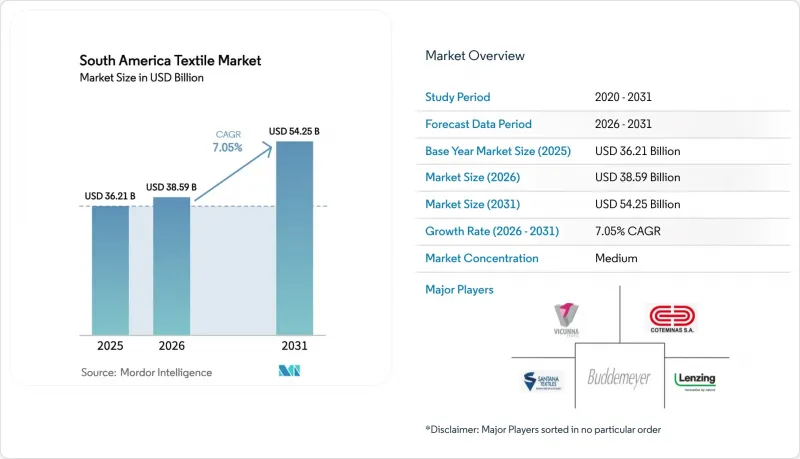
Benefits from apparel demand in Brazil and Argentina now overlap with structural gains in geotextiles, hygiene nonwovens, and recycled-polyester fiber, broadening the revenue base beyond fashion. Higher European circular-economy standards accelerated investment in traceable supply chains and Digital Product Passport pilots, positioning compliant exporters for tariff-free access to the EU. Foreign direct investment from Lenzing and Indorama secures regional feedstock, strengthens recycling infrastructure, and shields multinationals from cotton-price swings. At the same time, Sao Paulo's informal hubs cut design-to-shelf cycles to under 14 days, forcing formal mills to adopt on-demand manufacturing or risk erosion of their share. Energy-price volatility, especially Brazil's 12% electricity hike in 2025, continues to pressure dyeing and finishing margins.
South America Textile Market Trends and Insights
Uptake of Technical Textiles in Regional Mobility & Infrastructure
Brazil's 2024-2030 infrastructure plan earmarks USD 56 billion for transport upgrades, many of which require nonwoven geotextiles that meet ASTM standards. Demand for high-tenacity polyester fabrics in Argentina's Vaca Muerta shale projects rose 19% in 2025, reflecting stricter environmental protocols. Peru's mining sector is now specifying tailings-dam reinforcement fabrics, attracting European suppliers through Lima distributors. Enforcement of engineering standards, such as Brazil's ABNT NBR 12553, tilts procurement toward certified local producers. Consistent inspection remains critical, as lax oversight previously let substandard imports undercut compliant products.
Fast-Fashion Cycles and On-Demand Manufacturing
Informal clusters in Sao Paulo's Bras district and Buenos Aires' La Salada market turn social-media trends into finished garments within two weeks. Micro-factories combine cutting, sewing, and finishing on a single site, bypassing wholesalers and selling on Instagram or WhatsApp. By 2025, these informal operations produced 38% of Brazil's domestic apparel volume, underscoring their scale. Formal mills answer with digital printing and modular lines that trim minimum orders to 50 units, yet still struggle to match the agility without compromising traceability. Tension between speed and compliance will rise as EU buyers demand verified labor standards, pushing informal players either toward legalization or toward shrinking export avenues.
Volatile Energy and Raw-Material Prices
A 12% rise in Brazilian electricity tariffs during 2025 deepened margin pressure for energy-intensive dyeing and stentering operations. Cotton prices in Argentina spiked 18% in 2024 after the Chaco droughts, forcing mills to import at a premium. Polyester costs mirror crude-oil swings with a 60-day lag, leaving mills exposed under fixed-price apparel contracts. Producers with vertically integrated recycling, such as Indorama's Sao Paulo rPET facility, hedge against volatility in virgin resin prices. Firms lacking such buffers delay capex, risking obsolescence as buyers gravitate toward price-stable suppliers.
Other drivers and restraints analyzed in the detailed report include:
- E-Commerce and Social-Commerce Compressing Design-to-Shelf Time
- Mandatory EU-27 Separate Textile-Waste Collection (2025)
- High Capex for Advanced Recycling / Sorting Capacity
For complete list of drivers and restraints, kindly check the Table Of Contents.
Segment Analysis
The South America textile market share of Fashion & Apparel remains dominant at 55.55% yet slowing discretionary spend and mounting second-hand imports temper its pace. The industrial/Technical Textiles segment is advancing at a 6.15% CAGR, faster than any other application. Demand originates from civil-engineering geotextiles for Brazil's USD 56 billion transport overhaul and filtration fabrics keyed to Peru's mining sector. Apparel houses still invest in near-shoring to Argentina to avoid tariffs, but performance fabrics for oil, gas, and construction now capture a growing share of procurement budgets.
Technical textile producers bank on public procurement that mandates ASTM and ABNT certification, favouring mills with in-house labs. Local champions like Ober add ISO 9001 systems, while newcomers partner with German specialist HUESKER to deliver turnkey erosion-control solutions. Success hinges on the rapid commercialization of recycled-polyester geogrids that align with EU buyers' sustainability scorecards. Apparel mills counter by embedding QR-coded traceability to justify higher price points, signalling that both segments will coexist but with converging technology platforms.
The South America Textile Market Report is Segmented by Application (Fashion & Apparel, Industrial/Technical, and More), by Raw Material (Natural Fibers, Synthetic Fibers, Recycled Fibers, Specialty High-Performance Fibers), by Process/Technology (Woven, Knitted, Non-Woven, 3D Weaving & Spacer Fabrics), and by Geography (Brazil, Argentina, Peru, Rest of South America). The Market Forecasts are Provided in Terms of Value (USD).
List of Companies Covered in this Report:
- Vicunha Textil
- Coteminas S.A.
- Santana Textiles Group
- Buddemeyer S.A.
- Springs Global
- Lenzing AG
- Freudenberg Performance Materials
- Indorama Ventures (PET Brazil)
- Ahlstrom-Munksjo
- Beaulieu Technical Textiles
- HUESKER Synthetic GmbH
- TWE Group
- PFNonwovens
- DuPont de Nemours
- Berry Global Group
- Toray Industries
- Schoeller Textil AG
- Borgers SE & Co. KG
- Kaltex Textiles
- Albini Group
Additional Benefits:
- The market estimate (ME) sheet in Excel format
- 3 months of analyst support
TABLE OF CONTENTS
1 Introduction
- 1.1 Study Assumptions & Market Definition
- 1.2 Scope of the Study
2 Research Methodology
3 Executive Summary
4 Market Landscape
- 4.1 Market Overview
- 4.2 Market Drivers
- 4.2.1 Fast-fashion cycles & on-demand manufacturing
- 4.2.2 Mandatory EU-27 separate textile-waste collection (2025)
- 4.2.3 E-commerce & social-commerce compressing design-to-shelf time
- 4.2.4 Uptake of technical textiles in regional mobility & infrastructure
- 4.2.5 Surging investor interest in low-impact South-American natural fibres
- 4.2.6 Blockchain-enabled "Digital Product Passport" pilots in MERCOSUR
- 4.3 Market Restraints
- 4.3.1 Volatile energy & raw-material prices
- 4.3.2 High capex for advanced recycling / sorting capacity
- 4.3.3 Skilled-labour shortages (dyeing, finishing, automation)
- 4.3.4 SME fragmentation vs. new ESG / due-diligence compliance
- 4.4 Value / Supply-Chain Analysis
- 4.5 Regulatory Outlook
- 4.6 Technological Outlook
- 4.7 Industry Attractiveness - Porter's Five Forces
- 4.7.1 Bargaining Power of Buyers
- 4.7.2 Bargaining Power of Suppliers
- 4.7.3 Threat of New Entrants
- 4.7.4 Threat of Substitutes
- 4.7.5 Competitive Rivalry
- 4.8 Impact of Geopolitics on Textile Market
5 Market Size & Growth Forecasts (Value, In USD Billion)
- 5.1 By Application
- 5.1.1 Fashion & Apparel
- 5.1.2 Industrial/Technical Textiles
- 5.1.3 Household & Home Textiles
- 5.1.4 Medical & Healthcare Textiles
- 5.1.5 Automotive & Transport Textiles
- 5.1.6 Others (Protective, Sports Textiles, etc.)
- 5.2 By Raw Material
- 5.2.1 Natural Fibers
- 5.2.1.1 Cotton
- 5.2.1.2 Wool
- 5.2.1.3 Silk
- 5.2.2 Synthetic Fibers
- 5.2.2.1 Polyester
- 5.2.2.2 Nylon
- 5.2.2.3 Rayon / Viscose
- 5.2.2.4 Acrylic
- 5.2.2.5 Polypropylene
- 5.2.3 Recycled Fibers
- 5.2.4 Others (Speciality High-Performance Fibers (Aramid, Carbon, UHMWPE))
- 5.2.1 Natural Fibers
- 5.3 By Process / Technology
- 5.3.1 Woven
- 5.3.2 Knitted
- 5.3.3 Non-woven
- 5.3.3.1 Spunlaid (Spunbond / Melt-blown)
- 5.3.3.2 Dry-laid Hydro-entangled
- 5.3.3.3 Wet-Laid
- 5.3.3.4 Needle-punched
- 5.3.4 3-D Weaving & Spacer Fabrics
- 5.4 By Geography
- 5.4.1 Brazil
- 5.4.2 Argentina
- 5.4.3 Peru
- 5.4.4 Rest of South America
6 Competitive Landscape
- 6.1 Market Concentration
- 6.2 Strategic Moves
- 6.3 Market Share Analysis
- 6.4 Company Profiles {(includes Global level Overview, Market level overview, Core Segments, Financials as available, Strategic Information, Products & Services, and Recent Developments)}
- 6.4.1 Vicunha Textil
- 6.4.2 Coteminas S.A.
- 6.4.3 Santana Textiles Group
- 6.4.4 Buddemeyer S.A.
- 6.4.5 Springs Global
- 6.4.6 Lenzing AG
- 6.4.7 Freudenberg Performance Materials
- 6.4.8 Indorama Ventures (PET Brazil)
- 6.4.9 Ahlstrom-Munksjo
- 6.4.10 Beaulieu Technical Textiles
- 6.4.11 HUESKER Synthetic GmbH
- 6.4.12 TWE Group
- 6.4.13 PFNonwovens
- 6.4.14 DuPont de Nemours
- 6.4.15 Berry Global Group
- 6.4.16 Toray Industries
- 6.4.17 Schoeller Textil AG
- 6.4.18 Borgers SE & Co. KG
- 6.4.19 Kaltex Textiles
- 6.4.20 Albini Group
7 Market Opportunities & Future Outlook
- 7.1 White-space & Unmet-Need Assessment

