PUBLISHER: Mordor Intelligence | PRODUCT CODE: 2043990

PUBLISHER: Mordor Intelligence | PRODUCT CODE: 2043990
United States Enterprise Resource Planning - Market Share Analysis, Industry Trends & Statistics, Growth Forecasts (2026 - 2031)
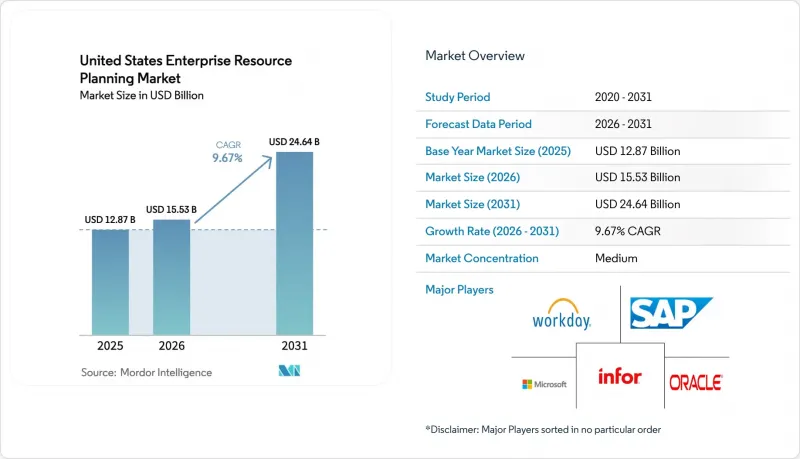
The United States enterprise resource planning market size is expected to increase from USD 12.87 billion, and USD 15.53 billion in 2026 to USD 24.64 billion by 2031, growing at a 9.67% CAGR over 2026-2031.
Shifts from capital-intensive on-premises suites to elastic cloud subscriptions are compressing payback periods, while embedded artificial intelligence automates finance, supply chain, and workforce tasks, elevating system value. Mid-market manufacturers and distributors that had long postponed upgrades are now migrating in waves because templated cloud offerings cut implementation cycles from 18 months to 9 and trim information-technology overhead by nearly one-third. Federal incentives tied to the CHIPS and Inflation Reduction Acts accelerate system replacements among semiconductor, clean-energy, and battery producers, whose subsidies require real-time traceability of energy, labor, and emissions data. Vendors that deliver quarterly feature releases, composable architectures, and zero-downtime updates gain share as decision makers prize agility, continuous compliance, and lower lifetime cost of ownership.
United States Enterprise Resource Planning Market Trends and Insights
Rising Adoption of Cloud ERP Among Mid-Market Businesses
Mid-market firms with USD 50 million to USD 1 billion in revenue migrate to cloud suites at a rate of more than 25% year-over-year because subscription pricing smooths cash outflows and eliminates hardware refreshes. One precision machining company in Texas cut IT overhead by 30% and lifted on-time delivery by 20% after replacing a 15-year-old system with an integrated cloud platform. Vendors preload connectors for Shopify, Amazon Marketplace, and third-party logistics providers, allowing distributors to synchronize sales, inventory, and finance without custom code. Private-equity owners now mandate cloud ERP at acquisition close to speed bolt-on integrations, further fueling demand. The momentum reduces the once-formidable switching barrier that kept legacy on-premise suites entrenched.
Integration of AI-Powered Analytics Within ERP Suites
Generative and predictive models embedded inside modern ERP platforms automate journal entries, supplier negotiations, and production scheduling. SAP's Joule Copilot processed more than one billion transactions in 2025 and shortened month-end close cycles by 40% for early adopters.Microsoft Dynamics 365 Copilot drafts cash-flow alerts and inventory reorder recommendations, while Oracle Fusion automatically classifies ledger lines and reconciles intercompany balances.These capabilities reduce manual effort, speed decision-making, and bring project payback within 18 months. Adoption lags in healthcare and banking, however, because leaders demand model explainability to satisfy HIPAA and Sarbanes-Oxley audits.
High Switching Costs from Legacy On-Premise Systems
Companies running highly customized SAP ECC or Oracle E-Business Suite face migration costs equal to 2-4% of annual revenue, with data cleansing alone consuming 40% of budgets and adding nine months to timelines. Consolidating multiple charts of accounts and customer masters inflates the scope, forcing many firms to phase migrations or accept costly customizations that compromise future upgrades. Mid-market enterprises, often short on change-management resources, feel the burden most acutely because they must rely on consultants billing USD 200-300 per hour.
Other drivers and restraints analyzed in the detailed report include:
- Demand for Real-Time Supply Chain Visibility Post-Pandemic
- Government Incentives for Digital Transformation in Manufacturing
- Cybersecurity Concerns Hampering Cloud Migrations
For complete list of drivers and restraints, kindly check the Table Of Contents.
Segment Analysis
Cloud-native suites segment commanded 53.76% in 2025 and will grow at a 10.56% CAGR through 2031, reflecting API-first architectures that enable finance or warehouse modules to be upgraded in isolation, ending weekend shutdowns and elevating uptime to 99.9%. Vendors such as Workday land with a core ledger and expand to an average of 3.2 modules within two years, proving the land-and-expand appeal.
Mobile-first ERP caters to field technicians and warehouse operators who primarily transact on smartphones, while social ERP embeds approvals and alerts within collaboration tools such as Teams and Slack. Two-tier or edge ERP synchronizes lightweight plant systems with a central cloud core, a strategy expected to achieve moderate penetration by 2027. Collectively, these patterns underline how composability helps organizations avoid lock-in and swap functionality without wholesale reimplementation.
Finance and accounting modules commanded 28.74% of spending in 2025 and will grow at a 10.56% CAGR through 2031, reflecting new tax, lease, and ESG disclosure rules that legacy systems cannot automate cost-effectively. Automated revenue recognition, intercompany eliminations, and multi-currency consolidation reduce audit fees and close cycles, making finance the entry point for many cloud migrations.
Supply-chain suites rank second, especially among manufacturers that need synchronized demand plans, procurement, and logistics. Human-capital tools now track skills inventories and pay equity metrics to comply with pay transparency laws. Customer and commerce modules unify digital and store channels, while manufacturing execution bridges shop-floor telemetry with financial ledgers, a necessity for lights-out automation programs.
The United States Enterprise Resource Planning Report is Segmented by Type (Cloud-Native Suite, Mobile-First ERP, and More), Business Function (Finance and Accounting, and More), Deployment Model (On-Premise, and Cloud), Organization Size (Large Enterprises, and Small and Medium Enterprises), and Industry Vertical (Manufacturing, BFSI, and More). The Market Forecasts are Provided in Terms of Value (USD).
List of Companies Covered in this Report:
- SAP SE
- Oracle Corporation
- Microsoft Corporation
- Infor Inc.
- Epicor Software Corporation
- The Sage Group plc
- Workday Inc.
- QAD Inc.
- IFS AB
- Acumatica Inc.
- Deltek Inc.
- SYSPRO (Pty) Ltd
- Plex Systems Inc.
- Unit4 N.V.
- Odoo SA
- Priority Software Ltd.
- Tyler Technologies Inc.
- Ramco Systems Limited
- Aptean Inc.
- UKG Inc.
Additional Benefits:
- The market estimate (ME) sheet in Excel format
- 3 months of analyst support
TABLE OF CONTENTS
1 INTRODUCTION
- 1.1 Study Assumptions and Market Definition
- 1.2 Scope of the Study
2 RESEARCH METHODOLOGY
3 EXECUTIVE SUMMARY
4 MARKET LANDSCAPE
- 4.1 Market Overview
- 4.2 Market Drivers
- 4.2.1 Rising Adoption of Cloud ERP Among Mid-Market Businesses
- 4.2.2 Integration of AI-Powered Analytics Within ERP Suites
- 4.2.3 Demand for Real-Time Supply Chain Visibility Post-Pandemic
- 4.2.4 Government Incentives for Digital Transformation in Manufacturing
- 4.2.5 Emergence of Composable ERP Architectures Enabling Modular Deployments
- 4.2.6 Shift Towards Subscription-Based Pricing Models Improving ROI
- 4.3 Market Restraints
- 4.3.1 High Switching Costs From Legacy On-Premise Systems
- 4.3.2 Cybersecurity Concerns Hampering Cloud Migrations
- 4.3.3 Shortage of ERP Implementation Talent in Rural Regions
- 4.3.4 Data Sovereignty and Compliance Complexities Across State Regulations
- 4.4 Impact of Macroeconomic Factors on the Market
- 4.5 Industry Value Chain Analysis
- 4.6 Regulatory Landscape
- 4.7 Technological Outlook
- 4.8 Porter's Five Forces Analysis
- 4.8.1 Bargaining Power of Suppliers
- 4.8.2 Bargaining Power of Buyers
- 4.8.3 Threat of New Entrants
- 4.8.4 Threat of Substitutes
- 4.8.5 Degree of Competition
5 MARKET SIZE AND GROWTH FORECASTS (VALUE)
- 5.1 By Type
- 5.1.1 Cloud-Native Suite
- 5.1.2 Mobile-First ERP
- 5.1.3 Social / Collaborative ERP
- 5.1.4 Two-Tier / Edge ERP
- 5.2 By Business Function
- 5.2.1 Finance and Accounting
- 5.2.2 Supply-Chain and Operations
- 5.2.3 Human Capital Management
- 5.2.4 Customer Relationship and Commerce
- 5.2.5 Manufacturing Execution and Quality
- 5.3 By Deployment Model
- 5.3.1 On-Premise
- 5.3.2 Cloud
- 5.4 By Organization Size
- 5.4.1 Large Enterprises
- 5.4.2 Small and Medium Enterprises
- 5.5 By Industry Vertical
- 5.5.1 Manufacturing
- 5.5.2 Retail and E-commerce
- 5.5.3 BFSI
- 5.5.4 Government and Public Sector
- 5.5.5 IT and Telecom
- 5.5.6 Healthcare and Life Sciences
- 5.5.7 Others Industry Vertical
6 COMPETITIVE LANDSCAPE
- 6.1 Market Concentration
- 6.2 Strategic Moves
- 6.3 Market Share Analysis
- 6.4 Company Profiles (includes Global Level Overview, Market Level Overview, Core Segments, Financials as available, Strategic Information, Market Rank/Share, Products and Services, Recent Developments)
- 6.4.1 SAP SE
- 6.4.2 Oracle Corporation
- 6.4.3 Microsoft Corporation
- 6.4.4 Infor Inc.
- 6.4.5 Epicor Software Corporation
- 6.4.6 The Sage Group plc
- 6.4.7 Workday Inc.
- 6.4.8 QAD Inc.
- 6.4.9 IFS AB
- 6.4.10 Acumatica Inc.
- 6.4.11 Deltek Inc.
- 6.4.12 SYSPRO (Pty) Ltd
- 6.4.13 Plex Systems Inc.
- 6.4.14 Unit4 N.V.
- 6.4.15 Odoo SA
- 6.4.16 Priority Software Ltd.
- 6.4.17 Tyler Technologies Inc.
- 6.4.18 Ramco Systems Limited
- 6.4.19 Aptean Inc.
- 6.4.20 UKG Inc.
7 MARKET OPPORTUNITIES AND FUTURE OUTLOOK
- 7.1 White-space and Unmet-Need Assessment

