PUBLISHER: Mordor Intelligence | PRODUCT CODE: 2044025

PUBLISHER: Mordor Intelligence | PRODUCT CODE: 2044025
Trade Promotion Optimization AI - Market Share Analysis, Industry Trends & Statistics, Growth Forecasts (2026 - 2031)
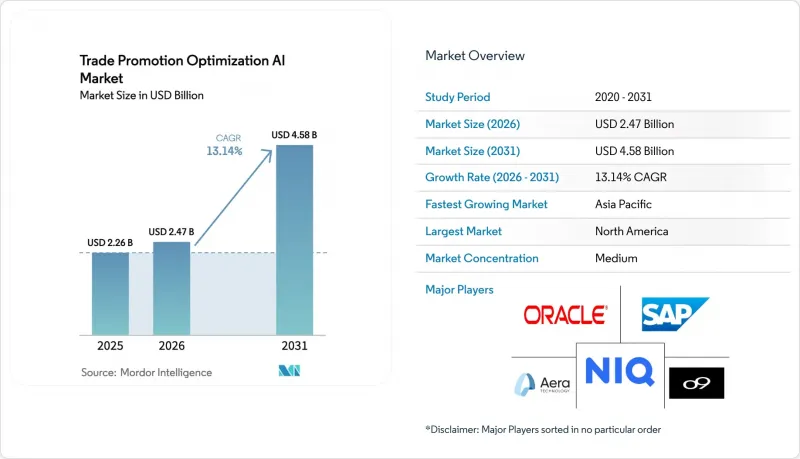
The trade promotion optimization AI market size was valued at USD 2.26 billion in 2025 and estimated to grow from USD 2.47 billion in 2026 to reach USD 4.58 billion by 2031, at a CAGR of 13.14% during the forecast period (2026-2031).
Brands are shifting budgets from intuition-based planning to algorithmic decisioning that quantifies every promotional dollar, a pivot reinforced by agentic platforms that unify pricing, inventory, and assortment decisions. Declining cloud infrastructure costs let even small consumer-packaged goods labels run advanced simulations once reserved for Tier-1 enterprises, while retailers monetize first-party data by demanding real-time elasticity models. Generative AI is shortening scenario-planning cycles from weeks to minutes, enabling thousands of offers to be tested virtually before a single shelf tag changes. Privacy-preserving techniques such as federated learning are gaining traction in Europe and North America, helping vendors comply with tightening data-regulation regimes without sacrificing model performance.
Global Trade Promotion Optimization AI Market Trends and Insights
Growing Availability of High-Fidelity Point-of-Sale Data
Electronic shelf labels and unified-commerce platforms stream SKU-level transactions at minute-by-minute cadence, giving machine-learning models fuel to calculate cross-category effects with laboratory-grade precision. Walmart's rollout cut price-change cycles from days to minutes, while Alibaba's Hema updates roughly 1,000 labels in 23 seconds, proving that rapid feedback loops are now plausible at hypermarket scale. NielsenIQ's 2025 acquisition of Gastrograph AI layers sensory-preference predictions onto this data stack, letting category teams test flavor concepts virtually before pilot runs. The intersection of loyalty cards, live inventory, and competitor scraping transforms promotion planning into a continuous control loop, replacing quarterly spreadsheets with near-real-time optimization.
Rapid Advances in GenAI-Powered Predictive Algorithms
Transformer architectures once used for language tasks now predict purchase likelihood for low-frequency categories, solving cold-start challenges that plagued rule-based engines. Toshiba Tec embedded generative modules directly into promotion optimization software in 2024, enabling one-to-one coupon allocation under tight funding limits. Profitmind's agentic AI, backed by Accenture Ventures in 2026, produces ranked weekly action lists that combine pricing, inventory, and assortment moves tied to profit impact, compressing analysis and execution into a single workflow. The market narrative is shifting from insight generation to automated decisioning that closes the loop without human re-keying.
Legacy ERP Integration Complexities
SAP and Oracle systems built on batch architectures resist real-time data ingestion, forcing enterprises to stitch middleware and transformation pipelines that elongate deployment timelines. An industry survey found 83% of retailers struggling to unify siloed data, underscoring the hidden costs behind plug-and-play marketing claims. Infosys's TradeEdge modules exemplify the compromise, reconciling nightly ERP logs with streaming feeds to feed optimization engines while preserving audit trails. Until standardized connectors mature, integration friction will temper the trade promotion optimization AI market's otherwise robust growth.
Other drivers and restraints analyzed in the detailed report include:
- Cloud Cost Reductions Enabling SMB Adoption
- Retailer Demand for Real-Time Price Elasticity Insights
- Rising Consumer Data-Privacy Regulations
For complete list of drivers and restraints, kindly check the Table Of Contents.
Segment Analysis
Cloud accounted for 62.73% of 2025 revenue, highlighting its effectiveness in handling streaming point-of-sale feeds and providing on-demand computational capabilities. The trade promotion optimization AI market size for cloud deployments is anticipated to grow at a compound annual growth rate (CAGR) of 21.34% during the forecast period from 2026 to 2031. This growth is expected to further widen the gap between cloud-based solutions and legacy on-premises installations. Enterprises are increasingly adopting cloud solutions for their ability to deliver faster time-to-value, support elastic scaling, and significantly reduce capital expenditure. Additionally, regulatory bodies are increasingly accepting regionally partitioned cloud infrastructures that comply with data-residency requirements, further driving adoption.
The Asia-Pacific region exemplifies the advantages of cloud adoption. For instance, India's ongoing retail digitization initiatives are fostering greenfield launches that entirely bypass traditional on-premises server setups. Similarly, Japan's Nippon Access has reported profit gains ranging from 6% to 20% by leveraging a cloud-native pricing AI solution. To address security concerns, vendors are introducing hybrid cloud models that retain sensitive master data on-premises while leveraging the cloud for model training. This approach is enabling cloud adoption even in highly regulated industries, such as the pharmaceutical industry, where data security and compliance are critical.
Solutions captured 58.23% revenue in 2025, dominated by subscription licenses for optimization engines and analytics dashboards. Yet the services slice is advancing at a 21.32% CAGR because enterprises recognize that change management, data cleansing, and continuous model tuning determine return on investment. Trade promotion optimization AI industry consultancies embed sprint teams within merchandising functions to shepherd adoption and guarantee financial outcomes.
The 2026 cost-reduction blueprint emphasizes establishing a transformation management office that integrates savings directly into budgets, underscoring that software solutions alone are insufficient. Wipro's partnership with RELEX combines platform rollouts with dedicated implementation squads, while NEC offers a managed service desk that interprets algorithmic outputs for category managers. NEC melds AI-driven pricing models with business process outsourcing in its retail price optimization solution. A dedicated pricing team not only operationalizes these offers but also explains their rationale to merchandisers and conducts performance analyses. This approach underscores NEC's offering as a model focused on generating results, rather than merely selling a tool.
The Trade Promotion Optimization AI Market Report is Segmented by Deployment Mode (Cloud, and On-Premise), Component (Solutions, and Services), Industry Vertical (Consumer Packaged Goods, Food and Beverage, and More), Application (Demand Forecasting, Post-Event Analysis, and More), Organization Size (Large Enterprises, and Small and Medium Enterprises), and Geography. The Market Forecasts are Provided in Terms of Value (USD).
Geography Analysis
North America led with 41.37% revenue in 2025, reflecting mature point-of-sale infrastructure, retailer media networks, and early adoption by Fortune 500 CPG firms. The region's dominance is driven by advanced technological integration and retailers' ability to leverage data for strategic decision-making. Kroger Precision Marketing's closed-loop attribution and Target's AI roadmap highlight how retailers monetize data as a service, compelling brands to align promotion funding with algorithmic ROI benchmarks. Additionally, private-label penetration, which has surpassed 21% of grocery sales, intensifies competition, making precise promotion math a strategic imperative for businesses aiming to maintain market share and profitability.
Europe ranks second but faces challenges due to GDPR constraints that push vendors toward federated learning and explainable dashboards. Retailers in Germany and the Netherlands are piloting privacy-preserving architectures that calculate lift without exporting raw loyalty data, ensuring compliance with stringent data protection regulations. While the trade promotion optimization AI market share in Europe remains substantial, growth lags behind North America because compliance cycles extend procurement decision-making timelines. Despite these challenges, the region continues to invest in innovative solutions to balance regulatory requirements with the need for advanced analytics, ensuring steady market development.
Asia-Pacific is the fastest-growing region, with a 18.23% CAGR, buoyed by digital-native retailers, rising disposable incomes, and government AI agendas. India's retail sector demonstrates strong demand for greenfield cloud-native optimization tools. China's nationwide AI rollout accelerates store automation, while Japan's Lawson uses transformer-based engines to allocate new-store media budgets. South America, the Middle East, and Africa advance in pockets, Brazilian hypermarkets and UAE convenience chains pilot dynamic pricing, but fragmented data and lower analytical maturity temper region-wide scaling.
- NielsenIQ, LLC
- SAP SE
- Oracle Corporation
- Accenture Plc
- IBM Corporation
- Aera Technology, Inc.
- Wipro Limited
- Infosys Limited
- Exceedra Ltd.
- Revionics, LLC
- Blacksmith Applications, Inc.
- Trade Promotion Master International B.V.
- o9 Solutions, Inc.
- Eversight, Inc.
- Blue Yonder Group, Inc.
- T-Pro Solutions LLC
- Uptake Technologies Inc.
- AFS Technologies, Inc.
- Quotient Technology Inc.
- Anaplan, Inc.
Additional Benefits:
- The market estimate (ME) sheet in Excel format
- 3 months of analyst support
TABLE OF CONTENTS
1 INTRODUCTION
- 1.1 Study Assumptions and Market Definition
- 1.2 Scope of the Study
2 RESEARCH METHODOLOGY
3 EXECUTIVE SUMMARY
4 MARKET LANDSCAPE
- 4.1 Market Overview
- 4.2 Market Drivers
- 4.2.1 Growing Availability of High-Fidelity Point-of-Sale Data
- 4.2.2 Rapid Advances in GenAI-Powered Predictive Algorithms
- 4.2.3 Cloud Cost Reductions Enabling SMB Adoption
- 4.2.4 Retailer Demand for Real-Time Price Elasticity Insights
- 4.2.5 Supermarket Private-Label Expansion Requiring Precise Promotion Math
- 4.2.6 Privacy-Preserving Federated Learning Models in CPG Retail
- 4.3 Market Restraints
- 4.3.1 Legacy ERP Integration Complexities
- 4.3.2 Rising Consumer Data-Privacy Regulations
- 4.3.3 Low Analytical Maturity in Emerging Markets
- 4.3.4 Internal Change-Management Barriers
- 4.4 Impact of Macroeconomic Factors on the Market
- 4.5 Industry Value Chain Analysis
- 4.6 Regulatory Landscape
- 4.7 Technological Outlook
- 4.8 Porter's Five Forces Analysis
- 4.8.1 Bargaining Power of Suppliers
- 4.8.2 Bargaining Power of Buyers
- 4.8.3 Threat of New Entrants
- 4.8.4 Threat of Substitutes
- 4.8.5 Intensity of Competitive Rivalry
5 MARKET SIZE AND GROWTH FORECASTS (VALUE)
- 5.1 By Deployment Mode
- 5.1.1 Cloud
- 5.1.2 On-Premise
- 5.2 By Component
- 5.2.1 Solutions
- 5.2.2 Services
- 5.3 By Industry Vertical
- 5.3.1 Consumer Packaged Goods
- 5.3.2 Retail and E-Commerce
- 5.3.3 Food and Beverage
- 5.3.4 Pharmaceutical and Healthcare
- 5.3.5 Electronics and Appliances
- 5.3.6 Other industry Verticals
- 5.4 By Application
- 5.4.1 Promotion Planning and Calendar Management
- 5.4.2 Demand Forecasting
- 5.4.3 Price and Promotion Optimization
- 5.4.4 Post-Event Analysis
- 5.4.5 Other Applications
- 5.5 By Organization Size
- 5.5.1 Large Enterprises
- 5.5.2 Small and Medium Enterprises
- 5.6 By Geography
- 5.6.1 North America
- 5.6.1.1 United States
- 5.6.1.2 Canada
- 5.6.1.3 Mexico
- 5.6.2 South America
- 5.6.2.1 Brazil
- 5.6.2.2 Argentina
- 5.6.2.3 Rest of South America
- 5.6.3 Europe
- 5.6.3.1 United Kingdom
- 5.6.3.2 Germany
- 5.6.3.3 France
- 5.6.3.4 Italy
- 5.6.3.5 Spain
- 5.6.3.6 Rest of Europe
- 5.6.4 Asia-Pacific
- 5.6.4.1 China
- 5.6.4.2 Japan
- 5.6.4.3 India
- 5.6.4.4 South Korea
- 5.6.4.5 Rest of Asia-Pacific
- 5.6.5 Middle East and Africa
- 5.6.5.1 Middle East
- 5.6.5.1.1 United Arab Emirates
- 5.6.5.1.2 Saudi Arabia
- 5.6.5.1.3 Rest of Middle East
- 5.6.5.2 Africa
- 5.6.5.2.1 South Africa
- 5.6.5.2.2 Egypt
- 5.6.5.2.3 Rest of Africa
- 5.6.5.1 Middle East
- 5.6.1 North America
6 COMPETITIVE LANDSCAPE
- 6.1 Market Concentration
- 6.2 Strategic Moves
- 6.3 Market Share Analysis
- 6.4 Company Profiles (includes Global Level Overview, Market Level Overview, Core Segments, Financials as available, Strategic Information, Market Rank/Share, Products and Services, Recent Developments)
- 6.4.1 NielsenIQ, LLC
- 6.4.2 SAP SE
- 6.4.3 Oracle Corporation
- 6.4.4 Accenture Plc
- 6.4.5 IBM Corporation
- 6.4.6 Aera Technology, Inc.
- 6.4.7 Wipro Limited
- 6.4.8 Infosys Limited
- 6.4.9 Exceedra Ltd.
- 6.4.10 Revionics, LLC
- 6.4.11 Blacksmith Applications, Inc.
- 6.4.12 Trade Promotion Master International B.V.
- 6.4.13 o9 Solutions, Inc.
- 6.4.14 Eversight, Inc.
- 6.4.15 Blue Yonder Group, Inc.
- 6.4.16 T-Pro Solutions LLC
- 6.4.17 Uptake Technologies Inc.
- 6.4.18 AFS Technologies, Inc.
- 6.4.19 Quotient Technology Inc.
- 6.4.20 Anaplan, Inc.
7 MARKET OPPORTUNITIES AND FUTURE OUTLOOK
- 7.1 White-Space and Unmet-Need Assessment

